As the global demand for smart, sustainable, and efficient transportation systems accelerates, the Automated Passenger Counting and Information System (APC & PIS) market is emerging as a pivotal force in reshaping public transit. With the convergence of AI, IoT, and advanced sensor technologies, APC and PIS are no longer optional add-ons—they are becoming essential components of modern mobility infrastructure.
The automated passenger counting and information system market is projected to grow from USD 9.70 billion in 2025 to USD 14.80 billion by 2030, growing at a CAGR of 8.8% from 2025 to 2030. But these numbers tell only part of the story. What’s unfolding is a broader transformation in how cities, transit agencies, and passengers interact with urban transportation.
Why the Shift? The Changing Dynamics of Urban Mobility
Urbanization, climate change, and population growth are placing unprecedented pressure on public transportation systems. Cities around the world are investing in smarter, more responsive infrastructure to reduce congestion, lower emissions, and meet the demands of a connected generation.
In this context, APC systems play a critical role by providing accurate, real-time data on passenger flow, vehicle occupancy, and route efficiency. This information allows transit authorities to optimize fleet operations, reduce wait times, and make evidence-based service changes. On the other side, Passenger Information Systems (PIS) enhance the commuter experience by delivering live updates through digital signage, mobile apps, and station interfaces—improving transparency and trust.
Together, APC and PIS form the digital backbone of intelligent public transport.
Technology Will Define the Future
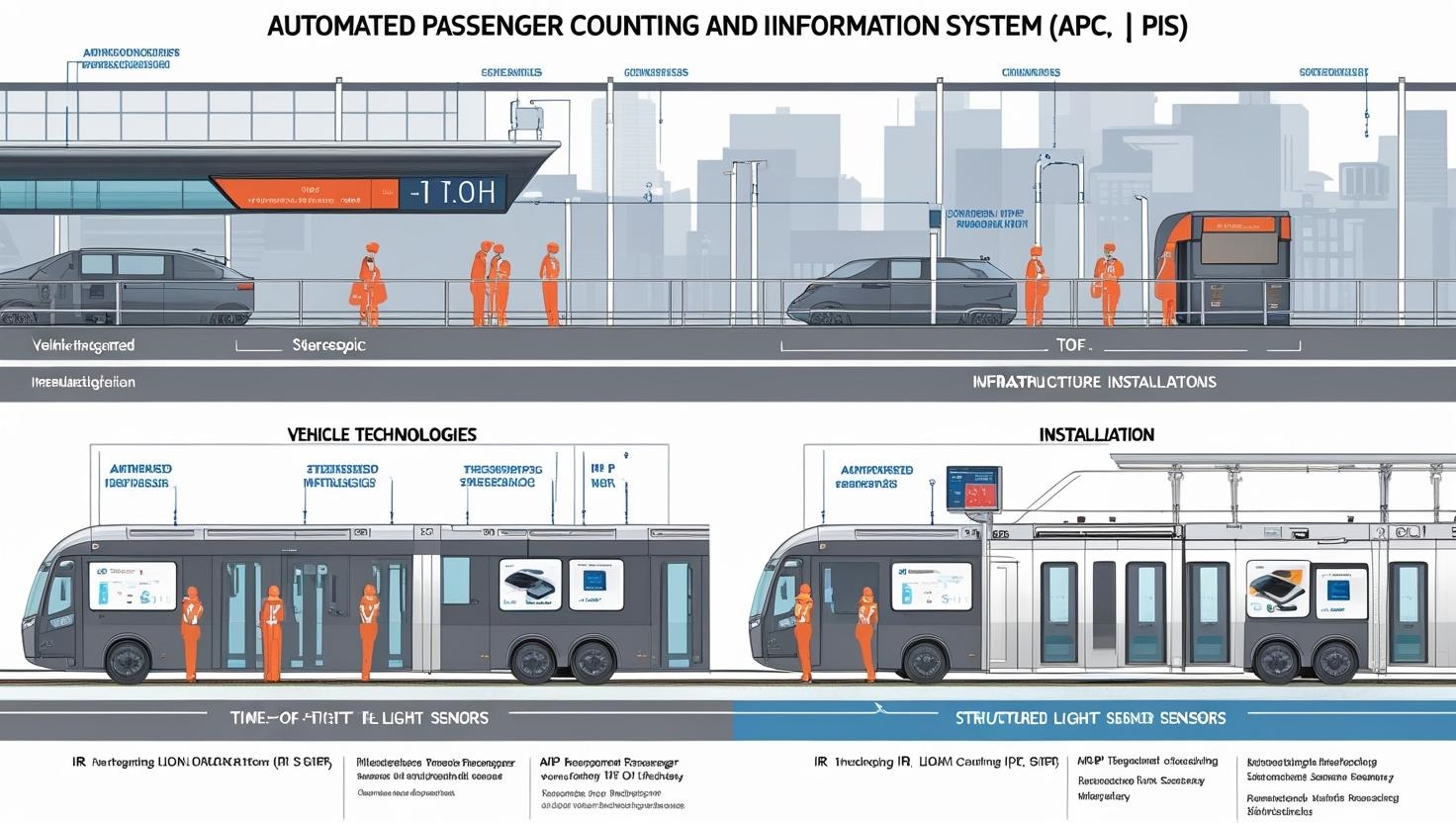
The next decade will be marked by rapid technological innovation in the APC & PIS space. Today’s systems already incorporate infrared sensors, stereoscopic cameras, Time-of-Flight (ToF) sensors, and AI-powered IP cameras. But the future holds even more integration, intelligence, and interactivity.
We’re likely to see:
- AI and machine learning enhancing predictive analytics, allowing transit agencies to forecast passenger loads and adjust in real time.
- Edge computing enabling faster data processing on vehicles or at stations, reducing latency and network load.
- IoT integration across entire transportation networks, turning APC and PIS into key components of connected smart cities.
- Multimodal coordination, where APC data from buses, trains, ferries, and bike-share systems feeds into centralized platforms for real-time planning.
The combination of hardware precision and software intelligence will make these systems indispensable—not just for transport operators, but also for urban planners and policy makers.
Download PDF Brochure @ https://www.marketsandmarkets.com/pdfdownloadNew.asp?id=17856390
Beyond Compliance: From Operations to Passenger-Centric Design
Historically, APC systems were often installed to meet regulatory requirements or justify funding. In the future, their role will go far beyond compliance. With detailed analytics, agencies can redesign routes based on true usage patterns, introduce dynamic pricing models, and manage unexpected surges in demand—such as during events or emergencies.
Similarly, PIS will evolve from simply displaying timetables to becoming full-fledged passenger engagement platforms. Future PIS solutions may include context-aware messaging, multilingual support, and even AR-based navigation inside stations. As passengers increasingly expect real-time, app-based experiences, information systems will play a central role in brand perception and service quality.
Regional Growth: Where the Market Is Headed
While North America and Europe are currently the most mature markets—driven by modernization of legacy systems and stringent data mandates—Asia-Pacific is poised to lead future growth. Mega-cities in China, India, and Southeast Asia are investing heavily in metro systems, BRT networks, and smart city infrastructure, creating enormous demand for integrated APC and PIS solutions.
Middle East and Latin America are also emerging as growth hubs, particularly where governments are prioritizing infrastructure investment and urban mobility transformation.
Key Opportunities in the Future APC & PIS Market
The Automated Passenger Counting and Information System industry offers a wealth of growth opportunities fueled by rapid technological advances and shifting urban mobility demands. Here are some of the most promising areas:
Expansion in Emerging Markets
Rapid urbanization and infrastructure development in regions like Asia-Pacific, Latin America, and the Middle East are driving massive investments in public transit. These fast-growing markets offer significant opportunities for APC and PIS providers to introduce scalable, cost-effective solutions tailored to local needs, such as BRT systems, metro expansions, and integrated multimodal hubs.
Integration with Smart City Initiatives
Governments worldwide are investing heavily in smart city programs that rely on data and connectivity to optimize urban services. APC and PIS systems, with their real-time data generation and communication capabilities, fit perfectly into these initiatives—enabling better traffic management, energy efficiency, and commuter experience enhancements.
Advancements in AI and Analytics
The infusion of artificial intelligence and machine learning into passenger counting and information delivery opens up opportunities for predictive maintenance, demand forecasting, and anomaly detection. Transit operators can leverage these insights to reduce operational costs and improve service reliability, creating strong value propositions for technology adopters.
Multimodal and Intermodal Transportation Solutions
As cities embrace multimodal transit—linking buses, trains, ferries, and shared micro-mobility—the demand for integrated APC and PIS platforms increases. This trend creates opportunities for providers to develop comprehensive systems that unify passenger data and information across modes, facilitating seamless travel experiences.
Post-Pandemic Safety and Social Distancing
In a world still mindful of health and safety, APC technologies enable operators to monitor and control vehicle occupancy, helping enforce social distancing guidelines and improving passenger confidence. This creates a timely opportunity for transit agencies to invest in systems that enhance safety while complying with public health regulations.
Growing Demand for Passenger Engagement and Personalization
Passenger Information Systems are evolving beyond static displays to become interactive, personalized platforms. There’s an opportunity to innovate with mobile integration, real-time updates, multilingual support, and accessibility features that cater to diverse rider needs, boosting ridership and satisfaction.
Collaboration with IoT and Edge Computing Ecosystems
The integration of APC and PIS with IoT networks and edge computing allows faster processing, reduced latency, and enhanced system resilience. This technical synergy offers opportunities for vendors to develop modular, interoperable solutions that fit within broader intelligent transportation systems.
Challenges Ahead
Despite its growth potential, the APC & PIS market faces several challenges. High initial installation costs, integration complexities with legacy systems, and privacy concerns related to video-based passenger tracking could pose adoption barriers. However, ongoing advancements in AI anonymization, open architecture platforms, and plug-and-play sensor modules are helping to reduce these obstacles.
Cybersecurity will also be a key focus area, as APC and PIS become part of critical urban infrastructure. Ensuring data protection and system integrity will be essential to maintain public trust.
Top Companies in global automated passenger counting and information system market include:
- Eurotech S.p.A. (Italy),
- iris-GmbH (Germany),
- DILAX Intelcom GmbH (Germany),
- Infodev EDI inc. (Canada),
- Siemens (Germany), Hitachi, Ltd. (Japan),
- innovation in traffic systems SE (Germany),
- Cisco Systems, Inc. (US), Cubic Corporation (US), BlueSurge Technologies (Canada), Clever Devices Ltd. (US), Teleste Information Solutions SRL (Finland), ETA Transit (US), EXEROS TECHNOLOGIES LTD. (UK), EYERIDE (US), GIKEN TRASTEM CO., LTD. (Japan), GMV (US), Masstrans Technologiies Private Limited (India), Passio Technologies (US), Postec Technology (Brazil), R-Com Technical (UK), Retail Sensing Limited. (UK), R2P GmbH (Germany), Xovis AG (Switzerland), and ALSTOM SA (France).
About MarketsandMarkets™
MarketsandMarkets™ is a blue ocean alternative in growth consulting and program management, leveraging a man-machine offering to drive supernormal growth for progressive organizations in the B2B space. We have the widest lens on emerging technologies, making us proficient in co-creating supernormal growth for clients.
The B2B economy is witnessing the emergence of $25 trillion of new revenue streams that are substituting existing revenue streams in this decade alone. We work with clients on growth programs, helping them monetize this $25 trillion opportunity through our service lines – TAM Expansion, Go-to-Market (GTM) Strategy to Execution, Market Share Gain, Account Enablement, and Thought Leadership Marketing.
Built on the ’GIVE Growth’ principle, we work with several Forbes Global 2000 B2B companies – helping them stay relevant in a disruptive ecosystem. Our insights and strategies are molded by our industry experts, cutting-edge AI-powered Market Intelligence Cloud, and years of research. The KnowledgeStore™ (our Market Intelligence Cloud) integrates our research, facilitates an analysis of interconnections through a set of applications, helping clients look at the entire ecosystem and understand the revenue shifts happening in their industry.
To find out more, visit www.MarketsandMarkets™.com or follow us on Twitter, LinkedIn and Facebook.
Contact:
Mr. Aashish Mehra
MarketsandMarkets™ INC.
630 Dundee Road
Suite 430
Northbrook, IL 60062
USA : 1-888-600-6441
