Executive Summary
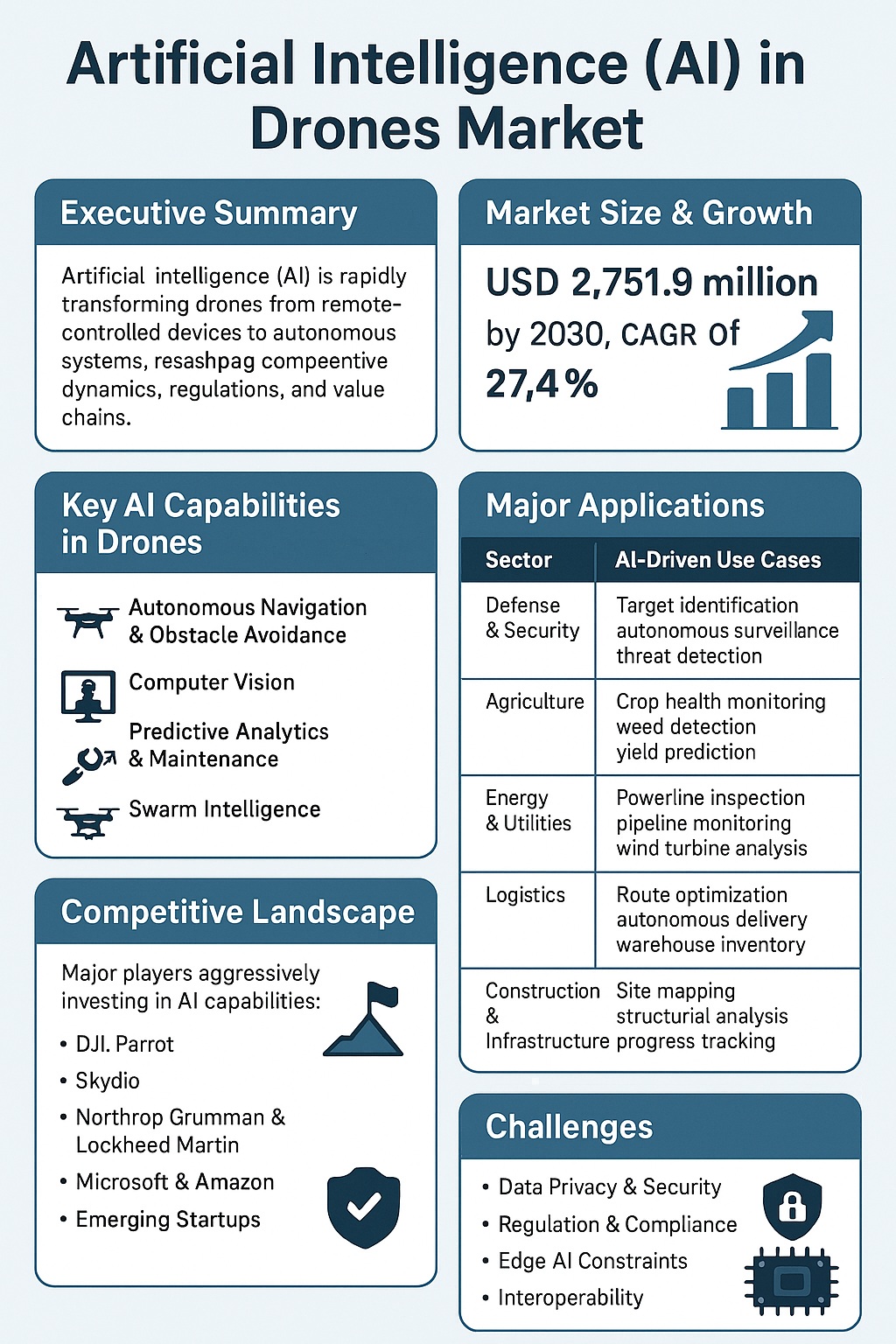
Artificial Intelligence (AI) is rapidly transforming the global drones market, redefining the capabilities, roles, and applications of unmanned aerial vehicles (UAVs). From defense and agriculture to logistics and infrastructure inspection, AI is no longer an add-onit is a core driver of drone functionality and market growth. The integration of AI technologies like machine learning, computer vision, and edge computing is pushing drones beyond remote-controlled tools into autonomous, adaptive, and intelligent systems. This evolution is not just technical it’s reshaping competitive dynamics, regulatory frameworks, and value chains across industries.
Market Size & Growth
The Global AI in Drones Market Size was estimated at USD 658.6 million in 2024 and is predicted to increase from USD 821.3 million in 2025 to approximately USD 2,751.9 million by 2030, expanding at a CAGR of 27.4% from 2025 to 2030. The AI in drones market is witnessing rapid growth driven by advancements in autonomous navigation, real-time data analytics, and military applications.
Download PDF Brochure :
https://www.marketsandmarkets.com/pdfdownloadNew.asp?id=43722301
- Increased demand for autonomous operations in military and commercial sectors.
- Growth in data-driven decision-making and real-time analytics.
- Advances in AI chipsets and edge computing reducing latency and enabling on-board intelligence.
- Expansion of BVLOS (Beyond Visual Line of Sight) regulations in several countries.
Key AI Capabilities in Drones
- Autonomous Navigation & Obstacle Avoidance
- AI algorithms enable drones to fly without human input using sensor fusion (LiDAR, GPS, IMU, cameras).
- Deep learning enhances real-time decision-making in dynamic environments (e.g., urban areas, forests).
- Computer Vision
- Used in object detection, target tracking, terrain mapping, and facial recognition.
- Critical in defense, surveillance, search & rescue, and precision agriculture.
- Predictive Analytics & Maintenance
- AI predicts equipment failures, reducing downtime and improving fleet reliability.
- Applied in logistics and infrastructure monitoring.
- Swarm Intelligence
- AI coordinates multiple drones in cooperative missions (e.g., area coverage, disaster response).
- Inspired by nature (bees, birds), this is emerging in both military and commercial use.
Major Applications
| Sector | AI-Driven Use Cases |
|---|---|
| Defense & Security | Target identification, autonomous surveillance, threat detection |
| Agriculture | Crop health monitoring, weed detection, yield prediction |
| Energy & Utilities | Powerline inspection, pipeline monitoring, wind turbine analysis |
| Logistics | Route optimization, autonomous delivery, warehouse inventory |
| Construction & Infrastructure | Site mapping, structural analysis, progress tracking |
Competitive Landscape
Major players are aggressively investing in AI capabilities:
- DJI: Integrating AI for autonomous flight modes and object tracking.
- Parrot: Offers open-source SDKs for AI-based customization.
- Skydio: Leading in computer vision-powered autonomous drones.
- Northrop Grumman & Lockheed Martin: Developing military-grade AI drone systems.
- Microsoft & Amazon: Providing cloud AI and ML platforms for drone data processing.
Startups are also emerging, focusing on niche solutions like AI for wildfire detection, drone swarms, and automated inspections.
Challenges
Data Privacy & Security: AI drones collect sensitive data—raising concerns over surveillance and misuse.
- Regulation & Compliance: Rapid tech growth outpaces legal frameworks. AI-driven BVLOS operations require new safety protocols.
- Edge AI Constraints: Limited onboard compute power and energy efficiency remain barriers for real-time inference.
- Interoperability: Integrating AI systems across drone types, payloads, and software ecosystems is complex.
Future Outlook
Over the next five years, the fusion of AI with drones will deepen. Expect breakthroughs in:
- Neuromorphic computing for real-time learning and adaptation.
- Generative AI models assisting in mission planning and anomaly detection.
- Federated learning to train models without transmitting sensitive data.
- AI-powered swarm autonomy for coordinated search and mapping in large-scale environments.
AI will turn drones into full-fledged intelligent agents—capable of collaborative decision-making, self-repair, and situational awareness. The shift isn’t just technological—it’s strategic. Companies and governments that master AI-drone integration will redefine operational capabilities, competitive advantage, and even geopolitical influence.