The Biosensors Market Ecosystems is witnessing rapid growth as technological advancements enable real-time, precise, and non-invasive monitoring of biological and physiological signals. From medical diagnostics to personalized wellness, biosensors are transforming how humans interact with technology and healthcare systems.
The global biosensors market is projected to grow from USD 34.51 billion in 2025 to USD 54.37 billion by 2030, at a CAGR of 9.5%
Healthcare: Revolutionizing Patient Monitoring and Care
Biosensors have become indispensable in healthcare, providing continuous monitoring of vital signs, blood glucose levels, and other biomarkers. Wearable sensor patches and embedded devices allow for remote patient monitoring, reducing hospital visits and enabling early detection of diseases. With the integration of electrochemical, optical, and nanomechanical technologies, biosensors improve accuracy and responsiveness in critical care applications.
Key benefits in healthcare include:
Real-time monitoring of chronic conditions like diabetes and cardiovascular disease
- Minimally invasive diagnostics and early detection
- Data-driven personalized treatment plans
- Fitness: Empowering Personalized Wellness
The fitness and wellness ecosystem is increasingly leveraging wearable biosensors such as wristwear (smartwatches, fitness bands) and bodywear (smart clothing). These devices track heart rate, oxygen saturation, sleep patterns, and physical activity, helping individuals optimize their lifestyle. Coupled with mobile apps and cloud analytics, biosensors are enabling personalized coaching and proactive health management.
Download PDF Brochure @ https://www.marketsandmarkets.com/pdfdownloadNew.asp?id=798
Diagnostics: Enhancing Accuracy and Speed
In diagnostics, biosensors streamline testing for infections, biomarkers, and metabolic conditions. Point-of-care biosensors deliver rapid results, reducing dependency on centralized laboratories. Innovations in electrochemical, optical, and piezoelectric sensing technologies allow for high sensitivity and specificity, transforming disease detection and management.
Applications include:
- Early-stage detection of infectious and chronic diseases
- Rapid biochemical assays and lab-on-chip devices
- Integration with AI for predictive diagnostics
- Beyond: Expanding into Environmental and Industrial Sectors
Biosensors are no longer limited to human health—they are finding applications in environmental monitoring, food safety, and industrial process control. For instance:
- Detecting toxins or pollutants in water and air
- Monitoring food quality and contamination in supply chains
- Industrial biosensors tracking fermentation, microbial activity, or bioprocess efficiency
This expansion reflects the versatility of biosensors and their potential to drive sustainability, safety, and efficiency across multiple industries.
Market Outlook
The global biosensors market is poised for strong growth, driven by rising healthcare awareness, adoption of wearable technology, and advancements in nanotechnology and IoT integration. As biosensors become smarter, smaller, and more interconnected, the market will continue to evolve toward personalized, real-time, and predictive health solutions.
Biosensors are shaping a new era of healthcare, fitness, diagnostics, and beyond, bridging the gap between human biology and digital intelligence. From continuous patient monitoring to proactive wellness and industrial applications, the biosensors ecosystem is expanding its reach—transforming lives and industries alike.
The future of biosensors is not just about measurement—it’s about intelligence, personalization, and action.
Biosensors Market FAQ
1. What are biosensors?
Biosensors are analytical devices that detect biological or physiological signals and convert them into measurable outputs. They combine a biological sensing element (like enzymes, antibodies, or cells) with a physical transducer (electrochemical, optical, piezoelectric, thermal, or nanomechanical).
2. What are the main types of biosensors?
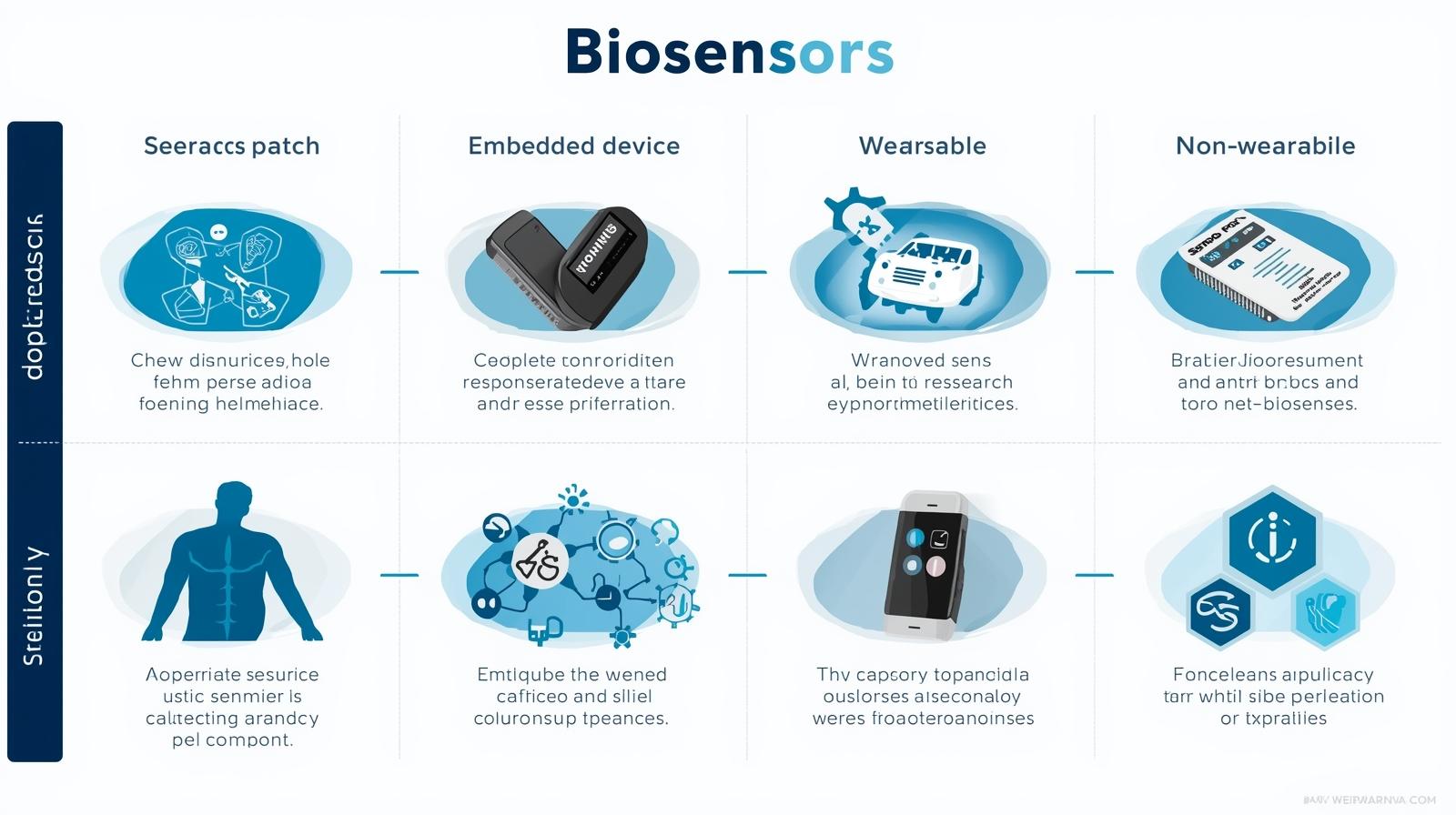
Sensor Patches – Wearable devices applied on the skin for continuous monitoring
Embedded Devices – Integrated into medical devices or IoT systems for long-term monitoring
Wearable Products – Wristbands, smartwatches, and bodywear for fitness and wellness
Non-Wearable Products – Diagnostic tools and lab-on-chip devices
3. What are the key technologies used in biosensors?
Electrochemical Sensors – Measure chemical reactions, widely used in glucose monitoring
Optical Sensors – Use light absorption or fluorescence for detection
Piezoelectric Sensors – Detect mechanical stress changes at micro or nano scale
Thermal Sensors – Measure heat changes from biochemical reactions
Nanomechanical Sensors – Ultra-sensitive, used for detecting very low concentrations of biomolecules
4. What are the primary applications of biosensors?
Healthcare – Continuous patient monitoring, chronic disease management, and early diagnosis
Fitness & Wellness – Tracking physical activity, heart rate, oxygen levels, and sleep patterns
Diagnostics – Rapid, point-of-care disease detection and laboratory assays
Beyond Healthcare – Environmental monitoring, food safety, and industrial bioprocess control
5. How are wearable biosensors different from non-wearable biosensors?
Wearable biosensors are designed for continuous, real-time monitoring in daily life (e.g., smartwatches, smart clothing).
Non-wearable biosensors are typically used in controlled environments like laboratories or clinics for diagnostics and testing.
About MarketsandMarkets™
MarketsandMarkets™ has been recognized as one of America’s Best Management Consulting Firms by Forbes, as per their recent report.
MarketsandMarkets™ is a blue ocean alternative in growth consulting and program management, leveraging a man-machine offering to drive supernormal growth for progressive organizations in the B2B space. With the widest lens on emerging technologies, we are proficient in co-creating supernormal growth for clients across the globe.
Today, 80% of Fortune 2000 companies rely on MarketsandMarkets, and 90 of the top 100 companies in each sector trust us to accelerate their revenue growth. With a global clientele of over 13,000 organizations, we help businesses thrive in a disruptive ecosystem.
The B2B economy is witnessing the emergence of $25 trillion in new revenue streams that are replacing existing ones within this decade. We work with clients on growth programs, helping them monetize this $25 trillion opportunity through our service lines – TAM Expansion, Go-to-Market (GTM) Strategy to Execution, Market Share Gain, Account Enablement, and Thought Leadership Marketing.
Built on the ‘GIVE Growth’ principle, we collaborate with several Forbes Global 2000 B2B companies to keep them future-ready. Our insights and strategies are powered by industry experts, cutting-edge AI, and our Market Intelligence Cloud, KnowledgeStore™, which integrates research and provides ecosystem-wide visibility into revenue shifts.
To find out more, visit www.MarketsandMarkets™.com or follow us on Twitter , LinkedIn and Facebook .
Contact:
Mr. Rohan Salgarkar
MarketsandMarkets™ INC.
1615 South Congress Ave.
Suite 103, Delray Beach, FL 33445
USA: +1-888-600-6441
