The humanoid robot market is entering a period of rapid expansion, driven by advances in artificial intelligence, automation technologies, and increasingly sophisticated hardware ecosystems. As industries seek flexible, human-like machines capable of performing complex tasks, humanoid robots are evolving from experimental prototypes into commercially viable solutions across sectors such as manufacturing, healthcare, logistics, and customer service. The global humanoid robot market is expected to grow from USD 2.92 billion in 2025 to USD 15.26 billion in 2030, with a CAGR of 39.2%
A key factor shaping this growth is the development of integrated ecosystems built around core components—particularly biped robots, wheel drive robots, advanced sensors, and high-performance actuators. Together, these technologies are enabling robots to perceive, move, and interact with the physical world in more precise and adaptive ways than ever before.
Biped Robots: Enabling Human-Like Mobility
Bipedal humanoid robots remain central to the vision of machines that can seamlessly operate in human environments. Unlike wheel-based systems, biped robots are designed to walk, balance, and navigate complex terrains such as stairs, uneven surfaces, and crowded spaces.
These robots rely heavily on advanced balance algorithms and real-time control systems powered by AI. Their ability to mimic human locomotion makes them ideal for environments designed for people, including offices, hospitals, and public spaces. However, achieving stable and energy-efficient bipedal movement remains a major engineering challenge, requiring precise coordination between sensors and actuators.
Download PDF Brochure @ https://www.marketsandmarkets.com/pdfdownloadNew.asp?id=99567653
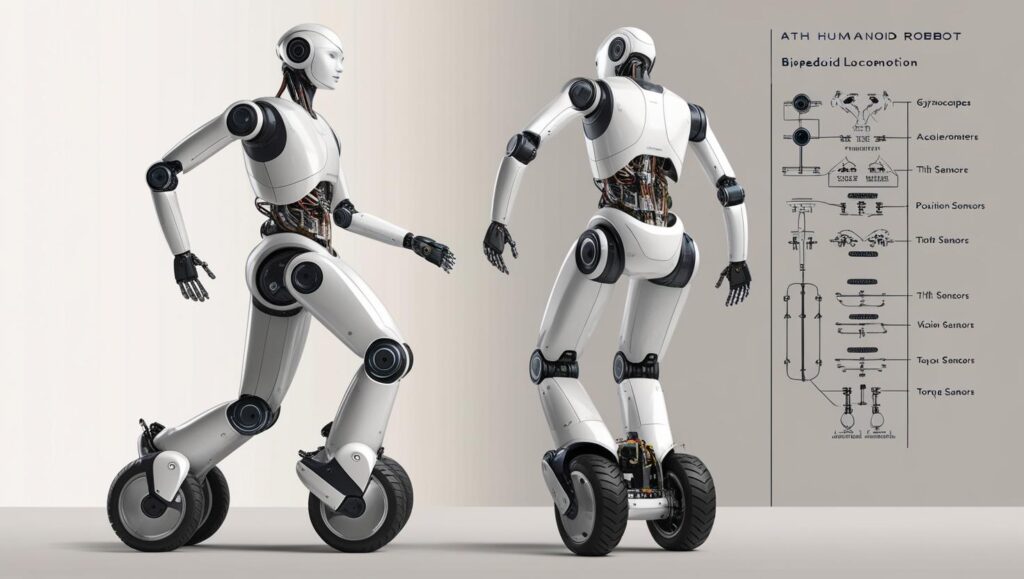
Wheel Drive Robots: Efficiency and Stability
While biped robots offer versatility, wheel drive robots provide a more stable and energy-efficient alternative for many applications. These robots are widely used in logistics, warehousing, and indoor delivery systems where terrain is predictable.
Wheel-based humanoid systems often serve as hybrid platforms, combining upper-body humanoid features with wheeled mobility. This design reduces mechanical complexity while still enabling human-like interaction capabilities. As a result, wheel drive robots are increasingly deployed in commercial settings where reliability and cost-effectiveness are critical.
Advanced Sensor Technologies: The Robot’s Perception System
Sensors form the “nervous system” of humanoid robots, enabling them to perceive their surroundings and maintain balance. Several types of sensors play a crucial role:
Gyroscopes: Measure angular velocity and help maintain orientation and stability, especially in biped robots.
Accelerometers: Detect changes in motion and acceleration, allowing robots to adjust their movements in real time.
Tilt Sensors: Provide feedback on the robot’s inclination, crucial for preventing falls.
Position Sensors: Track the exact position of joints and limbs for precise movement control.
Vision Sensors: Include cameras and computer vision systems that enable object recognition, navigation, and interaction.
Torque Sensors: Measure force applied at joints, helping regulate strength and ensure safe interaction with humans.
The integration of these sensors with AI-powered processing systems allows humanoid robots to interpret complex environments, make decisions, and adapt dynamically.
Actuators: The Driving Force Behind Movement
Actuators are responsible for converting electrical or mechanical energy into physical motion. The choice of actuator technology significantly impacts the robot’s performance, efficiency, and application range. Key types include:
Electrical Actuators: The most commonly used in humanoid robots due to their precision, efficiency, and ease of control.
Pneumatic Actuators: Use compressed air to generate movement, offering smooth and flexible motion, often used in soft robotics.
Hydraulic Actuators: Provide high القوة (force) output, making them suitable for heavy-duty applications, though they tend to be bulkier and require more maintenance.
Piezoelectric Actuators: Enable extremely fine and precise movements, commonly used in micro-robotics and high-precision applications.
The synergy between these actuator types and sensor feedback systems allows humanoid robots to perform tasks ranging from delicate manipulation to heavy lifting.
AI and Automation: The Catalyst for Growth
Artificial intelligence serves as the backbone of the humanoid robot ecosystem. Machine learning algorithms, computer vision, and natural language processing enable robots to learn from experience, recognize patterns, and interact with humans in intuitive ways.
Automation further enhances the value proposition of humanoid robots by enabling them to operate autonomously or with minimal human intervention. As industries face labor shortages and rising operational costs, the demand for intelligent automation solutions continues to rise.
Market Outlook and Future Potential
The humanoid robot market ecosystem is expected to accelerate as technological barriers continue to decline. Improvements in battery life, sensor accuracy, actuator efficiency, and AI capabilities are making humanoid robots more practical and cost-effective.
Additionally, increasing investments from governments and private companies are fueling research and development, leading to faster commercialization. Emerging use cases include:
- Assisted living and elder care
- Warehouse automation and logistics
- Retail and customer service
- Hazardous environment operations
- Education and research
The convergence of biped and wheel drive robotics, advanced sensor systems, and versatile actuator technologies is reshaping the humanoid robot landscape. Supported by breakthroughs in AI and automation, the ecosystem is evolving rapidly toward real-world deployment at scale.
As these technologies continue to mature, humanoid robots are poised to become integral to the future of work—bridging the gap between human capabilities and machine efficiency, and unlocking new possibilities across industries.
FAQ
1. What is the humanoid robot market?
The humanoid robot market focuses on robots designed to resemble and function like humans, with applications in industries such as manufacturing, healthcare, logistics, and customer service. These robots are built using advanced AI, automation, and hardware systems like sensors and actuators.
2. What are the main types of humanoid robots?
The primary types include:
Biped robots – Walk on two legs and mimic human movement
Wheel drive robots – Use wheels for mobility while retaining humanoid features
Hybrid robots – Combine bipedal upper bodies with wheeled bases for efficiency
3. What role do sensors play in humanoid robots?
Sensors act as the robot’s perception system, allowing it to understand its environment. Key sensors include:
Gyroscopes for balance
Accelerometers for motion detection
Vision sensors for object recognition
Torque sensors for force control
Position and tilt sensors for accurate movement and stability
4. What are actuators in humanoid robots?
Actuators are components that enable movement by converting energy into motion. Common types include:
Electrical actuators for precision and efficiency
Pneumatic actuators for flexible motion
Hydraulic actuators for high القوة applications
Piezoelectric actuators for ultra-precise movements
5. How is AI driving the humanoid robot market?
AI enables humanoid robots to:
Learn from data and experience
Recognize objects and speech
Make real-time decisions
Adapt to dynamic environments
This significantly enhances their functionality and commercial viability.
About MarketsandMarkets™
MarketsandMarkets™ has been recognized as one of America’s Best Management Consulting Firms by Forbes, as per their recent report.
MarketsandMarkets™ is a blue ocean alternative in growth consulting and program management, leveraging a man-machine offering to drive supernormal growth for progressive organizations in the B2B space. With the widest lens on emerging technologies, we are proficient in co-creating supernormal growth for clients across the globe.
Today, 80% of Fortune 2000 companies rely on MarketsandMarkets, and 90 of the top 100 companies in each sector trust us to accelerate their revenue growth. With a global clientele of over 13,000 organizations, we help businesses thrive in a disruptive ecosystem.
The B2B economy is witnessing the emergence of $25 trillion in new revenue streams that are replacing existing ones within this decade. We work with clients on growth programs, helping them monetize this $25 trillion opportunity through our service lines – TAM Expansion, Go-to-Market (GTM) Strategy to Execution, Market Share Gain, Account Enablement, and Thought Leadership Marketing.
Built on the ‘GIVE Growth’ principle, we collaborate with several Forbes Global 2000 B2B companies to keep them future-ready. Our insights and strategies are powered by industry experts, cutting-edge AI, and our Market Intelligence Cloud, KnowledgeStore™, which integrates research and provides ecosystem-wide visibility into revenue shifts.
To find out more, visit www.MarketsandMarkets™.com or follow us on Twitter , LinkedIn and Facebook .
Contact:
Mr. Rohan Salgarkar
MarketsandMarkets™ INC.
1615 South Congress Ave.
Suite 103, Delray Beach, FL 33445
USA: +1-888-600-6441
