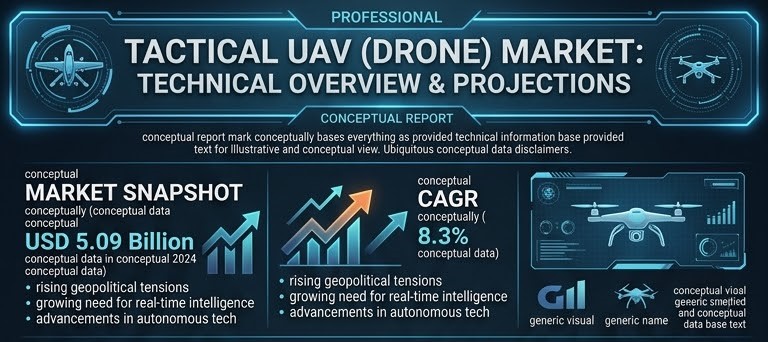
The global Tactical UAV (Drone) Market is expanding at a consistent pace as defense forces invest heavily in advanced unmanned systems to improve operational efficiency and intelligence capabilities. The market is expected to reach USD 7.86 billion by 2030 from USD 5.27 billion in 2025, growing at a CAGR of 8.3%. With a base value of USD 5.09 billion in 2024, the Tactical UAV (Drone) Market is gaining traction due to increased defense modernization and evolving security challenges.
The growing complexity of military operations has accelerated the adoption of UAV systems that provide continuous monitoring and rapid data transmission. As a result, the Tactical UAV (Drone) Market is becoming an indispensable part of modern defense infrastructure.
Understanding the Strategic Importance of the Tactical UAV (Drone) Market
The Tactical UAV (Drone) Market is central to modern military operations, offering capabilities that enhance situational awareness and operational control. These systems are deployed across multiple mission types, including border surveillance, threat detection, and reconnaissance.
Their capability to deliver high-resolution data and operate over extended durations makes them essential for mission success. The increasing reliance on UAVs for real-time intelligence underscores the strategic significance of the Tactical UAV (Drone) Industry.
Market Size, Forecast, and Growth Outlook of the Tactical UAV (Drone) Market
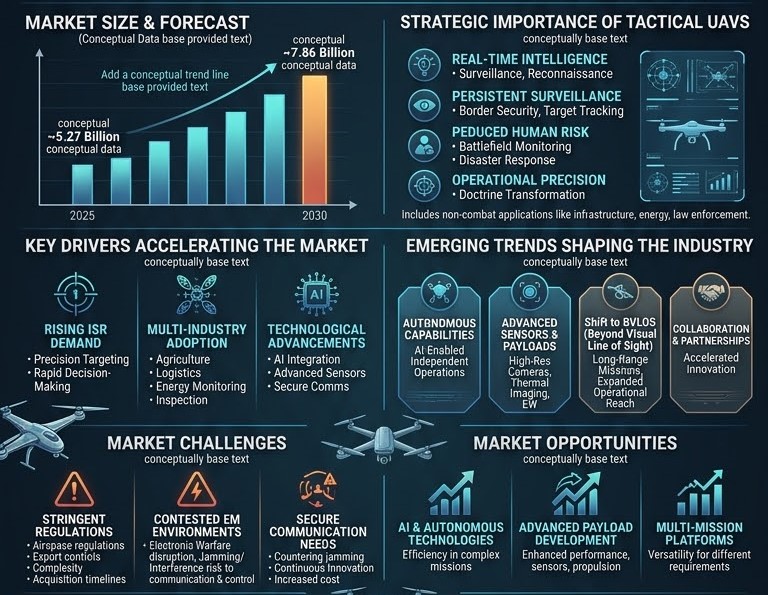
The Tactical UAV (Drone) Market demonstrates strong and steady growth potential, driven by increasing defense budgets and technological innovation. The market is projected to reach USD 7.86 billion by 2030, up from USD 5.27 billion in 2025, reflecting a CAGR of 8.3%.
Europe accounted for a significant 39.9% revenue share in 2025, highlighting the region’s strong focus on defense modernization and UAV adoption. Meanwhile, North America is expected to register the fastest growth during the forecast period, supported by investments in advanced ISR systems and AI-enabled platforms.
The continued expansion of beyond visual line of sight capabilities is a major factor contributing to market growth. BVLOS operations are becoming essential for long-range missions, increasing the operational reach and effectiveness of UAV systems. As a result, the Tactical UAV (Drone) Market is witnessing increasing adoption across defense and commercial sectors.
To Know About the Assumptions Considered for the Study Download the PDF Brochure: https://www.marketsandmarkets.com/pdfdownloadNew.asp?id=17400370
Key Drivers Accelerating the Tactical UAV (Drone) Market
One of the primary drivers of the Tactical UAV (Drone) Market is the rising demand for real-time ISR capabilities. Defense agencies are increasingly relying on UAVs to support precision targeting, mission planning, and rapid decision-making. These systems provide critical data that enhances situational awareness and operational effectiveness.
Another key driver is the growing adoption of UAVs across multiple industries. Beyond defense, sectors such as agriculture, energy, and logistics are leveraging tactical UAVs for monitoring, inspection, and data collection. This cross-industry adoption is expanding the scope of the Tactical UAV (Drone) Market.
Technological advancements are also playing a crucial role in market growth. The integration of AI, advanced sensors, and secure communication systems is enabling UAVs to perform complex missions with greater accuracy and efficiency. These innovations are driving increased investment in the Tactical UAV (Drone) Market.
Emerging Trends Shaping the Tactical UAV (Drone) Market
The Tactical UAV (Drone) Market is witnessing significant technological transformation, with a strong focus on autonomous capabilities and advanced payload integration. AI-enabled UAVs are becoming more capable of performing independent operations, reducing the need for human intervention.
Another key trend is the increasing use of advanced sensors and payloads. High-resolution cameras, thermal imaging systems, and electronic warfare capabilities are enhancing the functionality of UAVs, making them more versatile and effective.
The shift toward BVLOS operations is also shaping the Tactical UAV (Drone) Market. These capabilities allow UAVs to operate beyond the operator’s line of sight, enabling long-range missions and expanding operational coverage.
Additionally, collaborations between UAV manufacturers and technology providers are accelerating innovation. These partnerships are driving the development of next-generation UAV systems with improved performance and reliability.
Challenges Impacting the Tactical UAV (Drone) Market
Despite its growth potential, the Tactical UAV (Drone) Market faces several challenges. Stringent airspace regulations and export controls are limiting cross-border procurement and deployment. These regulatory barriers increase complexity and extend acquisition timelines.
Another major challenge is the presence of contested electromagnetic environments. Adversaries are developing advanced electronic warfare capabilities that can disrupt UAV communication and control systems. This poses a significant risk to mission success and operational reliability.
Maintaining secure and resilient communication systems is critical for the Tactical UAV (Drone) Market. Manufacturers must continuously innovate to counter jamming and interference, which increases development costs and complexity.
Opportunities in the Tactical UAV (Drone) Market
The Tactical UAV (Drone) Market offers significant opportunities driven by advancements in AI and autonomous technologies. AI-enabled UAVs are capable of performing complex missions with greater efficiency, making them highly valuable for defense and commercial applications.
The development of advanced payloads is another key opportunity. Enhanced sensors, improved propulsion systems, and optimized payload integration are enabling UAVs to deliver superior performance.
As defense agencies seek multi-mission capabilities, there is growing demand for versatile UAV platforms that can adapt to different operational requirements. This trend is creating new growth avenues in the Tactical UAV (Drone) Market.
Segment Analysis of the Tactical UAV (Drone) Market
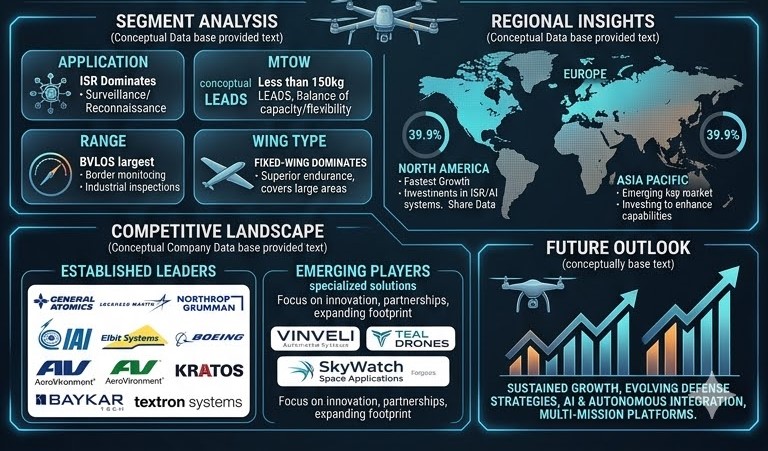
The Tactical UAV (Drone) Market is segmented based on application, MTOW, range, and wing type.
ISR operations dominate the market due to their critical role in intelligence gathering and situational awareness. Defense agencies rely heavily on UAVs for surveillance and reconnaissance missions.
The less than 150 kg segment leads in MTOW, offering a balance between payload capacity and operational flexibility. These UAVs are widely used due to their ease of deployment and versatility.
BVLOS remains the largest segment by range, enabling long-distance operations and expanding mission capabilities. This segment is essential for border monitoring and industrial inspections.
Fixed-wing UAVs dominate the market due to their superior endurance and ability to cover large areas. Their efficiency makes them ideal for long-range missions and large-scale surveillance operations.
Regional Insights in the Tactical UAV (Drone) Market
Europe holds a dominant position in the Tactical UAV (Drone) Market, accounting for a 39.9% revenue share in 2025. The region’s growth is driven by increased defense spending and modernization initiatives.
North America is expected to be the fastest-growing region, supported by strong investments in advanced UAV technologies and ISR capabilities. The region’s focus on innovation and AI integration is driving market expansion.
Asia Pacific is also emerging as a key market, with countries investing in UAV technologies to enhance defense capabilities and address security challenges.
Competitive Landscape of the Tactical UAV (Drone) Market
The Tactical UAV (Drone) Market is highly competitive, with established players and emerging companies driving innovation and growth.
General Atomics
General Atomics is a leading player in the Tactical UAV (Drone) Market, known for its high-endurance UAV systems used in ISR and defense missions. The company’s focus on advanced sensors, autonomy, and multi-mission capabilities strengthens its market leadership.
Lockheed Martin Corporation
Lockheed Martin Corporation plays a significant role in the Tactical UAV (Drone) Market, offering advanced UAV solutions integrated with cutting-edge technologies. Its strong defense portfolio and global presence make it a key contributor to market growth.
Northrop Grumman
Northrop Grumman is a major player in the Tactical UAV (Drone) Market, specializing in high-performance UAV systems and advanced ISR technologies. The company’s emphasis on innovation and system integration supports its competitive position.
Other Emerging and Established Players
Companies such as IAI, Elbit Systems Ltd., Boeing, AeroVironment, Kratos, BAYKAR TECH, SABIC, and Textron Systems are actively contributing to the growth of the Tactical UAV (Drone) Market. These organizations are focusing on product development, strategic partnerships, and expanding their global footprint.
Emerging players like VINVELI Automated Systems, SkyWatch Space Applications, and Teal Drones are gaining traction by offering specialized solutions and targeting niche market segments. Their innovation-driven approach is shaping the future of the Tactical UAV (Drone) Market.
Future Outlook of the Tactical UAV (Drone) Market
The Tactical UAV (Drone) Market is expected to witness sustained growth as defense strategies continue to evolve. Increasing investments in ISR capabilities, combined with advancements in AI and autonomous technologies, will drive long-term demand.
The shift toward multi-mission UAV platforms and enhanced operational efficiency will further strengthen market growth. As geopolitical tensions persist, the importance of tactical UAVs in defense and security operations will continue to rise.
Manufacturers that focus on innovation, scalability, and resilience will be well-positioned to capitalize on emerging opportunities in the Tactical UAV (Drone) Market. The integration of advanced technologies and the expansion of commercial applications will shape the future of the industry.
