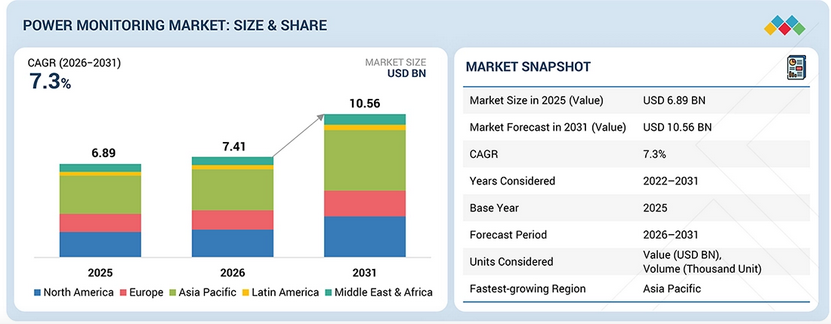
The report “Power Monitoring Market by Component (Hardware, Software, Services), Application (Energy Management, Industrial Automation, Building Automation, Transportation), End-Use, and Region – Global Forecast to 2031″ is projected to reach USD 10.56 billion by 2031 from an estimated USD 7.41 billion in 2026, at a CAGR of 7.3% during the forecast period.
The power monitoring market is rapidly expanding, driven by rising demand for real-time visibility into electrical parameters, power quality management, and energy optimization solutions amid frequent grid instability, increasing renewable energy integration, and rising electricity consumption across industries and cities. The main forces behind this need are the massive growth in manufacturing, data centers, commercial buildings, healthcare facilities, telecom infrastructure, utilities, and smart city projects, particularly in regions with aging electrical networks, high energy costs, or unreliable power supply. Compared to conventional manual checking or basic metering, power monitoring systems provide continuous, accurate data on voltage, current, power factor, harmonics, and energy usage. These characteristics contribute to reduced downtime, predictive maintenance, lower energy bills, and improved operational efficiency, especially in large-scale industrial facilities, commercial complexes, critical infrastructure, and mission-critical applications. In countries like China, India, and other emerging economies, industrial growth, smart grid initiatives, rapid urbanization, and renewable energy programs are significantly driving the adoption of advanced power monitoring technologies. As power demand continues to outpace supply and grid modernization challenges arise in developing regions, the need for high-accuracy, reliable power monitoring solutions has become essential. These solutions enable features such as remote monitoring and diagnostics, IoT connectivity, harmonic analysis, automatic alerts, load balancing, and integration with SCADA (Supervisory Control and Data Acquisition), BMS (Building Management Systems), and cloud platforms. This technology helps mitigate risks associated with equipment failure, production losses, and safety issues.
Download PDF Brochure @ https://www.marketsandmarkets.com/pdfdownloadNew.asp?id=197503460
By end user, the industrial segment is expected to dominate the market during the forecast period.
The industrial segment is expected to hold the largest share of the power monitoring market during the forecast period, driven by the increasing demand for real-time power quality analysis, energy optimization, and equipment protection across manufacturing facilities, mining operations, oil & gas sites, chemical plants, and large-scale processing industries. Industrial operations depend heavily on stable and high-quality electricity to run automated production lines, heavy machinery, motors, and sensitive electronic controls without interruption. Even minor power disturbances like voltage sags, harmonics, or transients can cause costly downtime, equipment damage, or safety issues. Power monitoring systems play a crucial role in these environments by providing continuous visibility into electrical parameters, enabling predictive maintenance, load balancing, and early problem detection. These systems offer several important benefits for industrial applications, including high accuracy under harsh operating conditions, quick response to anomalies, detailed reporting for energy audits, and seamless integration with SCADA, PLCs, and industrial automation platforms. They are widely used in industries located in remote or off-grid areas such as mining, oil & gas exploration, and heavy manufacturing, where access to reliable grid infrastructure is limited. In such scenarios, power monitoring solutions function as essential tools to support continuous operations, reduce energy waste, maintain compliance with strict efficiency and environmental regulations, and ensure business continuity during grid disturbances or outages. Furthermore, rapid industrialization, expansion of manufacturing facilities, and increasing infrastructure development projects across emerging economies are significantly boosting demand for industrial power monitoring systems. Many industrial facilities also deploy these solutions to lower operational costs, protect critical equipment, uphold safety standards, and improve overall productivity.
By application, the standby power segment is expected to dominate the market during the forecast period.
The energy management segment is expected to account for the largest market share in the power monitoring market over the forecast period, owing to the increasing focus on energy efficiency, cost reduction, and sustainability across residential, commercial, and industrial sectors. Power monitoring systems are widely deployed as core components of energy management solutions, providing real-time visibility into energy consumption, power quality, and usage patterns. With the growing emphasis on reducing electricity bills, meeting regulatory requirements, and achieving carbon reduction targets, the need for advanced energy management tools has increased significantly. Energy management applications offer several advantages, including detailed analytics, load profiling, peak-demand control, power-factor correction, and identification of energy-wastage areas. These systems are specifically designed to help organizations optimize consumption, improve operational efficiency, and support strategic decision-making when energy costs rise or sustainability goals become stricter. They are widely used in commercial buildings, manufacturing plants, data centers, hospitals, and large facilities where energy forms a major part of operating expenses. Moreover, rapid industrialization, adoption of smart building technologies, government incentives for energy conservation, and the integration of renewable energy sources are further driving the growth of energy management applications in the power monitoring market. In addition, industries and commercial facilities are increasingly investing in these systems to minimize energy waste, lower carbon footprints, prevent unnecessary costs, and maintain compliance with environmental standards.
Asia Pacific is expected to be the fastest-growing region during the forecast period.
Asia Pacific is expected to be the fastest-growing region in the power monitoring market during the forecast period. This is due to fast growth rates driven by rapid urbanization, industrialization, massive infrastructure development programs, and surging demand for reliable power quality and energy-efficiency solutions in China, India, Japan, South Korea, and emerging markets across Southeast Asia. The ambitious industrialization and smart grid modernization goals in the region, especially manufacturing expansion, data centers, commercial projects, and critical infrastructure, require advanced power monitoring systems to ensure a stable and efficient electricity supply. Power monitoring solutions are essential for providing real-time visibility into electrical parameters, detecting power quality issues, optimizing energy usage, and supporting seamless integration of renewable energy sources. These systems offer key capabilities such as continuous monitoring, harmonic analysis, load management, predictive maintenance, and remote diagnostics, which help avoid operational disruptions and improve overall system reliability in emerging economies. In countries such as China and India, industrial expansion, smart city development, rural electrification, rooftop solar growth, and the efficient supply of power to high-demand areas from manufacturing plants, commercial buildings, data centers, hospitals, telecom infrastructure, and robust distribution networks are driving significant investments in power monitoring technologies.
Make an Inquiry @ https://www.marketsandmarkets.com/Enquiry_Before_BuyingNew.asp?id=197503460
Key Market Players
Some of the major players in the power monitoring market are Schneider Electric (France), Siemens (Germany), ABB (Switzerland), Eaton (US), and Honeywell International Inc. (US). The major strategies adopted by these players include agreements, collaborations, investments, partnerships, product launches, and acquisitions.