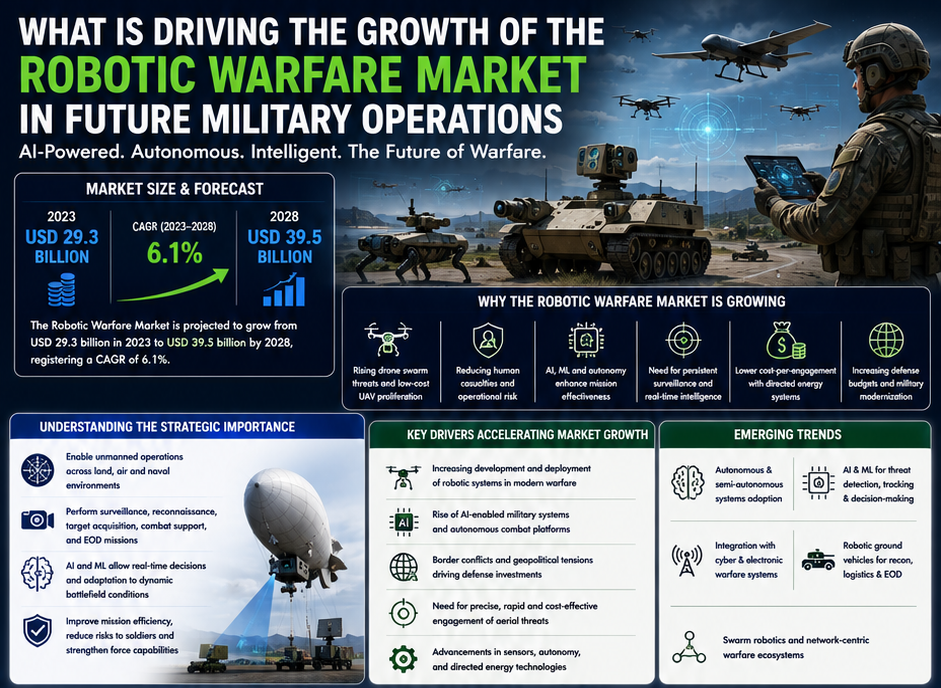
The Robotic Warfare Market is rapidly transforming the future of military operations as defense organizations increasingly adopt autonomous and semi-autonomous systems to enhance combat efficiency, reduce human casualties, and strengthen operational capabilities. The market is projected to grow from USD 29.3 billion in 2023 to USD 39.5 billion by 2028, registering a CAGR of 6.1%.
The growing need for AI-powered military systems, autonomous combat platforms, and advanced battlefield technologies is accelerating the expansion of the Robotic Warfare Market. Governments worldwide are investing heavily in robotic solutions to prepare for future warfare scenarios involving artificial intelligence, cyber warfare, and autonomous operations.
As modern warfare becomes increasingly technology-driven, the Robotic Warfare Market is emerging as a critical pillar of next-generation defense strategies.
Understanding the Strategic Importance of the Robotic Warfare Market
The Robotic Warfare Industry plays a significant role in modern defense ecosystems by enabling unmanned operations across land, air, and naval environments. Robotic warfare systems are designed to perform surveillance, reconnaissance, combat support, target acquisition, explosive disposal, and autonomous mission execution with minimal human intervention.
The integration of artificial intelligence and machine learning into robotic systems is transforming military operations. These technologies enable robots to analyze battlefield data, make real-time decisions, and adapt to changing combat conditions.
The Robotic Warfare Market is therefore essential for improving operational efficiency, reducing risks to soldiers, and enhancing mission effectiveness in complex and hostile environments.
Market Size, Forecast, and Growth Outlook of the Robotic Warfare Market
The Robotic Warfare Industry is expected to witness sustained growth as nations continue to modernize their armed forces and adopt advanced military technologies. The market is projected to reach USD 39.5 billion by 2028, up from USD 29.3 billion in 2023.
North America dominates the Robotic Warfare Market, supported by strong defense spending and extensive investments in AI, cybersecurity, and autonomous military systems. Europe also represents a major growth region due to the presence of leading defense companies and increasing military modernization initiatives.
The increasing deployment of unmanned systems in combat and surveillance missions is further driving the growth of the Robotic Warfare Market.
Key Drivers Accelerating the Robotic Warfare Market
One of the primary drivers of the Robotic Warfare Market is the increasing development and deployment of robotic systems in modern warfare. Military organizations are investing in unmanned technologies to improve operational performance and reduce human exposure to dangerous environments.
The rise of AI-enabled military systems is also accelerating market growth. Autonomous drones, robotic combat vehicles, and intelligent surveillance systems are becoming critical components of future warfare strategies.
Border conflicts and geopolitical tensions are further contributing to the expansion of the Robotic Warfare Market, as countries seek advanced technologies to strengthen national security and military readiness.
Download PDF Brochure: https://www.marketsandmarkets.com/pdfdownloadNew.asp?id=206201612
Emerging Trends Transforming the Robotic Warfare Market
The Robotic Warfare Market is evolving rapidly with several disruptive trends reshaping the industry. One major trend is the growing adoption of autonomous and semi-autonomous systems across defense operations.
Artificial intelligence and machine learning are playing a transformative role in robotic warfare technologies. These capabilities enable robotic platforms to process data, identify threats, and make operational decisions in real time.
Another significant trend is the integration of robotic systems with cyber warfare and electronic warfare capabilities. Modern defense forces are increasingly focusing on network-centric warfare, where robotic systems operate as part of interconnected battlefield ecosystems.
The use of robotic combat vehicles and unmanned ground systems is also increasing, particularly for reconnaissance, logistics, and explosive ordnance disposal missions.
Challenges Impacting the Robotic Warfare Market
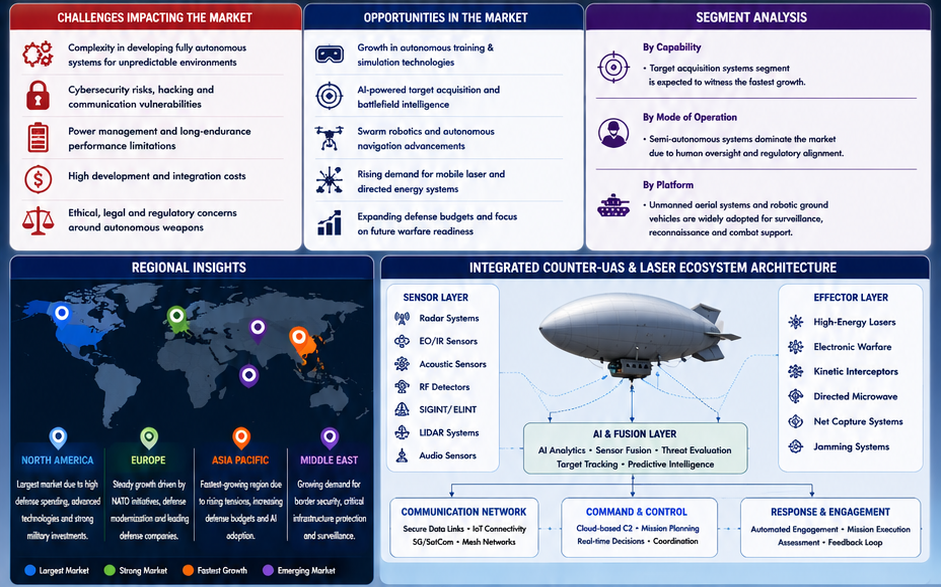
Despite its growth potential, the Robotic Warfare Market faces several technical and operational challenges. One major challenge is the complexity of developing robotic systems capable of operating autonomously in unpredictable combat environments.
Reliable communication and cybersecurity remain critical concerns. Military robotic systems require secure communication channels to prevent hacking, signal disruption, or unauthorized control.
Power management is another challenge in the Robotic Warfare Market, particularly for systems operating in remote or hostile areas where long-endurance performance is required.
Ethical concerns surrounding autonomous weapons systems continue to influence regulations and procurement strategies worldwide.
Opportunities in the Robotic Warfare Market
The Robotic Warfare Market presents significant growth opportunities driven by advancements in autonomous training and simulation technologies. AI-powered simulation systems are enabling realistic military training environments while reducing operational costs.
The increasing use of robotic systems in target acquisition and battlefield intelligence is also creating new revenue opportunities for market participants.
Emerging technologies such as swarm robotics, autonomous navigation, and advanced sensor systems are expected to generate substantial growth opportunities within the Robotic Warfare Market over the coming years.
Segment Analysis of the Robotic Warfare Market
The Robotic Warfare Market is segmented based on capability, mode of operation, platform, and application.
The target acquisition systems segment is projected to witness the fastest growth due to rising demand for accurate threat detection and precision targeting capabilities.
Semi-autonomous systems currently dominate the Robotic Warfare Market because they allow human oversight while reducing operational risks. These systems align with current military regulations and ethical standards regarding autonomous weapons.
Unmanned aerial systems and robotic ground vehicles continue to gain traction as militaries seek versatile solutions for surveillance, reconnaissance, and combat support missions.
Regional Insights in the Robotic Warfare Market
North America leads the Robotic Warfare Market, supported by significant investments in AI, cyber warfare capabilities, and advanced defense technologies. The US continues to dominate the regional market through large-scale defense modernization programs.
Europe is also witnessing strong growth due to the presence of leading defense contractors and increasing adoption of robotic systems for military applications.
Asia Pacific is emerging as a growing market for robotic warfare technologies, driven by rising defense budgets and regional security tensions.
Competitive Landscape of the Robotic Warfare Market
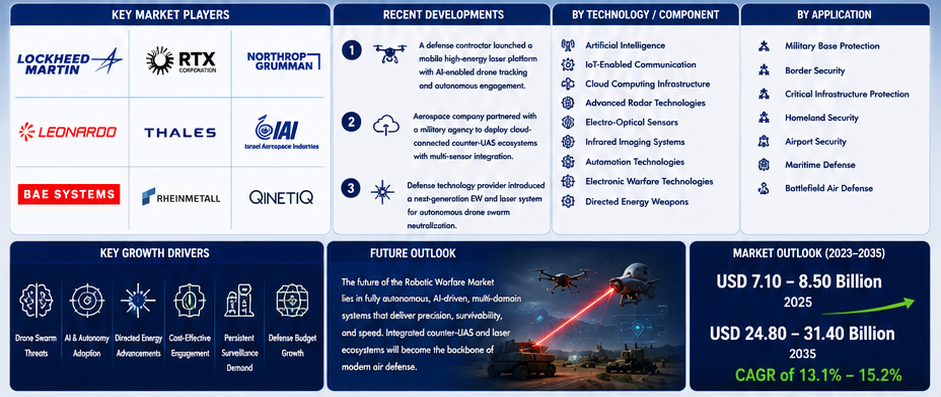
The Robotic Warfare Market is highly competitive, with Major Defense Companies focusing on innovation, autonomous systems, and AI-powered military technologies.
Elbit Systems Ltd.
Elbit Systems Ltd. is a leading player in the Robotic Warfare Market, known for its advanced robotic combat vehicles, autonomous systems, and AI-enabled battlefield technologies.
Lockheed Martin Corporation
Lockheed Martin Corporation plays a major role in the Robotic Warfare Market, developing advanced unmanned systems and integrated combat solutions for future military operations.
Northrop Grumman
Northrop Grumman specializes in autonomous military systems, advanced sensors, and AI-driven robotic warfare technologies that support modern defense operations.
Rheinmetall AG
Rheinmetall AG is expanding its presence in the Robotic Warfare Market through autonomous ground vehicles and advanced robotic combat systems.
QinetiQ
QinetiQ focuses on robotic military platforms, autonomous systems, and advanced defense technologies designed to improve battlefield efficiency and survivability.
Future Outlook of the Robotic Warfare Market
The Robotic Warfare Market is expected to experience substantial growth as militaries worldwide prioritize autonomous technologies, AI integration, and next-generation combat systems.
Future warfare strategies will increasingly rely on robotic platforms capable of performing complex missions with minimal human involvement. Advances in AI, machine learning, and autonomous navigation will continue to enhance operational effectiveness.
Companies that invest in innovation, cybersecurity, and autonomous capabilities will be best positioned to capitalize on emerging opportunities in the Robotic Warfare Market.
As military operations evolve toward AI-enabled and network-centric warfare environments, the Robotic Warfare Market will remain a critical driver of defense modernization worldwide.
