The Virtualized Evolved Packet Core (vEPC) Market has emerged as a critical pillar of modern telecommunications transformation, empowering service providers to build agile, scalable, and software-defined network infrastructures. As telecom operators accelerate investments in 5G, edge computing, Internet of Things (IoT) ecosystems, and enterprise digital transformation initiatives, vEPC solutions are delivering unprecedented levels of operational flexibility, network efficiency, and service innovation.
Historically, telecommunications networks relied on hardware-centric architectures that often constrained scalability, increased operational complexity, and limited responsiveness to evolving market demands. Today, operators are transitioning toward cloud-native frameworks and virtualized network functions (VNFs) that support intelligent, software-driven environments capable of adapting to dynamic business and customer requirements.
As organizations seek to accelerate service delivery, optimize operational expenditures, and enhance network performance, the Virtualized Evolved Packet Core (vEPC) Market continues to establish itself as a strategic foundation for next-generation connectivity and digital infrastructure modernization.
The Evolution of Cloud-Native Telecom Networks
The telecommunications industry is experiencing a profound architectural transformation driven by cloud-native technologies. Modern telecom networks are increasingly leveraging virtualization, containerization, microservices, orchestration platforms, and automation frameworks to create highly adaptive and scalable infrastructures.
This transition enables operators to:
- Accelerate network deployment and service activation
- Improve operational efficiency and resource utilization
- Support dynamic and on-demand service provisioning
- Reduce infrastructure and maintenance costs
- Enhance customer experience and service quality
- Foster continuous innovation and rapid scalability
Cloud-native principles are now becoming fundamental to telecom modernization strategies, particularly as operators prepare for exponential growth in mobile data traffic and emerging digital services.
Looking for growth strategies? Download the PDF with key business opportunities discovered via market research.
Understanding the Virtualized Evolved Packet Core (vEPC) Market
The Virtualized Evolved Packet Core (vEPC) Market encompasses software-based core network solutions that replace traditional hardware-dependent EPC infrastructures with virtualized, cloud-ready architectures.
By virtualizing essential network core functions, telecom operators can achieve:
- Greater scalability and network elasticity
- Increased operational flexibility
- Enhanced infrastructure efficiency
- Faster deployment and upgrade cycles
- Lower capital and operational expenditures
- Simplified management and orchestration
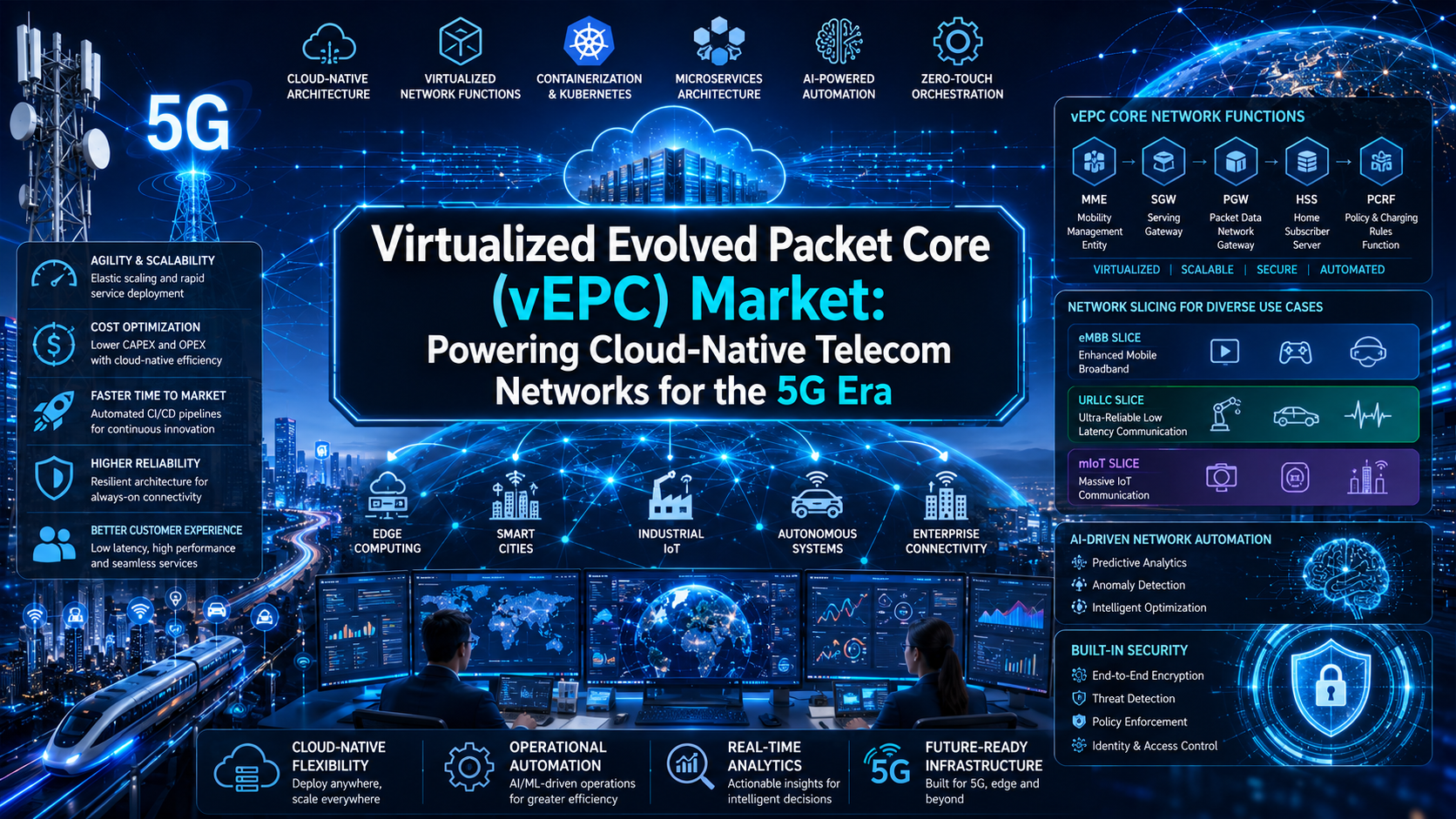
Core vEPC components typically include:
Mobility Management Entity (MME)
Responsible for subscriber mobility management, authentication, and session control.
Serving Gateway (SGW)
Handles packet routing and mobility management between network elements.
Packet Data Network Gateway (PGW)
Provides connectivity between subscriber devices and external IP networks.
Home Subscriber Server (HSS)
Stores subscriber information and authentication data.
Policy and Charging Rules Function (PCRF)
Manages policy enforcement, quality of service, and charging mechanisms.
Together, these functions establish the intelligent backbone of modern mobile broadband and next-generation telecom networks.
Why Telecom Operators Are Transitioning Beyond Traditional EPC
Legacy EPC infrastructures present several challenges that hinder innovation and operational agility.
Key limitations include:
- Heavy reliance on proprietary hardware
- Extended deployment and provisioning cycles
- Complex upgrade and maintenance requirements
- Limited scalability and flexibility
- Elevated operating costs
Virtualized architectures overcome these constraints by decoupling software from physical hardware, enabling network functions to be deployed, scaled, and managed dynamically.
This transformation empowers operators to respond more effectively to changing market conditions while accelerating service innovation and customer value creation.
For real business growth, this Sample Report is a game-changer—download yours today.
Cloud-Native Technologies Accelerating Telecom Innovation
Cloud-native telecom ecosystems integrate several advanced technologies that support highly agile and intelligent network environments.
Microservices Architecture
Network functions are decomposed into modular services that can be independently developed, deployed, and scaled.
Containerization
Containers enhance application portability, consistency, and infrastructure efficiency across hybrid and multi-cloud environments.
Kubernetes-Based Orchestration
Kubernetes automates deployment, scaling, monitoring, and lifecycle management of network workloads, improving operational reliability.
Continuous Integration and Continuous Deployment (CI/CD)
CI/CD pipelines accelerate software delivery cycles and enable rapid deployment of new features and services.
AI-Driven Automation
Artificial intelligence enhances network optimization, predictive maintenance, anomaly detection, and operational intelligence.
Collectively, these technologies are significantly accelerating the evolution of the Virtualized Evolved Packet Core (vEPC) Market.
Enterprise Benefits of vEPC Technologies
Enhanced Network Agility
Organizations can rapidly deploy, modify, and optimize network services without extensive infrastructure modifications.
Reduced Operational Expenditure
Virtualization minimizes hardware dependencies and improves infrastructure utilization, resulting in lower operational costs.
Dynamic Scalability
Network resources can automatically scale based on traffic demand and business requirements.
Accelerated Service Innovation
Telecom operators can launch new products, applications, and connectivity services more efficiently.
Improved Network Reliability
Cloud-native architectures enhance resilience, fault tolerance, and service availability.
These advantages continue to support substantial Virtualized Evolved Packet Core (vEPC) growth across global markets.
Applications Driving Market Expansion
5G Network Deployments
vEPC serves as a critical transitional platform supporting the evolution toward fully cloud-native 5G core architectures.
Enterprise Connectivity
Organizations benefit from secure, scalable, and high-performance connectivity solutions that support digital transformation initiatives.
Internet of Things (IoT)
Virtualized core networks provide the scalability necessary to manage billions of connected devices and intelligent endpoints.
Smart Cities
Municipal governments utilize vEPC-enabled infrastructure to support intelligent transportation systems, utilities management, and public services.
Industrial Automation
Manufacturers leverage advanced network capabilities to enable Industry 4.0 initiatives, smart factories, and real-time operational intelligence.
Private LTE and 5G Networks
Enterprises increasingly deploy private wireless networks utilizing virtualized core technologies to enhance security, performance, and operational control.
Virtualized Evolved Packet Core (vEPC) Trends Reshaping Connectivity
Several emerging Virtualized Evolved Packet Core (vEPC) trends are redefining the telecommunications landscape.
Cloud-Native Core Adoption
Operators are accelerating migration toward fully cloud-native core network environments.
Edge Computing Integration
Processing capabilities are moving closer to end users, reducing latency and enhancing application performance.
Network Slicing
5G-enabled network slicing allows operators to create customized network experiences tailored to specific applications and industries.
Open Telecom Ecosystems
Open architectures and interoperable platforms are fostering greater innovation and vendor flexibility.
AI-Powered Network Operations
Machine learning and automation technologies are transforming network monitoring, optimization, and management practices.
These developments underscore the industry’s commitment to delivering intelligent, adaptive, and future-ready connectivity solutions.
Virtualized Evolved Packet Core (vEPC) Analysis: Key Market Growth Drivers
A comprehensive Virtualized Evolved Packet Core (vEPC) analysis highlights several factors fueling market expansion.
Expansion of Global 5G Infrastructure
Large-scale 5G deployments continue to drive demand for flexible and scalable network core solutions.
Rising Mobile Data Consumption
The exponential growth of mobile traffic requires intelligent, software-defined network architectures.
Enterprise Digital Transformation
Organizations increasingly depend on high-performance connectivity to support mission-critical applications and digital operations.
Growth of IoT Ecosystems
The proliferation of connected devices requires robust and scalable network infrastructure.
Cost Optimization Initiatives
Telecom operators continue seeking operational efficiencies and reduced capital expenditures through virtualization.
Collectively, these factors are strengthening the long-term trajectory of the Virtualized Evolved Packet Core (vEPC) Market.
Security, Automation, and Network Intelligence
Modern telecommunications environments require robust security frameworks and intelligent operational capabilities.
vEPC architectures support:
- Automated threat detection and mitigation
- Real-time network monitoring and analytics
- Dynamic policy management
- Enhanced subscriber protection
- Secure access and identity management
The integration of AI and automation further strengthens network resilience, operational visibility, and service quality.
Virtualized Evolved Packet Core (vEPC) Share and Competitive Landscape
The Virtualized Evolved Packet Core (vEPC) share continues to expand as technology providers compete to deliver advanced cloud-native networking solutions.
Areas of competitive differentiation include:
- Cloud-native core platforms
- Network orchestration technologies
- Telecom automation solutions
- Edge computing integration capabilities
- Advanced 5G core innovations
This competitive landscape is expected to drive continued technological advancement and market adoption.
Virtualized Evolved Packet Core (vEPC) Outlook and Forecast
The Virtualized Evolved Packet Core (vEPC) outlook remains exceptionally strong as telecom operators continue modernizing network infrastructures.
Future innovations are expected to include:
- Fully cloud-native core networks
- AI-native telecom operations
- Autonomous network management
- Advanced edge computing ecosystems
- Intelligent network slicing capabilities
- Open and programmable telecom platforms
The Virtualized Evolved Packet Core (vEPC) forecast indicates sustained adoption among mobile operators, enterprise organizations, private network providers, and digital infrastructure stakeholders worldwide.
As cloud-native telecom architectures continue to mature, virtualized network cores will play an increasingly strategic role in enabling next-generation communications services.
Strategic Recommendations for Telecom and Enterprise Leaders
To maximize value from vEPC investments, organizations should prioritize the following initiatives:
- Accelerate cloud-native transformation programs.
- Invest in advanced automation and orchestration platforms.
- Strengthen network security and governance frameworks.
- Develop scalable edge computing strategies.
- Modernize legacy network infrastructure.
- Expand AI-driven network operations capabilities.
- Build future-ready architectures aligned with evolving 5G and next-generation network requirements.
Organizations that successfully execute these priorities will be better positioned to capitalize on emerging opportunities within the Virtualized Evolved Packet Core (vEPC) Market.
The Virtualized Evolved Packet Core (vEPC) Market is fundamentally transforming the way telecom operators and enterprises design, deploy, and manage network infrastructure. By leveraging virtualization, cloud-native technologies, intelligent automation, and advanced orchestration, vEPC solutions are enabling a new era of scalable, resilient, and software-defined connectivity.
As organizations continue to embrace 5G, edge computing, IoT, and AI-driven operations, virtualized network cores will become increasingly essential to delivering secure, high-performance, and future-ready communications services. Looking ahead, ongoing advancements in cloud-native telecom technologies will continue to strengthen Virtualized Evolved Packet Core (vEPC) share, Virtualized Evolved Packet Core (vEPC) size, Virtualized Evolved Packet Core (vEPC) analysis, Virtualized Evolved Packet Core (vEPC) trends, Virtualized Evolved Packet Core (vEPC) outlook, Virtualized Evolved Packet Core (vEPC) report, Virtualized Evolved Packet Core (vEPC) growth, and Virtualized Evolved Packet Core (vEPC) forecast, reinforcing its role as a critical enabler of next-generation digital connectivity.