The rapid rise of generative artificial intelligence (Gen AI) is reshaping the global technology landscape, creating unprecedented demand for high-performance computing infrastructure. From large language models (LLMs) and multimodal AI systems to enterprise copilots and autonomous agents, generative AI applications require enormous computational resources for both training and inference. As a result, the Generative AI Server Market has emerged as one of the fastest-growing segments within the broader AI infrastructure ecosystem.
According to MarketsandMarkets,Generative AI Server Market is expected to reach USD 448.60 billion by 2030 from USD 103.92 billion in 2025, registering a CAGR of 34.0% during the forecast period. , the growing adoption of generative AI across industries is driving significant investments in AI servers equipped with advanced GPUs, AI accelerators, high-bandwidth memory, and next-generation networking technologies. Enterprises, hyperscale cloud providers, and investors are increasingly focusing on AI server infrastructure as the foundation for future digital transformation initiatives.
As AI models become larger and more sophisticated, understanding the trends shaping the generative AI server market is critical for stakeholders seeking to capitalize on this transformative opportunity.
The Growing Importance of Generative AI Servers
Generative AI servers are specialized computing systems designed to handle the intensive workloads associated with AI model training and inference. Unlike traditional enterprise servers, these systems integrate advanced processors, AI accelerators, high-speed interconnects, and optimized memory architectures to support massive parallel processing.
The emergence of foundation models containing billions or even trillions of parameters has significantly increased computational requirements. Organizations deploying AI applications require infrastructure capable of processing enormous datasets while maintaining speed, scalability, and efficiency.
This demand is fueling a global AI infrastructure race as cloud providers, enterprises, and governments invest heavily in next-generation AI data centers.
Top 10 Key Takeaways
- Generative AI is driving unprecedented demand for AI server infrastructure.
- AI training workloads require massive GPU and accelerator deployments.
- Inference is expected to become the largest long-term AI server opportunity.
- Specialized AI chips are replacing traditional computing architectures.
- High-Bandwidth Memory (HBM) is becoming critical for AI performance.
- Networking infrastructure is essential for scaling large AI clusters.
- Cloud providers are leading investments in AI data centers.
- Enterprise AI adoption is creating sustained infrastructure demand.
- Energy-efficient AI servers are becoming a strategic priority.
- Sovereign AI initiatives are opening new growth opportunities globally.
Download PDF Brochure @ https://www.marketsandmarkets.com/pdfdownloadNew.asp?id=242200223
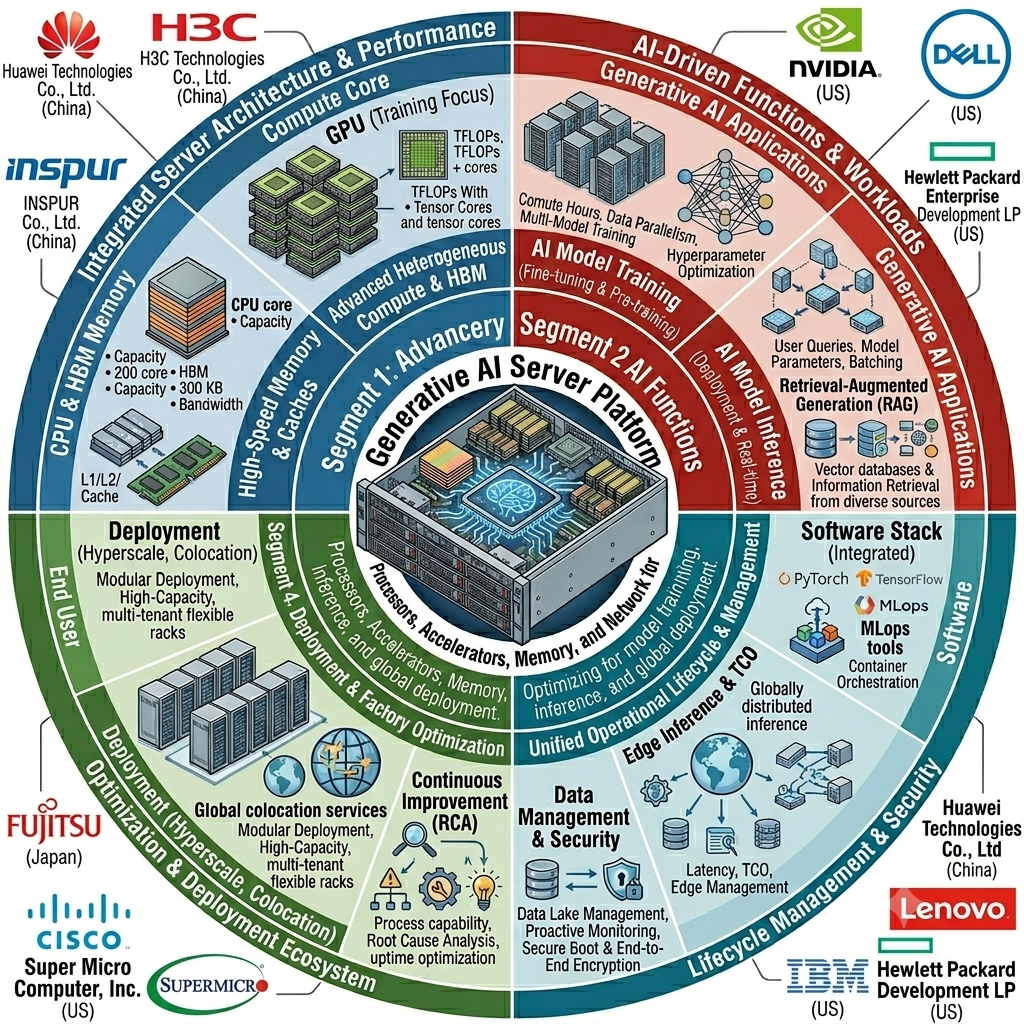
Trend 1: Explosive Demand for AI Training Infrastructure
One of the most significant trends driving the market is the growing need for AI training infrastructure.
Training modern generative AI models requires:
- Massive computational power
- High-performance GPUs
- Large memory capacity
- High-speed networking
- Efficient cooling systems
The development of advanced language models, image generators, video creation platforms, and AI copilots has created unprecedented demand for AI training clusters.
Organizations are increasingly deploying thousands of GPUs connected through ultra-fast networking architectures to accelerate training cycles and reduce development timelines.
For investors, companies involved in AI hardware, server manufacturing, memory technologies, and networking infrastructure represent key growth opportunities within this expanding ecosystem.
Trend 2: Inference Becomes the Largest Long-Term Opportunity
While training currently attracts significant attention, inference is expected to become the dominant workload over time.
Inference refers to the process of running trained AI models to generate outputs in real-world applications such as:
- Chatbots
- Virtual assistants
- Search engines
- Recommendation systems
- Autonomous systems
- Enterprise productivity tools
As AI adoption expands across industries, billions of daily inference requests will require scalable and cost-efficient infrastructure.
This shift is encouraging server vendors to develop systems optimized specifically for inference workloads, balancing performance with energy efficiency and operational costs.
For cloud providers, inference services are emerging as a major revenue stream, driving continued investment in AI server capacity.
Trend 3: Specialized AI Accelerators Gain Market Share
The AI server market is evolving beyond traditional CPU-based architectures.
Specialized accelerators now play a central role in AI infrastructure, including:
- Graphics Processing Units (GPUs)
- Neural Processing Units (NPUs)
- Tensor Processing Units (TPUs)
- Custom ASICs
- AI inference chips
These processors are specifically designed to handle matrix operations and parallel computations required by deep learning workloads.
The growing demand for AI-specific hardware is creating opportunities for semiconductor manufacturers that can deliver higher performance, lower latency, and improved energy efficiency.
Investors are increasingly monitoring the competitive landscape as major technology companies develop proprietary AI accelerators to reduce dependence on third-party hardware suppliers.
Trend 4: High-Bandwidth Memory Becomes Critical
As AI models increase in size and complexity, memory performance is becoming a major bottleneck.
High-Bandwidth Memory (HBM) is emerging as a critical component of next-generation AI servers due to its ability to provide significantly higher data transfer speeds compared to conventional memory architectures.
Key benefits include:
- Faster model training
- Reduced latency
- Improved inference performance
- Better energy efficiency
Demand for HBM is growing rapidly as hyperscalers and AI infrastructure providers compete for limited supply.
Memory manufacturers are expanding production capacity to support the accelerating requirements of AI workloads, making memory technologies an increasingly important area for investors to monitor.
Trend 5: AI Networking Infrastructure Takes Center Stage
AI workloads require efficient communication between thousands of processors operating simultaneously.
This has elevated networking technologies from supporting infrastructure to strategic assets within AI data centers.
Critical components include:
- Network Interface Cards (NICs)
- High-speed interconnects
- Ethernet fabrics
- AI networking switches
Modern AI clusters depend on ultra-low latency communication to ensure efficient data exchange across distributed systems.
As model sizes continue to grow, networking infrastructure is becoming a key differentiator for cloud providers and AI infrastructure vendors seeking to maximize performance.
Trend 6: Cloud Providers Lead AI Infrastructure Investments
Hyperscale cloud providers are among the largest investors in generative AI server infrastructure.
Cloud-based AI services offer organizations:
- Flexible computing resources
- Reduced capital expenditures
- Faster deployment
- Global scalability
- Access to advanced AI hardware
Major cloud providers continue expanding AI data center capacity to support growing demand for model training and inference services.
The cloud deployment model enables enterprises to access cutting-edge AI infrastructure without building their own large-scale computing environments.
This trend is expected to remain a major growth driver for the AI server market throughout the forecast period.
Trend 7: Enterprise AI Adoption Accelerates
Generative AI is rapidly moving from experimental deployments to enterprise-wide implementation.
Organizations across sectors including:
- Healthcare
- Financial services
- Manufacturing
- Retail
- Telecommunications
- Government
are integrating AI into business operations.
Common enterprise applications include:
- Customer service automation
- Content generation
- Software development assistance
- Predictive analytics
- Knowledge management
- Process optimization
As deployment scales, enterprises require dedicated AI infrastructure capable of meeting performance, security, and compliance requirements.
This growing demand is creating significant opportunities for server manufacturers and AI infrastructure providers.
Trend 8: Energy Efficiency Becomes a Competitive Advantage
The enormous power requirements of AI data centers are creating new challenges for infrastructure operators.
Training large-scale AI models consumes substantial energy, leading organizations to prioritize energy-efficient server architectures.
Key innovations include:
- Advanced cooling technologies
- Liquid cooling systems
- Energy-efficient accelerators
- Optimized power management
- Sustainable data center design
Investors are increasingly evaluating AI infrastructure providers based on their ability to balance performance with sustainability.
Energy efficiency is expected to become a major competitive differentiator as AI workloads continue to scale.
Trend 9: Edge AI Expands Beyond Centralized Data Centers
Although most generative AI workloads currently run in centralized cloud environments, edge AI deployment is gaining momentum.
Organizations are increasingly deploying AI inference closer to end users to reduce latency and improve responsiveness.
Edge AI servers support applications such as:
- Smart manufacturing
- Autonomous vehicles
- Healthcare diagnostics
- Retail analytics
- Industrial automation
This trend is creating demand for compact, high-performance AI servers optimized for distributed environments.
The expansion of edge AI represents an important long-term growth opportunity within the broader AI infrastructure market.
Trend 10: Sovereign AI Investments Create New Opportunities
Governments worldwide are investing heavily in sovereign AI infrastructure to support national AI strategies and reduce dependence on foreign technology providers.
Many countries are funding:
- National AI supercomputers
- Research infrastructure
- AI data centers
- Semiconductor development programs
These investments are creating additional demand for generative AI servers and supporting technologies.
For investors, sovereign AI initiatives represent a significant catalyst for long-term market expansion.
What Investors Should Watch
Investors evaluating opportunities within the generative AI server market should monitor several key indicators:
- AI accelerator adoption rates
- Cloud provider infrastructure spending
- HBM supply and pricing trends
- Data center expansion projects
- AI software adoption growth
- Energy efficiency innovations
- Semiconductor manufacturing capacity
Companies operating across the AI hardware value chain are likely to benefit from sustained growth in AI infrastructure investments.
What Enterprises Should Watch
Enterprises planning AI initiatives should focus on:
- Infrastructure scalability
- Total cost of ownership
- Security and compliance requirements
- Hybrid cloud deployment models
- AI workload optimization
- Future-proof hardware investments
Organizations that establish robust AI infrastructure strategies today will be better positioned to capture competitive advantages as AI adoption accelerates.
What Cloud Providers Should Watch
Cloud providers should prioritize:
- Capacity expansion
- AI hardware availability
- Networking performance
- Energy management
- AI service differentiation
- Strategic partnerships
As enterprise AI adoption grows, cloud providers capable of delivering reliable, scalable AI infrastructure will be well positioned for long-term success.
The Generative AI Server Market is rapidly becoming one of the most important segments of the global technology industry. Driven by the explosive growth of AI training and inference workloads, demand for advanced AI infrastructure continues to accelerate across enterprises, cloud providers, and government organizations.
Key trends such as specialized AI accelerators, high-bandwidth memory, AI networking infrastructure, cloud expansion, edge AI, and energy-efficient computing are reshaping the market landscape. For investors, enterprises, and cloud providers alike, understanding these trends will be essential for navigating the next phase of the AI revolution.
As generative AI continues transforming industries worldwide, the infrastructure powering this transformation—the AI server market—will remain at the center of innovation, investment, and long-term growth
Frequently Asked Questions (FAQs)
1. What is a generative AI server?
A generative AI server is a high-performance computing system designed to train and run AI models such as large language models, image generators, and other generative AI applications.
2. Why is the generative AI server market growing rapidly?
Growth is driven by increasing adoption of generative AI, rising demand for AI training and inference infrastructure, and growing investments in cloud and data center expansion.
3. What hardware is commonly used in AI servers?
AI servers typically include GPUs, CPUs, AI accelerators, high-bandwidth memory (HBM), and high-speed networking components.
4. How do cloud providers benefit from AI server growth?
Cloud providers offer AI infrastructure as a service, enabling enterprises to access powerful AI computing resources without investing in their own data centers.
5. What role does HBM play in AI servers?
High-Bandwidth Memory enables faster data processing and lower latency, improving AI model training and inference performance.
