The global Immunohistochemistry (IHC) market is projected to grow from USD 3.55 billion in 2025 to USD 5.14 billion by 2030, at a CAGR of 7.6% during the forecast period. Growth in the market is primarily driven by the increasing demand for advanced diagnostic techniques, particularly in oncology, along with favorable reimbursement policies in developed regions.
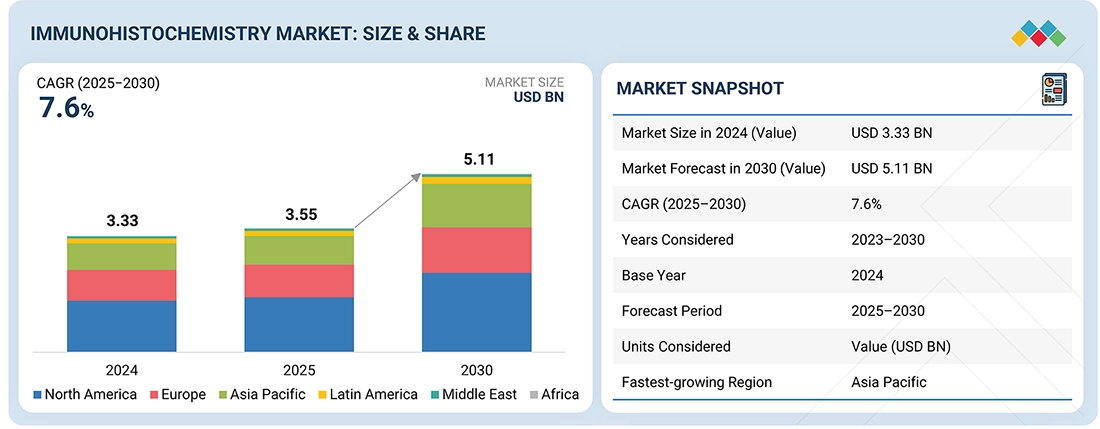
Download PDF Brochure:- https://www.marketsandmarkets.com/pdfdownloadNew.asp?id=121632939
Comprehensive reimbursement coverage for IHC tests is encouraging broader adoption by reducing patient out-of-pocket costs and increasing test volumes. However, variability and complexity in reimbursement frameworks across regions remain a challenge, potentially slowing the uptake of newer, high-cost IHC technologies.
Kits Segment to Register the Highest Growth
By product and service, the kits segment is expected to witness the highest growth rate during the forecast period. This growth is fueled by a growing preference among hospitals, diagnostic laboratories, and research institutions for standardized, ready-to-use solutions.
Integrated IHC kits offer closed-system reagents and pre-calibrated components, streamlining workflows and reducing manual preparation time. These solutions enhance laboratory efficiency, throughput, and reproducibility of results—critical factors in both clinical diagnostics and research applications. The shift toward single-vendor, comprehensive kits is a key trend shaping the market.
Hospitals & Diagnostic Laboratories Lead End-User Segment
Hospitals and diagnostic laboratories accounted for the largest share of the IHC market in 2024. This dominance is attributed to the essential role of IHC in disease diagnosis, particularly for cancer, infectious diseases, and autoimmune disorders.
IHC remains the gold standard for detecting protein biomarkers and guiding targeted therapies in oncology. The rising global cancer burden continues to drive demand for accurate and reliable diagnostic solutions. Additionally, the growing trend of hospitals establishing in-house diagnostic capabilities is improving turnaround times and integrating pathology more closely with patient care, further strengthening this segment.
Speak To Analyst:- https://www.marketsandmarkets.com/speaktoanalystNew.asp?id=121632939
Asia Pacific Emerges as the Largest Regional Market
Asia Pacific accounted for the largest share of the immunohistochemistry market in 2024. The region’s growth is supported by increasing healthcare investments, expanding access to advanced diagnostic services, and a rising prevalence of chronic diseases, including cancer.
Government initiatives such as China’s “Healthy China 2030” and India’s “Ayushman Bharat” are enhancing healthcare infrastructure and accessibility. The expansion of private diagnostic laboratories and the growth of medical tourism hubs in countries like Singapore and Thailand are further boosting demand for advanced diagnostic technologies. Additionally, the increasing presence of contract research organizations (CROs) supporting global clinical trials is contributing to the adoption of IHC techniques across the region.
Competitive Landscape
Key players in the immunohistochemistry market include F. Hoffmann-La Roche Ltd (Switzerland), Danaher Corporation (US), Agilent Technologies, Inc. (US), Thermo Fisher Scientific Inc. (US), Merck KGaA (Germany), Bio-Rad Laboratories, Inc. (US), Bio-Techne (US), Becton, Dickinson and Company (US), Takara Bio Inc. (Japan), PHC Holdings Corporation (Japan), Enzo Biochem Inc. (US), Sino Biological, Inc. (China), OriGene Technologies, Inc. (US), Cell Signaling Technology, Inc. (US), Bio SB (US), Miltenyi Biotec (Germany), Sakura Finetek (US), EagleBio (US), Biocare Medical LLC (US), Elabscience BioInnovation Inc. (US), Bio-Genex (US), Diagnostic BioSystems Inc. (US), Histo-Line Laboratories (Italy), Rockland Immunochemicals, Inc. (US), and CANDOR Bioscience GmbH (Germany), among others.
These companies are actively focusing on product innovation, portfolio expansion, and strategic collaborations to strengthen their global presence and address the growing demand for advanced diagnostic solutions.
