The Quantum Computing Market Analysis highlights one of the most transformative technology shifts of the modern era. Quantum computing leverages the principles of quantum mechanics—such as superposition and entanglement—to solve complex computational problems that are beyond the capabilities of classical computers.
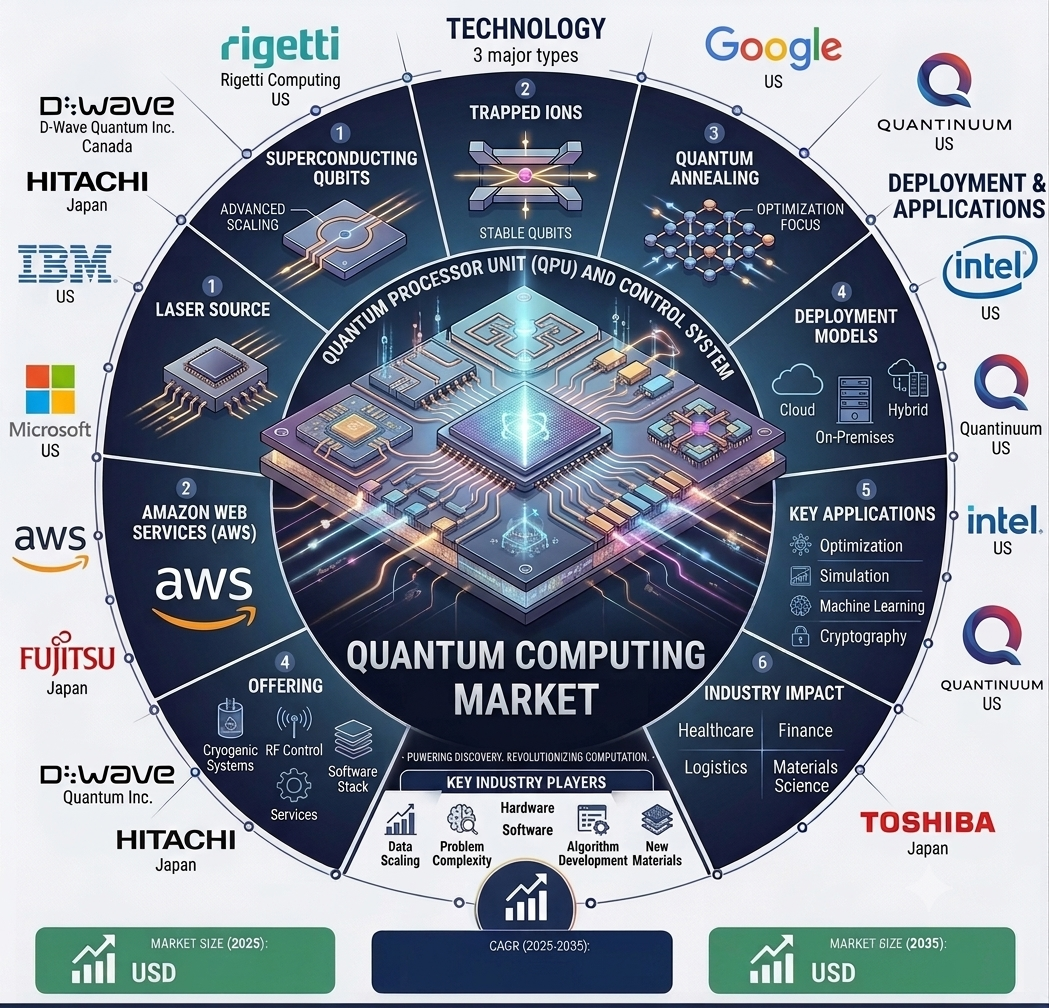
According to MarketsandMarkets, The quantum computing market is projected to reach USD 20.20 billion by 2030 from USD 3.52 billion in 2025, at a CAGR of 41.8% during the forecast period
This rapid expansion reflects rising investments from governments, cloud providers, and enterprises seeking quantum advantage in optimization, simulation, machine learning, and cryptography.
The Quantum Computing Market Analysis shows that industries such as AI, healthcare, and financial services are leading early adoption, as they face computational problems that traditional systems struggle to solve efficiently.
Top 10 Key Takeaways
- Quantum computing market is projected to grow at over 30% CAGR in the coming years.
- AI, healthcare, and financial services are leading early adoption.
- Cloud-based quantum computing is driving accessibility.
- Drug discovery is a major use case in healthcare.
- Portfolio optimization is a key BFSI application.
- Hybrid quantum-classical models are becoming standard.
- Government funding is accelerating global adoption.
- Quantum computing is still in the NISQ phase.
- Startups are playing a major role in innovation.
- Long-term potential lies in solving ultra-complex global problems.
Quantum Computing Market Analysis: Market Overview
The quantum computing ecosystem includes hardware systems, software platforms, and cloud-based quantum services. Key players such as IBM, Google, Microsoft, D-Wave, IonQ, and Quantinuum are building scalable quantum architectures to enable real-world applications.
Key market components include:
- Quantum hardware (superconducting qubits, trapped ions, photonic systems)
- Quantum software and algorithms
- Quantum-as-a-Service (QaaS) platforms
- Hybrid quantum-classical computing systems
The Quantum Computing Market Analysis indicates that cloud-based deployment is becoming the dominant model, enabling enterprises to access quantum systems without investing in expensive infrastructure.
Quantum Computing Market Analysis Across Key Industries
1. Artificial Intelligence (AI) and Machine Learning
AI is one of the strongest drivers in the Quantum Computing Market Analysis. Quantum computing enhances AI by accelerating:
- Pattern recognition
- Optimization problems
- Neural network training
- Large-scale data classification
Quantum machine learning (QML) models can process high-dimensional datasets more efficiently than classical systems. This creates opportunities in autonomous systems, recommendation engines, and generative AI models.
Recent research also shows quantum reservoir computing achieving high accuracy in time-series prediction tasks, demonstrating early potential for AI integration. arXiv
2. Healthcare and Pharmaceuticals
The healthcare sector is expected to benefit significantly from quantum computing advancements.
In Quantum Computing Market Analysis, healthcare applications include:
- Drug discovery and molecular simulation
- Protein folding analysis
- Genomic data processing
- Clinical trial optimization
Quantum simulations allow researchers to model molecular interactions at an atomic level, significantly reducing drug development timelines and costs.
For pharmaceutical companies, this means faster identification of potential treatments and improved precision in personalized medicine.
3. Financial Services (BFSI)
The financial sector is one of the earliest adopters in the Quantum Computing Market Analysis due to its need for high-performance optimization and risk modeling.
Key applications include:
- Portfolio optimization
- Fraud detection
- Algorithmic trading
- Risk analysis and stress testing
- Derivative pricing models
Quantum computing enables financial institutions to evaluate multiple market scenarios simultaneously, improving decision-making accuracy and speed.
A growing number of financial institutions are partnering with quantum startups to explore quantum-enhanced trading strategies and risk models.
Download PDF Brochure @ https://www.marketsandmarkets.com/pdfdownloadNew.asp?id=144888301
Quantum Computing Market Analysis: Key Growth Drivers
Rising Demand for High-Performance Computing
The need to solve computationally intensive problems is accelerating adoption across industries such as logistics, aerospace, and energy.
Government Investments and National Quantum Programs
Governments in the U.S., China, EU, and India are investing heavily in quantum research initiatives, fueling innovation and ecosystem development.
Expansion of Quantum-as-a-Service (QaaS)
Cloud-based quantum computing is reducing entry barriers, allowing enterprises to experiment with quantum algorithms without owning hardware.
Integration with AI and Big Data
The convergence of AI, big data analytics, and quantum computing is creating new possibilities for advanced decision-making systems.
Quantum Computing Market Analysis: Challenges
Despite rapid progress, several challenges remain:
- High hardware development costs
- Qubit instability and error rates
- Lack of scalable quantum systems
- Limited commercial-grade applications
- Shortage of skilled quantum engineers
The Quantum Computing Market Analysis suggests that the industry is still in the Noisy Intermediate-Scale Quantum (NISQ) era, where real-world applications are emerging but not yet fully scalable.
Quantum Computing Market Analysis: Emerging Trends
1. Cloud-Based Quantum Computing
Cloud providers like IBM and Microsoft are offering quantum systems via the cloud, accelerating enterprise adoption.
2. Hybrid Quantum-Classical Systems
Hybrid models combine classical computing with quantum processors to solve complex problems more efficiently.
3. Quantum Cryptography and Security
Quantum computing is driving the development of post-quantum cryptography to secure future digital infrastructure.
4. Industry-Specific Quantum Applications
Sectors like automotive, energy, and aerospace are increasingly exploring quantum-based simulation tools.
5. Growth of Quantum Startups
A growing ecosystem of startups is driving innovation in quantum algorithms, hardware design, and software platforms.
Quantum Computing Market Analysis: Regional Outlook
- North America leads the market due to strong investment from tech giants and government funding.
- Europe focuses on research collaboration and academic-industry partnerships.
- Asia-Pacific is expected to grow fastest due to strong government initiatives and expanding technology ecosystems.
Future Outlook
The future of the Quantum Computing Market Analysis indicates a transition from experimental systems to practical enterprise applications over the next decade.
As qubit stability improves and error correction technologies advance, quantum computing is expected to achieve breakthroughs in:
- Drug discovery
- Financial modeling
- Climate modeling
- AI optimization
Eventually, quantum computing will complement classical computing systems, forming a hybrid computing ecosystem that solves problems previously considered impossible.
FAQs
1. What is Quantum Computing Market Analysis?
It is the study of market trends, growth drivers, applications, and future opportunities in the quantum computing industry.
2. Which industries benefit most from quantum computing?
AI, healthcare, and financial services are the leading beneficiaries.
3. What is driving quantum computing growth?
High-performance computing demand, government funding, and cloud adoption are key drivers.
4. Is quantum computing commercially available?
Yes, but it is still in early stages through cloud-based and experimental platforms.
5. What is the future of quantum computing?
It is expected to evolve into a hybrid model working alongside classical computing systems.
