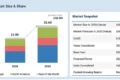
The Semi-Trailer Market is projected to grow at a CAGR of 6.6% during the forecast period, from an estimated USD 34.53 billion in 2026 to a projected USD 54.14 billion by 2033.
The global semi-trailer market is growing steadily, driven by expanding road freight activity, increasing warehouse and distribution networks, rising intermodal transportation, infrastructure development, and growing cold chain requirements for food and pharmaceutical logistics. The industry is shifting toward the adoption of smart trailers equipped with telematics, GPS tracking, tire pressure monitoring, brake diagnostics, cargo condition monitoring, and predictive maintenance systems, enabling higher fleet utilization and lower operating costs. Manufacturers are using high-strength steel, aluminum, and composite materials to reduce trailer weight and improve payload efficiency.
Dry vans are estimated to account for the largest market share of the semi-trailer market by type in 2026.
Dry vans lead the semi-trailer market due to their capability to serve the broadest range of freight applications across retail, consumer goods, e-commerce, manufacturing, food and beverage, parcel delivery, automotive components, third-party logistics (3PL), and general merchandise transportation. As these vans are enclosed and provide a weather-protected environment, they are suitable for most palletized and packaged goods, making them the preferred choice for high-volume freight movement. Their versatility enables operation across long-haul, regional, and last-mile distribution networks, while lower acquisition, maintenance, and operating costs compared to refrigerated and specialized trailers further support widespread adoption. The expansion of e-commerce fulfillment centers, warehouse networks, and retail distribution systems has increased demand for dry van capacity, particularly for transporting non-temperature-controlled goods. In addition, dry vans offer high fleet utilization rates, easier loading and unloading compatibility with standard dock infrastructure, and strong residual value, making them the most economical and operationally efficient trailer type for a large portion of freight transported globally.
Download PDF Brochure @ https://www.marketsandmarkets.com/pdfdownloadNew.asp?id=136867745
The above 100 tons segment is projected to record the highest growth rate in the semi-trailer market by tonnage during the forecast period.
The above 100 tons tonnage segment is emerging as the fastest-growing segment of the semi-trailer market. Increasing transportation demand for oversized and ultra-heavy cargo associated with infrastructure development, mining operations, energy projects, heavy manufacturing, and renewable energy installations is driving the growth. Governments and private sector investors are expanding investments in highways, bridges, rail networks, power plants, wind farms, and industrial facilities, creating a greater need to transport large construction machinery, transformers, turbines, generators, and mining equipment that exceed the capacity of conventional trailers. This segment is primarily served by lowboy trailers, modular trailers, hydraulic platform trailers, heavy-haul trailers, and multi-axle specialized transport systems, which are engineered to distribute extremely high loads while complying with road weight regulations. Growth is also supported by increasing wind energy installations, in which longer turbine blades, nacelles, and tower sections require specialized heavy-haul transportation solutions. Compared with lower-tonnage categories that are largely tied to routine freight movement, the above-100-ton segment benefits from rising global investment in large-scale infrastructure, energy transition projects, and industrial expansion, resulting in stronger growth prospects over the forecast period.
North America is estimated to be the second-largest regional semi-trailer market in 2026.
North America is estimated to be the second-largest market for semi-trailers in 2026, supported by its highly developed trucking industry, extensive interstate highway network, large installed trailer fleet, and strong freight demand from retail, manufacturing, agriculture, construction, energy, and e-commerce sectors. The region maintains one of the world’s most efficient road freight systems, where trucking accounts for a significant share of domestic cargo movement, resulting in high trailer utilization and replacement demand. The US represents the largest contributor to regional sales, driven by one of the world’s largest commercial trucking fleets, robust freight activity, and continued investments in fleet modernization. Trailer manufacturers are actively introducing smart trailer technologies, telematics, aerodynamic designs, and lightweight materials to improve fleet productivity and operating efficiency. Mexico is emerging as a key growth hub due to nearshoring trends, increasing manufacturing investments, expanding automotive production, and rising cross-border trade under the USMCA framework. Canada contributes through strong transportation demand from agriculture, forestry, mining, and oil & gas industries, which rely heavily on semi-trailers for long-distance freight movement. While the region exhibits a mature market structure compared to faster-growing regions, ongoing investments in cold chain logistics, warehouse expansion, connected trailer solutions, and replacement of aging trailer fleets are expected to sustain North America’s position as the second-largest market for semi-trailers through the forecast period.
Request Free Sample Report @ https://www.marketsandmarkets.com/requestsampleNew.asp?id=136867745