The AI Infrastructure Race Is Redefining Data Center Power Strategy
Artificial intelligence has entered a new phase where competitive advantage is increasingly determined by infrastructure rather than algorithms alone. The rapid deployment of hyperscale AI data centers by leading cloud providers, GPU infrastructure companies, and enterprise AI operators is fundamentally reshaping global power infrastructure. While GPUs, networking equipment, and liquid cooling receive much of the attention, one technology has become equally critical behind the scenes: advanced data center battery systems.
Recent industry developments underscore this transformation. Utilities across North America are reporting unprecedented demand for electrical infrastructure as AI-driven data centers accelerate expansion, resulting in transformer shortages, longer equipment lead times, and increased investments in grid resilience. Simultaneously, hyperscale operators are investing billions of dollars in integrated energy infrastructure to secure reliable power for next-generation AI campuses.
These developments are creating a structural growth opportunity for the global Data Center Battery Market, positioning batteries not simply as backup power assets but as strategic infrastructure enabling continuous AI operations.
Download PDF Brochure @ https://www.marketsandmarkets.com/pdfdownloadNew.asp?id=254269420
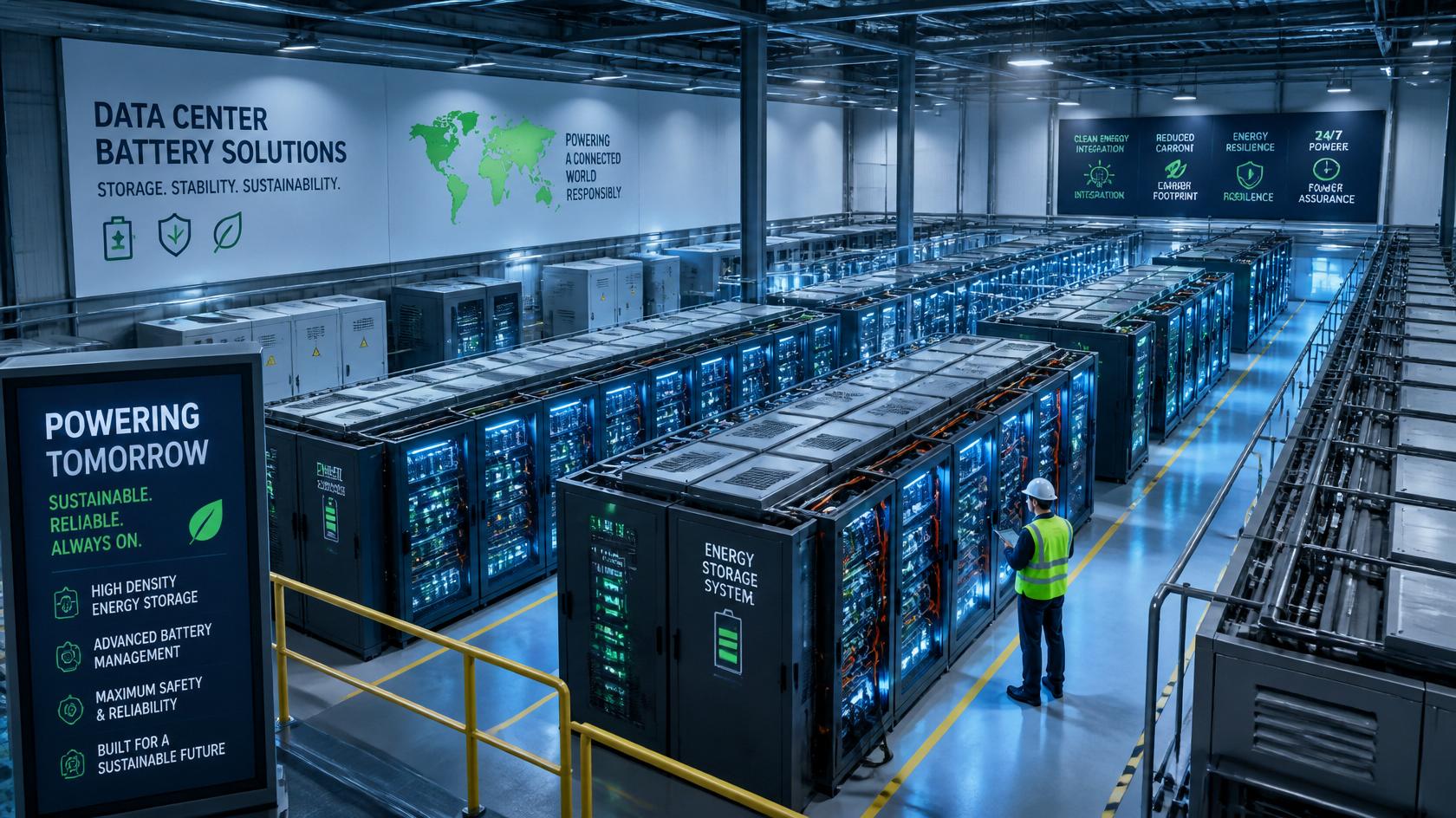
AI Workloads Have Changed Data Center Power Requirements
Traditional enterprise data centers were designed around relatively predictable workloads. AI infrastructure is entirely different.
Training and inference clusters powered by thousands of GPUs create:
- Extremely high rack power densities
- Rapid power fluctuations
- Higher peak electricity demand
- Increased sensitivity to power quality
- Zero tolerance for downtime
Unlike conventional computing, even millisecond-scale power interruptions can disrupt expensive AI training jobs worth hundreds of thousands of dollars.
Consequently, modern battery systems must now deliver:
- Instantaneous power response
- Higher discharge capability
- Improved thermal management
- Longer operational life
- Intelligent monitoring and predictive maintenance
This evolution is pushing operators away from viewing batteries solely as emergency backup systems toward treating them as active components of facility energy management.
Hyperscale AI Facilities Are Increasing Investment in Battery Infrastructure
The world’s largest technology companies are building AI campuses measured in gigawatts rather than megawatts.
Each new hyperscale facility requires multiple layers of electrical resilience including:
- UPS battery systems
- Battery Energy Storage Systems (BESS)
- Grid-interactive storage
- Renewable energy integration
- Microgrid capabilities
Battery systems now serve several simultaneous purposes:
| Traditional Function | Emerging AI Function |
|---|---|
| Backup power | Dynamic load balancing |
| UPS support | Peak shaving |
| Emergency runtime | Renewable integration |
| Generator bridging | Grid stabilization |
| Power continuity | AI workload optimization |
This shift substantially increases battery capacity deployed per facility compared with previous generations of data centers.
AI Is Driving Record Growth in Data Center Electricity Demand
The International Energy Agency projects that global electricity consumption by data centers will nearly double by 2030, reaching approximately 945 TWh, with AI acting as the primary growth driver. Data center electricity demand is expected to grow far faster than overall electricity consumption across the global economy.
Several market forces are converging:
- AI model training continues to become more computationally intensive.
- Enterprise AI adoption is accelerating globally.
- Sovereign AI infrastructure investments are increasing.
- Edge AI deployments require distributed data centers.
- Cloud providers continue expanding hyperscale capacity.
Every one of these trends increases demand for reliable battery infrastructure.
Batteries Are Becoming Active Energy Assets
Perhaps the biggest transformation is that batteries are no longer passive insurance policies.
Modern AI facilities increasingly deploy Battery Energy Storage Systems (BESS) capable of:
- Energy arbitrage
- Frequency regulation
- Demand response participation
- Peak demand reduction
- Renewable energy smoothing
- Grid resilience support
Rather than waiting for outages, battery assets now generate operational and financial value every day.
This transition significantly improves return on investment while reducing total energy costs.
Lithium-Ion Dominates—but Alternative Chemistries Are Emerging
Lithium-ion batteries remain the preferred technology because of their:
- High energy density
- Fast response times
- Reduced footprint
- Lower maintenance
- Longer cycle life
However, AI data centers are also evaluating:
- Sodium-ion batteries
- Nickel-zinc batteries
- Flow batteries
- Solid-state batteries
Selection increasingly depends on operating profile, safety requirements, sustainability objectives, lifecycle cost, and facility design.
Sustainability Goals Are Reshaping Battery Procurement
The AI boom has intensified scrutiny over electricity consumption and carbon emissions. Major technology companies are balancing rapid AI expansion with commitments to renewable energy, lower emissions, and improved resource efficiency, making power resilience and sustainability central to infrastructure planning.
Battery systems contribute to sustainability by enabling:
- Greater renewable energy utilization
- Reduced diesel generator dependence
- Improved energy efficiency
- Carbon-aware power management
- Microgrid deployment
These capabilities help operators meet ESG targets while maintaining uninterrupted AI services.
Digital Battery Intelligence Is Becoming Standard
Artificial intelligence is also improving battery management itself.
Next-generation Battery Management Systems (BMS) now incorporate:
- Predictive failure analytics
- Real-time thermal monitoring
- Cell balancing optimization
- Remaining useful life prediction
- Remote diagnostics
- AI-assisted maintenance scheduling
These capabilities reduce downtime, extend battery lifespan, and lower operating costs.
Regional Investment Trends
North America
North America continues leading global investment as hyperscale cloud providers rapidly expand AI infrastructure while utilities modernize transmission and power delivery systems.
Europe
Growing AI sovereignty initiatives and sustainability regulations are increasing investments in resilient battery-backed data centers.
Asia Pacific
China, India, Japan, Singapore, and South Korea continue expanding hyperscale capacity to support AI manufacturing, cloud computing, semiconductor ecosystems, and digital transformation.
Middle East
Government-backed AI strategies and smart city programs are accelerating investments in high-availability data center infrastructure supported by advanced battery technologies.
Market Opportunities Across the Value Chain
The transformation creates opportunities for:
- Battery manufacturers
- UPS suppliers
- Battery Management System providers
- Energy storage integrators
- Thermal management companies
- Power electronics manufacturers
- Microgrid developers
- Digital monitoring software vendors
- Renewable energy developers
- Grid infrastructure companies
Organizations capable of delivering integrated power resilience solutions are expected to benefit the most as AI infrastructure scales worldwide.
Outlook: The Future of the Data Center Battery Market
The next generation of AI infrastructure will require power systems that are not only larger but also more intelligent, resilient, and sustainable. As GPU clusters become denser and electricity demand continues to rise, batteries will evolve from backup assets into core infrastructure supporting continuous, high-performance computing.
Emerging concepts such as grid-interactive AI data centers, software-managed power flexibility, and facility-level energy storage point toward a future where batteries help optimize both computing performance and grid stability.
For technology vendors, utilities, infrastructure investors, and enterprise operators, the Data Center Battery Market represents one of the most strategically important segments within the broader AI infrastructure ecosystem.
Artificial intelligence is transforming the economics of data center design, making resilient power infrastructure a strategic necessity rather than a supporting function. Battery technologies are now central to ensuring uptime, enabling renewable integration, managing power quality, and supporting increasingly energy-intensive AI workloads. As hyperscale investments accelerate and grid constraints intensify, demand for advanced battery solutions will continue to rise, creating substantial opportunities across the global Data Center Battery Market. Organizations that understand these evolving power requirements will be best positioned to capitalize on one of the fastest-growing infrastructure markets of the AI era.
For more info: https://www.marketsandmarkets.com/Market-Reports/data-center-battery-market-254269420.html
