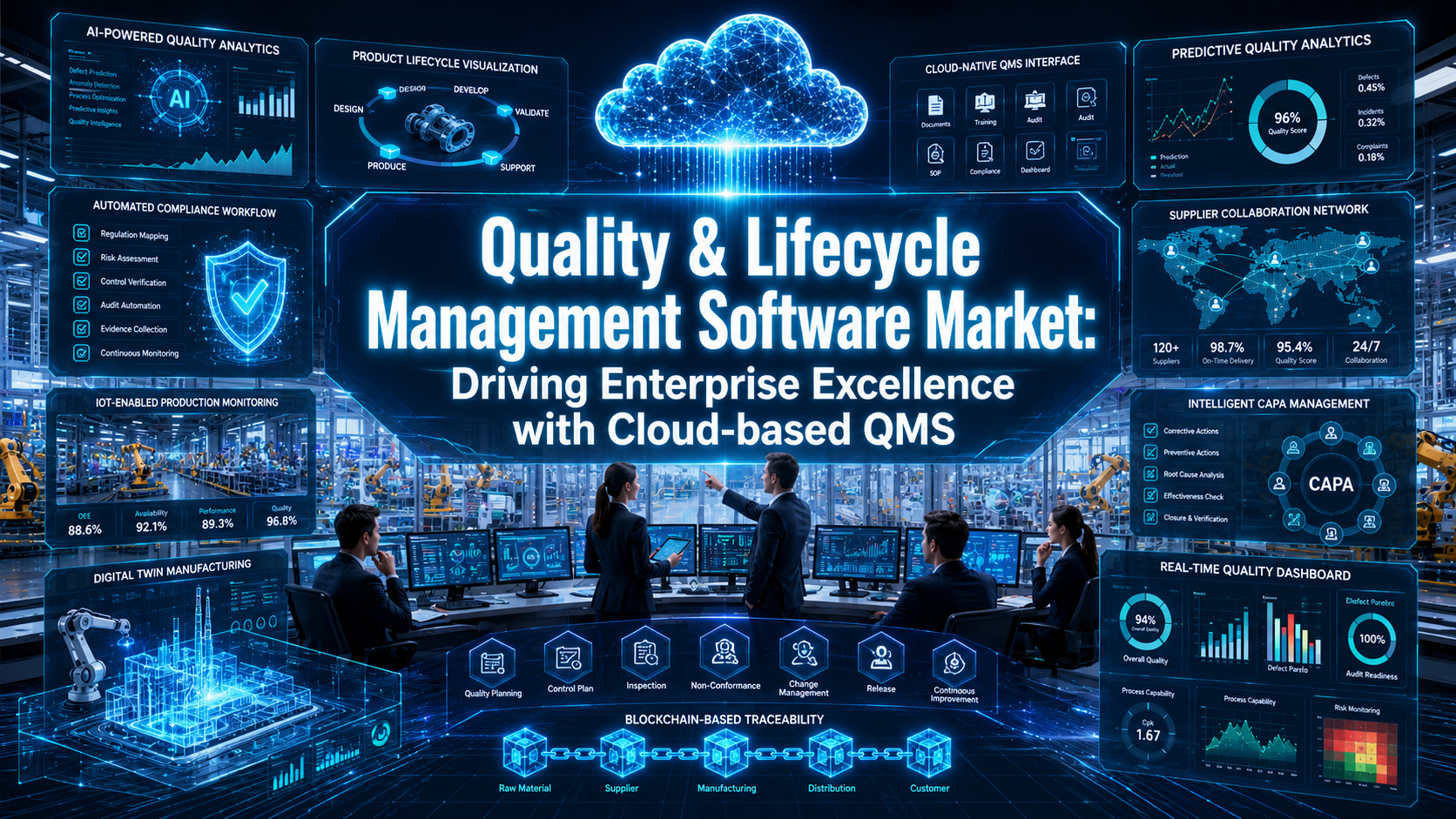
The market for quality and lifecycle management software is becoming one of the most significant areas of technology, assisting businesses in modernizing quality control, enhancing customer satisfaction, accelerating product innovation, and improving regulatory compliance. Traditional quality assurance is being transformed into a strategic business capability that promotes operational excellence and sustainable growth as more companies use cloud-based QMS.
Product quality, regulatory compliance, digital manufacturing, and customer experience all have a direct impact on corporate performance in today’s fiercely competitive industries. Organizations may automate quality procedures, centralize documentation, enhance teamwork, and obtain real-time visibility into quality performance across international operations with cloud-based QMS.
The quick development of the market for quality and lifecycle management software shows that quality management is now a competitive advantage that enables businesses to innovate more quickly, lower operational risks, and consistently produce business value.
Why Cloud-based QMS Has Become a Strategic Enterprise Investment
The way businesses create, produce, market, and support goods has been drastically altered by the digital economy. Businesses now have to handle worldwide manufacturing operations, increasingly complicated supply chains, changing legal constraints, and growing customer demands.
Traditional quality management systems often struggle to support these dynamic business environments because they rely heavily on manual documentation, disconnected processes, and limited visibility.
Cloud-based QMS addresses these challenges by providing a centralized, intelligent, and scalable platform for managing quality throughout the product lifecycle.
Key Drivers Behind Enterprise Adoption
- Digital transformation initiatives
- Increasing regulatory requirements
- Global supplier collaboration
- Product lifecycle complexity
- Industry 4.0 adoption
- AI-powered manufacturing
- Customer-centric quality management
- ESG reporting requirements
- Operational efficiency goals
- Continuous improvement programs
Organizations implementing Cloud-based QMS are achieving faster quality decisions, improved compliance, reduced operational costs, and stronger collaboration across departments.
Industry leaders are acting on these insights Download the PDF and access exclusive business opportunities revealed by market research.
Understanding the Strategic Rise of the Quality & Lifecycle Management Software Market
The market for quality and lifecycle management software has advanced much beyond conventional quality documentation. Quality management, product lifecycle management, supplier cooperation, compliance, engineering change management, and corporate analytics are all integrated into a single digital ecosystem by modern systems.
Leading enterprises are investing in intelligent quality platforms that combine automation, artificial intelligence, cloud computing, predictive analytics, and real-time reporting to improve business performance.
These integrated solutions help organizations:
Improve Product Quality
Digital quality workflows increase customer happiness, decrease errors, and improve consistency.
Accelerate Product Innovation
Engineering, manufacturing, quality, and suppliers may collaborate throughout product development thanks to cloud computing.
Strengthen Regulatory Compliance
Digital paperwork, automated audit trails, and compliance workflows make it easier to follow industry rules.
Reduce Business Risk
Real-time quality intelligence finds possible problems before they affect clients or output.
Enhance Executive Decision-Making
Leadership teams can take action by using advanced analytics to understand operational risks, supplier efficacy, quality performance, and business prospects.
Don’t miss out on this opportunity for business growth grab your Sample Report today.
Latest Technology Trends Driving Intelligent Quality Management
The Quality & Lifecycle Management Software Market is expanding faster thanks to a number of innovative technologies that are changing enterprise quality strategies.
AI-Powered Quality Intelligence
In order to anticipate flaws, spot irregularities, automate inspections, and suggest remedial measures before issues worsen, artificial intelligence evaluates quality data.
Quality 4.0
AI, IoT, cloud computing, robotics, analytics, and digital manufacturing are all integrated into Quality 4.0, a networked quality ecosystem that continuously boosts business performance.
Cloud-Native Quality Platforms
Compared to conventional on-premises systems, cloud-based designs offer scalability, remote collaboration, automatic upgrades, enhanced security, and reduced infrastructure expenses.
Predictive Quality Analytics
Instead of relying on reactive problem-solving, machine learning enables proactive quality management, detects trends, and forecasts product failures.
Intelligent CAPA Automation
Automation of Corrective and Preventive Action (CAPA) procedures allows businesses to improve regulatory compliance while resolving quality issues more quickly.
Digital Supplier Quality Management
Cloud systems lower supply chain risks, monitor quality performance, automate supplier audits, and enhance supplier collaboration.
Mobile Quality Applications
By using mobile devices to directly record inspections, non-conformances, pictures, approvals, and corrective actions, quality inspectors can increase operational efficiency and responsiveness.
ESG and Sustainability Integration
In order to support ethical manufacturing and sustainable business practices, contemporary QMS platforms integrate environmental, social, and governance measurements into enterprise quality strategies.
Why Traditional Quality Management Systems Can No Longer Meet Enterprise Expectations
When quality processes were mostly paper-based, isolated, and unrelated to larger corporate operations, legacy quality management systems were created. These systems frequently lead to inefficiencies in today’s digital businesses, which impede organizational agility, raise compliance concerns, and inhibit innovation.
It is challenging to maintain uniform quality standards across international operations since traditional methods usually rely on manual record-keeping, separate departmental workflows, and delayed reporting.
Cloud-based QMS overcomes these limitations by enabling:
- Real-time quality monitoring
- Automated compliance workflows
- Centralized document management
- AI-assisted decision-making
- End-to-end product lifecycle visibility
- Seamless collaboration across teams and suppliers
- Faster corrective and preventive actions (CAPA)
- Scalable support for global manufacturing and distributed workforces
By replacing fragmented processes with intelligent, cloud-native platforms, enterprises can improve operational efficiency, strengthen customer trust, and accelerate innovation.
Cloud-based QMS and Lifecycle Management: The Enterprise Strategy for Sustainable Growth
Quality management is evolving from a compliance function to a strategic business capability because to the convergence of cloud-based QMS and the market for quality and lifecycle management software. Quality is no longer seen as the domain of a single department in modern businesses. Rather, quality has evolved into an enterprise-wide endeavor that impacts long-term profitability, operational excellence, customer satisfaction, product innovation, and regulatory compliance.
Product Lifecycle Management (PLM), Enterprise Resource Planning (ERP), Manufacturing Execution Systems (MES), Customer Relationship Management (CRM), and Industrial Internet of Things (IIoT) platforms are all easily integrated with cloud-native quality management systems. Organizations can monitor quality at every stage of the product lifecycle—from concept and design to manufacturing, distribution, after-sales service, and continuous improvement—thanks to this cohesive ecosystem.
Enterprise Advantages of an Integrated Cloud-based QMS
- Centralized quality management across global operations
- Faster collaboration among engineering, manufacturing, suppliers, and quality teams
- Real-time quality intelligence through AI-driven analytics
- Automated compliance management for international standards
- Improved product traceability and lifecycle visibility
- Accelerated corrective and preventive actions (CAPA)
- Reduced operational costs through process automation
- Continuous improvement supported by actionable insights
Organizations adopting integrated quality and lifecycle management strategies are better positioned to innovate rapidly while maintaining consistent quality standards and regulatory compliance.
Enterprise Applications of the Quality & Lifecycle Management Software Market
Manufacturing
Manufacturers use cloud-based QMS to manage engineering changes, track supplier performance, maximize production quality, and lower product defects.
Business Benefits
- Improved production efficiency
- Reduced scrap and rework
- Predictive quality management
- Enhanced supplier collaboration
- Faster product launches
Healthcare and Life Sciences
Quality management platforms are used by pharmaceutical businesses and healthcare organizations to manage paperwork, maintain regulatory compliance, and enhance patient safety.
Business Benefits
- Automated regulatory reporting
- Electronic document control
- Improved product quality
- Faster audit readiness
- Better patient safety
Automotive
Lifecycle management software is used by automakers to handle engineering validation, supplier quality, product development, and adherence to industry standards.
Business Benefits
- Better product traceability
- Faster engineering change management
- Improved supplier performance
- Reduced warranty claims
- Increased manufacturing quality
Aerospace and Defense
Advanced quality systems are necessary for highly regulated businesses to maintain certification, paperwork, and ongoing compliance.
Business Benefits
- Digital audit management
- Compliance automation
- Enhanced product reliability
- Lifecycle documentation
- Reduced operational risks
Electronics and Semiconductor
Cloud quality platforms are used by technology manufacturers to increase production uniformity, lower error rates, and speed up innovation cycles.
Business Benefits
- Higher manufacturing yield
- Intelligent quality analytics
- Supplier quality monitoring
- Rapid defect analysis
- Improved customer satisfaction
Consumer Goods
Quality is managed by consumer product firms during product creation, production, packaging, distribution, and post-market monitoring.
Business Benefits
- Consistent product quality
- Faster market launches
- Brand protection
- Improved customer loyalty
- Lower recall risks
Business Benefits Every Enterprise Leader Should Understand
The Management of Quality and Lifecycle Beyond compliance, the software market offers quantifiable commercial benefit.
Operational Benefits
- Automated quality workflows
- Real-time performance dashboards
- Digital quality documentation
- Intelligent audit management
- Continuous process improvement
Financial Benefits
- Reduced quality costs
- Lower warranty expenses
- Fewer product recalls
- Better operational efficiency
- Higher return on technology investments
Strategic Benefits
- Accelerated innovation
- Improved customer trust
- Enhanced brand reputation
- Better executive decision-making
- Sustainable competitive advantage
By embedding Cloud-based QMS into enterprise operations, organizations can transform quality into a driver of business performance rather than a reactive control process.
Quality & Lifecycle Management Software Market Share, Size, Analysis, Trends, Outlook, Report, Growth, and Forecast
Quality & Lifecycle Management Software Market Share
The Management of Quality and Lifecycle Vendors providing cloud-native deployment, advanced analytics, integrated PLM capabilities, AI-enabled quality management, and industry-specific compliance solutions have a growing impact on software market share. Platforms that offer scalability, interoperability, and robust ecosystem integration are preferred by organizations.
Quality & Lifecycle Management Software Market Size
As businesses invest in cloud infrastructure, Industry 4.0 projects, digital quality transformation, and intelligent automation to boost operational resilience and customer happiness, the market for quality and lifecycle management software keeps growing.
Quality & Lifecycle Management Software Market Analysis
All-inclusive Quality and Lifecycle Management Growing regulatory requirements, intricate global supply chains, rising product complexity, and the need for real-time quality insights are all driving business adoption, according to software market data. Cloud computing, AI, and predictive analytics are changing how businesses handle quality across the product lifecycle.
Quality & Lifecycle Management Software Market Trends
The most influential Quality & Lifecycle Management Software Market trends include:
- AI-powered quality intelligence
- Quality 4.0 adoption
- Cloud-native eQMS platforms
- Predictive quality analytics
- Automated CAPA management
- Connected supplier quality ecosystems
- Low-code quality workflow automation
- Mobile-first quality inspections
- Digital twin-enabled quality assurance
- ESG and sustainability integration
These trends are helping enterprises modernize quality operations while improving agility and compliance.
Quality & Lifecycle Management Software Market Outlook
As businesses prioritize digital transformation, cloud adoption, AI-driven decision-making, and integrated lifecycle management, the outlook for the quality and lifecycle management software market is still very positive. Businesses are starting to see quality as a strategic differentiator that fosters innovation, resilience, and customer loyalty.
Quality & Lifecycle Management Software Market Report
A thorough approach to quality and lifecycle management Decision-makers can assess technological advancements, vendor capabilities, competitive positioning, investment prospects, customer adoption trends, and future growth strategies with the help of software market reports.
Quality & Lifecycle Management Software Market Growth
Long-Term Quality and Lifecycle Management Growth in the software market is anticipated as businesses continue to invest in intelligent quality systems that lower risk, automate compliance, foster better teamwork, and boost operational effectiveness in international business settings.
Quality & Lifecycle Management Software Market Forecast
The Management of Quality and Lifecycle The software market forecast indicates that enterprises will continue to invest in sophisticated analytics, automation technologies, integrated PLM systems, and AI-enabled cloud-based QMS. Companies who implement these improvements will be in a better position to retain long-term competitiveness, boost innovation, and enhance product quality.
For businesses looking to modernize quality management and achieve sustainable growth, cloud-based QMS has emerged as a key technology. Digital quality platforms give businesses the insight, agility, and intelligence they need to be competitive as they manage more complicated regulatory environments, global supply chains, and quickly shifting customer demands.
Compliance software is no longer the only factor defining the Quality & Lifecycle Management Software Market. It currently stands for a strategic ecosystem that unifies quality, automation, analytics, product lifecycle management, and teamwork into a single enterprise platform. Businesses may lower operational risk, boost customer satisfaction, spur innovation, and improve their market position by utilizing these skills.
