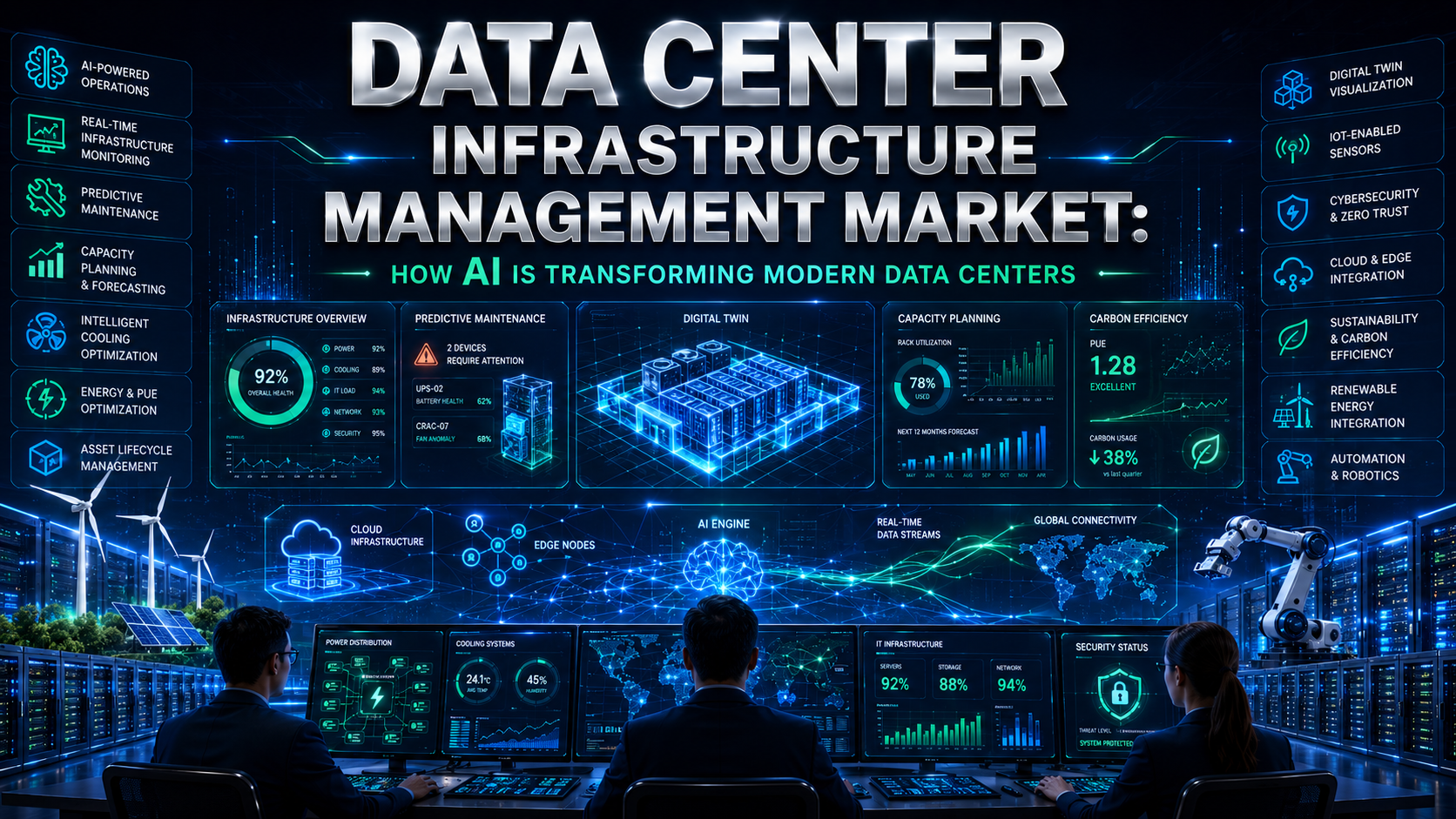
Artificial Intelligence (AI) is fundamentally redefining the future of enterprise IT infrastructure, with its most transformative impact being witnessed across the Data Center Infrastructure Management Market. As organizations continue accelerating investments in cloud computing, AI-driven workloads, edge computing, high-performance computing (HPC), and hybrid IT environments, data centers are evolving beyond traditional facilities into highly intelligent, autonomous ecosystems capable of optimizing performance, resilience, operational efficiency, and sustainability.
Historically, data center operations relied on manual monitoring, periodic maintenance, isolated management tools, and reactive troubleshooting. These conventional approaches often resulted in inefficient resource utilization, unexpected downtime, increasing operational costs, and limited infrastructure visibility.
Today, AI-powered Data Center Infrastructure Management (DCIM) platforms have transformed this operating model. By integrating machine learning, Internet of Things (IoT) sensors, digital twin technology, predictive analytics, intelligent automation, and real-time monitoring, modern DCIM solutions deliver end-to-end visibility across every layer of data center infrastructure—from power distribution and cooling systems to servers, storage, networking, environmental controls, and rack capacity.
As hyperscale cloud providers, colocation operators, financial institutions, healthcare organizations, telecommunications companies, manufacturing enterprises, and government agencies modernize their digital infrastructure, Data Center Infrastructure Management Market growth continues to accelerate worldwide. Intelligent DCIM solutions have become strategic business investments that help organizations reduce operational expenditures, improve infrastructure uptime, maximize energy efficiency, strengthen sustainability initiatives, and support increasingly demanding AI applications.
Rather than functioning solely as infrastructure monitoring tools, modern DCIM platforms have evolved into enterprise intelligence platforms that provide predictive insights, automate operational workflows, and enable data-driven decision-making across increasingly complex IT environments.
Understanding the Data Center Infrastructure Management Market
The Data Center Infrastructure Management Market encompasses a comprehensive ecosystem of software platforms, analytics solutions, automation technologies, and professional services designed to monitor, manage, optimize, and secure both physical and virtual data center assets.
Unlike traditional infrastructure management systems, next-generation DCIM platforms integrate operational technology (OT) with information technology (IT), enabling organizations to manage every component of the data center through a centralized intelligence platform.
Modern DCIM platforms typically include capabilities such as:
- AI-powered operational analytics
- Real-time infrastructure monitoring
- Predictive maintenance
- Intelligent asset lifecycle management
- Capacity planning and forecasting
- Power and cooling optimization
- Environmental monitoring
- Rack utilization analysis
- Network topology visualization
- Digital twin simulation
- Energy consumption analytics
- Carbon footprint monitoring
- Automated incident response
- Enterprise reporting dashboards
By consolidating these capabilities into a unified management platform, organizations gain complete operational visibility across critical infrastructure while significantly reducing operational complexity and business risk.
The growing adoption of AI-enabled infrastructure management continues shaping the latest Data Center Infrastructure Management Market trends, particularly among enterprises operating mission-critical digital infrastructure that requires maximum availability and operational resilience.
Market research indicates strong trends Download the PDF to uncover business insights.
Why Artificial Intelligence Is Revolutionizing Modern Data Centers
Modern data centers generate enormous volumes of operational data every second.
Servers continuously produce hardware telemetry.
Cooling systems monitor thermal performance.
UPS systems report battery health.
Power distribution units measure electrical consumption.
Environmental sensors capture humidity, airflow, vibration, and temperature.
Networking equipment generates traffic analytics.
Storage systems monitor capacity utilization.
Without Artificial Intelligence, much of this operational data remains underutilized.
AI transforms these massive datasets into actionable business intelligence by continuously analyzing millions of operational variables simultaneously.
Instead of reacting to failures after they occur, AI enables organizations to predict, prevent, and optimize infrastructure performance before operational issues impact business continuity.
Key AI capabilities include:
Intelligent Infrastructure Monitoring
Machine learning continuously evaluates infrastructure performance, automatically identifying abnormal operating conditions that may indicate developing equipment failures.
Unlike traditional monitoring systems that rely on static thresholds, AI adapts dynamically to changing operational conditions, significantly reducing false alerts while improving detection accuracy.
Predictive Failure Detection
Rather than waiting for hardware to fail, AI analyzes historical operating patterns, equipment behavior, maintenance history, environmental conditions, and workload characteristics to identify components likely to experience future failures.
This enables maintenance teams to schedule repairs during planned maintenance windows instead of responding to unexpected outages.
Predictive maintenance dramatically improves equipment reliability while lowering maintenance costs.
Automated Incident Response
Artificial Intelligence enables DCIM platforms to automatically execute predefined remediation workflows when infrastructure anomalies are detected.
Examples include:
- Redistributing workloads
- Activating backup cooling systems
- Rebalancing electrical loads
- Generating maintenance tickets
- Notifying engineering teams
- Isolating failing infrastructure
Automation significantly reduces mean time to detection (MTTD) and mean time to resolution (MTTR).
Intelligent Capacity Planning
AI continuously analyzes historical infrastructure utilization to forecast future requirements for:
- Compute resources
- Storage capacity
- Network bandwidth
- Rack availability
- Power consumption
- Cooling requirements
This enables organizations to optimize capital investments while avoiding both underutilized infrastructure and capacity shortages.
Dynamic Workload Optimization
Machine learning automatically places workloads based on:
- Server utilization
- Thermal conditions
- Power availability
- Business priorities
- Energy costs
- Cooling efficiency
The result is improved infrastructure performance while minimizing operational expenses.
Intelligent Energy Management
Energy remains one of the largest operating expenses for modern data centers.
AI continuously optimizes energy utilization by analyzing:
- Cooling efficiency
- Power consumption
- Environmental conditions
- Equipment utilization
- Renewable energy availability
- Electricity pricing
This intelligent optimization significantly lowers energy costs while supporting enterprise sustainability initiatives.
By continuously learning from operational data, Artificial Intelligence enables organizations to move beyond reactive infrastructure management toward autonomous, predictive, and self-optimizing data center operations.
This transformation is becoming one of the strongest drivers behind the expanding Data Center Infrastructure Management Market size, as enterprises increasingly recognize AI-enabled DCIM as a strategic capability for achieving operational excellence, business continuity, and long-term digital resilience.
This Sample Report is designed to fuel your business growth—download it today.
Key AI Applications in the Data Center Infrastructure Management Market
Artificial Intelligence is transforming Data Center Infrastructure Management from a passive monitoring solution into an intelligent operational platform capable of predicting failures, optimizing resources, automating workflows, and continuously improving infrastructure performance. Modern AI-powered DCIM solutions help organizations maximize operational efficiency while supporting increasingly complex digital workloads.
Predictive Maintenance
Predictive maintenance has emerged as one of the most valuable AI applications within the Data Center Infrastructure Management Market. Instead of relying on scheduled maintenance or reacting after equipment failures occur, AI continuously evaluates infrastructure health using real-time operational data.
Machine learning algorithms monitor the performance of:
- Uninterruptible Power Supply (UPS) systems
- Cooling and HVAC equipment
- Backup generators
- Power Distribution Units (PDUs)
- Server hardware
- Network switches and routers
- Storage infrastructure
- Battery systems
- Environmental sensors
AI detects subtle operational anomalies—including abnormal temperature fluctuations, increased vibration, power irregularities, airflow inconsistencies, and equipment degradation—that often precede component failures.
By identifying these warning signs weeks or even months in advance, organizations can schedule maintenance proactively, minimize downtime, extend equipment life cycles, reduce emergency repair costs, and significantly improve infrastructure availability.
Intelligent Capacity Planning
Capacity planning has become increasingly challenging as enterprises deploy AI applications, hybrid cloud environments, edge computing infrastructure, and high-density workloads.
Traditional planning methods often rely on historical utilization reports that quickly become outdated.
AI-powered DCIM platforms provide continuous capacity forecasting by analyzing:
- CPU utilization
- GPU consumption
- Storage growth
- Memory utilization
- Rack availability
- Network bandwidth
- Power demand
- Cooling capacity
- Business expansion forecasts
Using predictive analytics, AI recommends infrastructure upgrades before resource constraints affect business operations.
This intelligent planning enables organizations to:
- Improve capital allocation
- Delay unnecessary hardware purchases
- Maximize existing infrastructure investments
- Prevent over-provisioning
- Eliminate capacity shortages
- Support long-term business growth
As enterprises continue expanding AI infrastructure, intelligent capacity management remains one of the fastest-growing segments within the Data Center Infrastructure Management Market analysis.
Power Optimization
Power consumption represents one of the largest operational expenses for enterprise and hyperscale data centers.
AI-powered DCIM solutions continuously optimize electrical infrastructure through intelligent monitoring and automated control.
Modern systems analyze:
- Power utilization effectiveness (PUE)
- Equipment efficiency
- Load balancing
- Generator performance
- UPS utilization
- Renewable energy availability
- Utility pricing
- Peak demand patterns
Based on this analysis, AI dynamically redistributes workloads and adjusts power utilization to maximize efficiency while maintaining operational resilience.
Organizations benefit from:
- Reduced electricity costs
- Improved energy utilization
- Better infrastructure reliability
- Extended equipment lifespan
- Lower carbon emissions
These improvements directly contribute to both operational excellence and enterprise sustainability objectives.
Cooling Optimization
Cooling infrastructure accounts for a significant percentage of overall data center energy consumption.
Artificial Intelligence continuously monitors environmental conditions throughout the facility by analyzing:
- Temperature distribution
- Airflow patterns
- Rack density
- Server utilization
- Humidity levels
- Cooling equipment performance
AI dynamically adjusts cooling operations in real time to ensure optimal thermal performance without excessive energy consumption.
Intelligent cooling systems can automatically:
- Increase airflow to high-density racks
- Reduce unnecessary cooling
- Optimize fan speeds
- Balance thermal loads
- Predict cooling failures
- Improve HVAC efficiency
The result is lower operating costs, improved equipment reliability, and greater energy efficiency.
Digital Twins: Building Intelligent Data Centers
Digital twin technology has become one of the most transformative innovations within the Data Center Infrastructure Management Market.
A digital twin is a dynamic virtual representation of an organization’s physical data center that continuously synchronizes with live operational data.
Unlike static infrastructure diagrams, digital twins provide real-time simulation capabilities that enable organizations to visualize, analyze, and optimize every aspect of data center operations.
Using digital twins, organizations can:
- Simulate infrastructure upgrades before implementation
- Evaluate new rack layouts
- Model power distribution changes
- Optimize cooling strategies
- Test disaster recovery scenarios
- Predict equipment failures
- Analyze infrastructure dependencies
- Validate capacity expansion plans
Digital twins significantly reduce operational risk while improving planning accuracy and accelerating decision-making.
As AI and simulation technologies continue advancing, digital twins are expected to become foundational capabilities for autonomous data center management.
Driving Sustainability Through AI
Sustainability has evolved from a regulatory requirement into a strategic business objective.
Enterprise leaders increasingly view energy efficiency, carbon reduction, and ESG performance as competitive advantages.
AI-powered DCIM platforms enable organizations to achieve sustainability goals without compromising operational performance.
Power Usage Effectiveness (PUE) Optimization
AI continuously analyzes power utilization across the entire facility to reduce wasted energy and improve infrastructure efficiency.
Real-time optimization enables operators to achieve lower PUE values while maintaining system reliability.
Renewable Energy Integration
Organizations increasingly operate facilities powered by solar, wind, hydroelectric, and other renewable energy sources.
AI intelligently schedules workloads based on renewable energy availability while minimizing dependence on traditional power generation.
This improves sustainability while reducing operational costs.
Carbon Emissions Monitoring
Modern DCIM platforms provide executive dashboards that continuously measure:
- Carbon emissions
- Energy consumption
- Sustainability KPIs
- ESG metrics
- Environmental compliance
Automated reporting simplifies sustainability reporting for investors, regulators, and corporate stakeholders.
Infrastructure Resource Optimization
Artificial Intelligence maximizes utilization across servers, storage, networking equipment, cooling systems, and electrical infrastructure.
Improved resource efficiency reduces unnecessary hardware deployments while lowering environmental impact.
These sustainability initiatives continue expanding the Data Center Infrastructure Management Market share, particularly among organizations pursuing carbon neutrality and environmentally responsible digital transformation strategies.
Business Benefits of AI-Powered DCIM
Organizations implementing intelligent Data Center Infrastructure Management solutions realize measurable business outcomes that extend far beyond infrastructure monitoring.
Higher Infrastructure Availability
Predictive analytics significantly reduce unplanned outages by identifying infrastructure issues before they impact production environments.
Higher uptime directly improves customer satisfaction and business continuity.
Reduced Operational Costs
Automation minimizes manual monitoring, maintenance activities, and repetitive operational tasks.
Organizations benefit from:
- Lower labor costs
- Reduced maintenance expenses
- Lower energy consumption
- Improved operational efficiency
Improved Capacity Utilization
AI helps organizations maximize utilization of existing infrastructure before investing in additional hardware.
Better utilization improves return on capital investments while delaying unnecessary expansion projects.
Faster Executive Decision-Making
Interactive dashboards provide real-time operational intelligence that enables executives to make informed infrastructure decisions based on accurate performance data rather than historical reports.
Enhanced Regulatory Compliance
Automated reporting simplifies compliance with industry regulations and internal governance requirements by providing comprehensive infrastructure visibility and audit trails.
Superior Customer Experience
Reliable, high-performing infrastructure supports uninterrupted digital services, enabling organizations to deliver consistent user experiences while protecting business reputation.
Collectively, these measurable business outcomes continue driving strong Data Center Infrastructure Management Market growth across cloud providers, financial institutions, healthcare organizations, telecommunications companies, manufacturing enterprises, and government agencies.
Emerging Technology Trends Reshaping the Data Center Infrastructure Management Market
The rapid evolution of enterprise IT infrastructure is accelerating innovation across the Data Center Infrastructure Management Market. As organizations increasingly adopt AI-driven applications, distributed computing, and sustainable infrastructure strategies, several next-generation technologies are redefining how modern data centers are managed and optimized.
Artificial Intelligence and Autonomous Operations
Artificial Intelligence is becoming the operational intelligence layer of modern DCIM platforms. Advanced machine learning models continuously evaluate infrastructure performance, detect anomalies, recommend corrective actions, and automate operational workflows without requiring manual intervention.
Autonomous operations reduce administrative overhead while enabling IT teams to focus on strategic initiatives rather than repetitive monitoring tasks.
Machine Learning for Predictive Intelligence
Machine learning continuously improves prediction accuracy by analyzing historical infrastructure behavior alongside real-time operational telemetry.
These predictive capabilities enable organizations to:
- Anticipate infrastructure failures
- Optimize maintenance schedules
- Improve asset utilization
- Reduce operational risk
- Enhance infrastructure reliability
As AI models mature, predictive analytics will become increasingly accurate and business-critical.
Edge Computing
The rapid expansion of edge computing is creating thousands of distributed micro data centers closer to users and connected devices.
Unlike centralized facilities, edge environments require centralized visibility across geographically dispersed infrastructure.
Modern AI-powered DCIM platforms provide unified monitoring for:
- Edge facilities
- Regional data centers
- Cloud environments
- Hybrid infrastructure
- Multi-site enterprise deployments
This centralized visibility enables organizations to maintain operational consistency across increasingly complex digital ecosystems.
Internet of Things (IoT)
IoT-enabled sensors continuously monitor every aspect of physical infrastructure.
Connected devices collect information including:
- Temperature
- Humidity
- Air pressure
- Airflow
- Vibration
- Power utilization
- Equipment health
- Water leakage
- Physical security
Artificial Intelligence transforms this sensor data into operational intelligence, enabling real-time infrastructure optimization.
Digital Twin Technology
Digital twins continue evolving beyond infrastructure visualization into intelligent operational simulation platforms.
Future digital twins will support:
- Autonomous optimization
- AI-driven scenario modeling
- Capacity forecasting
- Energy simulation
- Disaster recovery validation
- Predictive infrastructure planning
These capabilities significantly improve strategic planning while reducing deployment risk.
Cloud-Native DCIM
Cloud-based DCIM solutions provide enterprises with greater scalability, centralized management, and simplified software deployment.
Cloud-native platforms enable organizations to:
- Monitor multiple global facilities
- Reduce infrastructure complexity
- Improve disaster recovery
- Accelerate software updates
- Support remote infrastructure management
As hybrid cloud adoption accelerates, cloud-native DCIM platforms will become the preferred deployment model for many enterprises.
Automation and Self-Healing Infrastructure
Automation is transforming data centers into intelligent environments capable of self-correction.
Future AI-powered systems will automatically:
- Restart failed services
- Reallocate workloads
- Adjust cooling systems
- Balance electrical loads
- Isolate failing equipment
- Schedule maintenance
- Notify engineering teams
These autonomous capabilities reduce downtime while improving operational resilience.
Collectively, these innovations continue strengthening the overall Data Center Infrastructure Management Market analysis, enabling enterprises to build intelligent, highly efficient, and future-ready digital infrastructure.
Implementation Challenges
Despite significant technological advancements, successful implementation of AI-powered DCIM requires careful planning, organizational alignment, and executive commitment.
Organizations commonly encounter several implementation challenges.
Legacy Infrastructure Integration
Many enterprises continue operating legacy hardware and software that were not designed to support modern AI-driven management platforms.
Integrating these environments requires phased modernization strategies that minimize operational disruption while maximizing long-term value.
Data Quality and Governance
Artificial Intelligence depends on accurate, consistent, and high-quality operational data.
Organizations must establish robust governance frameworks to ensure data accuracy, sensor reliability, and standardized operational processes.
Poor data quality directly impacts AI performance and predictive accuracy.
Multi-Vendor Interoperability
Modern data centers typically include equipment from numerous hardware and software vendors.
Ensuring interoperability across servers, networking equipment, cooling systems, power infrastructure, monitoring platforms, and cloud services remains a significant implementation consideration.
Open standards and API-driven integration are becoming increasingly important.
Cybersecurity Risks
As DCIM platforms become more connected, protecting management systems against cyber threats becomes essential.
Organizations should implement:
- Zero Trust Architecture
- Multi-Factor Authentication
- Identity and Access Management
- Network segmentation
- Continuous vulnerability assessments
- AI-powered threat detection
A secure DCIM platform protects both physical infrastructure and digital business operations.
Workforce Skills
Operating AI-enabled infrastructure requires professionals with expertise in:
- Artificial Intelligence
- Cloud computing
- Cybersecurity
- Data analytics
- Infrastructure automation
- Digital twin technology
Organizations should prioritize continuous workforce development to maximize technology investments.
Investment Considerations
Although AI-powered DCIM delivers substantial long-term returns, initial implementation requires investments in software, sensors, infrastructure modernization, integration services, and employee training.
A phased deployment strategy supported by executive leadership helps organizations realize measurable business value while controlling implementation costs.
Future Outlook
The future of enterprise infrastructure management will be increasingly intelligent, autonomous, and sustainability driven.
Artificial Intelligence will continue transforming every aspect of modern data center operations through predictive analytics, intelligent automation, and real-time optimization.
Future DCIM platforms are expected to support:
- Autonomous infrastructure management
- AI-driven workload orchestration
- Self-healing infrastructure
- Digital twin simulation
- Carbon-aware workload scheduling
- Intelligent edge infrastructure management
- Predictive sustainability optimization
- AI-assisted operational decision-making
- Autonomous energy optimization
- Enterprise-wide infrastructure intelligence
According to the evolving Data Center Infrastructure Management Market forecast, organizations will continue increasing investments in AI-powered automation, predictive analytics, intelligent monitoring, and sustainable infrastructure solutions to improve operational resilience while reducing total cost of ownership.
As enterprises expand cloud-native architectures, AI applications, hyperscale computing, and edge infrastructure, the Data Center Infrastructure Management Market outlook remains exceptionally positive.
Technology vendors, hyperscale cloud providers, colocation operators, enterprise IT organizations, telecommunications companies, and government agencies will continue investing in next-generation DCIM platforms capable of supporting increasingly complex digital ecosystems.
Consequently, every comprehensive Data Center Infrastructure Management Market report will play an increasingly important role in helping business leaders evaluate technology investments, benchmark competitive strategies, and identify emerging opportunities across the evolving infrastructure landscape.
Artificial Intelligence has fundamentally transformed the way organizations design, monitor, operate, and optimize modern data centers.
The Data Center Infrastructure Management Market has evolved far beyond traditional monitoring solutions into an intelligent operational ecosystem capable of predictive maintenance, autonomous infrastructure management, digital twin simulation, intelligent capacity planning, energy optimization, and sustainability reporting.
Organizations across cloud computing, telecommunications, banking, healthcare, manufacturing, retail, government, and colocation services are increasingly deploying AI-powered DCIM platforms to strengthen operational resilience, improve business continuity, reduce operational costs, enhance regulatory compliance, and accelerate digital transformation.
Looking ahead, the convergence of Artificial Intelligence, Machine Learning, IoT, digital twins, automation, cloud-native platforms, and sustainability initiatives will continue redefining enterprise infrastructure management. Organizations that invest in intelligent DCIM solutions today will be well positioned to build resilient, AI-ready, energy-efficient, and highly automated data centers capable of supporting future business growth and maintaining long-term competitive advantage.

