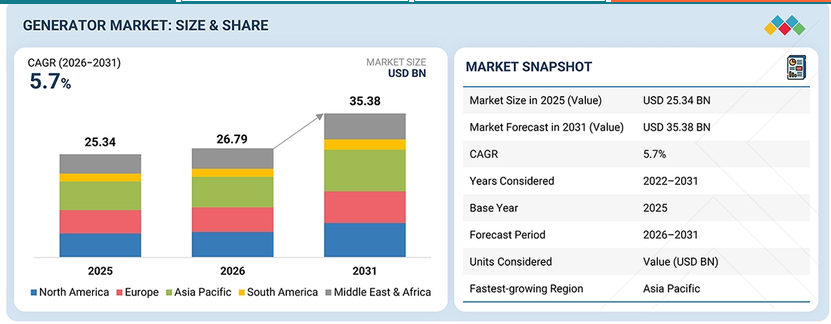
According to a latest research report, “Generator Market by Design (Stationary, Portable), Fuel Type (Diesel, Gas, LPG, Biofuels, Coal Gas, Gasoline, Producer Gas, Fuel Cells), Application (Standby, Peak Shaving, Prime & Continuous), Sales Channel, Power Rating, End User, and Region – Global Forecast to 2031″, is projected to grow from USD 26.79 billion in 2026 and to reach USD 35.38 billion by 2031, at a Compound Annual Growth Rate (CAGR) of 5.7% during the forecast period.
The generator market is witnessing strong growth across global power systems as governments, industries, utilities, and commercial enterprises increase investments in reliable and resilient power infrastructure to address rising electricity demand, grid instability, and emergency backup power requirements. In the diesel generator segment, continuous advancements in engine technology, fuel injection systems, and emission control solutions are improving fuel efficiency, reducing operating costs, and ensuring compliance with increasingly stringent environmental regulations. In addition, the growing deployment of generators in data centers, healthcare facilities, telecommunications infrastructure, manufacturing plants, construction sites, mining operations, and oil & gas facilities is accelerating demand for high-capacity standby and prime power solutions. The market is also benefiting from the adoption of cleaner fuels, hydrogen-ready generator technologies, advanced alternators, and intelligent load management systems that improve power quality, enhance operational flexibility, and support the transition toward more sustainable and resilient distributed energy systems.
Download PDF Brochure @ https://www.marketsandmarkets.com/pdfdownloadNew.asp?id=47544335
By fuel type, the diesel segment is expected to dominate the market during the forecast period.
The diesel segment is expected to dominate the generator market during the forecast period due to its superior reliability, high power output, and ability to provide uninterrupted electricity in standby, prime, and continuous power applications. Diesel generators remain the preferred choice across critical industries such as data centers, healthcare, manufacturing, construction, mining, oil & gas, telecommunications, utilities, and commercial infrastructure, where uninterrupted power supply is essential. Their high fuel efficiency, durability, and capability to operate under varying load conditions make them particularly suitable for medium- and high-power applications. The increasing construction of hyperscale data centers, industrial facilities, hospitals, airports, and infrastructure projects is significantly driving demand for diesel generators. Manufacturers are continuously introducing advanced models featuring electronically controlled engines, high-pressure common rail fuel injection systems, intelligent digital controllers, and remote monitoring capabilities to improve operational efficiency, reduce fuel consumption, and minimize maintenance costs. Additionally, predictive maintenance, IoT-enabled monitoring, cloud-based fleet management, and real-time diagnostics are enhancing generator reliability and optimizing asset performance. Despite growing adoption of gas generators, diesel generators continue to maintain a competitive advantage in regions with limited natural gas infrastructure and unreliable grid networks. Compliance with stringent emission regulations through advanced exhaust after-treatment systems, along with the increasing use of renewable diesel and biodiesel blends, is further strengthening the segment’s growth while supporting cleaner and more sustainable power generation solutions.
By power rating, the up to 62.5 kVA segment is expected to be the fastest in the market during the forecast period.
The up to 62.5 kVA segment is expected to account for a significant share of the generator market during the forecast period, driven by increasing demand for compact, cost-effective, and reliable backup power solutions across residential, small commercial, and light industrial applications. These generators are widely used in homes, retail stores, restaurants, offices, educational institutions, healthcare clinics, banks, telecom base stations, and small manufacturing units where continuous power is essential during grid outages. Their compact design, ease of installation, lower fuel consumption, and reduced maintenance requirements make them an attractive choice for customers seeking economical power solutions. The growing frequency of power interruptions, rapid urbanization, and expanding small and medium-sized enterprises are further driving demand for generators in this power range. Increasing investments in residential construction, commercial buildings, and telecommunications infrastructure, particularly in developing economies, are also supporting segment growth. Manufacturers are introducing advanced generator models equipped with fuel-efficient engines, automatic transfer switches (ATS), digital control panels, remote monitoring capabilities, and low-noise enclosures to improve operational efficiency and user convenience. Additionally, the adoption of cleaner technologies, including natural gas-powered and hybrid generators integrated with battery energy storage systems, is expanding the application scope of generators in this segment. Rising demand for portable generators for emergency backup, outdoor events, construction sites, and disaster response applications, coupled with stricter emission standards and advancements in engine technology, is expected to further strengthen the growth of the up to 62.5 kVA segment throughout the forecast period.
Asia Pacific is expected to be the largest region during the forecast period.
The Asia Pacific region is expected to dominate the global generator market during the forecast period, driven by rapid industrialization, urbanization, expanding power infrastructure, and increasing investments in manufacturing, construction, telecommunications, and data centers. Countries such as China, India, Japan, South Korea, Australia and Indonesia are witnessing strong demand for reliable backup and prime power solutions due to rising electricity consumption, frequent grid disruptions in certain areas and the expansion of commercial and industrial facilities. Growing investments in smart cities, transportation infrastructure, healthcare facilities, and large-scale residential developments are further accelerating the adoption of generators across the region. The rapid expansion of hyperscale data centers, semiconductor manufacturing facilities, and industrial parks is significantly increasing demand for medium- and high-capacity generators to ensure uninterrupted operations. In addition, the mining, oil & gas, and construction sectors continue to rely heavily on diesel and gas generators for off-grid and remote applications where grid connectivity remains limited. Governments across the region are also investing in strengthening energy security, disaster preparedness, and resilient power infrastructure, creating sustained demand for standby power systems. Manufacturers are introducing advanced generator technologies featuring fuel-efficient engines, intelligent digital controllers, IoT-enabled remote monitoring, predictive maintenance capabilities, and lower-emission power solutions to comply with evolving environmental regulations. Furthermore, the growing adoption of natural gas generators, hybrid generator systems integrated with battery energy storage, and renewable diesel-compatible generators is supporting the transition toward cleaner and more sustainable power generation. Strong economic growth, expanding industrial activities, and continuous infrastructure development are expected to maintain Asia Pacific’s leadership in the global generator market throughout the forecast period.
Make an Inquiry @ https://www.marketsandmarkets.com/Enquiry_Before_BuyingNew.asp?id=47544335
Key Market Players
Some of the major players in the generator market are Caterpillar (US), Cummins Inc. (US), Mitsubishi Heavy Industries, Ltd. (Japan), Rolls-Royce PLC (UK), and Generac Power Systems, Inc. (US). The major strategies adopted by these players include agreements, product launches, contracts, investments, partnerships, collaborations, and announcements.
