The semiconductor industry is undergoing one of its most significant architectural transformations with the emergence of chiplet technology. As conventional monolithic chip designs become increasingly difficult and expensive to manufacture at advanced process nodes, semiconductor companies are turning to modular chip architectures to improve performance, reduce costs, and accelerate product development. Chiplets enable manufacturers to integrate multiple specialized dies into a single package, delivering higher computing power while overcoming many of the limitations associated with traditional chip design. The chiplet market is expected to grow from USD 51.94 billion in 2025 to USD 157.23 billion by 2030, at a CAGR of 24.8% during the forecast period
The rapid adoption of artificial intelligence (AI), high-performance computing (HPC), cloud infrastructure, and data-intensive applications is accelerating demand for chiplet-based processors. Combined with innovations in advanced semiconductor packaging, chiplets are becoming a key enabler of next-generation computing platforms across data centres, automotive electronics, telecommunications, consumer devices, and industrial applications.
Top 10 Key Takeaways
- Chiplets enable modular semiconductor design with improved flexibility.
- AI workloads are accelerating demand for chiplet-based processors.
- High-performance computing is driving adoption of multi-die architectures.
- Advanced packaging technologies are essential for chiplet integration.
- Chiplets improve manufacturing yield by using smaller dies.
- Heterogeneous integration allows different process nodes within one package.
- Data centres are major adopters of chiplet-enabled processors.
- Automotive and telecommunications sectors present significant growth opportunities.
- Industry standards are evolving to improve chiplet interoperability.
- Chiplets are expected to shape the future of semiconductor innovation.
Understanding Chiplet Technology
A chiplet is a small, modular integrated circuit designed to perform a specific function within a larger processor package. Instead of manufacturing one large system-on-chip (SoC), manufacturers combine multiple chiplets using advanced packaging technologies to create a high-performance computing solution.
Each chiplet may be fabricated using different semiconductor process nodes, allowing designers to optimise performance, power consumption, and manufacturing costs. This modular approach improves design flexibility while increasing manufacturing yield because smaller dies generally experience fewer production defects than large monolithic chips.
Chiplet-based architectures are now being adopted for CPUs, GPUs, AI accelerators, networking processors, memory subsystems, and data centre processors.
Artificial Intelligence Driving Chiplet Adoption
Artificial intelligence has become one of the strongest growth drivers for the chiplet market. Training and deploying large language models, generative AI platforms, recommendation engines, and computer vision systems require enormous computing resources.
Modern AI accelerators contain billions of transistors, making monolithic chip manufacturing increasingly complex. Chiplets allow manufacturers to divide workloads across multiple specialised processing units while maintaining high-speed communication through advanced interconnect technologies.
AI workloads also benefit from integrating dedicated compute chiplets, memory chiplets, and input/output components into a single package. This architecture improves scalability, increases memory bandwidth, and reduces latency, making chiplets particularly attractive for hyperscale cloud providers and AI infrastructure developers.
High-Performance Computing Expands Market Opportunities
High-performance computing continues to push semiconductor performance requirements beyond the capabilities of conventional processor architectures. Scientific simulations, weather forecasting, financial modelling, genomic research, and engineering analysis require processors capable of handling enormous computational workloads efficiently.
Chiplet architectures allow HPC systems to incorporate multiple compute dies connected through high-speed interfaces, significantly increasing processing capabilities while maintaining power efficiency. This modular approach enables semiconductor companies to introduce new processor generations more rapidly without redesigning an entire chip from scratch.
Supercomputers and enterprise computing platforms increasingly rely on chiplet-based processors to meet growing performance requirements while improving scalability.
Download PDF Brochure @ https://www.marketsandmarkets.com/pdfdownloadNew.asp?id=131809383
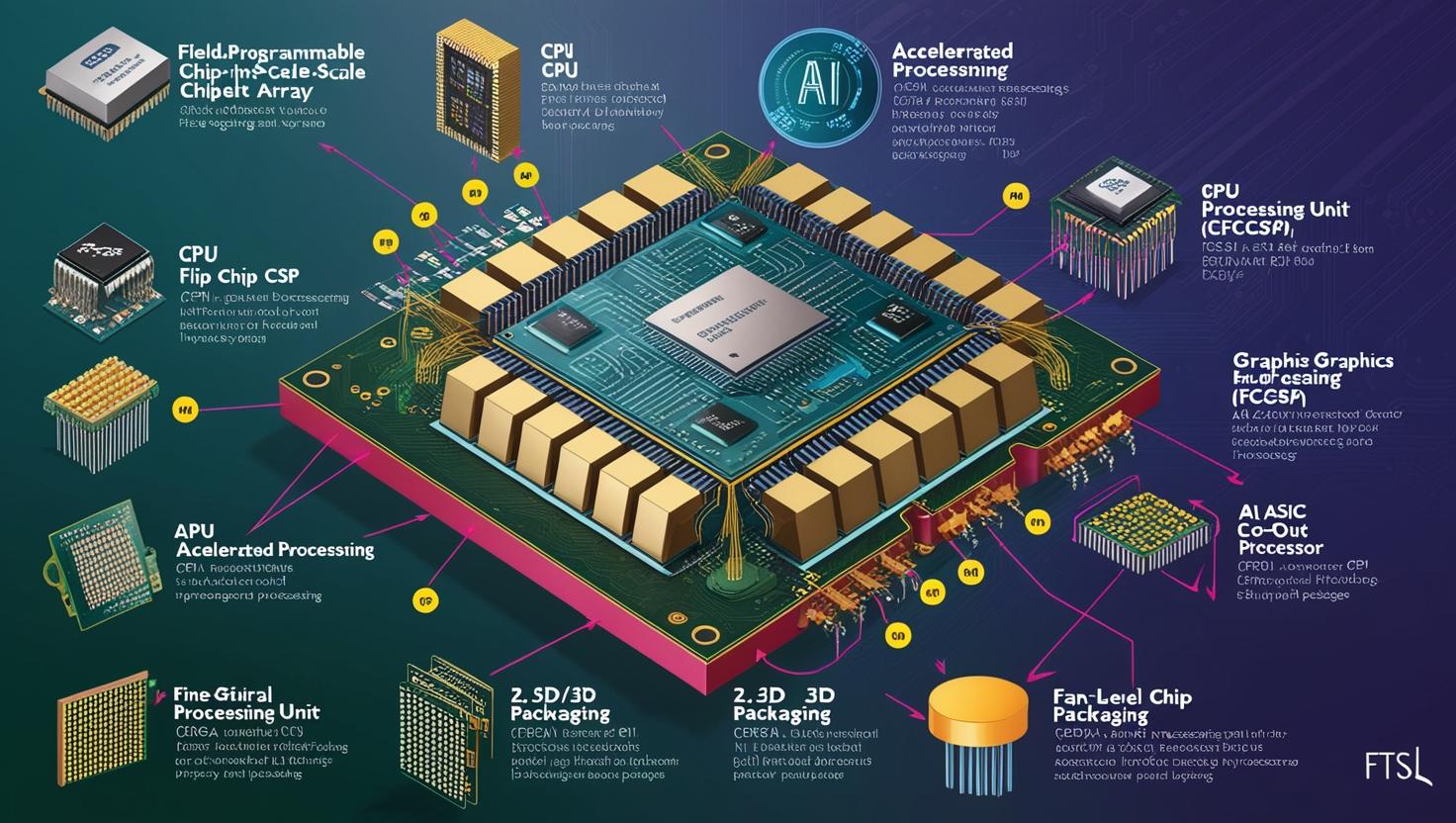
Advanced Packaging Technologies Fuel Innovation
The success of chiplets depends heavily on advances in semiconductor packaging. Technologies such as 2.5D packaging, 3D packaging, fan-out packaging, silicon interposers, hybrid bonding, and advanced substrate technologies enable multiple chiplets to communicate at extremely high speeds with minimal power loss.
Unlike conventional packaging methods, advanced packaging enables closer integration between compute, memory, and networking components, resulting in improved bandwidth, lower latency, and enhanced energy efficiency.
These packaging innovations have become critical as semiconductor manufacturers seek alternatives to traditional transistor scaling while continuing to deliver higher computing performance.
Benefits of Chiplet-Based Design
Chiplet technology offers several advantages over monolithic semiconductor architectures. Smaller dies generally improve manufacturing yields, reducing production costs associated with advanced process nodes. Designers gain greater flexibility by combining different functional blocks developed independently, enabling faster product development and easier upgrades.
Chiplets also support heterogeneous integration, allowing components manufactured using different fabrication technologies to coexist within a single package. This capability enables manufacturers to optimise cost, performance, and power consumption without relying on a single semiconductor process.
Additionally, modular architectures simplify product customisation, enabling companies to develop multiple processor variants using common chiplet building blocks.
Expanding Applications Across Industries
The adoption of chiplet technology extends well beyond traditional computing applications.
Data centres are deploying chiplet-based processors to support AI training, cloud computing, and large-scale analytics. Automotive manufacturers are exploring chiplets for autonomous driving platforms, advanced driver-assistance systems (ADAS), and in-vehicle computing.
Telecommunications providers are integrating chiplets into networking equipment supporting 5G and future communication standards. Industrial automation, robotics, aerospace, defence, healthcare, and consumer electronics manufacturers are also evaluating chiplet architectures to improve computing performance while reducing design complexity.
Regional Market Outlook
North America remains a leading market for chiplet innovation due to strong investments in AI infrastructure, semiconductor research, and cloud computing technologies. Several major semiconductor companies continue developing advanced chiplet platforms for enterprise and hyperscale applications.
Asia-Pacific is expected to witness substantial growth due to expanding semiconductor manufacturing, increasing electronics production, and government initiatives supporting domestic chip development. Countries such as Taiwan, South Korea, Japan, China, and India continue strengthening semiconductor ecosystems, creating favourable conditions for chiplet adoption.
Europe is also investing heavily in semiconductor manufacturing capabilities and advanced packaging technologies to support automotive electronics, industrial automation, and digital sovereignty initiatives.
Challenges Facing the Chiplet Market
Despite significant opportunities, several challenges remain. Designing high-performance chiplet systems requires sophisticated packaging technologies and advanced interconnect standards. Maintaining signal integrity, thermal management, and power efficiency across multiple chiplets adds engineering complexity.
Standardisation is another important challenge. Industry initiatives promoting open chiplet interconnect standards aim to improve interoperability, but broader ecosystem adoption is still evolving.
The semiconductor industry must also address manufacturing capacity constraints, advanced packaging availability, and increasing research and development costs to fully realise chiplet technology’s potential.
Future Outlook
The future of the chiplet market appears exceptionally promising. As artificial intelligence, high-performance computing, cloud infrastructure, edge computing, and autonomous systems continue expanding, demand for modular semiconductor architectures is expected to accelerate.
Advances in heterogeneous integration, advanced packaging, and high-speed interconnect technologies will further strengthen the role of chiplets in next-generation processors. Rather than relying solely on transistor scaling, semiconductor innovation is increasingly shifting toward system-level architecture, where chiplets provide a practical pathway to higher performance, greater flexibility, and improved manufacturing efficiency.
Chiplet technology is expected to become a cornerstone of the semiconductor industry’s long-term roadmap, enabling continued innovation across AI, HPC, networking, automotive, and industrial computing applications.
Frequently Asked Questions (FAQs)
1. What is a chiplet?
A chiplet is a small semiconductor die designed to perform a specific function within a larger integrated processor package.
2. Why is chiplet technology important?
Chiplets improve performance, manufacturing efficiency, scalability, and design flexibility while reducing development costs.
3. How does AI influence the chiplet market?
AI applications require massive computing power, making modular chiplet architectures an efficient solution for training and inference workloads.
4. What role does advanced packaging play?
Advanced packaging connects multiple chiplets with high-speed interconnects, enabling efficient communication, lower latency, and higher bandwidth.
5. Which industries are adopting chiplets?
Major adopters include data centres, cloud computing, automotive, telecommunications, aerospace, defence, industrial automation, and consumer electronics.
About MarketsandMarkets™
MarketsandMarkets™ has been recognized as one of America’s Best Management Consulting Firms by Forbes, as per their recent report.
MarketsandMarkets™ is a blue ocean alternative in growth consulting and program management, leveraging a man-machine offering to drive supernormal growth for progressive organizations in the B2B space. With the widest lens on emerging technologies, we are proficient in co-creating supernormal growth for clients across the globe.
Today, 80% of Fortune 2000 companies rely on MarketsandMarkets, and 90 of the top 100 companies in each sector trust us to accelerate their revenue growth. With a global clientele of over 13,000 organizations, we help businesses thrive in a disruptive ecosystem.
The B2B economy is witnessing the emergence of $25 trillion in new revenue streams that are replacing existing ones within this decade. We work with clients on growth programs, helping them monetize this $25 trillion opportunity through our service lines – TAM Expansion, Go-to-Market (GTM) Strategy to Execution, Market Share Gain, Account Enablement, and Thought Leadership Marketing.
Built on the ‘GIVE Growth’ principle, we collaborate with several Forbes Global 2000 B2B companies to keep them future-ready. Our insights and strategies are powered by industry experts, cutting-edge AI, and our Market Intelligence Cloud, KnowledgeStore™, which integrates research and provides ecosystem-wide visibility into revenue shifts.
To find out more, visit www.MarketsandMarkets™.com or follow us on Twitter , LinkedIn and Facebook .
Contact:
Mr. Rohan Salgarkar
MarketsandMarkets™ INC.
1615 South Congress Ave.
Suite 103, Delray Beach, FL 33445
USA: +1-888-600-6441
