The rapid advancement of augmented reality (AR), artificial intelligence (AI), and wearable computing technologies is transforming the way people interact with digital information. Among emerging wearable technologies, smart glasses are gaining significant attention due to their ability to combine real-world environments with digital content. These devices are evolving beyond consumer applications and becoming powerful tools for industries such as healthcare, manufacturing, logistics, defense, retail, and education.
The Smart Glasses Market is witnessing strong growth as organizations increasingly adopt AR-based solutions to improve productivity, enhance remote collaboration, optimize workflows, and provide immersive user experiences. Advancements in lightweight designs, high-resolution displays, advanced sensors, voice recognition, 5G connectivity, and AI-powered features are accelerating the adoption of smart glasses across multiple sectors. The global smart glasses industry is projected to reach USD 4,129.3 million by 2030 from USD 878.8 million in 2024; it is expected to grow at a CAGR of 29.4%.
Smart glasses are becoming an important component of digital transformation strategies as businesses seek innovative ways to improve operational efficiency and enable real-time access to information.
Understanding Smart Glasses Technology
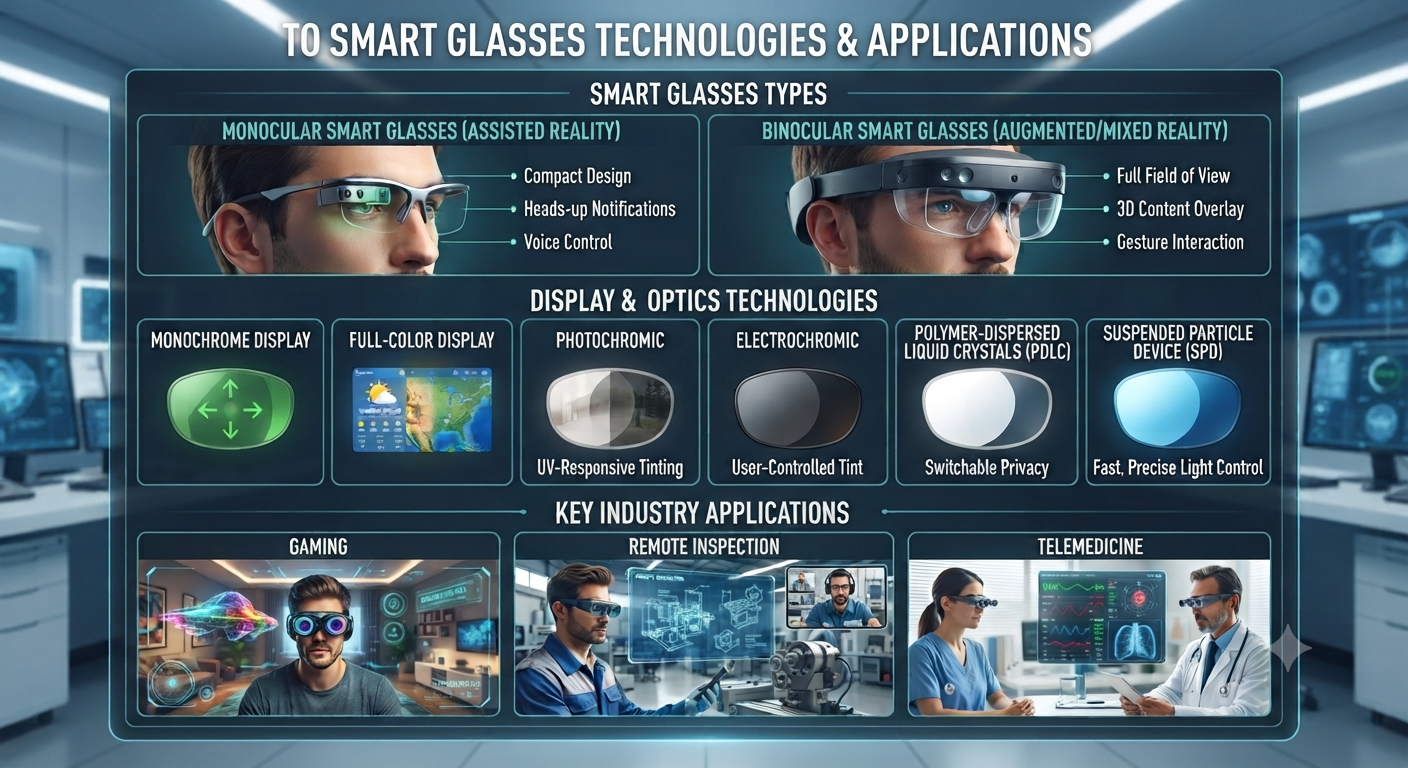
Smart glasses are wearable electronic devices that integrate digital displays, sensors, cameras, processors, and connectivity technologies into eyewear. Unlike traditional glasses, smart glasses provide users with digital information directly within their field of vision.
Key components of smart glasses include:
- Micro displays
- Cameras and image sensors
- Motion sensors
- Microphones and speakers
- Processing units
- Wireless connectivity modules
- Battery systems
- AI-powered software platforms
These technologies enable applications such as augmented reality visualization, hands-free communication, navigation assistance, remote support, and real-time data access.
Augmented Reality Driving Market Expansion
Augmented reality is one of the primary technologies fueling smart glasses adoption. AR overlays digital information, images, instructions, or 3D models onto the user’s physical environment, creating an interactive experience.
Industries are using AR-enabled smart glasses for:
- Real-time instructions
- Equipment visualization
- Remote assistance
- Training simulations
- Product demonstrations
- Navigation support
As companies increasingly invest in digital transformation initiatives, AR-based smart glasses are becoming valuable tools for improving operational efficiency and decision-making.
Industrial Applications Accelerating Adoption
The industrial sector represents one of the fastest-growing application areas for smart glasses. Manufacturing companies are using these devices to optimize production processes, reduce errors, and improve worker productivity.
Applications include:
- Assembly guidance
- Equipment maintenance
- Quality inspection
- Employee training
- Remote troubleshooting
Workers equipped with smart glasses can access digital instructions, technical diagrams, and real-time data while keeping their hands free. This improves efficiency and reduces downtime in complex industrial environments.
Smart Glasses Transforming Healthcare
Healthcare is emerging as a major application area for smart glasses due to their ability to support medical professionals with real-time information and visualization tools.
Applications include:
- Surgical assistance
- Medical training
- Remote consultations
- Patient monitoring
- Medical imaging visualization
Surgeons can use AR-enabled smart glasses to access critical information during procedures, while medical students can benefit from immersive training experiences. Remote healthcare applications also allow specialists to provide guidance without being physically present.
The increasing adoption of digital healthcare solutions is expected to create significant growth opportunities for smart glasses manufacturers.
Download PDF Brochure @ https://www.marketsandmarkets.com/pdfdownloadNew.asp?id=148134046
Remote Collaboration and Workforce Support
The rise of remote operations has increased demand for smart glasses that enable real-time collaboration between experts and field workers.
Using smart glasses, technicians can share live video feeds with remote specialists who can provide instructions and guidance.
Benefits include:
- Reduced travel requirements
- Faster problem resolution
- Improved technical support
- Enhanced workforce efficiency
Industries such as energy, telecommunications, manufacturing, and aviation are increasingly adopting remote assistance solutions powered by smart glasses.
Logistics and Warehousing Applications
The logistics industry is adopting smart glasses to improve warehouse operations and supply chain efficiency.
Applications include:
- Inventory management
- Order picking
- Navigation assistance
- Barcode scanning
- Shipment verification
Smart glasses provide workers with real-time information, reducing manual processes and improving accuracy. As e-commerce growth increases pressure on logistics operations, demand for wearable technologies is expected to rise.
Defense and Aerospace Adoption
Defense organizations are exploring smart glasses for applications requiring enhanced situational awareness and advanced information access.
Applications include:
- Battlefield visualization
- Training simulations
- Navigation assistance
- Maintenance support
- Mission planning
In aerospace, smart glasses are being used for aircraft maintenance, inspection, and technician support. The ability to access digital information without interrupting tasks makes smart glasses valuable in mission-critical environments.
Retail and Consumer Applications
Although enterprise applications currently dominate adoption, consumer applications continue to influence the Smart Glasses Market.
Retailers are exploring smart glasses for:
- Virtual product demonstrations
- Personalized shopping experiences
- Interactive advertisements
- Virtual fitting solutions
Consumers are also showing interest in smart eyewear integrated with AI assistants, cameras, audio systems, and communication features.
Future developments in design, affordability, and usability could increase consumer adoption.
Artificial Intelligence Enhancing Smart Glasses Capabilities
AI integration is significantly improving smart glasses functionality. AI-powered features enable devices to understand environments, process information, and provide intelligent assistance.
AI applications include:
- Object recognition
- Voice assistants
- Real-time translation
- Predictive recommendations
- Automated data analysis
AI-enabled smart glasses can analyze visual information and provide users with contextual guidance, making them more useful across professional and consumer applications.
5G and Connectivity Supporting Growth
Advanced connectivity technologies are improving the performance of smart glasses by enabling faster data transmission and cloud-based applications.
5G connectivity supports:
- Real-time video streaming
- Remote collaboration
- Cloud computing applications
- Low-latency AR experiences
As industries deploy connected infrastructure, smart glasses will become increasingly integrated into digital ecosystems.
Advances in Display and Sensor Technologies
Continuous improvements in display and sensor technologies are enhancing smart glasses performance.
Important innovations include:
- Lightweight optical systems
- Improved battery efficiency
- Higher-resolution displays
- Advanced depth sensors
- Better motion tracking
These developments are helping manufacturers create more comfortable, powerful, and practical smart glasses for professional and consumer use.
Key Trends Shaping the Smart Glasses Market
Growing Enterprise Adoption
Businesses are increasingly deploying smart glasses to improve workforce productivity, training, and operational efficiency.
AI-Powered Wearable Experiences
AI is enabling smarter and more interactive applications through object recognition, voice assistance, and real-time analytics.
Expansion of Industrial AR Applications
Manufacturing, logistics, and field services are becoming major growth areas for AR-based smart glasses.
Increasing Focus on Lightweight Designs
Manufacturers are developing smaller and more comfortable devices for extended usage.
Integration With Digital Platforms
Smart glasses are increasingly connecting with cloud systems, enterprise software, and IoT platforms.
Challenges Affecting Market Growth
Despite strong growth potential, the Smart Glasses Market faces several challenges.
High Device Costs
Advanced smart glasses with AR capabilities remain expensive, limiting adoption among some users.
Battery Life Limitations
Extended AR usage requires efficient battery technologies to support longer operating times.
User Acceptance and Comfort
Device weight, appearance, and usability continue to influence adoption.
Privacy and Security Concerns
Camera-enabled smart glasses raise concerns regarding data privacy and information security.
Addressing these challenges will be important for wider market penetration.
Regional Market Outlook
North America
North America is a leading market due to strong adoption of AR technologies, advanced enterprise solutions, and investments in AI and wearable computing.
Key growth areas include:
- Healthcare
- Defense
- Manufacturing
- Enterprise collaboration
Europe
Europe is experiencing increasing adoption of smart glasses in industrial automation, healthcare, and logistics applications.
Asia Pacific
Asia Pacific is expected to witness significant growth due to expanding manufacturing activities, technology investments, and increasing adoption of digital solutions.
Countries such as China, Japan, South Korea, and India are becoming important markets for AR-based technologies.
Future Outlook of the Smart Glasses Market
The future of the Smart Glasses Market will be shaped by advancements in AI, AR, connectivity, and wearable computing. As devices become lighter, more powerful, and more affordable, adoption is expected to expand across industries.
Future developments may include:
- AI-powered personal assistants
- Advanced AR navigation systems
- Industrial automation integration
- Smart healthcare applications
- Real-time language translation
- Enhanced remote collaboration tools
- Consumer-focused AR experiences
The convergence of AI, augmented reality, and wearable technology will continue creating new opportunities for smart glasses innovation.
Conclusion
The Smart Glasses Market is entering a period of significant growth as organizations across industries recognize the value of AR-based solutions. From improving industrial productivity and healthcare outcomes to enabling advanced remote collaboration and immersive experiences, smart glasses are becoming an important tool for digital transformation.
Advancements in AI, 5G connectivity, sensor technology, and display systems are accelerating adoption while expanding application possibilities. Although challenges related to cost, battery life, and privacy remain, ongoing innovation is expected to make smart glasses more accessible and widely adopted.
As industries continue embracing connected and intelligent technologies, smart glasses will play a crucial role in shaping the future of human-computer interaction and augmented digital experiences.
Top 10 Key Takeaways
- AR technology is the primary driver of smart glasses market growth.
- Enterprise applications are leading adoption across multiple industries.
- AI integration is enhancing smart glasses intelligence and functionality.
- Healthcare is emerging as a major application area.
- Manufacturing and logistics are using smart glasses to improve productivity.
- 5G connectivity is enabling advanced real-time AR experiences.
- Defense and aerospace sectors are adopting smart glasses for specialized applications.
- Display and sensor innovations are improving device performance.
- Asia Pacific is expected to experience strong market growth.
- Future smart glasses will combine AI, AR, and wearable computing for advanced digital experiences.
Frequently Asked Questions (FAQs)
1. What are smart glasses?
Smart glasses are wearable devices that combine traditional eyewear with digital displays, sensors, cameras, and computing capabilities to provide augmented reality experiences.
2. What industries use smart glasses?
Smart glasses are used in healthcare, manufacturing, logistics, defense, aerospace, retail, education, and field service industries.
3. How does AI improve smart glasses?
AI enables features such as object recognition, voice assistance, real-time translation, predictive analytics, and intelligent decision support.
4. Why are businesses adopting smart glasses?
Businesses use smart glasses to improve productivity, enable remote collaboration, reduce errors, and provide hands-free access to digital information.
5. What is the future outlook for the Smart Glasses Market?
The market is expected to grow as advancements in AR, AI, connectivity, and wearable technology create new applications across industries.
About MarketsandMarkets™
MarketsandMarkets™ has been recognized as one of America’s Best Management Consulting Firms by Forbes, as per their recent report.
MarketsandMarkets™ is a blue ocean alternative in growth consulting and program management, leveraging a man-machine offering to drive supernormal growth for progressive organizations in the B2B space. With the widest lens on emerging technologies, we are proficient in co-creating supernormal growth for clients across the globe.
Today, 80% of Fortune 2000 companies rely on MarketsandMarkets, and 90 of the top 100 companies in each sector trust us to accelerate their revenue growth. With a global clientele of over 13,000 organizations, we help businesses thrive in a disruptive ecosystem.
The B2B economy is witnessing the emergence of $25 trillion in new revenue streams that are replacing existing ones within this decade. We work with clients on growth programs, helping them monetize this $25 trillion opportunity through our service lines – TAM Expansion, Go-to-Market (GTM) Strategy to Execution, Market Share Gain, Account Enablement, and Thought Leadership Marketing.
Built on the ‘GIVE Growth’ principle, we collaborate with several Forbes Global 2000 B2B companies to keep them future-ready. Our insights and strategies are powered by industry experts, cutting-edge AI, and our Market Intelligence Cloud, KnowledgeStore™, which integrates research and provides ecosystem-wide visibility into revenue shifts.
To find out more, visit www.MarketsandMarkets™.com or follow us on Twitter , LinkedIn and Facebook .
Contact:
Mr. Rohan Salgarkar
MarketsandMarkets™ INC.
1615 South Congress Ave.
Suite 103, Delray Beach, FL 33445
USA: +1-888-600-6441