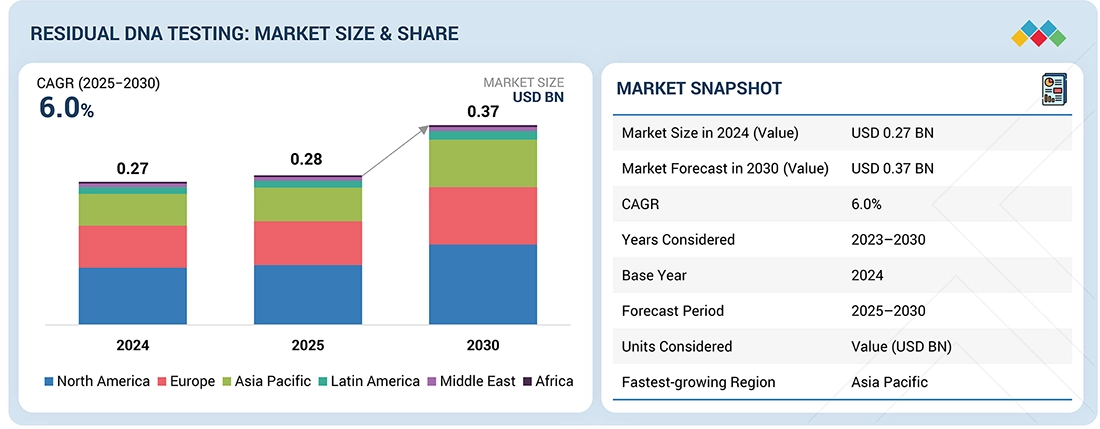
The global Residual DNA Testing Market is projected to grow from USD 0.28 billion in 2025 to USD 0.37 billion by 2030, registering a CAGR of 6.0% during the forecast period. The market’s growth is primarily driven by increasing regulatory approvals for biologics and biosimilars, stringent product safety and quality requirements, and rising investments in advanced therapeutic modalities.
Download PDF Brochure:- https://www.marketsandmarkets.com/pdfdownloadNew.asp?id=89689614
Growing Biologics and Biosimilars Pipeline Drives Demand for Residual DNA Testing
The increasing development and commercialization of biologics, biosimilars, vaccines, monoclonal antibodies (mAbs), and cell and gene therapies (CGTs) are creating sustained demand for advanced residual DNA testing solutions.
Residual DNA testing plays an important role in biopharmaceutical quality control by helping manufacturers assess and monitor residual host-cell DNA and other process-related impurities. As regulatory standards for product safety, efficacy, and quality continue to evolve, biopharmaceutical companies are increasing their focus on robust analytical testing throughout the manufacturing and product release process.
The growing number of regulatory approvals for biologic products is further strengthening demand for validated residual DNA assays and testing services. In addition, expanding R&D investments in emerging markets are creating new opportunities for testing providers, instrument manufacturers, and specialized analytical service organizations.
Final Product Release Testing Accounted for the Largest Market Share
The final product release testing segment accounted for the largest share of the residual DNA testing market in 2024.
Final product release testing is a critical stage in biopharmaceutical manufacturing, where manufacturers verify that products meet predefined quality and regulatory requirements before release.
Residual DNA testing at this stage helps validate the effectiveness of purification processes designed to remove process-related DNA impurities from the final product. These assays also support batch release assurance and help manufacturers demonstrate consistency and compliance with applicable quality standards.
The increasing complexity of biologics manufacturing and the growing emphasis on batch-to-batch consistency are expected to support continued demand for final product release testing throughout the forecast period.
Pharmaceutical & Biotechnology Companies Drive End-User Demand
Pharmaceutical and biotechnology companies accounted for a major share of the residual DNA testing products market in 2024.
The segment’s growth is supported by rising investments in biologics and advanced therapeutic modalities, along with increasing development activity across monoclonal antibodies, vaccines, and cell and gene therapies.
As biopharmaceutical pipelines become increasingly complex, companies are strengthening their analytical testing and quality-control capabilities to meet regulatory requirements and ensure product safety.
The growing trend toward outsourcing clinical, laboratory, and specialized analytical testing is also creating opportunities for CROs and CDMOs offering residual DNA testing services. Outsourcing enables biopharmaceutical companies to access specialized analytical expertise and testing infrastructure while supporting efficient development and manufacturing workflows.
PCR Technology Supports Reliable and Sensitive Testing
PCR-based technologies continue to play an important role in the residual DNA testing landscape due to their ability to support sensitive and specific detection of DNA impurities.
The increasing demand for efficient, validated, and scalable analytical methods is encouraging the adoption of advanced PCR-based assays across biopharmaceutical quality-control workflows.
As manufacturers expand production of complex biologics and advanced therapies, demand is expected to increase for analytical technologies that can support process development, raw material testing, bulk lot release, and final product release.
North America Held the Largest Regional Market Share
North America accounted for the largest share of the residual DNA testing market in 2024.
The region’s leadership is supported by its established biopharmaceutical industry, strong presence of testing product manufacturers and service providers, and continued investment in biologics research and development.
The US remains a major contributor to regional demand, driven by the expansion of biopharmaceutical manufacturing and increasing requirements for advanced analytical testing and quality-control solutions.
Collaborative initiatives between regulatory, research, and standards organizations are also supporting the development of analytical reference materials and standardized testing approaches. Such initiatives can help biopharmaceutical manufacturers strengthen the consistency and reliability of residual DNA measurement and quality-control processes.
Speak To Analyst:- https://www.marketsandmarkets.com/speaktoanalystNew.asp?id=89689614
Emerging Markets Create New Growth Opportunities
Emerging markets are expected to provide additional growth opportunities as pharmaceutical and biotechnology companies increase investment in biologics development, biosimilar manufacturing, and advanced therapeutic research.
Expanding biopharmaceutical manufacturing infrastructure and rising R&D activity are increasing demand for specialized analytical testing capabilities.
As companies in these regions work to align manufacturing and quality systems with international regulatory standards, the adoption of validated residual DNA testing methods is expected to expand.
Competitive Landscape
The residual DNA testing market includes companies providing analytical instruments, reagents and consumables, PCR-based technologies, testing services, and specialized quality-control solutions.
Leading players profiled in the report include Thermo Fisher Scientific Inc., Merck KGaA, Eurofins Scientific, Charles River Laboratories, QIAGEN, FUJIFILM Corporation, Maravai LifeSciences, and Bio-Rad Laboratories, among others.
Market participants are focusing on expanding their portfolios through advanced analytical technologies, improved assay performance, specialized testing services, and solutions designed to support the growing requirements of biologics and advanced therapy manufacturers.
