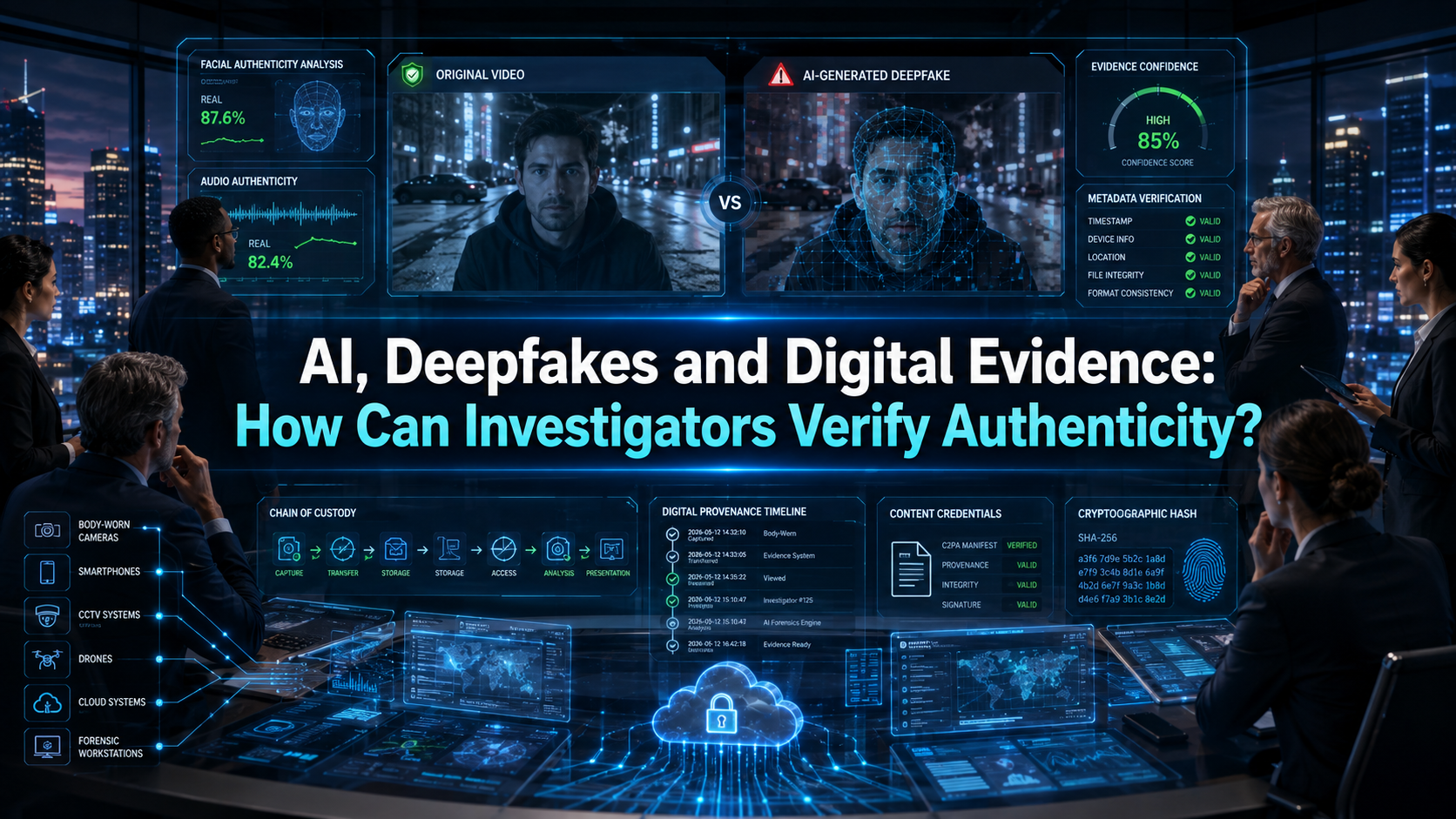
Strategic Introduction: When Evidence Itself Becomes a Question
Investigators can improve digital evidence authenticity by combining provenance, cryptographic integrity, metadata, forensic analysis, corroboration, chain of custody and human review rather than relying on a single deepfake detector.
The Digital Evidence Management Market is entering a new phase in which the central question is no longer simply how to store, search or share evidence. It is whether investigators can confidently establish where digital evidence came from, what happened to it, whether it was altered, and how much confidence should be placed in it.
That distinction is becoming critical.
A video can be fabricated. An audio recording can imitate a real person’s voice. A photograph can be synthetically generated. A screenshot can omit crucial context. Even authentic material can be misleading if it has been cropped, recompressed, recontextualized or separated from its original source.
The problem is therefore bigger than deepfakes.
It is a trust problem.
Recent forensic research describes the rapid growth of deepfake technology as a mounting challenge to the integrity and reliability of multimedia evidence.
At the same time, current market research shows that digital evidence platforms are becoming increasingly important for handling video, audio, images, documents, mobile extractions, cloud records and forensic outputs.
The next generation of evidence management will therefore need to answer two questions simultaneously:
Can we find the evidence?
and
Can we establish why we should trust it?
Market Context & Growth Narrative: Why Digital Trust Is Becoming Infrastructure
Growth in digital evidence volumes, AI-generated media, body cameras, surveillance systems, mobile devices and cloud data is increasing demand for secure evidence management and authenticity verification.
The market is expanding as investigations become increasingly digital.
Its research places North America at 38% of the market and identifies cloud deployment and software as leading segments.
Other research firms produce different estimates because market boundaries and methodologies differ.
The exact figure matters less than the underlying structural shift.
Evidence is being generated everywhere:
- Body-worn cameras
- Dashcams
- CCTV
- Smartphones
- Drones
- Emergency calls
- Social platforms
- Cloud applications
- IoT devices
- Digital documents
- Cybersecurity investigations
This volume is creating a management challenge—and AI is simultaneously creating an authenticity challenge.
That combination is accelerating the Digital Evidence Management Market growth narrative.
The industry is moving from basic evidence repositories toward systems capable of ingestion, classification, search, analytics, redaction, sharing, audit trails and integrity controls.
The next competitive layer is trust intelligence.
Discover emerging business opportunities Download the PDF supported by extensive market research.
Business Value Proposition: From Evidence Storage to Evidence Intelligence
AI-enabled evidence management can reduce investigation workloads by automating evidence discovery, transcription, classification, redaction and analysis while preserving human oversight and evidentiary controls.
Traditional evidence management answered a relatively straightforward question:
Where is the file?
Modern systems need to answer much more:
- What does the file contain?
- Where did it originate?
- Has it been modified?
- Who handled it?
- Does its metadata make sense?
- Does it match other evidence?
- Can its provenance be verified?
- Is there contradictory evidence?
- What confidence should investigators assign to it?
This is where evidence intelligence emerges.
AI can search large collections, transcribe recordings, identify objects, detect faces or license plates where legally appropriate, summarize video, identify duplicates and automate redaction. 360iResearch highlights these capabilities as part of AI’s growing impact on evidence review and management.
But AI should not become the final judge of authenticity.
A sophisticated system should instead produce an evidence confidence picture.
Imagine an investigator receiving a video file.
The platform could show:
Source: Body-worn camera
Original capture: Verified
Cryptographic integrity: Valid
Provenance: Available
Editing history: One documented transformation
Metadata consistency: High
AI manipulation indicators: Low confidence
Corroborating evidence: Three independent sources
That is substantially more useful than a simple green or red "deepfake" label.
The value proposition is therefore shifting from file management to defensible decision-making.
This Sample Report is designed to fuel your business growth download it today.
Industry Use Cases: Where Authenticity Verification Matters Most
Deepfake and authenticity verification are especially important in law enforcement, courts, insurance, cybersecurity, corporate investigations, intelligence and public safety.
Law Enforcement
Police departments increasingly work with video, audio, mobile data and social-media evidence.
A manipulated video can influence investigative direction, suspect identification or public perception. Evidence platforms therefore need mechanisms for preserving original files and documenting every subsequent action.
Courts and Prosecutors
The courtroom creates a higher standard of scrutiny.
A prosecutor may need to explain not only what a video shows, but how it was obtained, preserved, transferred and authenticated.
A recent 2026 legal analysis argues that deepfakes can create evidentiary problems well before trial—including during investigations, charging decisions, plea negotiations and litigation strategy.
Insurance Investigations
Fraud investigations increasingly depend on photographs, videos, documents and digital communications.
Synthetic or manipulated evidence could influence claims decisions, making provenance and corroboration increasingly valuable.
Corporate Investigations
Organizations investigating misconduct, fraud, insider threats or intellectual-property theft may encounter manipulated recordings, screenshots, emails or documents.
Cybersecurity
Digital investigations frequently involve logs, screenshots, endpoint artifacts, communications and other digital traces.
Here, evidence integrity is directly connected to incident response and legal defensibility.
Public Safety and Intelligence
Large-scale video and sensor environments create an enormous evidence-processing challenge.
AI can accelerate discovery—but the organization still needs to distinguish machine-generated confidence from verified fact.
Technology Architecture Overview: Building a Trust Layer Around Evidence
A modern digital evidence architecture combines secure ingestion, hashing, metadata preservation, provenance, chain-of-custody controls, AI analytics, forensic validation and human review.
The emerging architecture can be visualized as:
Capture → Secure Ingestion → Cryptographic Integrity → Provenance → AI Analysis → Corroboration → Human Validation → Controlled Sharing
Layer 1: Evidence Capture
Evidence originates from cameras, smartphones, drones, sensors, computers, cloud platforms and other systems.
Layer 2: Secure Ingestion
Original evidence should enter a controlled environment with appropriate access restrictions and audit records.
Layer 3: Integrity Protection
Cryptographic hashes and related mechanisms can help establish whether a digital asset has changed.
Layer 4: Provenance
Provenance provides information about an asset’s origin and history.
One important development is the C2PA Content Credentials framework, which uses digitally signed manifests to record provenance information and cryptographically bind it to content.
Layer 5: AI Analysis
AI can support transcription, search, object detection, summarization, classification, redaction and anomaly analysis.
Layer 6: Corroboration
Investigators compare evidence against independent sources.
Layer 7: Human Validation
Experts review the evidence, methodology and context before consequential decisions are made.
That final layer is crucial.
C2PA itself notes that provenance can establish information about the origin and history of content, but provenance alone cannot determine whether the content depicts factual truth.
That distinction should become foundational to digital evidence strategy.
Regulatory & Compliance Landscape: Authenticity, Integrity and Accountability
Digital evidence systems must support chain of custody, access control, auditability, privacy, data integrity and defensible evidence-handling procedures.
Deepfake detection cannot be separated from governance.
An organization may have an advanced AI detector, but if investigators cannot demonstrate how evidence was collected, preserved and analyzed, the technology alone may not solve the evidentiary problem.
A mature evidence governance framework should address:
- Chain of custody
- Access controls
- Encryption
- Audit trails
- Retention policies
- Evidence preservation
- Data minimization
- Privacy
- Authentication procedures
- AI model governance
- Human oversight
The growing focus on provenance is particularly relevant.
C2PA describes Content Credentials as a mechanism for recording provenance through cryptographically verifiable information, while emphasizing that provenance is a trust signal rather than an absolute declaration that content is factually true.
This is an important distinction for executives.
Authenticity, provenance and factual truth are related—but they are not interchangeable.
Implementation Roadmap for Enterprises and Investigative Agencies
Organizations should establish digital evidence authenticity through controlled capture, secure preservation, provenance tracking, AI-assisted analysis, corroboration and documented human review.
A practical implementation strategy can follow seven stages.
Stage 1: Establish an Evidence Policy
Define what constitutes original evidence, derivative evidence, working copies and verified evidence.
Stage 2: Protect the Original
Preserve the source file and establish cryptographic integrity as early as possible.
Stage 3: Capture Provenance
Where supported, record information about creation, modification and handling.
Stage 4: Deploy AI as an Assistant
Use AI to prioritize and analyze evidence—not to make unsupported final judgments.
Stage 5: Build Corroboration Workflows
Compare video with timestamps, device information, witness statements, location information and independent recordings where available.
Stage 6: Create Human Review Gates
High-impact decisions should receive expert review, particularly when AI identifies possible manipulation.
Stage 7: Preserve the Investigation Record
Every meaningful action should be traceable.
The objective is not simply to determine whether a file is "fake."
The objective is to create a defensible chain of reasoning about why the evidence should—or should not—be trusted.
Challenges & Risk Considerations: Why No Single AI Detector Is Enough
Deepfake detection tools can generate useful signals, but investigators should combine detector results with provenance, metadata, forensic analysis and independent corroboration.
The most dangerous assumption in digital evidence management may be that one AI model can reliably answer:
Real or fake?
Detection systems can produce false positives and false negatives. New generation techniques can also evolve faster than detection models.
Compression presents another problem.
A legitimate video downloaded, edited for format, uploaded to a platform and downloaded again may contain artifacts that look suspicious.
Conversely, sophisticated synthetic media can be produced without obvious visual anomalies.
This means the Digital Evidence Management Market analysis increasingly needs to consider the entire evidence lifecycle rather than treating detection as an isolated technical feature.
Recent commentary on digital evidence makes the same broader point: investigators are increasingly concerned with origin, integrity, completeness and context rather than relying on appearance alone.
The strategic response is layered verification.
Never let one signal carry the entire evidentiary burden.
Competitive Advantage & Future Outlook: The Rise of Evidence Intelligence
The future of digital evidence management will combine AI analytics with provenance, secure storage, forensic workflows, interoperability and explainable evidence-confidence scoring.
The market opportunity is expanding beyond storage.
Vendors increasingly have an opportunity to differentiate through:
- AI-assisted evidence discovery
- Automated redaction
- Intelligent transcription
- Video analytics
- Provenance tracking
- Evidence integrity monitoring
- Cross-platform search
- Secure evidence sharing
- Forensic workflow integration
- Evidence-confidence dashboards
This creates a new category of value.
The winning platform may not be the one that stores the most evidence.
It may be the one that helps investigators understand the evidence fastest while preserving the strongest chain of trust.
That is an important shift in the Digital Evidence Management Market outlook.
The system becomes an intelligence layer connecting evidence capture, forensic analysis, investigators, prosecutors, courts and regulated organizations.
2026 Trends: From Deepfake Detection to Digital Provenance
Key 2026 trends include AI-assisted evidence analysis, digital provenance, Content Credentials, cloud evidence platforms, automated redaction, multimodal investigation and evidence-confidence frameworks.
1. Digital Provenance
Organizations are increasingly interested in recording where content originated and what happened to it throughout its lifecycle.
2. Content Credentials
C2PA’s specifications provide a standardized approach for attaching cryptographically verifiable provenance information to digital content.
3. Multimodal AI Investigation
Evidence platforms are moving toward simultaneous analysis of text, images, audio and video.
4. AI-Assisted Evidence Review
AI can reduce the time investigators spend searching enormous evidence collections.
5. Automated Redaction
AI-powered redaction is increasingly valuable for protecting personally identifiable information, victims, minors and sensitive information before evidence is shared.
6. Cloud Evidence Management
Cloud platforms are increasingly used to centralize evidence, support collaboration and scale storage and analysis.
7. Evidence Interoperability
Investigations rarely remain inside one system. Connecting cameras, mobile devices, forensic tools, case-management systems and judicial workflows will become increasingly important.
8. Evidence Confidence Scoring
Instead of simply labeling content "real" or "fake," future systems may increasingly present multiple evidence signals and confidence levels.
9. Human-in-the-Loop AI
AI will increasingly assist investigators while humans remain accountable for consequential evidentiary decisions.
10. Evidence Intelligence
The long-term opportunity is to move from Digital Evidence Management to Digital Evidence Intelligence—using AI to connect evidence, context, provenance and investigative reasoning.
Strategic Conclusion: Trust Becomes the New Evidence Infrastructure
The Digital Evidence Management Market forecast points toward sustained growth, but the industry’s most important transformation may not be measured in storage capacity or software licenses.
It will be measured in trust.
Digital evidence is becoming more abundant at precisely the moment it is becoming harder to authenticate.
That creates a paradox.
AI can help investigators process millions of files faster but AI can also create convincing synthetic evidence.
The answer is not to reject digital evidence.
It is to build a stronger evidence ecosystem.
That ecosystem combines:
Secure capture + cryptographic integrity + provenance + forensic analysis + AI assistance + independent corroboration + human judgment.
Organizations that build those capabilities will be better positioned to manage the next generation of investigations.
And the strategic opportunity for technology providers is equally significant.
The future is not simply about managing evidence.
It is about helping institutions determine what they can trust, why they can trust it, and how they can prove that trust to someone else.
In the age of deepfakes, that may become the most valuable capability in the entire evidence technology stack.
