The Refrigeration Coolers Market Opportunities are expanding as businesses worldwide invest in efficient, reliable, and environmentally sustainable temperature-control infrastructure. The growing need for cold storage, refrigerated logistics, food preservation, pharmaceutical distribution, and modern retail is accelerating demand for advanced refrigeration coolers.
According to MarketsandMarkets, the global refrigeration coolers market is projected to reach USD 6.85 billion by 2032 from USD 4.72 billion in 2026, at a CAGR of 6.4 during the forecast period. Market growth is being supported by expanding cold chain infrastructure, rising demand for energy-efficient refrigeration, adoption of natural and low-GWP refrigerants, modernization of food retail and processing facilities, and increasing pharmaceutical cold-storage requirements.
Top 10 Key Takeaways
- The global refrigeration coolers market is projected to reach USD 6.85 billion by 2032.
- The market is expected to grow at a 6.4% CAGR from 2026 to 2032.
- Expanding cold-storage and refrigerated logistics infrastructure is a major growth driver.
- Evaporators and air coolers are expected to record the highest growth among offerings.
- CO₂ is expected to be among the fastest-growing refrigerant segments.
- Sustainable and low-GWP refrigeration technologies are becoming increasingly important.
- IoT, intelligent monitoring, and predictive maintenance are creating new technology opportunities.
- Retail is expected to be the fastest-growing application segment.
- Asia Pacific is positioned as the fastest-growing regional market.
- Energy efficiency, sustainability, and digitalization will remain central to future Refrigeration Coolers Market Opportunities.
Refrigeration Coolers Market Opportunities Driven by Cold Chain Expansion
One of the most significant Refrigeration Coolers Market Opportunities comes from the expansion of refrigerated warehouses and cold-storage facilities. Growing demand for temperature-controlled logistics is encouraging businesses to invest in high-efficiency condensers, compressors, evaporators, and air coolers.
Cold chain infrastructure is essential for preserving food, pharmaceuticals, vaccines, dairy products, fresh produce, and other temperature-sensitive goods. As supply chains become increasingly sophisticated, refrigeration systems must provide reliable temperature control while reducing energy consumption and operating costs.
This creates opportunities for manufacturers offering energy-efficient cooling equipment and integrated refrigeration solutions.
Sustainability Reshapes Refrigeration
Sustainability is becoming a central theme across Refrigeration Coolers Market Opportunities. Governments, businesses, and consumers are placing greater emphasis on reducing greenhouse-gas emissions and improving energy efficiency.
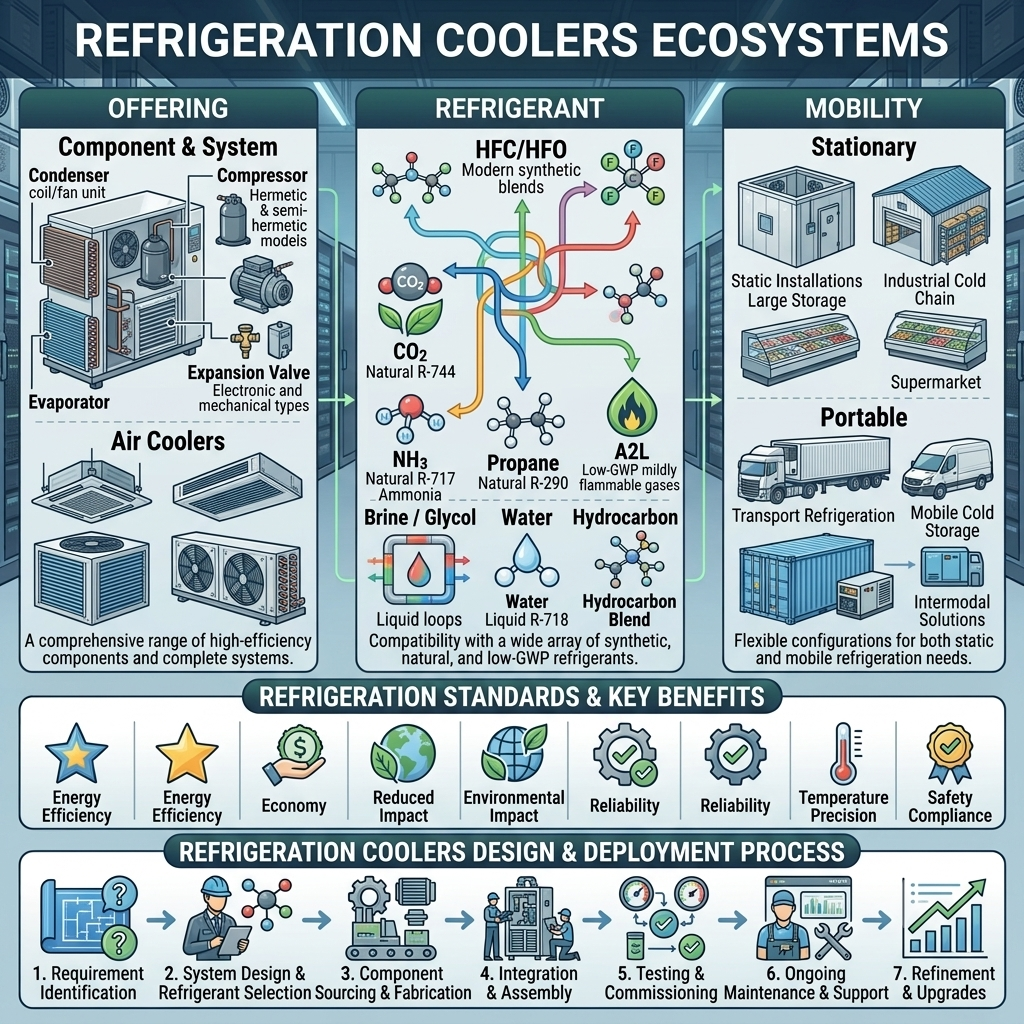
This transition is encouraging the adoption of natural refrigerants such as CO₂, ammonia (NH₃), and propane, alongside low-GWP refrigerant alternatives. MarketsandMarkets identifies increasing adoption of natural and low-GWP refrigerants as a major trend influencing the industry.
CO₂ is expected to be among the fastest-growing refrigerant segments during the forecast period because of its very low global warming potential and suitability for sustainable refrigeration applications.
For equipment manufacturers, this transition creates opportunities to develop condensers, compressors, evaporators, controls, and complete refrigeration systems optimized for natural refrigerants.
Download PDF Brochure @ https://www.marketsandmarkets.com/pdfdownloadNew.asp?id=250448757
Energy Efficiency Creates New Market Potential
Energy consumption represents a major portion of the operating costs associated with refrigeration infrastructure. Consequently, businesses are increasingly looking for systems capable of delivering high cooling performance with lower energy requirements.
This trend is creating important Refrigeration Coolers Market Opportunities for advanced heat exchangers, high-efficiency compressors, optimized evaporators, variable-speed technologies, intelligent controls, and energy-management systems.
Technological advances are also improving heat-transfer performance. According to MarketsandMarkets, innovations include microchannel heat-exchanger configurations, smaller internal circuit volumes, and customized cooler designs developed for specific refrigerants and operating environments.
These innovations can help manufacturers differentiate products while enabling end users to reduce lifecycle costs.
Evaporators and Air Coolers Present Attractive Opportunities
By offering, evaporators and air coolers are expected to register the highest CAGR during the forecast period. Increasing demand for efficient temperature control across cold storage, food processing, retail, and pharmaceutical applications is supporting this growth.
Evaporators are essential for transferring heat from the environment or product being cooled to the refrigerant. Improvements in heat-exchange surfaces, airflow management, materials, and system design can improve overall refrigeration efficiency.
For suppliers, the opportunity extends beyond basic equipment. Intelligent evaporators and air coolers incorporating digital monitoring and advanced controls can provide greater visibility into system performance.
IoT Opens the Door to Intelligent Refrigeration
Another important area of Refrigeration Coolers Market Opportunities is the integration of IoT and connected technologies.
IoT-enabled refrigeration systems can continuously monitor temperature, pressure, energy consumption, equipment status, and other operating parameters. Connected monitoring can help operators identify abnormalities before they lead to system failures or product losses.
MarketsandMarkets highlights IoT adoption in refrigeration technologies as a key opportunity. Intelligent monitoring and predictive maintenance capabilities are helping move refrigeration from conventional equipment toward connected infrastructure.
AI can further enhance these capabilities by analyzing operational data to identify patterns and support predictive maintenance. This can help operators move from reactive repairs toward proactive equipment management.
FMCG Demand Creates Significant Opportunities
The growing consumption of fast-moving consumer goods (FMCG), particularly frozen foods, packaged products, beverages, dairy, and fresh produce, is creating another major area of Refrigeration Coolers Market Opportunities.
As consumers increasingly purchase refrigerated and frozen products, retailers and food processors need dependable cooling infrastructure. Supermarkets, convenience stores, hypermarkets, restaurants, and food distribution centers are investing in modern refrigeration systems to maintain product quality.
MarketsandMarkets identifies increased FMCG demand as a key opportunity for the refrigeration coolers industry.
Retail Emerges as a High-Growth Application
The retail segment is expected to register the highest CAGR among applications during the forecast period. Expanding supermarkets, convenience stores, hypermarkets, and hospitality establishments are increasing demand for refrigeration systems capable of delivering reliable temperature control and energy efficiency.
Modern retailers are also looking for smart refrigeration solutions that can monitor equipment performance and reduce energy consumption.
This creates opportunities for suppliers that can combine refrigeration hardware with digital monitoring, remote diagnostics, automation, and energy-management capabilities.
Pharmaceutical Cold Chain Creates High-Value Opportunities
Healthcare and pharmaceutical applications represent another important area of Refrigeration Coolers Market Opportunities.
Temperature-sensitive medicines, vaccines, biological products, and pharmaceutical ingredients require tightly controlled storage and transportation conditions. The expansion of pharmaceutical cold chains is therefore generating demand for reliable and precise refrigeration equipment.
Unlike conventional food storage, pharmaceutical applications can require strict temperature stability and monitoring. Connected refrigeration systems can provide continuous monitoring and alerts, helping operators respond quickly when temperatures move outside acceptable ranges.
The increasing globalization of pharmaceutical manufacturing and distribution is expected to further support investment in temperature-controlled infrastructure.
Stationary Systems Continue to Dominate
By mobility, stationary refrigeration coolers are expected to dominate the market during the forecast period. These systems are widely used in supermarkets, warehouses, food-processing facilities, pharmaceutical storage, hospitality, and industrial refrigeration applications.
Stationary systems offer continuous, high-capacity cooling and are suitable for permanent installations. Their widespread deployment creates opportunities for manufacturers providing scalable and energy-efficient systems.
Portable refrigeration coolers, meanwhile, can serve applications requiring mobility and temporary temperature-controlled environments, creating additional niche opportunities.
Asia Pacific Offers Significant Growth Potential
Asia Pacific is expected to be the fastest-growing regional market for refrigeration coolers. Rapid industrialization, expanding cold-chain infrastructure, increasing food-processing activity, and rising pharmaceutical storage requirements are contributing to regional demand.
Investments across China, India, Japan, and Southeast Asia are supporting supermarkets, refrigerated warehouses, food-processing facilities, logistics networks, and pharmaceutical infrastructure.
For market participants, this creates opportunities across equipment manufacturing, installation, system integration, maintenance, and digital refrigeration services.
Digital Monitoring and Predictive Maintenance
The future of Refrigeration Coolers Market Opportunities will increasingly depend on digital technologies.
Connected systems can collect operational information from refrigeration components and send it to centralized platforms for analysis. Operators can use this information to identify energy inefficiencies, equipment degradation, temperature fluctuations, and maintenance requirements.
Predictive maintenance can potentially reduce unexpected failures and extend equipment life. It can also reduce product losses caused by refrigeration breakdowns.
MarketsandMarkets highlights intelligent monitoring and predictive maintenance as important developments reshaping the refrigeration coolers industry.
Challenges Could Influence Adoption
Despite significant Refrigeration Coolers Market Opportunities, high installation and operating costs remain a key restraint. Initial investments can include refrigeration equipment, piping, controls, electrical infrastructure, and specialized systems compatible with natural refrigerants.
Energy consumption, maintenance, and servicing requirements also contribute to total ownership costs.
Another challenge is the shortage of skilled personnel. Refrigeration systems using ammonia and propane require specialized expertise because of installation, servicing, and safety considerations.
Industry participants that provide training, remote diagnostics, simplified maintenance, and safer system designs can therefore gain an advantage.
Competitive Landscape
The competitive environment includes global refrigeration and thermal-management companies such as Johnson Controls, LU-VE, Kelvion Holdings, Rivacold, Lennox International, Güntner, Copeland, Danfoss, Modine Manufacturing, and EVAPCO.
Companies are increasingly competing through energy efficiency, sustainable refrigerant compatibility, intelligent controls, product customization, and digital services.
Recent industry developments also demonstrate the convergence between refrigeration and intelligent thermal management. For example, MarketsandMarkets reports developments involving AI-enabled controllers, cloud-based refrigeration solutions, high-efficiency cooling technologies, and advanced thermal-management systems.
Future Outlook
The future of the Refrigeration Coolers Market Opportunities will be shaped by the convergence of sustainability, energy efficiency, digitalization, and cold-chain expansion.
Refrigeration coolers are evolving from conventional mechanical systems into intelligent, connected, and environmentally optimized platforms. Natural refrigerants, IoT monitoring, predictive maintenance, advanced heat exchangers, and high-efficiency compressors and evaporators will increasingly influence product development.
The expansion of food retail, FMCG consumption, pharmaceutical logistics, refrigerated warehousing, and e-commerce will provide sustained demand for temperature-controlled infrastructure.
With the global market expected to reach USD 6.85 billion by 2032, companies that invest in sustainable refrigerants, energy-efficient technologies, connected monitoring, and application-specific cooling solutions can position themselves to capture emerging Refrigeration Coolers Market Opportunities.
Ultimately, the next phase of the industry will not be defined simply by how effectively refrigeration systems cool products. It will be defined by how efficiently, intelligently, sustainably, and reliably they manage temperature across increasingly complex global cold chains.