The rapid expansion of artificial intelligence (AI), cloud computing, high-performance computing, edge infrastructure, and digital services is transforming the global data center industry. As data centers become more complex and energy-intensive, operators are increasingly adopting advanced monitoring and automation technologies to improve reliability, efficiency, security, and operational visibility. Supervisory Control and Data Acquisition (SCADA) systems are emerging as an important technology for managing critical data center infrastructure.
The SCADA in data center market is projected to grow from USD 3.90 billion in 2025 to USD 9.13 billion by 2032, at a CAGR of 12.9% during the forecast period. Market expansion is being supported by the rapid deployment of AI-ready data centers, growing operational complexity in hyperscale facilities, and increasing demand for centralized monitoring of power, cooling, energy consumption, and infrastructure performance.
SCADA systems provide centralized visibility and control over critical infrastructure components. In data center environments, they can monitor electrical systems, cooling equipment, environmental conditions, sensors, meters, and other operational assets. The integration of SCADA with data center infrastructure management (DCIM), building management systems (BMS), AI analytics, and IoT is creating more intelligent and automated operating environments.
SCADA in Data Center Market Growth Drivers
One of the major growth drivers for the SCADA in Data Center Market is the increasing complexity of modern data center infrastructure. Conventional enterprise facilities are being supplemented by hyperscale, colocation, edge, and AI-focused data centers that contain thousands of interconnected assets.
Data center operators require continuous visibility into infrastructure conditions to maintain uptime and prevent operational disruptions. SCADA platforms can aggregate data from sensors, programmable logic controllers (PLCs), remote terminal units (RTUs), power meters, cooling systems, and other equipment into centralized monitoring environments.
The rapid expansion of AI workloads is adding another layer of complexity. AI servers and accelerated computing systems can require substantially greater power and cooling capacity than conventional workloads. Consequently, operators need intelligent monitoring and control systems capable of tracking power consumption, thermal conditions, cooling performance, and equipment status in real time.
The increasing importance of operational continuity is also supporting SCADA adoption. Data centers support critical applications across cloud computing, financial services, healthcare, telecommunications, government, and enterprise IT. Continuous monitoring and automated alerts can help operators identify abnormal conditions and respond more quickly.
Download PDF Brochure @ https://www.marketsandmarkets.com/pdfdownloadNew.asp?id=79684683
AI-Ready Data Centers Accelerate SCADA Adoption
AI is becoming one of the most important forces influencing data center infrastructure. Training and running advanced AI models require high-performance computing systems that can significantly increase power density and thermal loads.
AI-ready data centers therefore require sophisticated infrastructure management. SCADA platforms can provide real-time data related to electrical distribution, cooling systems, environmental conditions, and equipment performance.
AI can also enhance SCADA functionality. Machine learning algorithms can analyze operational data to identify patterns, detect anomalies, predict equipment failures, and recommend optimization strategies.
For example, an AI-enabled SCADA platform could identify unusual energy consumption from a cooling system and alert operators before the issue develops into a larger operational problem. Predictive analytics can also help determine when equipment requires maintenance based on performance trends rather than fixed maintenance schedules.
The combination of SCADA and AI is therefore moving data center management from reactive monitoring toward predictive and increasingly autonomous operations.
Integration of SCADA, DCIM, and BMS
The convergence of SCADA, DCIM, and BMS platforms is an important trend in the market. Historically, data center electrical, mechanical, building, and IT systems were frequently managed through separate platforms.
Modern facilities increasingly require integrated visibility across these environments. SCADA can provide industrial-grade monitoring and control, while DCIM platforms offer broader visibility into data center infrastructure and IT assets. BMS platforms support building and facility management.
Integration between these systems can create a unified operational environment. Operators can monitor power, cooling, environmental conditions, equipment status, and other parameters through centralized dashboards.
This convergence can also improve decision-making. Instead of analyzing isolated datasets, operators can correlate information across infrastructure systems to identify the causes of performance issues.
MarketsandMarkets identifies the convergence of SCADA, DCIM, and BMS as a major trend shaping the SCADA in Data Center Market.
Power Monitoring and Energy Management
Power management is becoming increasingly important as data center electricity consumption rises. High-density AI infrastructure is intensifying demand for reliable and efficient power distribution.
SCADA platforms can monitor power generation, distribution, UPS systems, switchgear, power quality, and energy consumption. This real-time visibility enables operators to identify inefficiencies and optimize infrastructure performance.
Energy management is also closely connected to sustainability objectives. Data center operators are increasingly seeking ways to reduce electricity consumption, improve power utilization, and integrate renewable energy sources.
SCADA systems can support these initiatives by collecting real-time energy data and enabling automated responses based on operational conditions.
The growing focus on energy efficiency and sustainability is therefore creating significant opportunities for SCADA providers.
Cooling and Thermal Management
Cooling represents another major application area for SCADA in data centers. As compute density increases, effective thermal management becomes critical to maintaining equipment reliability and operational continuity.
Traditional air cooling systems are increasingly being supplemented or replaced by advanced technologies, including liquid cooling, immersion cooling, and high-efficiency cooling systems.
SCADA platforms can monitor temperature, humidity, airflow, cooling equipment, pumps, valves, and other parameters. This enables operators to understand thermal conditions across the facility and respond to changes in real time.
AI-enabled analytics can further improve cooling optimization by identifying relationships between computing workloads, temperature, energy consumption, and cooling-system performance.
The increasing deployment of AI data centers is therefore expected to accelerate demand for intelligent cooling monitoring and control.
Predictive Maintenance Creates New Opportunities
Predictive maintenance is becoming a major opportunity in the SCADA in Data Center Market. Conventional maintenance approaches often rely on fixed schedules or reactive responses after equipment failure.
SCADA systems generate continuous operational data that can be analyzed to identify early signs of equipment degradation. When combined with machine learning, this information can support predictive maintenance strategies.
For example, changes in equipment temperature, vibration, power consumption, or operating performance could indicate an emerging problem. Operators can receive alerts and schedule maintenance before the issue causes downtime.
Predictive maintenance can potentially improve equipment availability, extend asset lifecycles, and reduce unplanned maintenance costs.
Cloud-Based and Hybrid SCADA Deployment
Cloud-based SCADA is gaining attention as data center operators seek scalable and remotely accessible monitoring platforms. Cloud architectures can provide centralized visibility across geographically distributed infrastructure.
This is particularly important for operators managing multiple facilities or edge data centers. Rather than maintaining independent monitoring systems at every location, organizations can use centralized platforms to monitor infrastructure across multiple sites.
However, many critical data center operations continue to require local control and rapid response. This is encouraging the adoption of hybrid architectures that combine on-premises control with cloud-based analytics and remote monitoring.
Hybrid SCADA can provide the benefits of cloud analytics while maintaining local operational control for critical infrastructure.
Edge Data Centers Create New Market Opportunities
Edge computing is creating another growth opportunity for SCADA solutions. Edge data centers are typically smaller and geographically distributed compared with hyperscale facilities.
Because edge facilities may have limited on-site technical staff, remote monitoring and automation become particularly important. SCADA platforms can allow operators to monitor power, cooling, environmental conditions, and equipment status remotely.
Cloud-connected and lightweight SCADA architectures are well suited to this environment. Operators can manage multiple geographically dispersed sites from centralized operations centers.
As applications such as autonomous vehicles, industrial IoT, 5G, smart cities, and real-time analytics drive edge computing deployment, demand for remote infrastructure monitoring is expected to increase.
Digital Twins Transforming Data Center Management
Digital twin technology is emerging as an important innovation in advanced data center operations. A digital twin creates a virtual representation of physical infrastructure and can use real-time data to simulate and analyze facility performance.
When SCADA data is integrated into a digital twin, operators can gain deeper visibility into infrastructure behavior. They can simulate cooling performance, power distribution, equipment utilization, and other operational scenarios.
Digital twins can also support capacity planning. Operators can model the impact of adding new computing equipment before making physical changes to a facility.
The combination of SCADA, AI, IoT, and digital twins could enable increasingly sophisticated data center optimization.
Cybersecurity Becomes a Strategic Priority
As SCADA systems become more connected to enterprise networks, cloud platforms, and IoT devices, cybersecurity is becoming increasingly important.
Data centers are critical digital infrastructure, and disruptions to operational technology can affect power, cooling, and other essential systems. Operators therefore require secure SCADA architectures with network segmentation, authentication, access controls, secure remote access, monitoring, and anomaly detection.
The convergence of IT and operational technology is increasing the need for cybersecurity strategies that address both environments.
Future SCADA platforms are expected to place greater emphasis on cybersecurity-by-design and secure integration with cloud, DCIM, and enterprise systems.
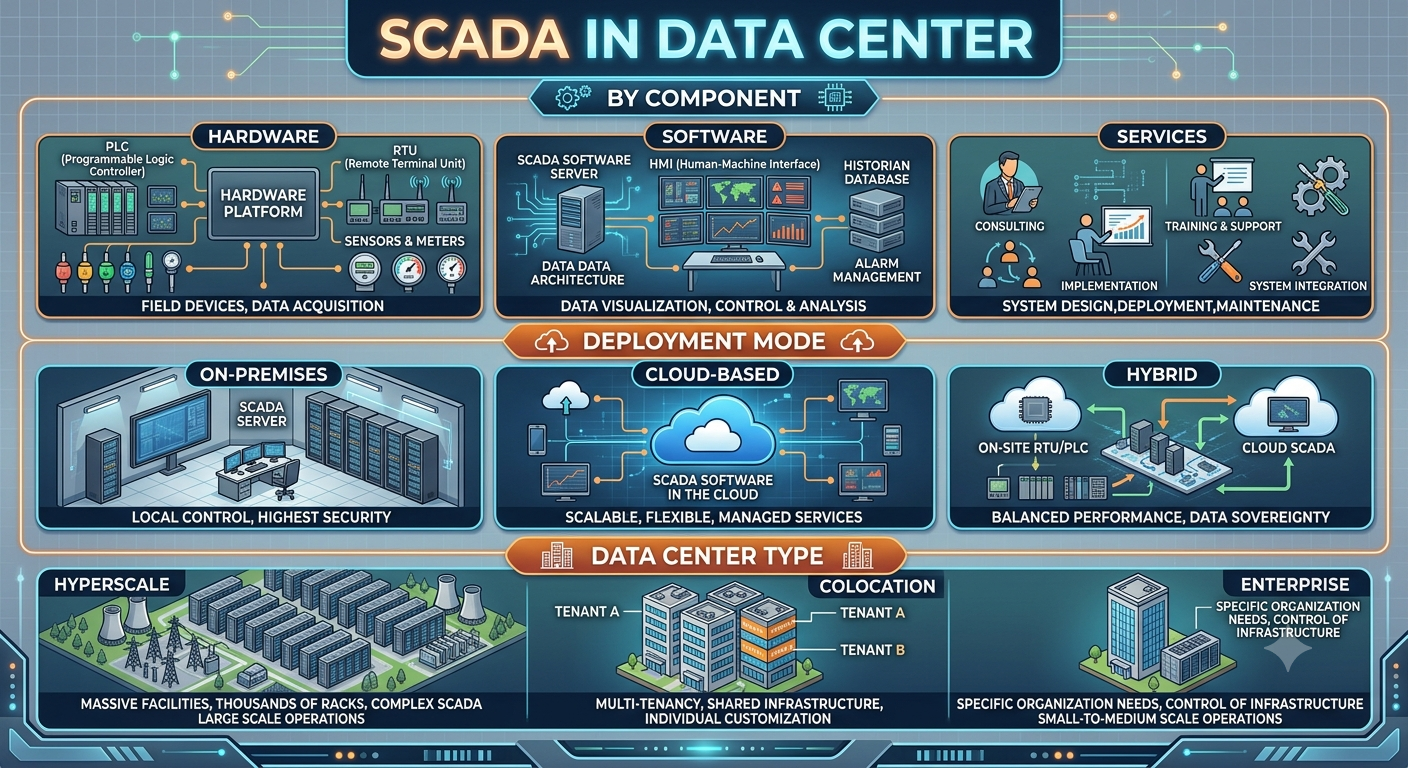
SCADA in Data Center Market by Component
The market is segmented into hardware, software, and services. Hardware includes PLCs, RTUs, sensors, and meters that collect and transmit infrastructure data.
Software provides visualization, monitoring, analytics, reporting, control, and data management capabilities. AI-enabled analytics software is becoming increasingly important as operators seek predictive insights rather than basic monitoring.
Services include consulting, system integration, implementation, maintenance, support, and managed services. Integration services are particularly important because data centers frequently contain equipment from multiple manufacturers and technology generations.
SCADA in Data Center Market by Deployment Mode
The market includes on-premises, cloud-based, and hybrid deployment models.
On-premises SCADA remains important for organizations requiring direct control over critical infrastructure and operational data. Cloud-based deployment is gaining momentum because of scalability and remote accessibility.
Hybrid deployment provides a balance between local control and cloud-based analytics. This model is particularly relevant for organizations managing multiple facilities or geographically distributed edge infrastructure.
SCADA in Data Center Market by Data Center Type
SCADA adoption varies across hyperscale, colocation, and enterprise data centers.
Hyperscale facilities represent an important market because of their size, infrastructure complexity, and significant power and cooling requirements. Colocation facilities are also adopting advanced monitoring systems to improve operational visibility and provide greater transparency to customers.
Enterprise data centers are modernizing their infrastructure as businesses adopt hybrid cloud, AI, analytics, and other digital technologies.
Edge and modular data centers represent emerging opportunities because their distributed nature increases the need for centralized and remote monitoring.
SCADA in Data Center Market by Application
Major applications include power monitoring and energy management, cooling and HVAC management, security and access control, asset monitoring, predictive maintenance, and environmental monitoring.
Power and cooling applications are becoming particularly important as AI workloads increase infrastructure density. Predictive maintenance is also gaining importance as operators seek to minimize downtime and improve asset utilization.
Environmental monitoring helps operators track temperature, humidity, airflow, and other conditions that can affect equipment performance.
Regional Outlook
North America remains a major market for SCADA in data centers because of its concentration of hyperscale cloud providers, advanced data center infrastructure, and strong adoption of automation technologies. The region benefits from substantial AI infrastructure investment and an established ecosystem of data center technology providers.
Asia Pacific is emerging as a high-growth region. China, India, Japan, South Korea, Singapore, and Australia are experiencing increasing investment in cloud infrastructure, AI computing, telecommunications, and digital services. The expansion of hyperscale and edge facilities is creating new demand for intelligent infrastructure monitoring.
Europe is emphasizing energy efficiency, sustainability, cybersecurity, and data sovereignty. These priorities are encouraging data center operators to invest in advanced monitoring and energy management solutions.
Markets in the Middle East and Latin America are also attracting investment as governments and enterprises expand digital infrastructure and cloud adoption.
Competitive Landscape
The SCADA in Data Center Market includes industrial automation companies, electrical infrastructure providers, data center technology companies, and software providers.
Key companies identified in the current MarketsandMarkets market landscape include Schneider Electric, Siemens, Vertiv, ABB, Honeywell, Emerson Electric, Rockwell Automation, Eaton, Johnson Controls, and Delta Electronics.
Competition is increasingly focused on integrated platforms rather than standalone monitoring products. Vendors are combining SCADA with DCIM, energy management, AI analytics, cybersecurity, and predictive maintenance capabilities.
Partnerships and technology integrations are also becoming important as operators seek unified infrastructure management across increasingly complex data center environments.
Key Opportunities in the SCADA in Data Center Market
Several opportunities are expected to shape the next phase of market development. AI-ready data centers require sophisticated power and cooling management, creating demand for intelligent supervisory systems.
The growth of edge computing provides opportunities for cloud-connected and remotely managed SCADA platforms. Digital twins offer another opportunity by enabling simulation-based infrastructure optimization.
Sustainability is also creating demand for energy monitoring, renewable energy integration, intelligent cooling, and carbon management.
Finally, the convergence of SCADA, DCIM, BMS, AI, and IoT provides opportunities for vendors to develop unified platforms capable of supporting increasingly autonomous data center operations.
Future Outlook
The future of the SCADA in Data Center Market will be closely connected to the evolution of AI infrastructure, cloud computing, edge computing, and sustainable digital infrastructure.
SCADA systems are evolving from traditional monitoring platforms into intelligent operational systems that can combine real-time telemetry, predictive analytics, automation, and centralized control.
The integration of AI will enable data centers to identify anomalies, predict equipment failures, optimize energy consumption, and automate infrastructure responses. IoT will provide increasingly granular data from sensors and connected equipment, while digital twins will enable simulation and optimization.
The transition toward autonomous data center operations is likely to be gradual, but the underlying technologies are developing rapidly. MarketsandMarkets notes that future SCADA applications will increasingly leverage AI and digital twins to support autonomous operations and real-time optimization.
The SCADA in Data Center Market is becoming an increasingly important part of modern digital infrastructure management. The market is projected to increase from USD 3.90 billion in 2025 to USD 9.13 billion by 2032, reflecting a CAGR of 12.9%.
The expansion of AI-ready data centers, increasing power and cooling requirements, growing adoption of predictive maintenance, edge computing, sustainability initiatives, and the convergence of SCADA with DCIM and BMS are creating substantial growth opportunities.
As data centers become more complex, operators will increasingly require intelligent systems capable of providing real-time visibility, predictive insights, and automated control. The convergence of SCADA, AI, IoT, digital twins, cloud computing, and cybersecurity is expected to shape the next generation of intelligent data center infrastructure.
