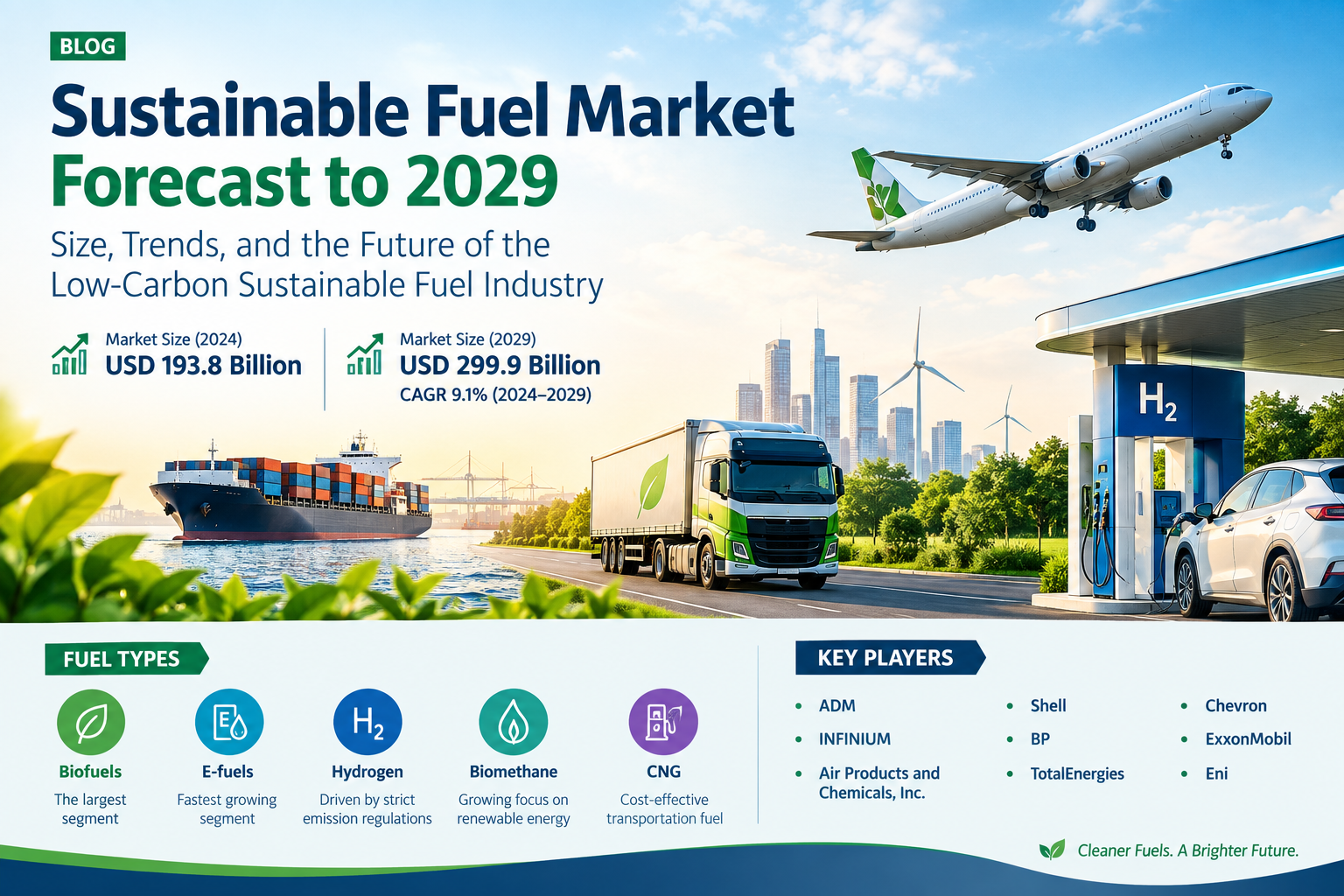
The global transportation sector is under growing pressure to cut emissions as governments, fuel producers, and end users work toward net-zero targets. Against this backdrop, the Sustainable Fuel Market is emerging as a central pillar of the energy transition. The market was valued at USD 193.8 billion in 2024 and is projected to reach USD 299.9 billion by 2029, growing at a CAGR of 9.1% from 2024 to 2029. Rising climate concerns, stricter emission regulations, and the push to reduce dependence on fossil fuels are shaping the sustainable fuel industry and its long-term outlook.
Sustainable Fuel Industry at the Center of Transport Decarbonization
Sustainable fuels are low- or zero-emission fuels that produce fewer greenhouse gas emissions than conventional fossil fuels when combusted. The sustainable fuel industry includes biofuels, e-fuels, hydrogen, biomethane, and other alternatives. Together they serve road transportation, aviation, and marine applications.
Most transportation still depends on gasoline and diesel, which release carbon dioxide into the atmosphere. According to the United Nations Environment Programme (UNEP), the transportation sector accounts for approximately one-quarter of all energy-related greenhouse gas emissions. The International Energy Agency (IEA) notes that CO2 emissions from fossil fuel combustion in the road sector rose by 200 million metric tons between 2015 and 2022. To stay on track with the IEA Net Zero Emissions by 2050 Scenario, emissions must fall by about one-third by 2030. This gap is a major driver of sustainable fuel market growth.
Download PDF Brochure : https://www.marketsandmarkets.com/pdfdownloadNew.asp?id=68114533
Sustainable Fuel Market Size and Growth Outlook
The sustainable fuel market size reflects strong momentum across fuel types and end-use sectors. Three factors are supporting steady expansion through 2029:
- Growing environmental concerns linked to conventional fuels
- Favorable government policies aimed at reducing greenhouse gas emissions
- Rising adoption of low-emission fuels across transport applications
The sustainable fuel market forecast points to healthy growth as demand for energy efficiency rises and economies shift toward renewable energy sources.
Government Policies and Regulations Accelerating Adoption
Regulatory support is one of the strongest forces behind the sustainable fuel industry. Mandates, tax credits, and financial incentives are encouraging production and adoption of cleaner fuels. North America is expected to be the largest regional market, supported by government tax credits and financial benefits. Stringent pollution control regulations and efforts to reduce greenhouse gas emissions are also strengthening demand there.
In the marine sector, tighter emission standards are pushing shipping operators toward cleaner fuels. According to the United Nations, around 80% of global trade relies on maritime shipping, which contributes nearly 3% of total global greenhouse gas emissions. Reaching zero CO2 emissions from ships by 2050 requires stronger standards and policies, and this is making marine the fastest-growing end user segment.
Fuel Types Shaping the Sustainable Fuel Market
The market is segmented by fuel type into biofuels, e-fuels, hydrogen, biomethane, and compressed natural gas (CNG).
- Biofuels: Expected to be the largest segment, supported by tax credits, mandates, and investments that encourage adoption. Ethanol, biodiesel, renewable diesel, and biojet all fall within this segment.
- E-fuels: Expected to be the fastest-growing segment. Government clean energy initiatives and net-zero goals are increasing their prominence as an alternative to fossil-derived fuels.
- Hydrogen: Strict emission regulations are driving demand for both blue and green hydrogen.
- Biomethane: A growing focus on renewable energy supports demand.
- Compressed Natural Gas (CNG): Demand for cost-effective transportation fuel supports this segment.
Regional Outlook: North America Leads the Sustainable Fuel Industry
North America is expected to hold the largest share of the sustainable fuel market between 2024 and 2029, followed by Asia Pacific and Europe. Rising investment in sustainable fuels, along with the presence of leading providers such as ADM, INFINIUM, and Air Products and Chemicals, Inc., is creating opportunities for sustainable fuel projects across the region.
Asia Pacific is expected to be the second-largest market, with rising adoption of alternative fuels to curb carbon emissions creating opportunities for market players over the next five years.
Key Challenges Facing the Sustainable Fuel Market
Despite its strong outlook, the sustainable fuel market faces hurdles that stakeholders must address:
- High initial capital investment: Building and operating biofuel, biomethane, e-fuel, and hydrogen plants is costly. Biorefinery installation, feedstock procurement, testing, and maintenance add to the expense, making it harder for these fuels to compete with fossil fuels.
- Limited commercial availability of sustainable fuel-powered vehicles: According to the IEA’s Global EV Outlook 2023, there were approximately 72,000 fuel cell electric vehicles worldwide in 2022. Hydrogen-powered vehicles remain at an early stage of commercialization.
- Emerging market readiness: Developing countries such as India and Brazil are still in the early stages of development. Flex-fuel vehicles that run on gasoline-ethanol blends of up to 83% are gaining focus in countries including the US, Brazil, and the UK, while 100% biofuel-powered vehicles remain at an early stage. In August 2023, India introduced the world’s first electrified flex-fuel vehicle that can run on 100% ethanol.
Opportunities from the Transition Toward Renewable Energy
Efforts to reduce carbon footprints have accelerated the adoption of clean and sustainable energy alternatives. Rapid industrialization and urbanization are raising energy demand and speeding the move to renewable sources such as biomass, hydroelectric, and geothermal power. Vehicles can run on biofuels such as ethanol and biodiesel derived from renewable biomass, and hydrogen fuel cells can use green hydrogen.
According to the IEA, biofuels and renewable electricity could reduce oil demand in the transportation sector by nearly 4 million barrels of oil equivalent per day by 2028. This would help limit the global carbon footprint and greenhouse gas emissions.
Emerging Sustainable Fuel Market Trends
Several trends are influencing the sustainable fuel industry over the forecast period:
Rapid Growth of E-Fuels
Government clean energy initiatives and net-zero commitments are increasing interest in e-fuels, which are expected to be the fastest-growing fuel type through 2029.
Marine Sector Decarbonization
Strict emission regulations in shipping are driving the marine end user segment toward sustainable fuels, making it the fastest-growing segment by end user.
Biofuel Mandates and Tax Incentives
Supportive policies, mandates, and tax credits continue to reinforce the position of biofuels as the largest fuel type segment.
Hydrogen and Biomethane Development
Stricter emission rules and a growing focus on renewable energy are supporting hydrogen and biomethane, along with the technologies behind them, such as electrolysis and biogas upgrading.
Rising Investment in North America
Increased investment in sustainable fuel projects and the presence of leading providers are strengthening the region’s position as the largest market.
Strategic Partnerships and Capacity Expansion
Industry players are entering collaborations and expanding production capacity. In May 2024, TotalEnergies and SINOPEC joined forces to develop a 230,000 tons per year sustainable aviation fuel (SAF) production unit at a SINOPEC refinery in China. In March 2024, Gasum and the Norwegian Road Transport Association (NLF) signed a collaboration agreement to promote biogas as an alternative to fossil fuels.
Explore In-Depth Industry Analysis: https://www.marketsandmarkets.com/Market-Reports/sustainable-fuel-market-68114533.html
Key Market Players
The sustainable fuel industry features established and financially strong suppliers with diverse product ranges, advanced technologies, and strong global sales and marketing networks. Prominent companies include ADM (US), Shell plc (UK), Saudi Arabian Oil Co. (Saudi Arabia), Siemens Energy (Germany), and Chevron Corporation (US). Other players active in the market include Air Liquide, Linde PLC, Air Products and Chemicals, Inc., Neste, Valero, TotalEnergies, BP p.l.c., Repsol, and Indian Oil Corporation Ltd.