The report “Relay Market by Type (Electromechanical, Thermal, Reed, Time, Solid State), Voltage (Low, Medium, High), Application (Protection, Monitor, Control), Vertical (Residential & Commercial, Industrial, Energy), Mounting Type, & Region – Global Forecast to 2031″ is projected to grow from USD 11.75 billion in 2026 to USD 15.65 billion by 2031, at a CAGR of 5.0% during the forecast period.
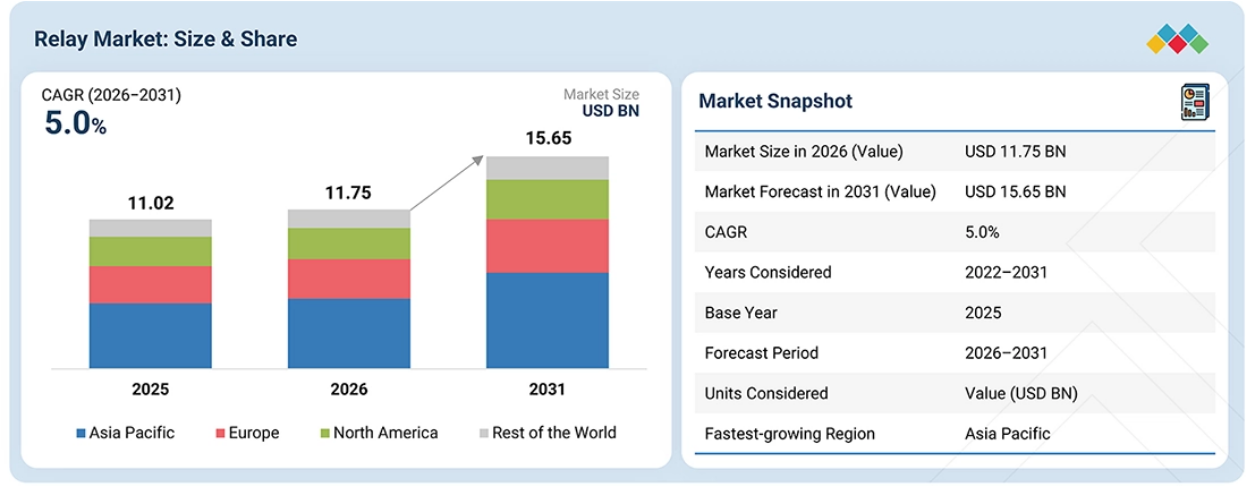
The global Relay market is experiencing steady growth, driven by increasing investments in industrial automation, power transmission and distribution infrastructure, renewable energy integration, electric mobility, and smart electrical systems. The expansion of manufacturing automation, data centers, EV charging infrastructure, and digitalized power networks is increasing the deployment of relays for switching, protection, control, and isolation applications. In addition, growing electricity demand and grid modernization initiatives are creating opportunities for relays across utility, industrial, automotive, and commercial applications.
The market is also being shaped by increasing demand for higher switching capacity, compact designs, improved reliability, and advanced protection capabilities. Electromechanical relays continue to account for a significant share due to their established use across industrial and power applications, while high-voltage relays are gaining traction as electrification expands across EVs, battery energy storage, renewable energy systems, and high-voltage electrical equipment. Technological developments in solid-state, reed, and high-voltage relays are further supporting demand for application-specific switching solutions.
Download PDF Brochure @ https://www.marketsandmarkets.com/pdfdownloadNew.asp?id=58206549
Electromechanical relays are expected to account for the largest share of the relay market, by type, during the forecast period.
Electromechanical relays are expected to account for the largest share of the Relay market by type during the forecast period, supported by their widespread adoption across industrial automation, power systems, automotive, HVAC, building equipment, and electrical control applications. These relays provide established switching performance, electrical isolation, mechanical robustness, and compatibility with a broad range of AC and DC electrical systems. Their extensive installed base, availability across different contact configurations and power ratings, and relatively simple operating mechanism continue to support demand across both new installations and replacement applications. Increasing investments in industrial automation, control panels, power distribution equipment, and manufacturing infrastructure are expected to further sustain their adoption. Although solid-state, reed, and other advanced relay technologies are gaining traction in specialized applications requiring faster switching, compact designs, and higher switching frequency, electromechanical relays are expected to maintain their market position due to their broad application base, cost competitiveness, established supply chain, and proven reliability.
High-voltage relays are expected to register the highest CAGR in the relay market, by voltage, during the forecast period.
High-voltage relays are expected to register the highest growth rate during the forecast period, supported by increasing electrification across automotive, energy, industrial, and power applications. The rapid adoption of EVs, battery energy storage systems, renewable energy installations, and high-voltage charging infrastructure is driving demand for relays that can safely switch, control, and isolate high-voltage electrical circuits. High-voltage relays are increasingly used in battery management systems, EV powertrains, DC fast-charging equipment, inverters, photovoltaic systems, energy storage systems, and power distribution equipment. The increasing voltage levels used in EV platforms and charging systems are further creating opportunities for high-voltage DC relay solutions with improved insulation, arc suppression, and switching reliability. In addition, the expansion of renewable energy generation and grid-connected storage is increasing the requirement for reliable high-voltage switching and protection components. These trends are expected to accelerate adoption of high-voltage relays across transportation, energy, and industrial applications during the forecast period.
North America is expected to be the fastest-growing region in the relay market during the forecast period.
North America is expected to be the fastest-growing region in the relay market during the forecast period, driven by investments in industrial automation, grid modernization, renewable energy, EV infrastructure, data centers, and advanced electrical systems. The US is witnessing increasing deployment of renewable power generation, battery energy storage systems, EV charging infrastructure, and data center facilities, creating additional demand for relays across power, energy, automotive, and industrial applications. Investments in modernizing aging transmission and distribution infrastructure are also supporting demand for protection, control, and switching relays used in substations and electrical equipment. In parallel, expanding domestic manufacturing and automation are increasing the deployment of relays in industrial control systems, machinery, robotics, and process automation equipment. The region’s established automotive, electronics, aerospace, and industrial manufacturing sectors, combined with increasing electrification and infrastructure investments, are expected to create additional revenue opportunities for relay manufacturers during the forecast period.
Make an Inquiry @ https://www.marketsandmarkets.com/Enquiry_Before_BuyingNew.asp?id=58206549
Key Players
Key players in the global relay market include HONGFA, TE Connectivity, OMRON Corporation, GE Vernova, Fuji Electric Co., Ltd., ABB, Schneider Electric, Standex Electronics, Inc., Sensata Technologies, Inc., Siemens, Eaton, Rockwell Automation, Mitsubishi Electric Corporation, FCL Components Limited, and Littelfuse, Inc. These companies are strengthening their market positions through product portfolio expansion, technological development, capacity expansion, strategic partnerships, and geographic expansion. The competitive landscape is increasingly influenced by demand for high-voltage, compact, reliable, and application-specific relay solutions across automotive electrification, industrial automation, renewable energy, smart grids, and power electronics applications.