The aerospace industry is experiencing significant technological transformation as aircraft manufacturers, airlines, defense organizations, and maintenance, repair, and overhaul (MRO) providers increasingly prioritize safety, reliability, and operational efficiency. Non-destructive testing (NDT) plays a critical role in this transformation by enabling the inspection of aircraft components without damaging their structural integrity. The Aerospace NDT Market Key Trends reflect the growing adoption of artificial intelligence (AI), automation, digital inspection systems, and advanced testing techniques across aircraft manufacturing and maintenance operations.
Aerospace NDT technologies help identify cracks, corrosion, material inconsistencies, structural fatigue, and other defects in aircraft components. These inspection methods are essential for ensuring airworthiness, maintaining quality standards, and complying with stringent aviation safety requirements. As aircraft designs become more sophisticated and manufacturers increasingly use lightweight composite materials, the need for accurate and efficient inspection solutions continues to grow.
According to MarketsandMarkets,The aerospace NDT market is projected to reach USD 5.69 billion by 2032 from USD 3.23 billion in 2026, at a CAGR of 9.9%. Increasing aircraft production, expansion of global fleets, growing MRO activities, and advancements in inspection technologies are supporting this growth.
Among the most influential Aerospace NDT Market Key Trends are AI-powered defect detection, automated inspection equipment, digital radiography, advanced ultrasonic testing, robotics, and data-driven predictive maintenance. These innovations are transforming conventional inspection procedures into faster, more consistent, and increasingly data-driven processes.
Artificial Intelligence Transforms Aerospace NDT Inspection
Artificial intelligence is emerging as a significant innovation in the aerospace NDT industry. Traditional inspection methods often depend on skilled technicians to interpret inspection results, identify anomalies, and determine whether components meet the required quality standards. Although human expertise remains essential, AI-based systems can help improve the consistency and speed of analyzing complex inspection data.
AI algorithms can analyze digital radiographic images, ultrasonic signals, and other inspection outputs to identify patterns associated with cracks, voids, corrosion, and material defects. Machine learning models trained on suitable inspection datasets can assist technicians in recognizing potential defects and prioritizing components that require further examination.
This capability is particularly valuable in aerospace manufacturing, where inspection accuracy and traceability are essential. AI-supported inspection systems can help reduce repetitive manual analysis, improve defect classification, and support more consistent quality-control procedures. However, their effectiveness depends on representative training data, validation, and appropriate human oversight.
Another important development is the integration of AI with predictive maintenance. By combining historical inspection records, component usage data, and maintenance information, analytics platforms can help maintenance teams identify potential risks and plan inspections more effectively. This approach can reduce unnecessary maintenance activities while helping organizations identify emerging problems before they become serious.
The Aerospace NDT Market Key Trends associated with AI also create opportunities for software developers, inspection equipment manufacturers, and technology integrators. Companies that combine advanced sensing technologies with reliable analytics and aviation-specific expertise can develop solutions that improve inspection productivity and support long-term aircraft reliability.
Download PDF Brochure @ https://www.marketsandmarkets.com/pdfdownloadNew.asp?id=234773952
Automation Improves Inspection Speed and Accuracy
Automation is another major factor influencing the Aerospace NDT Market Key Trends. Aircraft contain thousands of components that require inspection during manufacturing, assembly, maintenance, and repair. Manual inspection can be time-consuming, especially when technicians must examine large structural surfaces, complex engine components, or difficult-to-access areas.
Automated NDT systems use robotic arms, programmable scanning equipment, mechanized probes, and computer-controlled inspection platforms to conduct repeatable testing procedures. These systems can follow predefined inspection paths, collect measurement data, and generate standardized reports. This improves repeatability and can reduce the variation associated with manual operations.
Automated ultrasonic testing is particularly useful for examining aircraft structures and composite materials. Mechanized scanners can move ultrasonic probes across selected surfaces to detect internal flaws and structural inconsistencies. Phased array ultrasonic testing further supports detailed inspection by electronically controlling multiple ultrasonic elements to examine components from different angles.
Robotic inspection systems can also access areas that are difficult or hazardous for technicians to reach. In suitable applications, remotely operated equipment and drone-based inspection solutions can support examinations of large aircraft surfaces and other challenging structures.
For aircraft manufacturers and MRO providers, automation can improve inspection throughput, reduce repetitive workloads, and support more efficient resource allocation. Nevertheless, automated systems require appropriate calibration, maintenance, procedure validation, and trained operators.
As aerospace production volumes and maintenance requirements increase, automation is expected to remain one of the most important Aerospace NDT Market Key Trends, creating opportunities for robotics manufacturers, equipment suppliers, and integrated inspection solution providers.
Digital Inspection Drives Data-Based Decision-Making
Digital inspection is changing how aerospace companies collect, manage, analyze, and share non-destructive testing information. Conventional inspection processes may involve separate records, manual documentation, and disconnected reporting systems. Digital platforms can consolidate inspection results into structured records that support traceability and faster decision-making.
Digital radiography is an important part of this transformation. Unlike conventional film-based radiography, digital systems capture and process images electronically. This can reduce image-processing delays, simplify data storage, and enable inspection results to be reviewed using compatible software platforms.
Digital inspection solutions can also integrate information from ultrasonic testing, eddy current testing, visual inspection, and other NDT techniques. Centralized records help manufacturers and maintenance providers track defects, document corrective actions, and compare inspection results over time.
Cloud-based data management can make inspection information accessible to authorized teams across manufacturing facilities and maintenance locations. This is particularly useful for aerospace organizations operating across multiple sites and working with several suppliers.
Digital records also support auditability and quality assurance by helping organizations maintain documented inspection histories. When integrated with maintenance management systems, digital inspection data can improve planning, reporting, and coordination between engineering and maintenance teams.
The Aerospace NDT Market Key Trends associated with digitalization therefore extend beyond inspection equipment. They include inspection software, data integration, secure storage, reporting platforms, and analytics services that help organizations turn inspection results into actionable operational information.
Advanced Ultrasonic and Radiographic Testing Gain Importance
Advanced inspection techniques remain central to the aerospace NDT industry because aircraft components require different testing methods depending on their materials, geometry, and operating conditions.
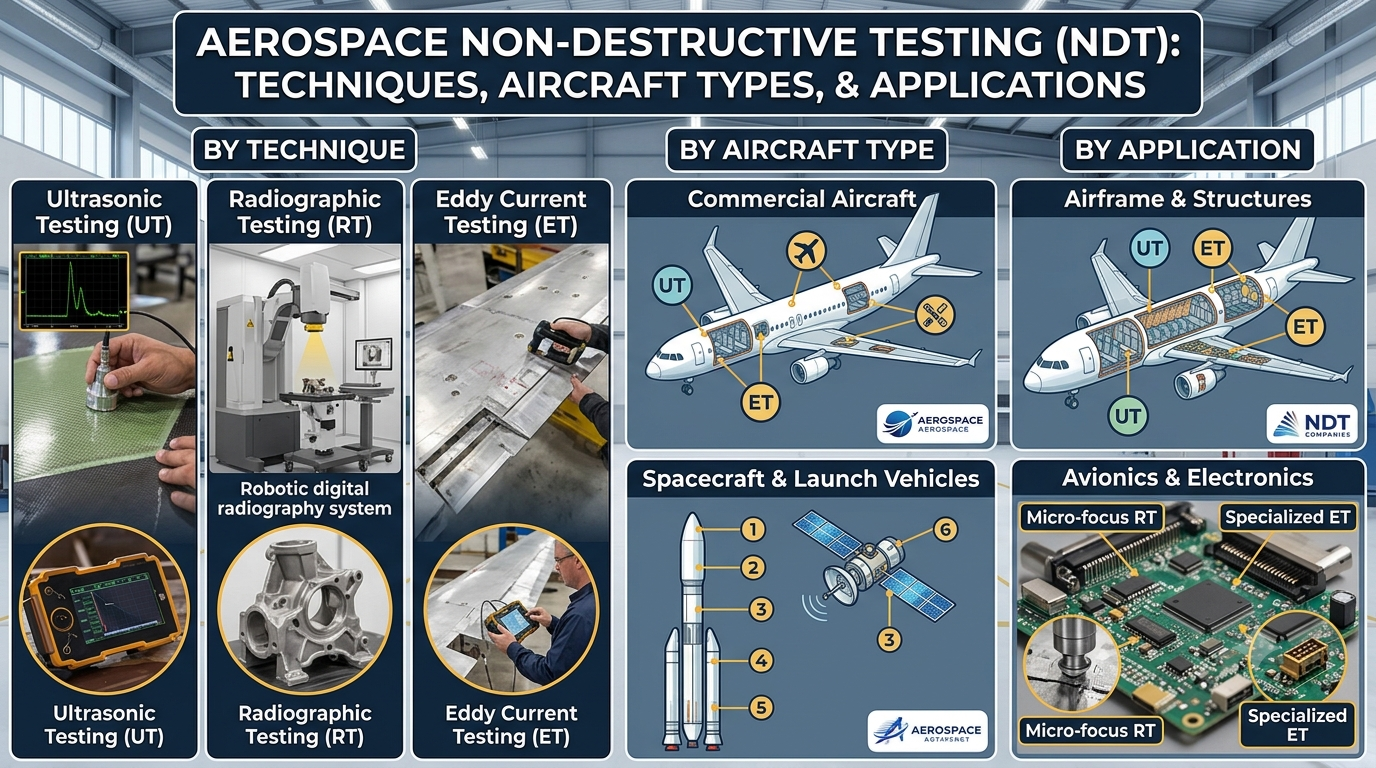
Ultrasonic testing uses high-frequency sound waves to identify internal defects and assess material characteristics. It is widely used to inspect structural components, welds, and composite materials. Phased array ultrasonic testing offers greater flexibility by allowing technicians to control inspection angles electronically and generate detailed representations of inspected areas.
Radiographic testing uses X-rays or other suitable radiation sources to reveal internal structural features and potential defects. Digital radiography and computed tomography can provide detailed information about internal geometries, making them valuable for inspecting complex aerospace components and selected additively manufactured parts.
Eddy current testing is another important technique, particularly for identifying surface and near-surface defects in electrically conductive materials. It is useful for examining aircraft structures, fasteners, and certain engine components.
Liquid penetrant testing and magnetic particle testing also support aerospace quality control, although their applicability depends on the material and the type of defect being investigated.
These techniques are complementary rather than interchangeable. Selecting the appropriate method depends on component design, material properties, inspection objectives, regulatory requirements, and approved procedures.
As aircraft manufacturers adopt advanced materials and more complex component designs, the Aerospace NDT Market Key Trends will increasingly favor inspection solutions that combine high detection capability, digital data capture, and efficient workflows.
Composite Materials Create New Inspection Opportunities
The increasing use of lightweight composite materials is reshaping aircraft design and creating additional demand for specialized NDT solutions. Composite structures can reduce aircraft weight and contribute to fuel efficiency, but they may develop defects that require carefully selected inspection techniques.
Potential defects include delamination, internal voids, impact damage, and disbonds between structural layers. Some of these problems may not be readily visible during a conventional visual inspection, making advanced testing essential.
Ultrasonic testing is widely used to evaluate composite structures, while thermography, radiographic methods, and other specialized techniques may be appropriate for particular materials and applications. The choice depends on the defect characteristics, component configuration, and approved inspection procedure.
Digital imaging and advanced data analysis can help technicians interpret complex inspection results and document damage consistently. Automated scanning systems can also improve coverage across large composite surfaces.
These developments create opportunities for equipment manufacturers and inspection service providers that specialize in composite aircraft structures. As next-generation aircraft and other aerospace platforms incorporate increasingly sophisticated materials, the demand for accurate, material-specific inspection solutions is expected to increase.
Predictive Maintenance Strengthens Aerospace NDT Demand
Predictive maintenance is becoming increasingly important as airlines and MRO providers seek to improve aircraft availability and control maintenance costs. Rather than relying exclusively on fixed schedules or reacting to failures, predictive approaches use available data to support maintenance planning and risk assessment.
Aerospace NDT contributes to this process by identifying defects and monitoring the condition of critical components. When inspection results are combined with maintenance histories, operating conditions, and other relevant information, engineering teams can make better-informed decisions about additional inspections and corrective actions.
AI and data analytics can help identify patterns across inspection records, while digital platforms make it easier to track component condition over time. These capabilities can support maintenance prioritization and help reduce avoidable delays.
However, predictive maintenance does not replace mandatory inspections, approved maintenance schedules, or regulatory requirements. Aviation organizations must continue to follow applicable airworthiness standards and use validated procedures.
The Aerospace NDT Market Key Trends related to predictive maintenance create opportunities for integrated solutions that connect inspection equipment, digital records, analytics platforms, and maintenance management systems.
Regional Growth and Competitive Landscape
Asia Pacific is expected to be a major growth region for aerospace NDT, supported by expanding aircraft fleets, increasing defense expenditure, aerospace manufacturing investments, and developing MRO infrastructure. Growing demand for commercial aviation and regional investments in aerospace capabilities are creating opportunities for inspection equipment suppliers and service providers.
North America remains important because of its established aerospace manufacturing base, defense programs, aircraft operators, and advanced testing infrastructure. Europe also represents a significant market, supported by aircraft manufacturing, engineering expertise, and demand for quality assurance across the aerospace supply chain.
According to MarketsandMarkets, major companies in the aerospace NDT market include SGS SA, Wabtec Corporation, Baker Hughes Company, Bureau Veritas, Element Materials Technology, MISTRAS Group, DEKRA, Nikon Metrology, Intertek Group, and Applus+.
These companies participate in areas such as inspection equipment, testing services, industrial measurement, quality assurance, and certification. Competition increasingly involves developing advanced testing capabilities, expanding service networks, integrating digital technologies, and delivering consistent inspection results.
Partnerships between equipment manufacturers, software developers, aerospace OEMs, and MRO providers can also accelerate the adoption of innovative inspection systems.
Challenges Affecting Aerospace NDT Market Key Trends
Despite strong growth opportunities, the aerospace NDT industry faces several challenges. Advanced inspection equipment, automated scanning systems, and digital infrastructure can require substantial initial investment. Smaller service providers may find it difficult to justify these expenses without sufficient inspection volumes or clear productivity benefits.
A shortage of experienced technicians can also slow adoption. Advanced inspection technologies require personnel with appropriate technical knowledge, training, and certification. Organizations must invest in workforce development as inspection methods and aircraft materials evolve.
Data management and system integration present additional challenges. Combining results from different inspection techniques and equipment vendors requires compatible formats, reliable workflows, and appropriate cybersecurity controls. AI-based inspection systems also require careful validation to demonstrate that their outputs are reliable for the intended application.
Finally, rapidly evolving materials, manufacturing processes, and inspection technologies require continuing updates to equipment, procedures, and employee skills. Companies must balance innovation with safety, reliability, and regulatory compliance.
Future Outlook for Aerospace NDT Market Key Trends
The future of aerospace NDT will be shaped by the convergence of AI, automation, digital inspection, advanced materials, and predictive analytics. These technologies are expected to support more efficient inspection workflows, improved data traceability, and increasingly sophisticated defect analysis.
Potential opportunities include AI-assisted image interpretation, robotic inspection of complex structures, digital radiography, automated ultrasonic scanning, and integrated inspection management platforms. Continued investment in aerospace manufacturing, aircraft maintenance, defense aviation, and commercial space activities may further expand demand for specialized NDT solutions.
For industry participants, the strongest opportunities will involve technologies that solve practical inspection challenges while meeting rigorous safety and quality requirements. Equipment manufacturers can focus on accuracy and automation, software companies can improve data analysis and traceability, and service providers can expand specialized inspection capabilities.
The Aerospace NDT Market Key Trends demonstrate how AI, automation, and digital inspection are reshaping aerospace testing and maintenance. Advanced ultrasonic testing, digital radiography, robotics, and data analytics are helping industry participants improve inspection efficiency and manage increasingly complex aircraft structures.
With the global aerospace NDT market projected to reach USD 5.69 billion by 2032, growing investment in aircraft safety, MRO services, and advanced inspection technologies presents significant opportunities for equipment manufacturers and service providers.
Although implementation costs, workforce requirements, and data integration remain important challenges, continued technological innovation is expected to strengthen the role of NDT across the aerospace lifecycle. Companies that combine reliable inspection methods with automation and validated digital solutions will be well positioned to address the evolving requirements of the global aerospace industry.
FAQs
1. What are the key trends shaping the Aerospace NDT Market?
The key trends shaping the Aerospace NDT Market include artificial intelligence (AI), automated inspection systems, digital radiography, advanced ultrasonic testing, robotics, and predictive maintenance.
2. How is AI driving Aerospace NDT Market growth?
AI is helping improve defect detection, analyze inspection data, identify potential structural issues, and support faster, more consistent quality-control processes.
3. What role does automation play in aerospace non-destructive testing?
Automation improves inspection repeatability, reduces manual workloads, and supports efficient testing of complex aircraft components, composite structures, and engine parts.
4. Which technologies are widely used in the Aerospace NDT Market?
Major technologies include ultrasonic testing, radiographic testing, eddy current testing, liquid penetrant testing, magnetic particle testing, and visual inspection.
5. What factors are driving growth in the Aerospace NDT Market?
Key growth drivers include rising aircraft production, increasing demand for maintenance, repair, and overhaul (MRO) services, stringent aviation safety requirements, greater use of composite materials, and advances in digital inspection technologies.
About MarketsandMarkets™
MarketsandMarkets™ has been recognized as one of America’s Best Management Consulting Firms by Forbes, as per their recent report.
MarketsandMarkets™ is a blue ocean alternative in growth consulting and program management, leveraging a man-machine offering to drive supernormal growth for progressive organizations in the B2B space. With the widest lens on emerging technologies, we are proficient in co-creating supernormal growth for clients across the globe.
Today, 80% of Fortune 2000 companies rely on MarketsandMarkets, and 90 of the top 100 companies in each sector trust us to accelerate their revenue growth. With a global clientele of over 13,000 organizations, we help businesses thrive in a disruptive ecosystem.
The B2B economy is witnessing the emergence of $25 trillion in new revenue streams that are replacing existing ones within this decade. We work with clients on growth programs, helping them monetize this $25 trillion opportunity through our service lines – TAM Expansion, Go-to-Market (GTM) Strategy to Execution, Market Share Gain, Account Enablement, and Thought Leadership Marketing.
Built on the ‘GIVE Growth’ principle, we collaborate with several Forbes Global 2000 B2B companies to keep them future-ready. Our insights and strategies are powered by industry experts, cutting-edge AI, and our Market Intelligence Cloud, KnowledgeStore™, which integrates research and provides ecosystem-wide visibility into revenue shifts.
To find out more, visit www.MarketsandMarkets™.com or follow us on Twitter , LinkedIn and Facebook .
Contact:
Mr. Rohan Salgarkar
MarketsandMarkets™ INC.
1615 South Congress Ave.
Suite 103, Delray Beach, FL 33445
USA: +1-888-600-6441