The global Generative AI Server Market is expanding rapidly as enterprises, hyperscale data centers, and cloud service providers invest in advanced computing infrastructure to support increasingly complex artificial intelligence workloads. The growing adoption of large language models (LLMs), AI copilots, content generation tools, and real-time inference applications is increasing demand for servers equipped with powerful processors, high-bandwidth memory, advanced networking, and efficient cooling systems.
According to MarketsandMarkets, the Generative AI Server Market is projected to grow from USD 103.92 billion in 2025 to USD 448.60 billion by 2030, registering a compound annual growth rate (CAGR) of 34.0% during the forecast period. MarketsandMarkets+1 This growth reflects the increasing importance of dedicated AI infrastructure in enterprise digital transformation, cloud computing, and next-generation data center development.
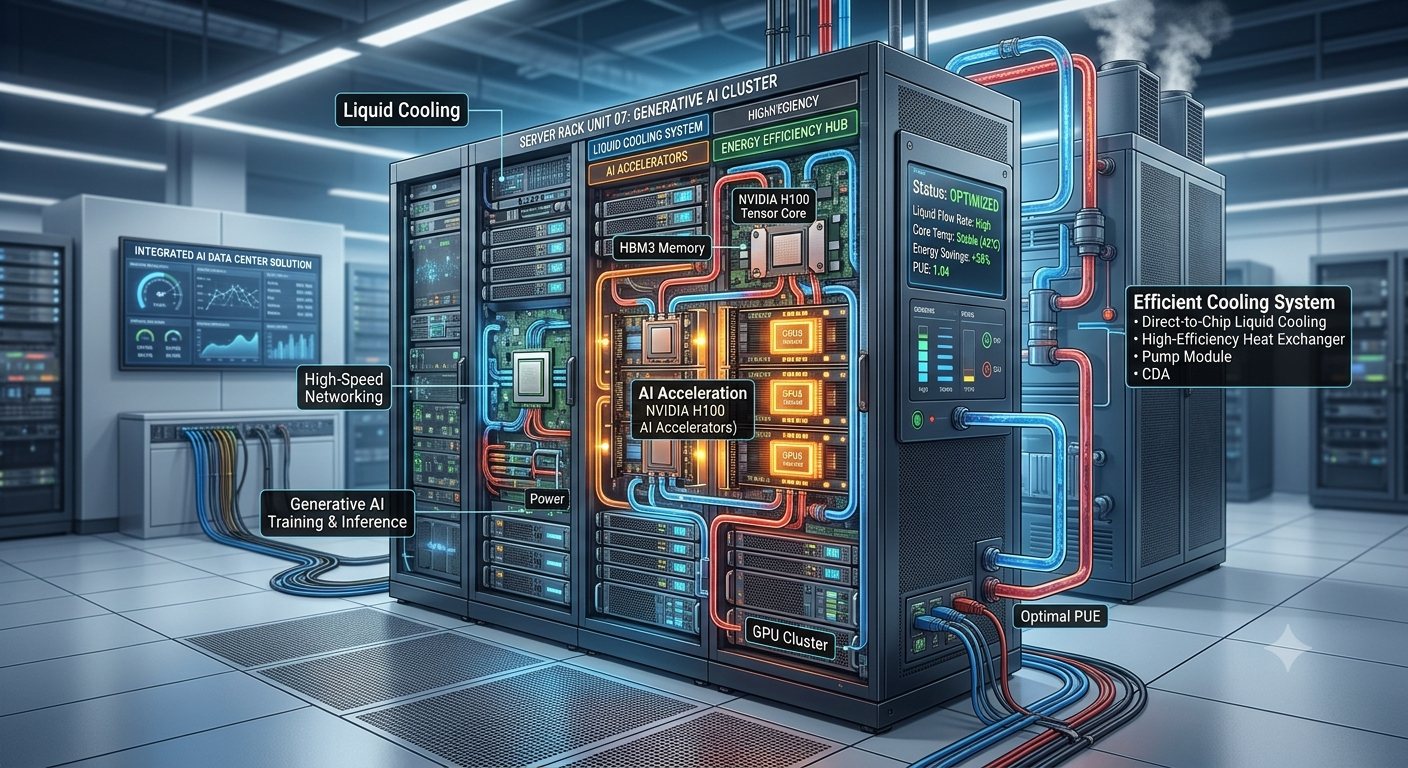
Energy efficiency, liquid cooling, and AI acceleration are emerging as critical factors shaping the future of the market. As generative AI models become more computationally demanding, server manufacturers are focusing on improving processing performance, reducing power consumption per workload, and developing scalable architectures that support high-density AI deployments.
Energy Efficiency: A Key Priority for AI Infrastructure
Energy efficiency is becoming a central consideration in the Generative AI Server Market as organizations deploy increasingly powerful computing systems. Training large language models and operating generative AI applications require substantial processing capacity, memory bandwidth, networking, and electrical power. As AI workloads expand, enterprises and data center operators are under pressure to improve computing performance while controlling energy consumption and operating costs.
Server manufacturers are addressing these requirements through more efficient processors, optimized power delivery, workload scheduling, and improved system architectures. GPU- and ASIC-based servers can accelerate specific AI workloads, while software optimization helps improve resource utilization and reduce unnecessary computation.
Energy-efficient infrastructure can also help data center operators manage capacity constraints and sustainability objectives. However, improvements depend on the workload, hardware configuration, utilization rate, and overall facility design. Consequently, energy efficiency is expected to remain an important purchasing consideration for organizations investing in next-generation AI servers. MarketsandMarkets
Liquid Cooling: Transforming High-Density AI Data Centers
Liquid cooling is emerging as a significant technology in the Generative AI Server Market. High-performance GPUs and AI accelerators generate substantial heat when operating at high utilization levels. Traditional air-cooling systems can become less effective as rack power densities increase, creating demand for advanced thermal management solutions.
Liquid cooling transfers heat more efficiently by circulating coolant through cold plates or other cooling components near heat-generating hardware. Depending on the system design, this approach can support higher compute density, improve thermal stability, and reduce the cooling energy required compared with some conventional air-cooled configurations.
MarketsandMarkets projects that the liquid cooling segment will register a CAGR of 37.3% during the 2025–2030 forecast period, highlighting its growing importance in AI infrastructure. MarketsandMarkets+1
Key developments in liquid cooling include:
- Direct-to-chip cooling: Coolant circulates through cold plates attached to processors and other high-heat components.
- Immersion cooling: Servers or selected components are immersed in specially engineered dielectric fluids to remove heat.
- Hybrid cooling: Air and liquid cooling technologies are combined to accommodate different equipment configurations and thermal requirements.
- Advanced rack designs: Integrated power, cooling, and networking architectures support high-density AI computing environments.
Despite its advantages, liquid cooling can require specialized infrastructure, leak detection, coolant distribution systems, and maintenance expertise. Vendors that simplify installation and improve reliability will be better positioned to support large-scale AI deployments.
Download PDF Brochure @ https://www.marketsandmarkets.com/pdfdownloadNew.asp?id=242200223
AI Acceleration: GPUs, ASICs, and Advanced Server Architectures
AI acceleration is another major factor shaping the future of the Generative AI Server Market. Conventional server architectures are not always optimized for the parallel processing and memory bandwidth required by large generative AI models. Purpose-built accelerators enable faster model training, fine-tuning, and inference.
GPU-Based Servers
Graphics processing units (GPUs) are widely used for generative AI because they can perform many computations simultaneously. MarketsandMarkets reports that GPU-based servers accounted for an estimated 70.7% share of the processor segment in 2024. MarketsandMarkets
Their established software ecosystems, high parallel-processing capacity, and broad adoption make them a central component of AI infrastructure. Server manufacturers are integrating multiple GPUs with high-bandwidth memory and high-speed interconnects to support large-scale model development.
Application-Specific Integrated Circuits
Application-specific integrated circuits (ASICs) are designed to accelerate particular computing tasks. For selected AI workloads, ASIC-based systems can offer attractive performance and energy efficiency. Their role is likely to expand as cloud providers and enterprises seek alternatives tailored to specific inference and training requirements.
Field-Programmable Gate Arrays
Field-programmable gate arrays (FPGAs) offer reconfigurable hardware that can be adapted to specialized processing requirements. They can support selected inference, signal-processing, and low-latency applications where flexibility is valuable.
The continued development of GPUs, ASICs, and FPGAs is giving organizations more options for matching server architectures to workload requirements, performance targets, and operating budgets.
Inference Workloads and Enterprise AI Adoption
The growing deployment of generative AI applications is shifting attention from model training alone to inference, the process of using a trained model to generate outputs. AI assistants, customer service chatbots, code-generation tools, recommendation systems, and real-time content applications require continuous processing and responsive performance.
MarketsandMarkets identifies inference as a high-growth function segment, with a projected CAGR of 29.6% during the forecast period. MarketsandMarkets+1
As businesses integrate generative AI into everyday workflows, they need servers that balance latency, throughput, scalability, and cost per request. Optimized inference infrastructure can help enterprises deliver AI services more efficiently while supporting growing user demand.
Private and on-premises AI deployments are also relevant for organizations that require greater control over sensitive data, system configuration, and model access. Cloud deployments remain important because they provide flexible access to computing capacity without requiring every organization to build its own large-scale infrastructure.
Regional Outlook: Asia Pacific Emerges as a Growth Market
Asia Pacific is expected to register the highest CAGR in the Generative AI Server Market during the forecast period, according to MarketsandMarkets. MarketsandMarkets Government initiatives, expanding cloud infrastructure, AI research, and enterprise digital transformation are contributing to demand across the region.
China, Japan, South Korea, Singapore, and India are among the markets investing in AI capabilities and supporting infrastructure. Data center development, increasing use of large language models, and growth in AI-enabled business services are creating opportunities for server manufacturers and infrastructure providers.
North America remains important because of its established cloud ecosystem, major technology companies, and substantial AI infrastructure investments. Europe also offers opportunities as enterprises adopt AI applications and modernize data center environments, with energy efficiency and regulatory considerations influencing purchasing decisions.
Challenges and Future Opportunities
Despite strong growth prospects, the Generative AI Server Market faces challenges related to high infrastructure costs, electricity consumption, cooling requirements, component availability, and skilled-labor shortages. Building AI-ready facilities requires coordination across computing hardware, power delivery, networking, thermal management, and software.
Data privacy and regulatory requirements can also influence deployment decisions, particularly in sectors such as finance, healthcare, and government. Organizations must evaluate whether cloud, on-premises, or hybrid architectures best meet their security and operational needs.
Future opportunities include energy-efficient accelerators, liquid-cooled rack systems, optimized inference servers, high-speed interconnects, and integrated AI infrastructure. Vendors that deliver improved performance per watt, simplified deployment, and flexible scaling options can strengthen their position in this expanding market.
The future of the Generative AI Server Market will be shaped by the convergence of energy efficiency, advanced cooling technologies, and AI acceleration. As demand for generative AI applications expands, organizations will need computing infrastructure that delivers high performance without allowing power, cooling, and operating costs to grow uncontrollably.
With the market projected to reach USD 448.60 billion by 2030 at a CAGR of 34.0%, opportunities are expanding for server manufacturers, AI accelerator developers, and data center infrastructure providers. MarketsandMarkets Liquid cooling, GPU-based systems, specialized accelerators, and inference optimization will remain important areas of innovation as enterprises scale AI adoption.
FAQs
1. What is the projected growth of the Generative AI Server Market?
The Generative AI Server Market is projected to grow from USD 103.92 billion in 2025 to USD 448.60 billion by 2030, registering a CAGR of 34.0% during the forecast period.
2. What are the key factors driving the Generative AI Server Market?
Key growth drivers include increasing adoption of generative AI applications, rising demand for high-performance computing, expanding cloud infrastructure, growing use of large language models, and increasing enterprise investments in AI technologies.
3. How is liquid cooling influencing the Generative AI Server Market?
Liquid cooling improves heat removal from high-performance GPUs and AI accelerators, supporting high-density server deployments, improved thermal management, and potentially greater energy efficiency in AI data centers.
4. Which technologies are shaping the future of the Generative AI Server Market?
Key technologies include GPU-based servers, application-specific integrated circuits (ASICs), field-programmable gate arrays (FPGAs), high-bandwidth memory, advanced networking, and energy-efficient liquid cooling systems.
5. Which region is expected to experience significant growth in the Generative AI Server Market?
Asia Pacific is expected to register the highest CAGR during the forecast period, supported by expanding data center infrastructure, AI adoption, government initiatives, and enterprise digital transformation.
About MarketsandMarkets™
MarketsandMarkets™ has been recognized as one of America’s Best Management Consulting Firms by Forbes, as per their recent report.
MarketsandMarkets™ is a blue ocean alternative in growth consulting and program management, leveraging a man-machine offering to drive supernormal growth for progressive organizations in the B2B space. With the widest lens on emerging technologies, we are proficient in co-creating supernormal growth for clients across the globe.
Today, 80% of Fortune 2000 companies rely on MarketsandMarkets, and 90 of the top 100 companies in each sector trust us to accelerate their revenue growth. With a global clientele of over 13,000 organizations, we help businesses thrive in a disruptive ecosystem.
The B2B economy is witnessing the emergence of $25 trillion in new revenue streams that are replacing existing ones within this decade. We work with clients on growth programs, helping them monetize this $25 trillion opportunity through our service lines – TAM Expansion, Go-to-Market (GTM) Strategy to Execution, Market Share Gain, Account Enablement, and Thought Leadership Marketing.
Built on the ‘GIVE Growth’ principle, we collaborate with several Forbes Global 2000 B2B companies to keep them future-ready. Our insights and strategies are powered by industry experts, cutting-edge AI, and our Market Intelligence Cloud, KnowledgeStore™, which integrates research and provides ecosystem-wide visibility into revenue shifts.
To find out more, visit www.MarketsandMarkets™.com or follow us on Twitter , LinkedIn and Facebook .
Contact:
Mr. Rohan Salgarkar
MarketsandMarkets™ INC.
1615 South Congress Ave.
Suite 103, Delray Beach, FL 33445
USA: +1-888-600-6441
