The healthcare industry is undergoing a significant transformation as hospitals increasingly adopt digital technologies to improve patient care, streamline clinical workflows, and enhance operational efficiency. The integration of artificial intelligence (AI), the Internet of Medical Things (IoMT), cloud computing, robotics, big data analytics, and advanced connectivity is changing how healthcare facilities operate. Traditional hospitals are gradually evolving into intelligent, connected environments capable of supporting real-time patient monitoring, automated operations, and data-driven clinical decision-making.
The Smart Hospital Industry is gaining momentum as healthcare providers invest in advanced medical infrastructure to address growing patient volumes, rising healthcare costs, workforce shortages, and increasing demand for personalized treatment. Smart hospitals use interconnected medical devices, intelligent software platforms, automated systems, and digital healthcare solutions to improve coordination between patients, healthcare professionals, and hospital management teams.
According to MarketsandMarkets, the global smart hospital market is projected to grow from USD 134.69 billion in 2026 to USD 246.17 billion by 2032, registering a compound annual growth rate (CAGR) of 10.6% during the forecast period. Increasing investments in hospital modernization, connected medical devices, remote patient monitoring, and AI-enabled healthcare infrastructure are supporting market expansion.
The Smart Hospital Industry is also benefiting from innovations in digital health platforms, electronic health records (EHR), intelligent diagnostic imaging, automated medication management, and real-time location systems. These developments are enabling healthcare facilities to improve resource utilization, reduce administrative workloads, and provide more coordinated patient care.
Top 10 Takeaways: Smart Hospital Industry
- The global smart hospital market is projected to reach USD 246.17 billion by 2032.
- The market is expected to register a CAGR of 10.6% during 2026–2032.
- Hardware is expected to account for the largest share by offering.
- Cloud-based deployment is projected to grow at approximately 20.6% CAGR.
- Wi-Fi connectivity is expected to register approximately 18.7% CAGR.
- AI and machine learning are expected to be the fastest-growing technology segment.
- Remote patient monitoring is projected to grow at approximately 15.9% CAGR.
- Asia Pacific is expected to account for approximately 32.3% of the market in 2032.
- AI, IoMT, robotics, and digital twins are transforming hospital operations.
- Siemens Healthineers, GE HealthCare, Philips, FUJIFILM, and Canon are among the prominent market players.
Smart Hospital Industry: The Growing Role of AI and IoMT in Modern Healthcare
Artificial intelligence and the Internet of Medical Things are becoming essential technologies in the development of smart hospitals. Their integration enables hospitals to collect, analyze, and exchange information across medical devices, clinical applications, and hospital management systems.
AI-powered healthcare solutions can analyze medical information, support clinical decision-making, identify patterns, and assist healthcare professionals in managing complex workflows. Machine learning algorithms are also being used in medical imaging, predictive analytics, patient monitoring, and operational planning.
IoMT connects medical equipment, wearable devices, monitoring systems, and healthcare infrastructure through communication networks. These connected devices generate real-time information that can help healthcare professionals monitor patients and respond to changing clinical conditions.
For example, connected patient monitoring devices can continuously track vital signs and transmit information to centralized monitoring systems. AI-based analytics can help identify abnormal patterns and generate alerts for clinical review. Similarly, intelligent hospital management platforms can monitor bed availability, equipment utilization, patient movement, and staff allocation.
The convergence of AI and IoMT is helping hospitals transition toward proactive, connected, and data-driven healthcare delivery.
Key Growth Drivers Transforming the Smart Hospital Industry
Several factors are accelerating investments in smart hospital technologies across public and private healthcare facilities.
1. Increasing Deployment of Connected Hospital Infrastructure
The growing adoption of connected medical devices and digital infrastructure is one of the major factors supporting the Smart Hospital Industry. Healthcare providers are investing in intelligent monitoring systems, automated equipment, connected hospital networks, and centralized management platforms.
Real-time location systems (RTLS) help hospitals track medical equipment, patients, and healthcare personnel. These technologies improve asset visibility, reduce equipment search times, and support better resource allocation.
Connected infrastructure also enables hospitals to integrate clinical operations, administrative functions, and facility management into unified digital environments.
2. Growing Integration of Artificial Intelligence
AI is transforming healthcare operations by supporting medical imaging, predictive analytics, clinical documentation, and patient management.
AI-enabled diagnostic tools can help healthcare professionals analyze medical images and identify patterns that may require further investigation. Predictive analytics can support patient risk assessment, resource planning, and hospital capacity management.
The increasing availability of healthcare data and advanced computing infrastructure is encouraging hospitals to adopt AI-powered solutions.
3. Rising Demand for Efficient Patient Care
Hospitals are facing increasing pressure to improve patient outcomes while managing operational expenses and growing patient volumes.
Smart hospital technologies support continuous patient monitoring, automated workflows, and improved coordination between healthcare departments. Digital platforms can also reduce manual administrative activities, allowing medical professionals to focus more on patient care.
4. Increasing Investments in Hospital Modernization
Healthcare organizations are modernizing existing infrastructure to support connected medical devices, advanced imaging equipment, cloud-based systems, and automated hospital operations.
Government-led digital healthcare initiatives and investments by private hospital networks are also supporting the adoption of smart hospital technologies.
5. Growing Adoption of Interoperable Healthcare Systems
Interoperability allows different medical devices, healthcare applications, and information systems to exchange information efficiently.
Hospitals are increasingly focusing on integrating electronic health records, hospital information systems, patient monitoring devices, and digital health platforms. Improved interoperability supports coordinated patient care and reduces information fragmentation.
Download PDF Brochure @ https://www.marketsandmarkets.com/pdfdownloadNew.asp?id=29319948
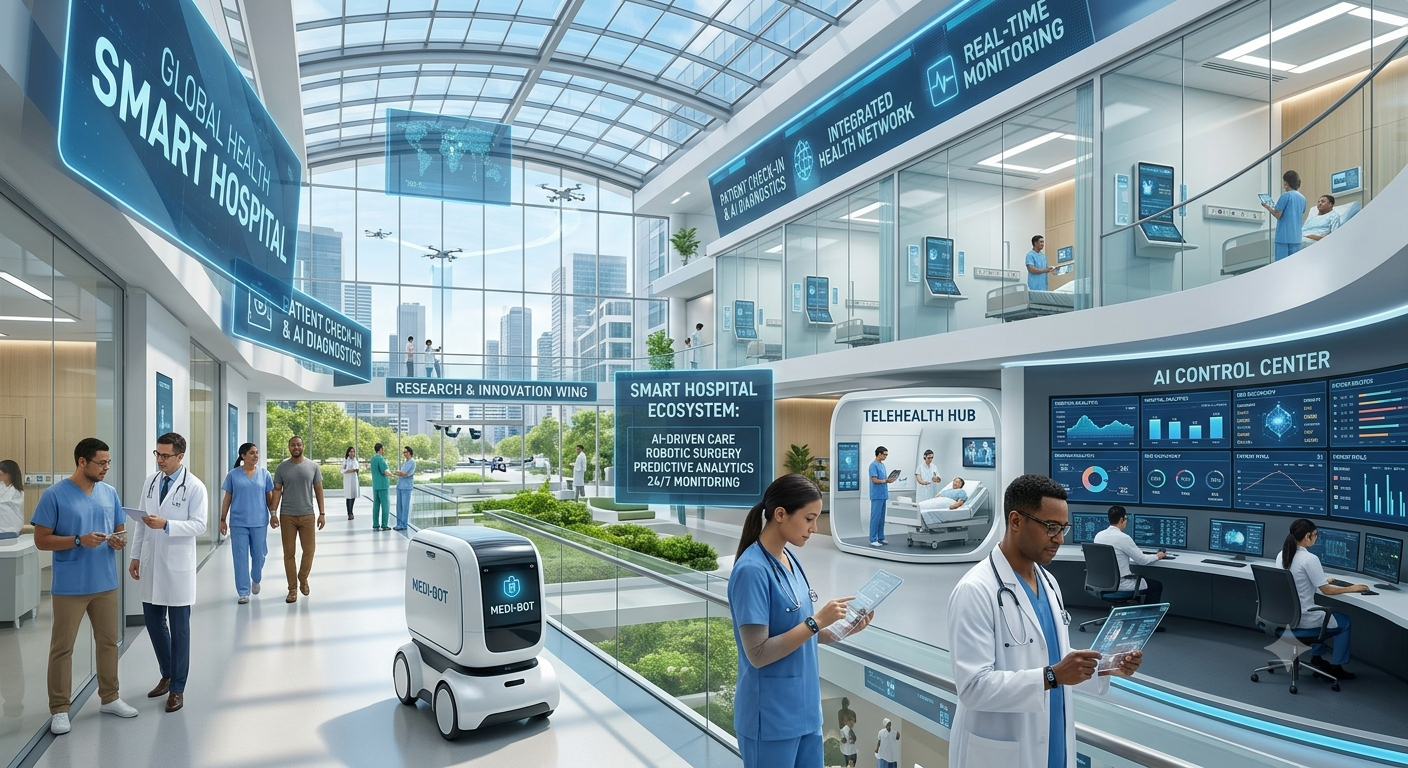
Smart Hospital Industry by Offering: Hardware, Software, and Services
The Smart Hospital Industry comprises three major offering categories: hardware, software, and services. Each category supports the development and operation of connected healthcare infrastructure.
Hardware
Hardware forms the physical foundation of smart hospital infrastructure. It includes medical imaging systems, patient monitoring devices, smart beds, connected medical equipment, networking devices, sensors, and robotics.
Medical Imaging Systems: Advanced imaging technologies such as MRI, CT, ultrasound, and digital X-ray systems are increasingly incorporating AI-enabled capabilities to support image analysis and diagnostic workflows.
Patient Monitoring Devices: Connected monitoring equipment enables healthcare professionals to track vital signs and other patient parameters. These devices support continuous monitoring and remote patient care.
Smart Beds: Intelligent hospital beds incorporate sensors and connected technologies to support patient positioning, movement monitoring, occupancy tracking, and safety management.
Connected Medical Devices: IoMT-enabled medical equipment facilitates real-time data exchange and improves coordination between clinical systems.
Robotics: Healthcare robotics supports selected surgical, rehabilitation, logistics, and hospital service applications.
According to MarketsandMarkets, the hardware segment is expected to account for the largest share of the Smart Hospital Industry during the forecast period, supported by growing investments in connected medical devices, imaging systems, patient monitoring equipment, and hospital automation infrastructure.
Software
Software solutions enable hospitals to manage clinical information, automate administrative processes, analyze healthcare data, and coordinate hospital operations.
Electronic health records, hospital information systems, clinical decision support software, and patient management platforms are becoming important components of smart hospital infrastructure.
AI-powered software can support medical documentation, predictive analytics, clinical workflow optimization, and operational planning. Cloud-based platforms are also improving data accessibility and enabling integration across multiple healthcare facilities.
Services
Services are essential for implementing, integrating, maintaining, and optimizing smart hospital infrastructure.
Key services include system integration, deployment, consulting, managed services, technical support, cybersecurity management, and maintenance.
Healthcare providers increasingly depend on specialized technology partners to integrate new digital solutions with existing hospital systems while maintaining reliability, security, and interoperability.
Smart Hospital Industry by Deployment Mode: Cloud-Based, On-Premises, and Hybrid Solutions
Deployment models determine how smart hospital applications and healthcare information systems are hosted, accessed, and managed.
Cloud-Based Deployment
Cloud-based deployment enables hospitals to store, process, and access healthcare information through scalable cloud infrastructure. These solutions support electronic health records, AI analytics, telemedicine, remote patient monitoring, and centralized hospital management.
Cloud platforms can simplify information sharing across healthcare networks and reduce the need for extensive on-site IT infrastructure.
On-Premises Deployment
On-premises solutions involve hosting hospital software and data infrastructure within healthcare facilities. These systems provide organizations with greater direct control over their IT environments, data management, and infrastructure configurations.
Hospitals with specific security, operational, and regulatory requirements may continue to use on-premises infrastructure.
Hybrid Deployment
Hybrid deployment combines cloud-based and on-premises infrastructure. It enables hospitals to maintain selected systems locally while using cloud platforms for scalable storage, analytics, and information sharing.
This approach provides flexibility for healthcare organizations modernizing existing infrastructure.
Smart Hospital Industry by Connectivity Technology: Enabling Seamless Healthcare Communication
Connectivity technologies provide the communication infrastructure required to connect medical devices, healthcare professionals, hospital information systems, and patients. Reliable connectivity enables real-time information exchange and supports coordinated healthcare delivery.
Wi-Fi
Wi-Fi is widely used in smart hospitals to connect medical devices, monitoring equipment, computers, smartphones, and hospital management systems. It supports electronic health record access, telemedicine, mobile clinical workflows, and connected patient monitoring.
Bluetooth and Bluetooth Low Energy
Bluetooth and Bluetooth Low Energy (BLE) enable short-range wireless communication between medical devices, wearable sensors, and healthcare applications. These technologies support patient monitoring, connected diagnostic equipment, and wearable healthcare solutions.
BLE is particularly useful for applications requiring low power consumption and continuous communication.
Radio Frequency Identification (RFID)
RFID technology enables hospitals to identify and track medical equipment, supplies, patient identification tags, and other assets. It improves inventory visibility, supports equipment management, and reduces the time required to locate essential medical resources.
Cellular Connectivity (4G and 5G)
Cellular connectivity supports remote patient monitoring, telemedicine, connected ambulances, and communication across geographically distributed healthcare facilities.
The increasing availability of 5G networks is creating opportunities for low-latency communication, high-speed medical data transmission, and advanced connected healthcare applications.
Zigbee, Ethernet, and LPWAN
Zigbee supports low-power communication between connected devices, while Ethernet provides reliable wired networking for hospital IT infrastructure. Low-power wide-area network (LPWAN) technologies support selected applications requiring long-range connectivity and low energy consumption.
These connectivity technologies collectively strengthen the communication infrastructure of the Smart Hospital Industry.
Smart Hospital Industry by Technology: AI, IoMT, Cloud Computing, and Robotics
Technological innovation is transforming hospitals into connected and intelligent healthcare environments. The integration of multiple technologies enables hospitals to improve patient monitoring, clinical workflows, infrastructure management, and operational efficiency.
Internet of Medical Things (IoMT)
IoMT connects medical devices, wearable technologies, monitoring equipment, and healthcare applications through digital networks.
Connected devices enable continuous collection and exchange of patient information, helping healthcare professionals monitor health conditions and coordinate care.
IoMT applications include smart patient monitoring, connected diagnostic devices, wearable health sensors, and intelligent medical equipment.
Cloud Computing
Cloud computing provides scalable infrastructure for storing, processing, and managing healthcare information. Hospitals can use cloud platforms to support EHR systems, medical data analytics, telemedicine, and remote patient monitoring.
Cloud-based infrastructure also improves accessibility and information sharing across healthcare networks.
Edge Computing
Edge computing enables healthcare devices and systems to process information closer to where it is generated. This approach can reduce data transmission delays and support applications requiring faster responses.
It is particularly relevant for connected medical devices, real-time monitoring, and selected AI-enabled healthcare applications.
Big Data Analytics
Big data analytics helps hospitals analyze large volumes of clinical, operational, and administrative information.
These solutions support patient flow analysis, resource allocation, clinical performance monitoring, and hospital planning. Advanced analytics can also help healthcare organizations identify operational patterns and improve decision-making.
Robotics and Digital Twins
Robotics is supporting selected healthcare applications, including surgical assistance, rehabilitation, logistics, and automated material handling.
Digital twin technology creates virtual representations of hospital facilities, equipment, or operational processes. These models can help hospital administrators simulate different scenarios, evaluate capacity, and improve resource utilization.
The increasing adoption of these technologies is expanding opportunities across the Smart Hospital Industry.
Smart Hospital Industry by Application: Transforming Patient Care and Hospital Operations
Smart hospital technologies are being deployed across clinical, administrative, and facility management applications. Their adoption is improving operational coordination and enabling more connected healthcare delivery.
Remote Patient Monitoring
Remote patient monitoring enables healthcare professionals to track patient health information through connected medical devices, wearable sensors, and digital platforms.
These solutions support continuous monitoring and allow selected patient information to be shared with healthcare teams outside traditional hospital environments.
The increasing adoption of IoMT devices, cloud computing, and connected healthcare platforms is supporting demand for remote monitoring.
Patient Care Management
Patient care management solutions help hospitals coordinate patient information, treatment plans, appointments, and clinical activities.
Digital platforms improve communication between healthcare professionals and support more coordinated patient journeys.
Clinical Workflow Optimization
Clinical workflow optimization solutions automate administrative and clinical processes, including documentation, scheduling, patient registration, and information management.
AI-powered applications can reduce repetitive tasks and help healthcare professionals access relevant information more efficiently.
Asset Tracking and Management
Asset tracking solutions use RFID, BLE, RTLS, and connected sensors to monitor the location and utilization of medical equipment.
These technologies help hospitals improve equipment availability, reduce search time, and optimize asset utilization.
Medication Management
Smart medication management solutions support medication tracking, inventory monitoring, dispensing, and administration workflows.
Connected medication systems can help healthcare facilities improve visibility across pharmaceutical operations and support medication safety processes.
Telemedicine
Telemedicine enables patients to consult healthcare professionals through digital communication platforms. It supports remote consultations, follow-up appointments, and access to healthcare services.
The integration of connected monitoring devices and cloud platforms is expanding the capabilities of telemedicine.
Diagnostic Imaging
Smart diagnostic imaging combines advanced medical imaging equipment with AI-enabled analysis and digital information systems.
These technologies support imaging workflows, image processing, and clinical interpretation, helping healthcare professionals manage diagnostic information more efficiently.
Hospital Workflow and Building Management
Smart hospital workflow management systems coordinate administrative and operational activities across healthcare facilities.
Building management solutions monitor lighting, temperature, ventilation, energy consumption, and other infrastructure functions. These systems help hospitals improve facility performance and resource utilization.
Smart Hospital Industry by End User: Public and Private Healthcare Facilities
The adoption of smart hospital technologies is expanding across different healthcare facilities. Hospitals, ambulatory surgery centers, specialty clinics, diagnostic centers, and academic medical institutions are investing in connected healthcare infrastructure.
Public and Private Hospitals
Public and private hospitals represent the primary end-user segment of the Smart Hospital Industry. These facilities are increasingly adopting AI, IoMT, cloud platforms, connected medical devices, and automation systems.
Public hospitals are investing in digital healthcare infrastructure to improve patient management and resource utilization. Private hospital networks are adopting advanced technologies to improve clinical workflows, patient experiences, and operational efficiency.
Regional Outlook: Asia Pacific to Witness Significant Smart Hospital Industry Growth
Regional investments in healthcare infrastructure, digital transformation, medical technology, and connected healthcare services are creating opportunities across the global Smart Hospital Industry.
Future Outlook: What Will Shape the Next Generation of Smart Hospitals?
The Smart Hospital Industry is moving toward more intelligent, automated, and interconnected healthcare infrastructure. Future developments will focus on improving clinical decision-making, enhancing patient experiences, and optimizing hospital operations.
1. AI-Powered Clinical Decision Support: AI algorithms will increasingly support medical imaging, clinical documentation, patient risk assessment, and healthcare workflow management.
2. Expansion of Hospital Command Centers: Centralized command centers will integrate patient monitoring, bed occupancy, staff allocation, and equipment utilization data to provide real-time operational visibility.
3. Digital Twin Technology: Digital twins will help hospitals simulate patient flow, infrastructure performance, and resource utilization to support operational planning.
4. Autonomous Hospital Robotics: Robotics will expand across logistics, material handling, selected clinical applications, and hospital service operations.
5. Advanced Remote Patient Monitoring: Connected medical devices and wearable technologies will enable continuous health monitoring and support more coordinated patient care.
6. Cloud-Based Healthcare Infrastructure: Cloud computing will support scalable healthcare platforms, centralized data management, and integration across hospital networks.
7. Connected and Interoperable Medical Devices: Greater interoperability will enable medical equipment, patient monitoring systems, and hospital information platforms to exchange information more efficiently.
These innovations will create opportunities for healthcare technology companies, medical device manufacturers, software developers, and hospital infrastructure providers.
Conclusion: Intelligent Technologies Will Redefine Modern Healthcare Facilities
The Smart Hospital Industry is entering an important phase of technological transformation as healthcare providers increasingly adopt AI, IoMT, cloud computing, robotics, and advanced connectivity solutions.
The integration of these technologies is changing how hospitals manage patient information, monitor medical conditions, coordinate clinical workflows, and utilize healthcare resources. Connected medical devices, intelligent diagnostic systems, automated hospital infrastructure, and digital healthcare platforms are becoming essential components of modern healthcare facilities.
With the global smart hospital market projected to reach USD 246.17 billion by 2032, opportunities are expanding for medical technology manufacturers, healthcare IT providers, cloud computing companies, system integrators, and digital healthcare innovators.
AI-powered clinical systems, remote patient monitoring, hospital command centers, and digital twin technologies will play an increasingly important role in the next generation of healthcare infrastructure.
As hospitals continue to prioritize patient-centric care, operational efficiency, and digital transformation, organizations investing in intelligent and interoperable healthcare solutions will be well positioned to capitalize on emerging opportunities in the Smart Hospital Industry.
Frequently Asked Questions (FAQs):
Q1. What is the projected size of the Smart Hospital Market by 2032?
The global smart hospital market is projected to grow from USD 134.69 billion in 2026 to USD 246.17 billion by 2032, registering a CAGR of 10.6% during the forecast period.
Q2. What are the key factors driving the growth of the Smart Hospital Industry?
Major growth drivers include increasing adoption of AI and IoMT, rising demand for remote patient monitoring, investments in digital healthcare infrastructure, growing use of connected medical devices, and the need to improve hospital operational efficiency.
Q3. Which segment is expected to grow at the highest CAGR in the Smart Hospital Market?
The cloud-based deployment segment is expected to register the highest CAGR of approximately 20.6%, driven by increasing demand for scalable healthcare IT infrastructure, centralized data management, and connected digital health platforms.
Q4. Which region is expected to dominate the Smart Hospital Market?
Asia Pacific is expected to be a significant regional market, accounting for approximately 32.3% of the global smart hospital market in 2032. Growing healthcare investments, hospital modernization, and digital transformation initiatives are supporting regional growth.
Q5. Who are the key players in the Smart Hospital Industry?
Major companies operating in the Smart Hospital Industry include Siemens Healthineers, GE HealthCare, Philips, FUJIFILM Holdings, Canon, Stryker, Baxter International, Medtronic, Becton, Dickinson and Company, and Abbott.
About MarketsandMarkets™
MarketsandMarkets™ has been recognized as one of America’s Best Management Consulting Firms by Forbes, as per their recent report.
MarketsandMarkets™ is a blue ocean alternative in growth consulting and program management, leveraging a man-machine offering to drive supernormal growth for progressive organizations in the B2B space. With the widest lens on emerging technologies, we are proficient in co-creating supernormal growth for clients across the globe.
Today, 80% of Fortune 2000 companies rely on MarketsandMarkets, and 90 of the top 100 companies in each sector trust us to accelerate their revenue growth. With a global clientele of over 13,000 organizations, we help businesses thrive in a disruptive ecosystem.
The B2B economy is witnessing the emergence of $25 trillion in new revenue streams that are replacing existing ones within this decade. We work with clients on growth programs, helping them monetize this $25 trillion opportunity through our service lines – TAM Expansion, Go-to-Market (GTM) Strategy to Execution, Market Share Gain, Account Enablement, and Thought Leadership Marketing.
Built on the ‘GIVE Growth’ principle, we collaborate with several Forbes Global 2000 B2B companies to keep them future-ready. Our insights and strategies are powered by industry experts, cutting-edge AI, and our Market Intelligence Cloud, KnowledgeStore™, which integrates research and provides ecosystem-wide visibility into revenue shifts.
To find out more, visit www.MarketsandMarkets™.com or follow us on Twitter , LinkedIn and Facebook .
Contact:
Mr. Rohan Salgarkar
MarketsandMarkets™ INC.
1615 South Congress Ave.
Suite 103, Delray Beach, FL 33445
USA: +1-888-600-6441