The global electronics and energy industries are undergoing significant transformation as electrification, renewable energy adoption, electric vehicles (EVs), and industrial automation continue to expand. These developments are increasing the demand for accurate, reliable, and efficient current measurement technologies. Magnetic current sensors are emerging as essential components in modern electrical and electronic systems because they enable non-contact current measurement, electrical isolation, and real-time monitoring.
The Magnetic Current Sensor Market Trends reflect the growing importance of advanced sensing technologies in supporting energy-efficient systems, intelligent power management, and next-generation electronic applications. These sensors detect the magnetic field generated by electrical current flowing through a conductor and convert it into measurable electrical signals. Their ability to measure alternating current (AC) and direct current (DC) makes them suitable for applications across automotive, consumer electronics, industrial automation, telecommunications, and energy infrastructure.
According to MarketsandMarkets, the global magnetic current sensor market is projected to grow from USD 2.05 billion in 2026 to USD 4.20 billion by 2032, registering a compound annual growth rate (CAGR) of 12.7% during the forecast period. Increasing EV production, renewable energy installations, battery energy storage systems, and smart grid development are creating significant growth opportunities.
As industries prioritize precision, miniaturization, and energy efficiency, magnetic current sensors are becoming increasingly important for modern power electronics and intelligent electrical infrastructure.
Growing Adoption of Electric Vehicles Drives Market Growth
The increasing adoption of electric vehicles is one of the major factors influencing the magnetic current sensor industry. EVs depend on sophisticated electrical systems that require accurate current monitoring to maintain battery performance, improve energy efficiency, and ensure operational safety.
Magnetic current sensors are widely used in battery management systems (BMS), traction inverters, onboard chargers, DC-DC converters, and electric motor control systems. These applications require reliable current measurement to monitor battery charging and discharging, regulate power distribution, and protect electrical components against overload conditions.
The growing development of fast-charging infrastructure is further increasing the demand for advanced current sensing solutions. Charging stations require precise monitoring of electrical current to maintain charging efficiency and protect connected equipment.
Automotive manufacturers are also focusing on compact, high-performance, and automotive-grade sensing technologies to support next-generation electric powertrains. These developments are creating new opportunities for sensor manufacturers offering high-accuracy, electrically isolated, and fast-response solutions.
According to MarketsandMarkets, the automotive vertical accounted for approximately 33.0% of the magnetic current sensor market in 2026, making it the largest application vertical. The continued expansion of EV manufacturing and vehicle electrification is expected to support this segment.
Renewable Energy Expansion Creates New Opportunities
The global transition toward clean energy is another important factor supporting the Magnetic Current Sensor Market Trends. Governments and energy companies are increasing investments in solar, wind, and other renewable energy projects to reduce carbon emissions and strengthen energy security.
Magnetic current sensors play an important role in renewable energy systems by enabling accurate current measurement in photovoltaic inverters, power converters, wind energy systems, and battery storage infrastructure.
In solar power installations, these sensors monitor current flow between photovoltaic panels, inverters, and energy storage systems. Accurate measurement helps improve power conversion efficiency and supports maximum power point tracking (MPPT), which optimizes the electricity generated by solar panels.
Wind energy systems also require reliable current monitoring to manage power conversion and electrical distribution. Magnetic current sensors help monitor generator output, inverter performance, and other critical electrical parameters.
The growing deployment of battery energy storage systems is creating additional demand. These systems require precise monitoring of charging and discharging operations to maintain battery efficiency and improve operational safety.
As renewable energy capacity increases globally, demand for compact, high-accuracy, and reliable magnetic current sensing technologies is expected to rise.
Download PDF Brochure @ https://www.marketsandmarkets.com/pdfdownloadNew.asp?id=187942507
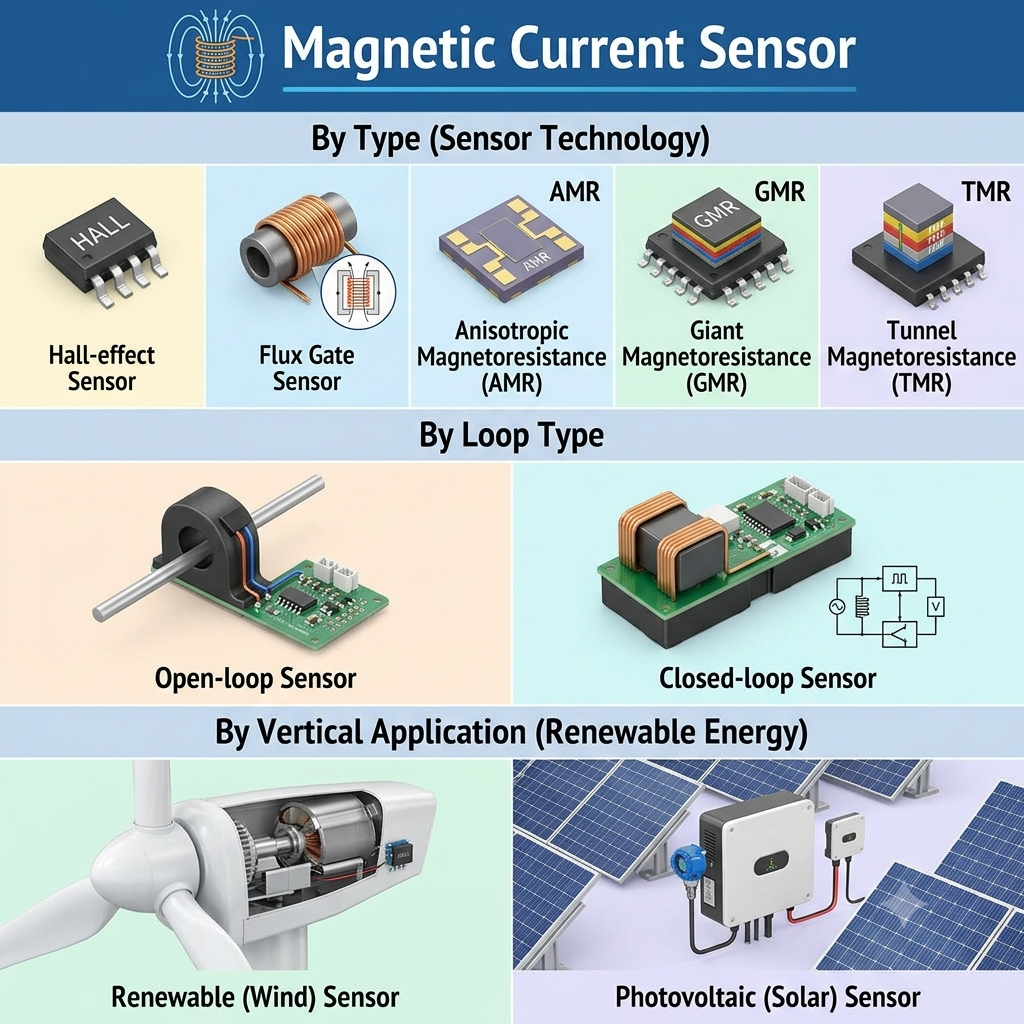
Hall-Effect Sensors Maintain a Strong Market Position
Hall-effect technology represents a major segment of the magnetic current sensor market because of its versatility, cost-effectiveness, and ability to measure both AC and DC currents.
Hall-effect sensors operate by detecting the magnetic field generated by current flowing through a conductor. Their non-contact measurement capability provides electrical isolation between the measured current and the sensing circuit, making them suitable for applications involving high voltages and demanding operating conditions.
These sensors are widely used in electric vehicles, industrial equipment, consumer electronics, power supplies, and renewable energy systems.
According to MarketsandMarkets, Hall-effect current sensors are expected to account for approximately 74.4% of the market in 2026. Their widespread adoption is supported by established manufacturing processes, broad application compatibility, and relatively economical implementation.
Manufacturers are also developing advanced Hall-effect sensors with improved sensitivity, smaller footprints, higher bandwidth, and better resistance to external magnetic interference.
These improvements are supporting the integration of Hall-effect technology into compact electronic devices and advanced power conversion systems.
XMR Technologies Transforming High-Precision Current Sensing
Magnetoresistive technologies are creating new opportunities in advanced magnetic current sensing. These technologies include anisotropic magnetoresistance (AMR), giant magnetoresistance (GMR), and tunnel magnetoresistance (TMR).
XMR-based sensors are gaining attention because of their high sensitivity, accuracy, compact form factors, and low power consumption. They are suitable for applications requiring precise current measurement and reliable performance in increasingly complex electronic environments.
TMR technology, in particular, offers high magnetic sensitivity and supports the development of compact sensing devices for automotive electronics, industrial automation, and power management applications.
AMR and GMR technologies are also being adopted in applications requiring efficient magnetic field detection and accurate current measurement.
The increasing demand for high-performance power electronics, EV battery monitoring, and industrial control systems is expected to accelerate the adoption of magnetoresistive sensors.
MarketsandMarkets expects XMR technologies to register the highest growth rate among the sensor types during the forecast period. Continuous improvements in magnetic materials, sensor integration, and manufacturing processes are expected to strengthen their market position.
Closed-Loop Current Sensors Gain Momentum
Loop configuration is another important factor shaping the Magnetic Current Sensor Market Trends. The market is broadly divided into open-loop and closed-loop magnetic current sensors.
Open-loop sensors measure the magnetic field generated by current flowing through a conductor without using a feedback compensation mechanism. They offer advantages such as simple construction, compact design, and cost-effective implementation.
Closed-loop sensors use a feedback mechanism to compensate for the magnetic field generated by the measured current. This approach provides improved linearity, measurement accuracy, and dynamic response.
Closed-loop technology is particularly suitable for applications requiring high-precision current measurement, including electric vehicle powertrains, industrial motor drives, renewable energy converters, and advanced power electronics.
According to MarketsandMarkets, the closed-loop segment is projected to register a CAGR of 13.7% during the forecast period. Increasing requirements for accurate measurement, fast response, and reliable electrical isolation are supporting its growth.
As industries adopt more sophisticated electrical systems, demand for advanced closed-loop sensing solutions is expected to increase.
Industrial Automation Increases Demand for Smart Current Monitoring
Industrial automation is transforming manufacturing operations through robotics, intelligent machinery, connected equipment, and advanced control systems. These technologies require accurate monitoring of electrical parameters to maintain equipment performance and operational reliability.
Magnetic current sensors are used in industrial motor drives, power supplies, robotics, automated production equipment, and industrial control systems.
They help monitor motor current, detect abnormal operating conditions, and support equipment protection. Accurate current measurement also enables industrial operators to evaluate energy consumption and identify opportunities to improve operational efficiency.
The integration of magnetic current sensors with industrial Internet of Things (IIoT) platforms is another emerging development. Connected sensing devices can transmit real-time operational data to monitoring platforms, enabling advanced analytics and predictive maintenance.
Manufacturers can use this information to identify unusual current patterns, detect equipment deterioration, and reduce unexpected downtime.
As smart manufacturing and Industry 4.0 initiatives expand, magnetic current sensors are expected to become increasingly important components of intelligent industrial infrastructure.
IoT and Smart Grids Expand Application Opportunities
The increasing adoption of Internet of Things technologies is creating new opportunities for magnetic current sensor manufacturers. Connected devices, smart meters, energy management platforms, and intelligent electrical systems require continuous monitoring of power consumption and electrical performance.
Magnetic current sensors provide accurate measurements that can be used for real-time energy monitoring, fault detection, and automated power management.
In smart grid infrastructure, these sensors support current monitoring across electrical distribution networks and connected power equipment. They help utilities improve operational visibility, identify irregularities, and manage electricity distribution more efficiently.
The growing integration of distributed renewable energy resources and battery storage systems is also increasing the need for advanced sensing solutions.
IoT-enabled magnetic current sensors can work with edge computing and cloud-based analytics platforms to support intelligent monitoring and predictive maintenance.
The combination of compact sensor designs, low-power operation, and digital connectivity is expected to create additional opportunities across smart buildings, transportation infrastructure, healthcare equipment, and industrial applications.
Miniaturization and Advanced Sensor Integration Shape Innovation
Miniaturization is becoming an important development in the magnetic current sensor industry. Electronic manufacturers are increasingly designing smaller devices with higher functionality, creating demand for compact sensing components that deliver accurate performance without increasing system size.
Advancements in semiconductor manufacturing, magnetic materials, and integrated circuit design are enabling manufacturers to develop smaller and more efficient current sensors.
Integrated magnetic current sensors can combine sensing elements, signal conditioning, and other electronic functions within compact packages. This reduces system complexity and supports easier integration into printed circuit boards and power electronic modules.
The development of advanced semiconductor technologies, including silicon carbide (SiC) and gallium nitride (GaN), is also influencing sensor requirements. These wide-bandgap semiconductor devices support high-frequency and high-efficiency power conversion, increasing the need for sensors with fast response times and suitable bandwidth.
Consequently, the Magnetic Current Sensor Market Trends increasingly emphasize miniaturization, high-bandwidth sensing, thermal stability, and improved electromagnetic compatibility.
Asia Pacific Emerges as the Fastest-Growing Regional Market
Asia Pacific is expected to register the highest CAGR of 14.6% in the global magnetic current sensor market during the forecast period. The region’s strong automotive manufacturing ecosystem, expanding electronics industry, and increasing investments in renewable energy are supporting market expansion.
China, India, Japan, and South Korea are important contributors to regional demand. These countries are investing in electric mobility, battery manufacturing, solar power infrastructure, industrial automation, and advanced semiconductor technologies.
China’s large EV manufacturing ecosystem and expanding renewable energy installations are creating significant demand for current sensing components.
India is witnessing increasing investments in electric vehicles, charging infrastructure, solar energy, and smart grid development. These initiatives are creating opportunities for manufacturers of advanced magnetic sensing solutions.
Japan and South Korea are also important markets because of their established automotive, electronics, and semiconductor industries.
The growing manufacturing capabilities and government initiatives supporting electrification are expected to strengthen Asia Pacific’s position in the global magnetic current sensor industry.
Competitive Landscape and Key Market Players
The magnetic current sensor market includes established semiconductor manufacturers, sensor technology providers, and electronic component companies. Competition is primarily driven by product accuracy, sensitivity, integration capabilities, reliability, power consumption, and manufacturing costs.
Major companies operating in the market include:
- Allegro MicroSystems, Inc.
- Infineon Technologies AG
- TDK Corporation
- Asahi Kasei Corporation
- LEM International SA
- Melexis
- Honeywell International Inc.
- Texas Instruments Incorporated
- TAMURA Corporation
- YAGEO Group
These companies are focusing on product innovation, advanced magnetic sensing technologies, strategic collaborations, and portfolio expansion to strengthen their market positions.
Manufacturers are developing Hall-effect and TMR-based sensing solutions for electric vehicles, renewable energy systems, industrial automation, and advanced power electronics.
The increasing demand for compact and high-accuracy sensors is also encouraging investments in research and development. Companies that can deliver reliable, cost-efficient, and integrated sensing solutions are expected to benefit from emerging market opportunities.
Challenges Affecting Market Growth
Despite strong growth opportunities, the magnetic current sensor industry faces several challenges that may influence adoption.
One important restraint is declining average selling prices caused by intense competition among sensor manufacturers. Increasing product availability and cost-sensitive applications are creating pricing pressure, potentially affecting manufacturer profit margins.
Electromagnetic interference is another challenge. External magnetic fields can influence sensor measurements and affect accuracy in electrically noisy environments. Manufacturers must develop advanced shielding, compensation, and signal processing techniques to improve reliability.
Temperature variations can also affect sensor performance. Automotive and industrial applications often involve demanding thermal conditions, making temperature stability and accurate measurement essential.
Closed-loop sensors may experience self-heating under high-current operating conditions, while open-loop sensors can face stability limitations at temperature extremes.
Continuous improvements in magnetic materials, temperature compensation, packaging, and calibration technologies will be important for addressing these challenges.
Future Outlook: Electrification and Smart Energy Management Drive Market Expansion
The future of the magnetic current sensor industry will be closely connected to the global transition toward electrification, renewable energy, smart manufacturing, and connected infrastructure.
Increasing EV production, expansion of battery storage systems, and investments in solar and wind energy are expected to create sustained demand for accurate current measurement technologies.
Advancements in Hall-effect, AMR, GMR, and TMR technologies will support the development of compact, high-sensitivity, and energy-efficient sensing solutions. Integration with IoT platforms, advanced power electronics, and intelligent monitoring systems will further expand their application potential.
The projected increase in market size from USD 2.05 billion in 2026 to USD 4.20 billion by 2032 highlights the growing importance of these technologies.
Overall, the Magnetic Current Sensor Market Trends indicate a strong shift toward high-precision, contactless, and digitally integrated sensing solutions. Companies investing in miniaturization, advanced magnetic technologies, thermal stability, and high-bandwidth performance will be well positioned to capitalize on emerging opportunities.
As electrification and smart energy management become increasingly important across industries, magnetic current sensors will remain essential components in building efficient, reliable, and intelligent electrical systems.
FAQs
Q1. What is the projected size of the magnetic current sensor market?
The magnetic current sensor market is projected to grow from USD 2.05 billion in 2026 to USD 4.20 billion by 2032, registering a CAGR of 12.7% during the forecast period.
Q2. What are the key factors driving the magnetic current sensor market?
Increasing electric vehicle adoption, renewable energy installations, industrial automation, smart grid development, and rising demand for energy-efficient power management systems are driving market growth.
Q3. Which technology dominates the magnetic current sensor market?
Hall-effect technology dominates the market due to its cost-effectiveness, reliable performance, ability to measure AC and DC currents, and widespread adoption across automotive and industrial applications.
Q4. Which region is expected to experience the fastest growth in the magnetic current sensor market?
Asia Pacific is expected to register the highest CAGR, supported by expanding EV production, renewable energy investments, semiconductor manufacturing, and industrial automation in China, India, Japan, and South Korea.
Q5. Who are the key players in the magnetic current sensor market?
Major companies include Allegro MicroSystems, Infineon Technologies, TDK Corporation, Asahi Kasei, LEM International, Melexis, Honeywell International, Texas Instruments, TAMURA Corporation, and YAGEO Group.
About MarketsandMarkets™
MarketsandMarkets™ has been recognized as one of America’s Best Management Consulting Firms by Forbes, as per their recent report.
MarketsandMarkets™ is a blue ocean alternative in growth consulting and program management, leveraging a man-machine offering to drive supernormal growth for progressive organizations in the B2B space. With the widest lens on emerging technologies, we are proficient in co-creating supernormal growth for clients across the globe.
Today, 80% of Fortune 2000 companies rely on MarketsandMarkets, and 90 of the top 100 companies in each sector trust us to accelerate their revenue growth. With a global clientele of over 13,000 organizations, we help businesses thrive in a disruptive ecosystem.
The B2B economy is witnessing the emergence of $25 trillion in new revenue streams that are replacing existing ones within this decade. We work with clients on growth programs, helping them monetize this $25 trillion opportunity through our service lines – TAM Expansion, Go-to-Market (GTM) Strategy to Execution, Market Share Gain, Account Enablement, and Thought Leadership Marketing.
Built on the ‘GIVE Growth’ principle, we collaborate with several Forbes Global 2000 B2B companies to keep them future-ready. Our insights and strategies are powered by industry experts, cutting-edge AI, and our Market Intelligence Cloud, KnowledgeStore™, which integrates research and provides ecosystem-wide visibility into revenue shifts.
To find out more, visit www.MarketsandMarkets™.com or follow us on Twitter , LinkedIn and Facebook .
Contact:
Mr. Rohan Salgarkar
MarketsandMarkets™ INC.
1615 South Congress Ave.
Suite 103, Delray Beach, FL 33445
USA: +1-888-600-6441