The global microdisplay market growth is witnessing significant growth as advancements in display technologies, increasing adoption of augmented reality (AR) and virtual reality (VR) devices, and rising demand for compact, high-resolution visual solutions transform the electronics landscape. Microdisplays are becoming essential components in smart glasses, head-mounted displays, automotive head-up displays (HUDs), electronic viewfinders, medical imaging equipment, and defense systems. Their ability to deliver high pixel density, superior image quality, low power consumption, and compact form factors is driving their adoption across consumer electronics and industrial applications.
According to MarketsandMarkets, the global microdisplay market is projected to grow from USD 2.08 billion in 2026 to USD 3.71 billion by 2032, registering a CAGR of 10.2% during the forecast period (2026–2032). The growing demand for immersive digital experiences, lightweight wearable devices, advanced automotive displays, and next-generation optical technologies is expected to create significant opportunities for market participants.
This Microdisplay Market Growth analysis explores the major industry drivers, emerging technology trends, market segmentation, regional developments, competitive landscape, challenges, and future opportunities shaping the global microdisplay industry.
Microdisplay Market Growth: Key Factors Driving Industry Expansion
The increasing integration of advanced display technologies across consumer electronics, automotive, healthcare, and defense applications is supporting the expansion of the global microdisplay market. Several key factors are contributing to this growth.
1. Rising Adoption of AR and VR Devices
The growing popularity of augmented reality and virtual reality technologies is one of the major factors driving microdisplay market growth. AR and VR devices require compact, lightweight, and high-resolution displays to deliver immersive visual experiences.
Microdisplays enable manufacturers to integrate high pixel density into small optical systems without significantly increasing device size or weight. These features make them suitable for smart glasses, VR headsets, mixed-reality devices, and other near-to-eye applications.
The increasing adoption of immersive technologies across gaming, entertainment, education, healthcare, and industrial training is expected to generate substantial demand for advanced microdisplay solutions.
2. Increasing Demand for Smart Glasses and Wearable Electronics
Smart glasses and wearable electronic devices are gaining popularity as consumers and businesses seek more convenient ways to access digital information.
Microdisplays play a critical role in these products by projecting digital information directly into the user’s field of view. They enable applications such as real-time navigation, notifications, remote assistance, industrial inspection, and hands-free communication.
The growing demand for lightweight, energy-efficient, and aesthetically designed wearable devices is encouraging manufacturers to develop smaller and more efficient microdisplay panels.
3. Growing Integration of Automotive Head-Up Displays
The automotive industry is increasingly incorporating advanced display technologies to improve driver convenience, safety, and situational awareness.
Head-up displays project important driving information, including vehicle speed, navigation instructions, and safety alerts, onto the windshield or a dedicated transparent display surface.
Microdisplays provide the brightness, resolution, and compactness required for these applications. The increasing adoption of connected vehicles, advanced driver-assistance systems (ADAS), and smart cockpit technologies is creating additional opportunities for microdisplay manufacturers.
4. Advancements in OLED and MicroLED Technologies
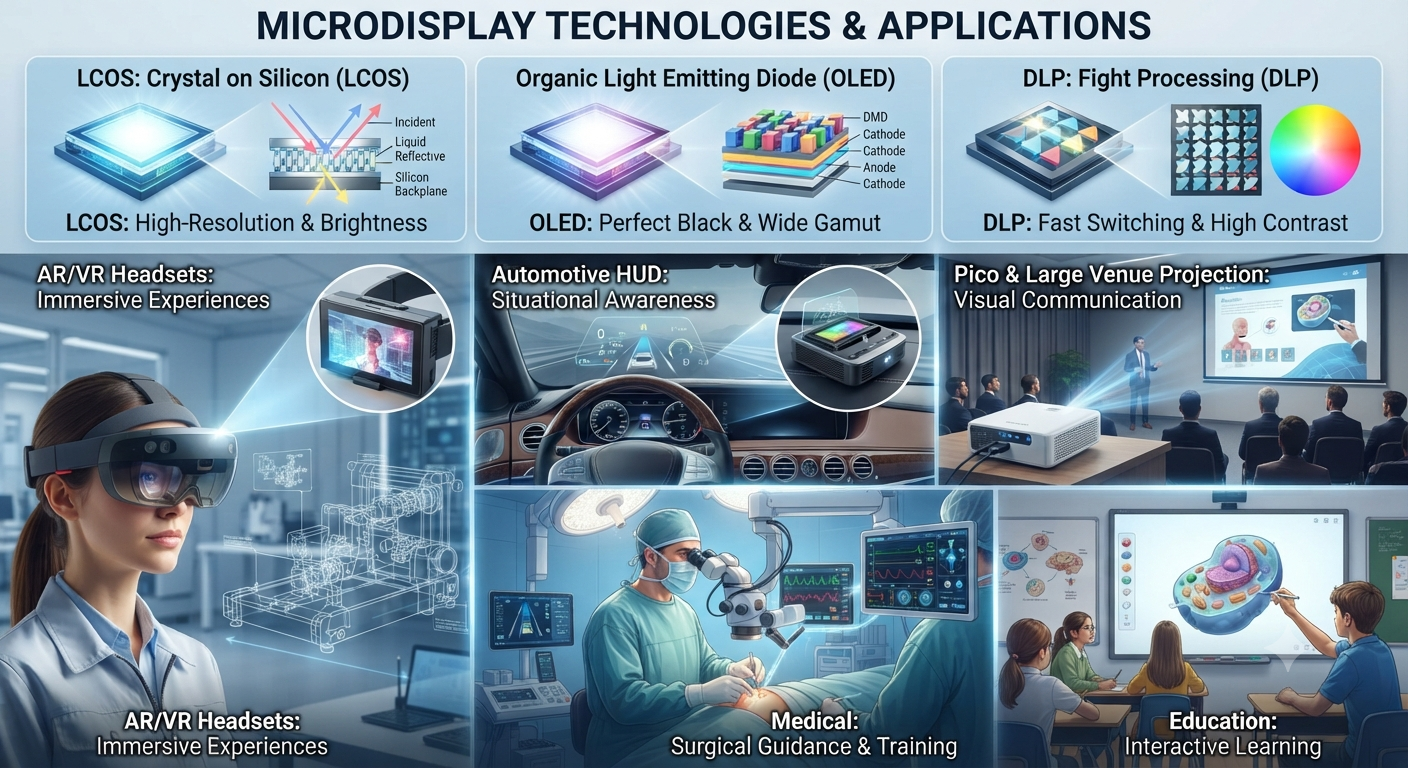
Technological advancements in organic light-emitting diode (OLED), MicroLED, liquid crystal on silicon (LCoS), and digital light processing (DLP) technologies are transforming the microdisplay industry.
OLED microdisplays offer high contrast ratios, deep black levels, fast response times, and low power consumption, making them suitable for VR headsets, electronic viewfinders, and compact optical devices.
Meanwhile, MicroLED technology is gaining attention due to its high brightness, energy efficiency, durability, and potential for outdoor applications.
Continuous innovation in display materials, semiconductor backplanes, and optical integration is expected to improve microdisplay performance and expand commercial applications.
Download PDF Brochure @ https://www.marketsandmarkets.com/pdfdownloadNew.asp?id=430
Emerging Trends Shaping the Microdisplay Market
The global microdisplay industry is evolving as manufacturers invest in advanced display architectures, improved optical performance, and next-generation wearable technologies.
1. Increasing Adoption of MicroLED Displays
MicroLED technology is emerging as an important innovation in the microdisplay industry. These displays use microscopic inorganic light-emitting diodes to produce bright, high-quality images with improved energy efficiency.
MicroLED displays offer several advantages, including high luminance, long operational life, fast response times, and suitability for outdoor environments.
These characteristics make the technology attractive for AR smart glasses, automotive head-up displays, military equipment, and industrial visualization systems.
According to MarketsandMarkets, the MicroLED technology segment is expected to register the highest CAGR during the forecast period.
2. Growing Demand for High-Resolution Microdisplays
Consumers and businesses increasingly expect sharper images, improved visual clarity, and realistic digital experiences from compact display devices.
Microdisplays with resolutions higher than Full HD (FHD) are gaining importance in advanced AR/VR headsets, medical visualization equipment, and professional imaging systems.
Higher-resolution displays improve image details and support immersive applications where visual precision is essential.
MarketsandMarkets indicates that the higher-than-FHD resolution segment is expected to register the highest CAGR of 10.6% from 2026 to 2032.
3. Expansion of Near-to-Eye Display Technologies
Near-to-eye devices represent an important product category in the global microdisplay market.
These systems position compact displays close to the user’s eyes to deliver digital images through specialized optical components.
Applications include AR glasses, VR headsets, electronic viewfinders, military helmet-mounted displays, and medical visualization equipment.
The growing adoption of wearable computing and immersive digital platforms is expected to support continued demand for near-to-eye microdisplay solutions.
4. Integration of Microdisplays in Healthcare and Medical Imaging
Healthcare is emerging as an important application area for advanced microdisplay technologies.
Microdisplays can be integrated into surgical visualization systems, medical loupes, diagnostic imaging equipment, and augmented reality-assisted procedures.
These solutions enable healthcare professionals to access digital information, medical images, and procedural guidance while performing clinical tasks.
The growing adoption of digital healthcare technologies and advanced medical visualization systems is expected to create new opportunities for microdisplay manufacturers.
Microdisplay Market Segmentation Analysis
The global microdisplay market is segmented by product, resolution, size, technology, and vertical. Each category contributes to the industry’s development through different technological capabilities and application requirements.
By Product: Near-to-Eye Devices, Head-Up Displays, and Projectors
The near-to-eye devices segment is expected to dominate the global microdisplay market throughout the forecast period.
Near-to-eye technologies are widely used in AR/VR headsets, smart glasses, electronic viewfinders, and wearable display systems. Their compact design, high pixel density, and ability to deliver immersive visual information make them suitable for next-generation consumer and enterprise devices.
Head-up displays are also gaining traction in automotive and aviation applications, while microdisplay-based projectors are used in specialized imaging and visualization systems.
By Resolution: Higher-than-FHD Displays Gaining Momentum
The microdisplay market includes resolutions below HD, HD, Full HD, and higher than Full HD.
The higher-than-FHD segment is expected to register the fastest growth, with a projected CAGR of 10.6% between 2026 and 2032.
The increasing demand for detailed visual output in AR/VR devices, medical applications, and professional imaging systems is supporting the adoption of high-resolution microdisplays.
By Size: Growing Demand for Compact Display Panels
Microdisplays are available in different sizes, including less than 0.5 inch, 0.5–1.0 inch, and 1.0–2.0 inches.
The 0.5–1.0-inch segment is expected to dominate the market in 2032.
Meanwhile, smaller display panels are gaining importance in lightweight smart glasses, compact optical devices, electronic viewfinders, and wearable technologies where space efficiency is essential.
By Technology: OLED and MicroLED Innovations
The major technologies in the microdisplay market include:
- OLED: Provides high contrast, excellent image quality, low power consumption, and fast response times.
- MicroLED: Offers high brightness, energy efficiency, long operational life, and strong potential for outdoor applications.
- LCoS: Combines liquid crystal technology with silicon backplanes to deliver high-resolution images in compact optical systems.
- DLP: Uses digital micromirror technology for projection-based display applications.
- LCD: Supports compact display solutions across various electronic and visualization applications.
OLED currently dominates the technology segment, while MicroLED is expected to register the highest growth during the forecast period.
By Vertical: Consumer Electronics Leading Adoption
The consumer segment is expected to dominate the microdisplay market, accounting for approximately 35.6% of the market in 2032.
Increasing demand for smart glasses, VR headsets, wearable electronics, and electronic viewfinders is supporting this segment.
Other important verticals include industrial and enterprise, military and defense, aerospace, education, automotive, medical, retail, and hospitality.
Regional Outlook: Asia Pacific to Witness the Fastest Growth
Asia Pacific is expected to register the highest CAGR of 12.6% in the global microdisplay market during the forecast period.
The region’s strong semiconductor manufacturing ecosystem, established consumer electronics industry, and growing investments in advanced display technologies are supporting market expansion.
China, Japan, South Korea, and Taiwan are important contributors to the regional microdisplay industry.
Japan has an established presence in advanced display manufacturing, while China is strengthening its position through investments in semiconductor technologies, smart wearable devices, and display production.
South Korea and Taiwan also contribute through their advanced electronics manufacturing capabilities and display technology development.
North America represents another important market, supported by investments in AR/VR technologies, defense applications, healthcare visualization, and advanced automotive systems.
Europe is also witnessing increasing demand for microdisplays across automotive, industrial, aerospace, and medical applications.
Opportunities in the Global Microdisplay Market
The increasing adoption of advanced display technologies is creating significant business opportunities for microdisplay manufacturers, semiconductor companies, optical component suppliers, and technology developers.
1. Expansion of AR Smart Glasses and Spatial Computing
The growing development of AR smart glasses and spatial computing devices is creating new opportunities for microdisplay manufacturers.
Technology companies are focusing on lightweight wearable devices that provide real-time information, immersive visual experiences, and hands-free digital interaction.
The demand for compact, high-brightness, and energy-efficient microdisplays is expected to increase as these technologies become more widely adopted.
2. Growing Applications in Defense and Aerospace
Microdisplays are increasingly being integrated into military helmet-mounted displays, night vision equipment, thermal imaging systems, and electronic viewfinders.
These technologies provide essential visual information to military personnel and support situational awareness in challenging environments.
The increasing modernization of defense equipment and investments in advanced military visualization systems are expected to create additional market opportunities.
3. Increasing Adoption in Medical Visualization
The integration of microdisplays into surgical visualization equipment, medical imaging systems, and augmented reality-assisted procedures offers promising growth opportunities.
High-resolution microdisplays enable healthcare professionals to access detailed visual information while performing complex procedures.
Growing investments in advanced medical technologies and digital healthcare infrastructure are expected to support this application segment.
4. Commercialization of MicroLED Technology
The commercialization of MicroLED technology represents a significant opportunity for the microdisplay industry.
Its high brightness, low power consumption, and long operational life make it suitable for next-generation AR devices, automotive displays, and industrial applications.
As manufacturing processes improve and production costs decline, MicroLED technology could gain wider commercial adoption.
Challenges Affecting Microdisplay Market Growth
Despite promising growth opportunities, the microdisplay industry faces several technical and commercial challenges.
High Manufacturing Costs: Developing advanced microdisplay panels requires specialized manufacturing facilities, sophisticated semiconductor processes, and significant research and development investments. These factors can increase production costs.
MicroLED Manufacturing Complexity: The mass transfer and integration of microscopic LEDs onto silicon backplanes remain technically challenging. Alignment accuracy, pixel integration, and manufacturing yields can affect large-scale commercialization.
Thermal Management: High-performance microdisplays require efficient thermal management to maintain display quality, reliability, and operational stability, particularly in compact wearable devices.
Strict Industry Qualification Requirements: Automotive, medical, aerospace, and defense applications require rigorous testing, safety validation, and compliance with industry standards. These requirements can extend product development and commercialization timelines.
Addressing these challenges through manufacturing innovation, improved production yields, and advanced semiconductor technologies will be important for long-term market development.
Competitive Landscape: Major Companies in the Microdisplay Market
The global microdisplay market includes established display manufacturers, semiconductor companies, and specialized technology providers competing through product innovation, manufacturing capabilities, and strategic partnerships.
Some of the prominent companies identified by MarketsandMarkets include:
- Sony Group Corporation
- Seiko Epson Corporation
- SeeYA Technology
- Kopin Corporation
- eMagin
- Himax Technologies, Inc.
- HOLOEYE Photonics AG
- WiseChip Semiconductor Inc.
- Raystar Optronics, Inc.
- Winstar Display Co., Ltd.
These companies are focusing on developing advanced OLED, MicroLED, LCoS, and other microdisplay technologies to address the growing demand for compact and high-performance visual solutions.
Product innovation, high-resolution display development, manufacturing efficiency, and expansion into emerging applications are important competitive strategies.
Future Outlook: What Lies Ahead for the Microdisplay Market?
The future of the global microdisplay industry looks promising as technological advancements continue to improve display resolution, brightness, power efficiency, and compactness.
The increasing commercialization of AR smart glasses, VR headsets, automotive head-up displays, and wearable electronics is expected to create sustained demand for advanced microdisplay solutions.
MicroLED technology is likely to gain importance as manufacturers overcome production challenges and improve manufacturing scalability. OLED-on-silicon technologies are also expected to remain important for compact, high-resolution near-to-eye applications.
Additionally, the growing use of microdisplays in healthcare, defense, industrial visualization, and aerospace applications will diversify market demand.
Asia Pacific is expected to remain an important growth center due to its established semiconductor manufacturing ecosystem and increasing investments in advanced display technologies.
As manufacturers continue to focus on miniaturization, energy efficiency, and improved optical performance, microdisplays are expected to play an increasingly important role in the future of connected and immersive digital experiences.
Conclusion
The global microdisplay industry is entering a promising growth phase, supported by rising demand for AR/VR devices, smart glasses, automotive head-up displays, and next-generation visualization technologies.
According to MarketsandMarkets, the global microdisplay market is projected to grow from USD 2.08 billion in 2026 to USD 3.71 billion by 2032, registering a CAGR of 10.2%.
The growing adoption of near-to-eye devices, advancements in OLED and MicroLED technologies, and expanding applications across consumer electronics, healthcare, automotive, and defense sectors are expected to drive industry expansion.
Although manufacturing costs, technical complexities, and production scalability remain important challenges, continuous technological innovation is expected to improve commercial opportunities.
As demand for immersive visual experiences and compact display solutions increases, the microdisplay market is positioned for continued growth, creating significant opportunities for technology developers, manufacturers, investors, and industry stakeholders.
FAQ
1. What is the projected size of the global microdisplay market by 2032?
According to MarketsandMarkets, the global microdisplay market is projected to grow from USD 2.08 billion in 2026 to USD 3.71 billion by 2032, driven by increasing demand for advanced display technologies and wearable electronic devices.
2. What is the expected CAGR of the microdisplay market?
The global microdisplay market is expected to register a CAGR of 10.2% during the forecast period from 2026 to 2032, supported by growing adoption of AR/VR devices, smart glasses, and high-resolution display solutions.
3. What are the major factors driving microdisplay market growth?
Key growth drivers include increasing adoption of augmented reality (AR) and virtual reality (VR) devices, rising demand for smart glasses, advancements in OLED and MicroLED technologies, and growing applications in automotive, healthcare, aerospace, and defense sectors.
4. Which region is expected to experience the fastest growth in the microdisplay market?
Asia Pacific is expected to register the highest growth rate in the global microdisplay market, with a projected CAGR of 12.6%. Strong semiconductor manufacturing capabilities, increasing investments in display technologies, and rising demand for consumer electronics are supporting regional expansion.
5. Which technologies are shaping the future of the microdisplay market?
OLED, MicroLED, Liquid Crystal on Silicon (LCoS), Digital Light Processing (DLP), and LCD are among the major technologies shaping the market. MicroLED is gaining attention due to its high brightness, energy efficiency, durability, and potential applications in next-generation AR smart glasses and advanced display systems.
About MarketsandMarkets™
MarketsandMarkets™ has been recognized as one of America’s Best Management Consulting Firms by Forbes, as per their recent report.
MarketsandMarkets™ is a blue ocean alternative in growth consulting and program management, leveraging a man-machine offering to drive supernormal growth for progressive organizations in the B2B space. With the widest lens on emerging technologies, we are proficient in co-creating supernormal growth for clients across the globe.
Today, 80% of Fortune 2000 companies rely on MarketsandMarkets, and 90 of the top 100 companies in each sector trust us to accelerate their revenue growth. With a global clientele of over 13,000 organizations, we help businesses thrive in a disruptive ecosystem.
The B2B economy is witnessing the emergence of $25 trillion in new revenue streams that are replacing existing ones within this decade. We work with clients on growth programs, helping them monetize this $25 trillion opportunity through our service lines – TAM Expansion, Go-to-Market (GTM) Strategy to Execution, Market Share Gain, Account Enablement, and Thought Leadership Marketing.
Built on the ‘GIVE Growth’ principle, we collaborate with several Forbes Global 2000 B2B companies to keep them future-ready. Our insights and strategies are powered by industry experts, cutting-edge AI, and our Market Intelligence Cloud, KnowledgeStore™, which integrates research and provides ecosystem-wide visibility into revenue shifts.
To find out more, visit www.MarketsandMarkets™.com or follow us on Twitter , LinkedIn and Facebook .
Contact:
Mr. Rohan Salgarkar
MarketsandMarkets™ INC.
630 Dundee Road
Suite 430
Northbrook, IL 60062
USA : 1-888-600-6441
