The automotive industry is undergoing a major transformation as electric vehicles (EVs), hybrid electric vehicles (HEVs), and plug-in hybrid electric vehicles (PHEVs) gain popularity worldwide. The transition toward electric mobility is increasing the demand for advanced battery technologies that deliver higher energy efficiency, improved safety, longer battery life, and reliable vehicle performance. Battery Management Systems (BMS) have become essential components of modern automotive battery architectures, enabling manufacturers to monitor, control, and optimize battery operations.
An automotive Battery Management System is an electronic system designed to monitor battery parameters such as voltage, current, temperature, state of charge (SoC), and state of health (SoH). It protects battery packs against overcharging, deep discharge, overheating, and other operating conditions that can affect battery performance and safety. Advanced BMS solutions also support cell balancing, thermal management, fault detection, and real-time battery diagnostics.
According to MarketsandMarkets, the global automotive Battery Management System market is projected to grow from USD 6.53 billion in 2025 to USD 15.65 billion by 2030, registering a compound annual growth rate (CAGR) of 19.1% during the forecast period. Increasing EV adoption, advancements in battery technologies, government support for vehicle electrification, and growing demand for intelligent battery monitoring are driving market expansion.
As automotive manufacturers accelerate investments in electrification, BMS technologies are becoming increasingly important for improving vehicle reliability, optimizing battery utilization, and supporting next-generation mobility solutions.
Rising Electric Vehicle Adoption Driving Automotive BMS Market Growth
The rapid expansion of the electric vehicle industry is one of the primary factors driving the automotive BMS market. Governments across major economies are introducing emission reduction targets, financial incentives, and policies to encourage electric vehicle adoption. At the same time, automotive manufacturers are expanding their EV portfolios and investing in advanced battery platforms.
Electric vehicles rely on sophisticated battery packs to deliver power to electric motors and other vehicle systems. Managing these battery packs requires accurate monitoring and control to maintain safe operating conditions and maximize energy utilization.
Automotive BMS solutions help manufacturers improve battery performance by monitoring individual cells, controlling charging and discharging cycles, and identifying potential faults. These systems also provide important information about battery health, helping vehicle manufacturers optimize maintenance schedules and extend battery service life.
The increasing adoption of electric buses, commercial vehicles, passenger cars, and electric two-wheelers is creating additional demand for scalable BMS architectures. Fleet operators are also focusing on battery reliability and lifecycle management to reduce operating costs and improve vehicle availability.
As EV production increases globally, automotive manufacturers and battery suppliers are expected to invest more in intelligent battery management technologies.
Download PDF Brochure @ https://www.marketsandmarkets.com/pdfdownloadNew.asp?id=15321159
Advancements in Battery Technologies Creating New Opportunities
Continuous innovation in battery chemistry and energy storage technologies is creating new opportunities for automotive BMS manufacturers. Lithium-ion batteries remain widely used in electric vehicles because of their high energy density, efficient charging and discharging capabilities, and relatively long operating life.
However, the development of new battery technologies, including solid-state batteries and advanced lithium-ion chemistries, is increasing the need for more sophisticated battery monitoring and control systems.
Advanced BMS platforms must accommodate different battery chemistries while maintaining accurate measurements of voltage, temperature, current, and battery health. They must also support improved thermal management, cell balancing, and fault detection.
Solid-state batteries represent an emerging opportunity because of their potential to improve energy density and safety. Their commercialization will require battery management solutions capable of handling new operating characteristics and charging requirements.
Similarly, innovations in lithium iron phosphate (LFP) and nickel manganese cobalt (NMC) battery technologies are encouraging manufacturers to develop flexible BMS solutions that can support different battery configurations.
Companies investing in battery monitoring algorithms, advanced sensors, and adaptable electronic control architectures are positioned to benefit from these developments.
Automotive BMS Market Segmentation Analysis
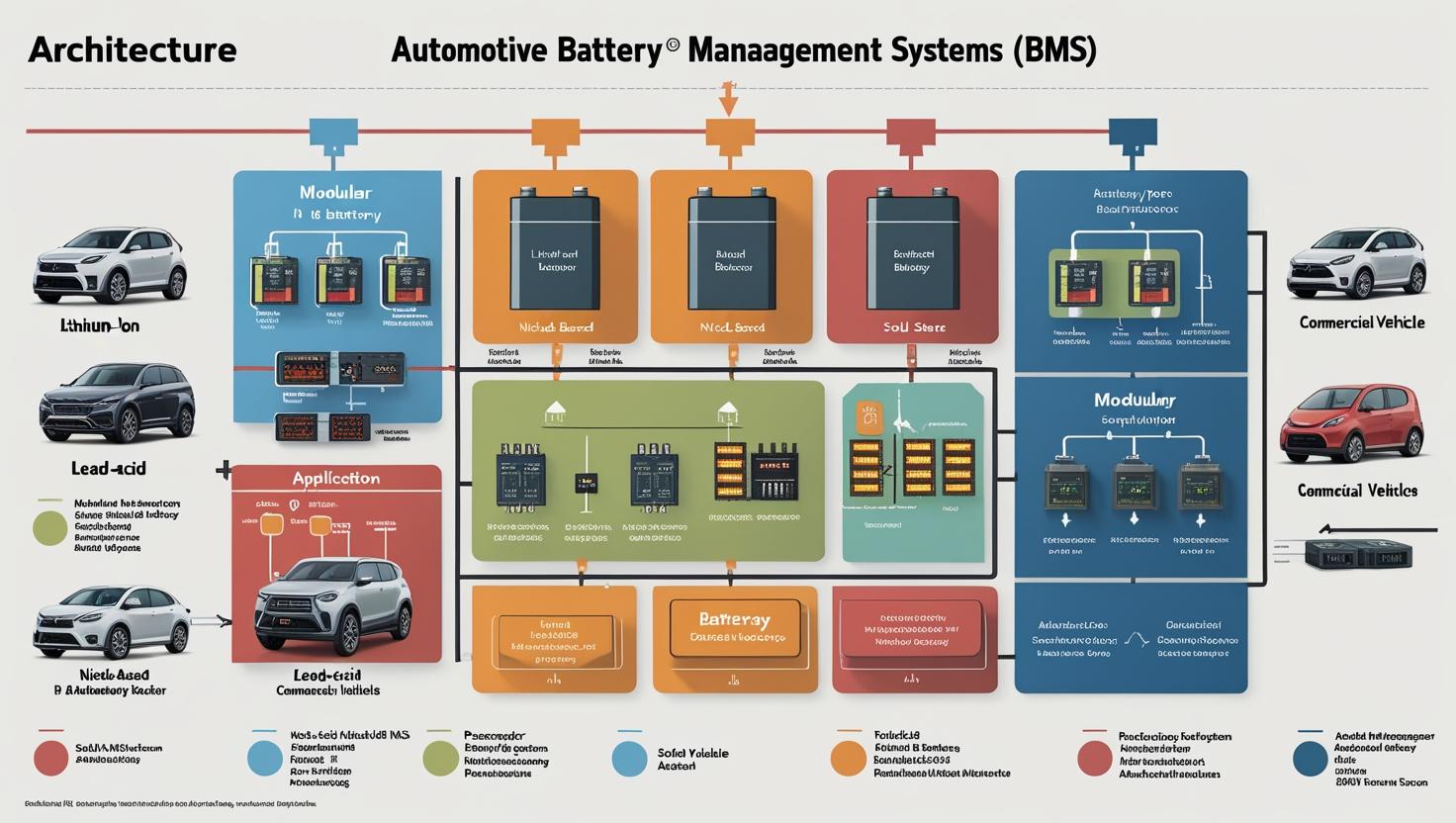
The automotive BMS market is segmented by battery type, topology, application, and region. These segments highlight the different technologies and automotive applications contributing to market growth.
1. By Battery Type: Lithium-ion Batteries
The lithium-ion battery segment is expected to register the highest CAGR of 19.5% during the forecast period.
Lithium-ion batteries are widely adopted in electric and hybrid vehicles because of their high energy density, compact design, and efficient power delivery. However, these batteries require accurate monitoring to prevent overheating, overcharging, and cell imbalance.
Automotive BMS solutions help maintain battery operating conditions by monitoring individual cells and controlling charging and discharging processes. They also estimate SoC and SoH, allowing vehicle manufacturers to improve battery utilization and performance.
The growing adoption of lithium-ion batteries across passenger vehicles, electric buses, and commercial EVs is expected to support demand for advanced battery management systems.
2. By Topology: Centralized, Modular, and Distributed BMS
Automotive battery management systems are available in three major architectures: centralized, modular, and distributed.
Centralized BMS: A centralized architecture uses a single control unit to monitor and manage the battery pack. It offers a compact and cost-efficient configuration, making it suitable for applications where simplified battery monitoring is required.
Modular BMS: Modular systems divide battery management functions across multiple modules. This architecture provides flexibility and scalability, particularly for larger battery packs used in electric vehicles.
Distributed BMS: Distributed architectures place monitoring electronics closer to individual battery cells or groups of cells. This approach can improve monitoring flexibility and support complex battery configurations.
The selection of BMS topology depends on battery pack size, vehicle architecture, cost considerations, and performance requirements. As EV platforms become more advanced, manufacturers are exploring flexible architectures that simplify integration and improve battery monitoring accuracy.
3. By Application: Passenger and Commercial Vehicles
The passenger vehicle segment is expected to register a CAGR of 19.8% during the forecast period.
Increasing consumer interest in electric cars, growing environmental awareness, and government incentives are encouraging automotive manufacturers to introduce new electric passenger vehicle models.
Battery management systems are essential for passenger EVs because they help optimize driving range, charging efficiency, battery safety, and long-term performance.
Commercial vehicles also represent an important application segment. Electric buses, trucks, delivery vehicles, and fleet transportation systems require reliable battery management solutions to support high-capacity batteries and demanding operating conditions.
The increasing electrification of public transportation and commercial fleets is expected to create additional opportunities for BMS manufacturers.
Key Technology Trends Transforming the Automotive BMS Market
AI-Powered Battery Management Systems
Artificial intelligence is creating new opportunities for intelligent battery monitoring and predictive maintenance. AI-powered BMS platforms can analyze battery operating data, identify unusual performance patterns, and predict potential battery failures.
Machine learning algorithms can improve SoC and SoH estimation by analyzing charging behavior, temperature variations, and battery degradation patterns. These capabilities help automotive manufacturers identify battery issues earlier and optimize battery utilization.
The integration of AI with cloud-based battery analytics is also supporting remote diagnostics and predictive battery lifecycle management. As connected vehicles become more common, intelligent BMS solutions are expected to play an increasingly important role in automotive electrification.
Wireless Battery Management Systems
Wireless Battery Management Systems are emerging as an important technology opportunity. Traditional BMS architectures rely on wired connections between battery cells and control units, which can increase wiring complexity, weight, and installation requirements.
Wireless BMS solutions use wireless communication to exchange battery monitoring data, reducing the need for extensive wiring harnesses. This can simplify battery pack assembly, improve design flexibility, and potentially reduce vehicle weight.
The technology is particularly relevant for electric vehicles with complex battery configurations. As manufacturers focus on improving vehicle range and simplifying battery architecture, wireless BMS adoption is expected to create new growth opportunities.
Advanced Thermal Management and Battery Safety
Thermal management is one of the most important functions of automotive battery management systems. Battery temperature directly influences charging efficiency, performance, durability, and operational safety.
Advanced BMS solutions monitor temperature variations across battery cells and help coordinate cooling and heating systems. They can also identify abnormal thermal conditions and trigger protective measures to reduce the risk of battery damage.
With the increasing adoption of fast-charging technologies and high-capacity battery packs, demand for advanced thermal monitoring and protection capabilities is expected to increase.
Fast Charging and Intelligent Energy Management
The growing demand for faster EV charging is encouraging manufacturers to develop advanced BMS technologies capable of managing higher charging currents and complex battery operating conditions.
Intelligent BMS platforms regulate charging processes based on battery temperature, voltage, and operating status. They help maintain safe charging conditions while optimizing battery performance.
The development of high-voltage EV architectures and fast-charging infrastructure will create opportunities for advanced battery monitoring, charging control, and power management technologies.
Major Factors Driving the Automotive BMS Market
Several industry developments are supporting the growing adoption of automotive battery management systems.
Growing EV Production: Increasing production of battery electric vehicles and hybrid vehicles is directly expanding demand for automotive BMS solutions.
Government Support and Incentives: Policies supporting clean mobility, emission reduction, and domestic battery manufacturing are encouraging investment in EV technologies.
Increasing Battery Safety Requirements: Automotive manufacturers are prioritizing battery protection, real-time diagnostics, thermal monitoring, and fault detection.
Expansion of Electric Public Transportation: Electric buses and other commercial transportation platforms require advanced battery monitoring systems to support large battery packs and demanding operating conditions.
Connected and Software-Defined Vehicles: The development of connected vehicles is encouraging integration of intelligent BMS platforms with cloud services, vehicle electronics, and predictive analytics.
Asia Pacific: The Leading Growth Engine for Automotive BMS
Asia Pacific is expected to be the fastest-growing region in the global automotive BMS market. The region benefits from strong electric vehicle manufacturing capabilities, established battery supply chains, increasing investments in battery technologies, and government initiatives supporting transportation electrification.
China, Japan, South Korea, and India are important markets contributing to regional development.
China has a strong position in electric vehicle production and lithium-ion battery manufacturing. The country’s expanding EV ecosystem is generating significant demand for advanced battery management solutions.
Japan and South Korea are home to major automotive and battery technology companies that are investing in battery innovation, intelligent monitoring systems, and next-generation energy storage technologies.
India is also creating opportunities through electric mobility initiatives, expanding electric two-wheeler and three-wheeler adoption, and investments in domestic EV manufacturing.
Asia Pacific accounted for 47.3% of the global automotive BMS market revenue in 2024, highlighting its importance in the worldwide automotive electrification ecosystem.
For BMS manufacturers, the region offers opportunities in battery electronics, software development, battery pack integration, and advanced monitoring technologies.
Competitive Landscape: Key Companies in the Automotive BMS Market
The automotive BMS market includes automotive suppliers, battery manufacturers, technology developers, and electronic system providers. Companies are focusing on product innovation, strategic partnerships, and advanced battery monitoring solutions to strengthen their market positions.
Some of the key companies operating in the market include:
- Eberspächer (Germany): Develops automotive battery systems and battery management solutions, with a focus on safety and vehicle electrification.
- Sensata Technologies (US): Provides sensing, monitoring, and electrical protection technologies for automotive applications.
- LG Energy Solution (South Korea): Develops advanced battery technologies and intelligent battery management solutions.
- AVL (Austria): Provides automotive engineering, battery testing, and battery management technology solutions.
- Ficosa Internacional (Spain): Develops automotive electronic systems and battery management solutions.
Competition is increasingly focused on improving battery monitoring accuracy, thermal safety, software capabilities, and integration with advanced electric vehicle architectures.
Strategic collaborations between automotive OEMs, battery manufacturers, semiconductor companies, and software developers are also expected to influence the competitive landscape.
Challenges Affecting Automotive BMS Adoption
Despite strong growth opportunities, the automotive BMS market faces several technical and commercial challenges.
Lack of Universal BMS Standards
Different manufacturers use varying battery configurations, communication protocols, measurement parameters, and monitoring algorithms. This creates challenges in standardizing BMS performance across different vehicle platforms.
The development of common standards and testing procedures will be important for improving interoperability and simplifying integration.
Environmental and Operating Conditions
Battery management systems must operate accurately under changing temperatures, vibration, humidity, and other demanding automotive conditions.
Extreme temperatures can affect battery performance and the accuracy of monitoring systems. Manufacturers must develop reliable sensors, algorithms, and electronic components capable of maintaining consistent performance under different operating conditions.
Complexity of Advanced Battery Technologies
The emergence of new battery chemistries and high-voltage architectures is increasing the complexity of battery management systems.
Manufacturers must continuously upgrade hardware, software, and monitoring algorithms to support changing battery characteristics while maintaining safety and reliability.
Addressing these challenges through innovation, testing, standardization, and collaboration will be essential for long-term market growth.
Future Outlook: Investment Opportunities in Next-Generation Automotive BMS
The automotive BMS market is expected to experience significant technological and commercial development through 2030. Increasing EV production, advanced battery chemistry, wireless communication, and AI-powered diagnostics are creating new investment opportunities across the automotive value chain.
Some of the most promising areas include:
- Wireless BMS Technology: Investment in wireless battery monitoring architectures that reduce wiring complexity and improve battery pack flexibility.
- AI-Based Battery Analytics: Development of intelligent algorithms for predictive maintenance, battery health estimation, and fault detection.
- Advanced Battery Safety: Innovative solutions for thermal monitoring, cell balancing, and battery protection.
- Solid-State Battery Management: Development of monitoring systems designed for emerging solid-state battery technologies.
- High-Voltage BMS Platforms: Solutions supporting advanced EV architectures and fast-charging applications.
- Cloud-Connected BMS: Integration of battery monitoring systems with connected vehicle platforms and remote diagnostics.
- Commercial EV Battery Management: Advanced solutions for electric trucks, buses, and fleet transportation systems.
Companies that invest in scalable architectures, intelligent software, advanced sensing technologies, and battery safety solutions are likely to benefit from the increasing demand for next-generation automotive battery management systems.
Conclusion
The automotive Battery Management System market is becoming a critical part of the global electric mobility ecosystem. As automotive manufacturers accelerate the transition toward electric and hybrid vehicles, the demand for intelligent battery monitoring, advanced safety systems, and efficient energy management technologies is increasing.
With the global market projected to reach USD 15.65 billion by 2030, growing at a CAGR of 19.1% from 2025 to 2030, the industry presents significant opportunities for automotive OEMs, battery manufacturers, electronic component suppliers, and technology developers.
Lithium-ion batteries, wireless BMS architectures, AI-powered diagnostics, and advanced thermal management are expected to influence the next phase of market development. Furthermore, Asia Pacific’s strong automotive manufacturing ecosystem and expanding EV adoption will continue to support regional growth.
Ultimately, advancements in automotive BMS technologies will be essential for improving battery safety, extending battery life, optimizing vehicle performance, and accelerating the transition toward sustainable mobility.
FAQ
Q1. What is the projected size of the automotive BMS market by 2030?
A. The global automotive BMS market is projected to reach USD 15.65 billion by 2030, growing at a CAGR of 19.1% from 2025 to 2030.
Q2. Which region is expected to grow fastest in the automotive BMS market?
A. Asia Pacific is expected to register the highest growth, driven by electric vehicle adoption, battery manufacturing, and government electrification initiatives.
Q3. Which battery type is expected to grow fastest in the automotive BMS market?
A. The lithium-ion battery segment is expected to register the highest CAGR of 19.5% during the forecast period.
Q4. Which application segment is expected to grow fastest in the automotive BMS market?
A. The passenger vehicle segment is expected to register a CAGR of 19.8% during the forecast period.
Q5. Who are the key players in the automotive BMS market?
A. Key players include Eberspächer, Sensata Technologies, LG Energy Solution, AVL, and Ficosa Internacional.
About MarketsandMarkets™
MarketsandMarkets™ has been recognized as one of America’s Best Management Consulting Firms by Forbes, as per their recent report.
MarketsandMarkets™ is a blue ocean alternative in growth consulting and program management, leveraging a man-machine offering to drive supernormal growth for progressive organizations in the B2B space. With the widest lens on emerging technologies, we are proficient in co-creating supernormal growth for clients across the globe.
Today, 80% of Fortune 2000 companies rely on MarketsandMarkets, and 90 of the top 100 companies in each sector trust us to accelerate their revenue growth. With a global clientele of over 13,000 organizations, we help businesses thrive in a disruptive ecosystem.
The B2B economy is witnessing the emergence of $25 trillion in new revenue streams that are replacing existing ones within this decade. We work with clients on growth programs, helping them monetize this $25 trillion opportunity through our service lines – TAM Expansion, Go-to-Market (GTM) Strategy to Execution, Market Share Gain, Account Enablement, and Thought Leadership Marketing.
Built on the ‘GIVE Growth’ principle, we collaborate with several Forbes Global 2000 B2B companies to keep them future-ready. Our insights and strategies are powered by industry experts, cutting-edge AI, and our Market Intelligence Cloud, KnowledgeStore™, which integrates research and provides ecosystem-wide visibility into revenue shifts.
To find out more, visit www.MarketsandMarkets™.com or follow us on Twitter , LinkedIn and Facebook .
Contact:
Mr. Rohan Salgarkar
MarketsandMarkets™ INC.
630 Dundee Road
Suite 430
Northbrook, IL 60062
USA : 1-888-600-6441