The global Rotary Laser Exterior Levelling Tool Market is gaining momentum as construction companies, infrastructure developers, contractors, and surveying professionals increasingly adopt precision-based measurement technologies. Rotary laser exterior levelling tools play an important role in improving construction accuracy, optimizing site preparation, and reducing manual measurement errors. These tools are widely used in road construction, foundation layout, excavation, concrete work, landscaping, drainage installation, and large-scale infrastructure projects.
The growing emphasis on construction productivity, project efficiency, and accurate site measurements is encouraging businesses to invest in advanced rotary laser technologies. Features such as automatic self-leveling, dual-slope functionality, green laser beams, extended working ranges, and Bluetooth connectivity are transforming the capabilities of modern exterior levelling equipment.
According to MarketsandMarkets, the global rotary laser exterior levelling tool market is projected to grow from USD 0.58 billion in 2026 to USD 0.79 billion by 2032, registering a CAGR of 5.4% during the forecast period. This growth reflects increasing construction activities, infrastructure modernization, and the adoption of advanced precision levelling solutions.
Customer Insights: Understanding Changing Buyer Requirements
Customer preferences in the rotary laser exterior levelling tool market are evolving as construction professionals prioritize accuracy, durability, operational efficiency, and ease of use. General contractors, infrastructure companies, excavation specialists, landscaping contractors, and professional surveyors increasingly require equipment that delivers consistent performance across challenging outdoor environments.
One of the most important purchasing considerations is measurement accuracy. Construction companies require reliable levelling equipment to support foundation alignment, grading, concrete formwork, and site preparation. Rotary laser systems help reduce measurement errors, minimize rework, and improve overall construction quality.
Another significant customer requirement is operational convenience. Contractors prefer self-leveling systems that reduce manual adjustments and simplify equipment setup. Dual-slope rotary lasers are gaining attention because they allow users to establish precise slopes along two axes, making them suitable for complex grading, drainage, and infrastructure applications.
Durability is also an important purchasing factor. Outdoor construction environments expose equipment to dust, moisture, vibration, and accidental impacts. Consequently, customers increasingly value rugged product designs, weather-resistant protection, extended battery life, and reliable laser receivers.
Additionally, digital connectivity is influencing purchasing decisions. Bluetooth-enabled rotary lasers, remote-control functionality, and integration with digital construction workflows help professionals improve equipment management and operational productivity.
Download PDF Brochure @ https://www.marketsandmarkets.com/pdfdownloadNew.asp?id=238458526
Market Growth Drivers and Emerging Business Opportunities
Increasing Residential and Commercial Construction Activities
The expansion of residential, commercial, and mixed-use construction projects is creating significant demand for rotary laser exterior levelling tools. Housing developments, commercial buildings, industrial facilities, and urban redevelopment projects require accurate foundation preparation, site grading, and structural alignment.
Rotary laser systems help construction professionals perform these activities with greater precision while reducing dependence on traditional manual levelling techniques. Increasing investments in construction infrastructure are therefore expected to support market expansion.
Growing Adoption of Precision Levelling Technologies
Construction companies are increasingly adopting advanced measurement technologies to improve project efficiency and reduce operational costs. Rotary laser exterior levelling tools provide accurate horizontal and vertical reference measurements across large outdoor working areas.
Self-leveling functionality, automatic alignment, digital slope control, and extended working ranges are making these solutions more attractive to professional users. The increasing focus on precision construction is expected to create additional opportunities for manufacturers.
Expansion of Urban Redevelopment and Infrastructure Projects
Urban redevelopment, smart city initiatives, road modernization, and infrastructure expansion are creating new opportunities for rotary laser equipment suppliers.
These projects require accurate grading, excavation, drainage installation, foundation preparation, and exterior alignment. Manufacturers offering advanced dual-slope systems and digital construction compatibility can benefit from increasing demand across infrastructure applications.
Integration with Digital Construction Technologies
The integration of rotary laser equipment with Building Information Modeling (BIM), machine control systems, and digital construction platforms represents an emerging growth opportunity.
Connected laser systems can support more efficient grading operations, improve measurement workflows, and reduce manual intervention. Manufacturers investing in connected equipment and automated construction technologies can strengthen their competitive positioning.
Competitive Benchmarking: Key Players and Market Positioning
The rotary laser exterior levelling tool market features established construction equipment manufacturers and specialized measurement technology providers. Companies compete through product innovation, measurement accuracy, product durability, pricing strategies, distribution networks, and after-sales services.
Leading companies identified in the market include Robert Bosch GmbH, Hilti Group, Leica Geosystems, and Topcon Corporation. These companies have established market positions through broad product portfolios, technological capabilities, and global distribution networks.
Other important participants include Johnson Level & Tool, Milwaukee Tool, Makita, Trimble, Stabila, Stanley Black & Decker, and Laserliner.
Competitive benchmarking is increasingly important as customers evaluate equipment based on working range, slope functionality, laser visibility, battery performance, durability, and overall ownership costs.
Bosch
Robert Bosch GmbH focuses on professional construction measurement solutions with advanced rotary laser technologies. Its product capabilities include green-beam technology, Bluetooth connectivity, dual-slope functionality, and remote operation. These features support outdoor levelling and grading applications.
Hilti Group
Hilti Group competes through professional construction equipment, advanced measurement capabilities, and integrated digital workflows. Its rotary laser solutions support exterior levelling, excavation, alignment, and grading operations. The company’s focus on automated alignment and digital slope control strengthens its positioning in professional construction applications.
Leica Geosystems
Leica Geosystems focuses on high-precision measurement and surveying technologies. Its solutions support professional construction layout, site preparation, concrete work, and infrastructure applications. Product accuracy, reliability, and integration with surveying workflows are important competitive advantages.
Topcon Corporation
Topcon Corporation provides precision construction and positioning technologies. Its rotary laser-based machine control solutions support grading operations by integrating laser references, receivers, and tilt-sensing technologies. These capabilities help contractors improve grading accuracy and reduce manual checking.
Emerging and Specialized Competitors
Companies such as Johnson Level & Tool, Stabila, Milwaukee Tool, Makita, and Stanley Black & Decker contribute to market competition through specialized construction tools, product differentiation, and broader distribution strategies.
These manufacturers can strengthen their market presence by targeting small and medium-sized contractors, expanding product accessibility, and offering cost-effective solutions for general construction and landscaping applications.
High-Growth Market Segments
Dual-Slope Rotary Laser Systems
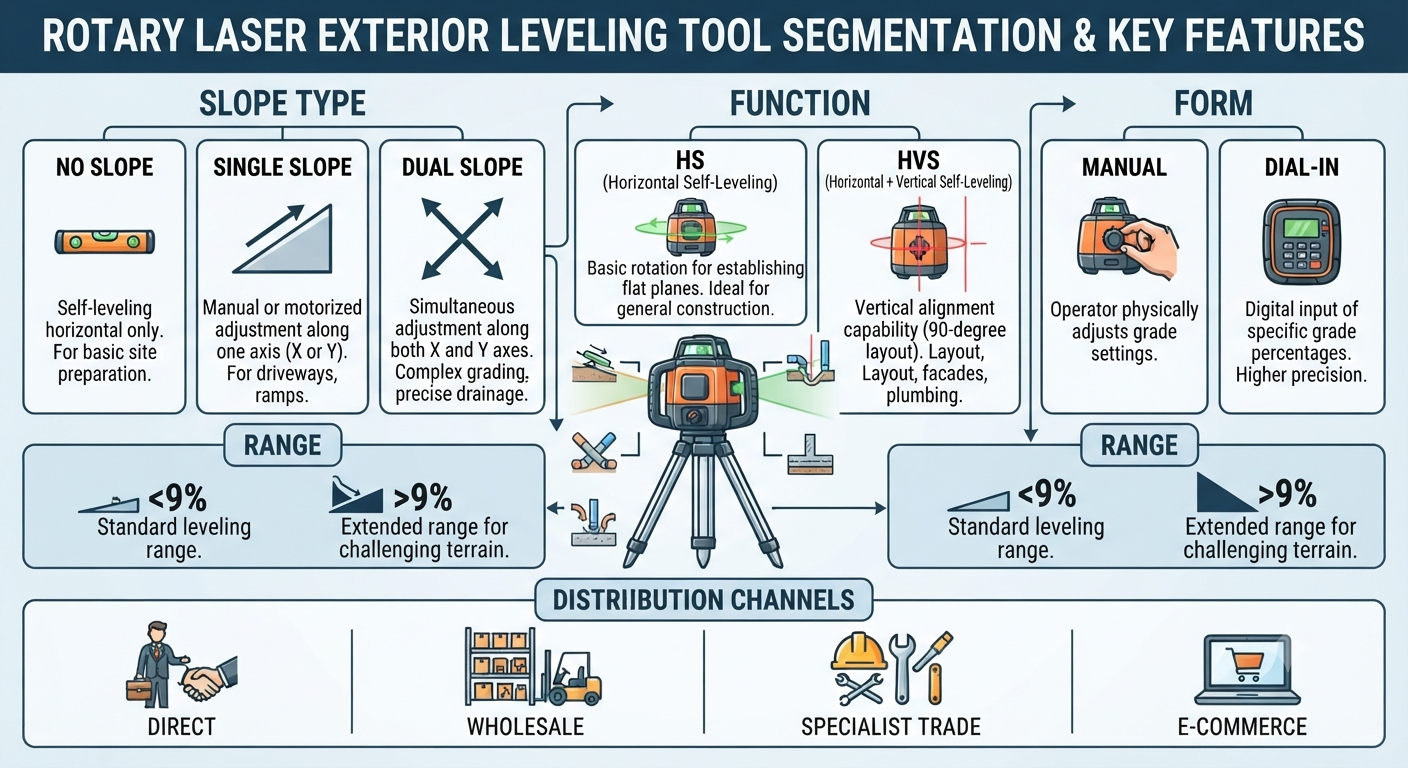
The dual-slope segment is expected to register the highest CAGR of 9.1% during the forecast period. These systems allow users to control slope settings across two axes, making them suitable for road construction, drainage installation, airport runways, and large-scale site grading.
The ability to reduce manual adjustments and improve measurement accuracy makes dual-slope technology an attractive investment area for manufacturers.
Horizontal-Vertical Functionality
The horizontal-vertical segment is projected to register a CAGR of 8.2%. These systems support applications requiring both horizontal and vertical reference measurements.
Increasing demand for precise construction layouts, alignment, and outdoor measurement solutions is supporting adoption.
Dial-In Slope Technology
Dial-in slope systems are expected to register the highest CAGR of 10.1% among slope forms. These solutions allow operators to digitally enter precise slope values, reducing manual intervention and improving setup efficiency.
Their growing use in drainage, grading, road construction, and commercial infrastructure projects creates opportunities for advanced equipment manufacturers.
E-Commerce Distribution
E-commerce is expected to register a CAGR of approximately 6.7% during the forecast period. Online purchasing channels are improving product accessibility and allowing contractors to compare product specifications, pricing, and features.
Manufacturers can strengthen their digital sales strategies through dedicated webstores, online product demonstrations, technical information, and customer support.
General Construction Applications
General construction is expected to account for the largest market share by application. Rotary laser tools are widely used in foundation work, site layout, grading, concrete formwork, and structural alignment.
Continuous investments in residential and commercial construction are expected to sustain demand from this segment.
Regional Market Outlook: Asia Pacific Creates Growth Opportunities
Asia Pacific is expected to represent approximately 40% of the global rotary laser exterior levelling tool market in 2026 and is also projected to be the fastest-growing regional market during the forecast period.
China, India, Indonesia, and other Southeast Asian countries are witnessing increasing construction activities, infrastructure investments, and urban redevelopment initiatives. These developments are creating demand for advanced construction measurement and levelling equipment.
India represents an important growth opportunity due to infrastructure modernization, residential construction, commercial development, and smart city projects. Increasing awareness of precision construction technologies among contractors and engineering companies is expected to support the adoption of rotary laser systems.
North America and Europe also offer opportunities through established construction equipment markets, infrastructure upgrades, and the increasing adoption of digital construction technologies.
Business Strategies for Market Participants
1. Invest in Product Innovation
Manufacturers should prioritize the development of advanced rotary laser systems featuring automatic self-leveling, dual-slope functionality, green-beam technology, and extended working ranges. Product innovation can help companies differentiate their offerings and address evolving customer requirements.
2. Strengthen Digital Integration
Integrating rotary laser equipment with Bluetooth connectivity, remote-control applications, BIM platforms, and machine control systems can improve customer value. Connected solutions can also support automated grading and more efficient construction workflows.
3. Develop Competitive Pricing Strategies
High initial equipment costs remain a challenge, particularly for small and medium-sized contractors. Manufacturers can address price sensitivity by introducing multiple product tiers, flexible financing options, and affordable solutions for entry-level users.
4. Expand Distribution and E-Commerce Channels
Building stronger relationships with authorized dealers, construction equipment distributors, rental companies, and online retailers can improve market penetration. Manufacturer-operated webstores can also help businesses strengthen customer engagement and provide direct technical support.
5. Strengthen After-Sales Services
Calibration, maintenance, operator training, warranty support, and technical assistance are important factors influencing customer satisfaction. Companies that provide comprehensive after-sales services can improve customer retention and build long-term business relationships.
6. Focus on Emerging Markets
Expanding operations in Asia Pacific and other developing economies can help manufacturers capture opportunities arising from infrastructure development and urbanization. Local partnerships, regional distribution networks, and application-specific product offerings can support expansion.
Recent Technological Developments Shaping Competition
Technological innovation is becoming an important competitive differentiator in the rotary laser exterior levelling tool market.
In January 2026, Makita U.S.A. introduced its 18V LXT Green Exterior Dual Slope 360° Rotary Laser (SKR001), featuring dual-slope functionality, a green beam, cordless operation, and a working range of up to 2,600 feet.
DEWALT expanded its rotary laser portfolio in 2026 with a 20V MAX XR Green Rotary Laser Base Kit, featuring a green beam, automatic beam-finding functionality, and extended battery runtime.
Hilti also advanced its Nuron rotary laser platform with automated levelling and alignment capabilities, supporting more efficient exterior grading and measurement workflows.
These developments highlight the industry’s movement toward cordless equipment, enhanced outdoor visibility, automated alignment, and connected construction technologies.
Future Outlook: Building a Competitive Advantage Through Innovation
The future of the rotary laser exterior levelling tool market will be shaped by the growing need for construction accuracy, infrastructure development, digitalization, and productivity-enhancing equipment.
Manufacturers that combine advanced laser technology with connected capabilities, durable product designs, and customer-focused pricing strategies are likely to strengthen their competitive positions.
Dual-slope systems, dial-in slope functionality, horizontal-vertical measurement capabilities, and extended working ranges are expected to create attractive opportunities for product development and commercialization.
Furthermore, the expansion of e-commerce, equipment rental models, and digital construction workflows will influence how manufacturers reach customers and deliver value.
With the global market projected to reach USD 0.79 billion by 2032, companies have opportunities to strengthen product portfolios, expand regional distribution, develop strategic partnerships, and capture emerging demand.
Conclusion
The rotary laser exterior levelling tool market is evolving as construction companies increasingly prioritize precision, efficiency, and advanced measurement technologies. Growing residential and commercial construction activities, infrastructure investments, and digital construction adoption are creating opportunities for equipment manufacturers and technology providers.
Competitive success will depend on product innovation, pricing strategies, digital integration, distribution expansion, and strong customer support. Companies that understand changing customer requirements and benchmark their offerings against leading competitors will be better positioned to capture future growth.
As construction activities continue to expand globally, rotary laser exterior levelling tools will remain important equipment for improving measurement accuracy, reducing rework, and supporting efficient project execution.
Top 5 Takeaways
- The global rotary laser exterior levelling tool market is projected to reach USD 0.79 billion by 2032, growing at a CAGR of 5.4% from 2026 to 2032.
- Asia Pacific is expected to account for approximately 40% of the market in 2026, driven by construction and infrastructure investments.
- Dual-slope rotary laser systems are expected to register the highest CAGR of 9.1% among slope types.
- Bosch, Hilti, Leica Geosystems, and Topcon are among the leading competitive players.
- Green-beam technology, Bluetooth connectivity, automation, and machine control integration are creating new product development and business opportunities.
Frequently Asked Questions (FAQs)
Q1. What is the projected size of the rotary laser exterior levelling tool market by 2032?
The market is projected to reach USD 0.79 billion by 2032, growing from USD 0.58 billion in 2026 at a CAGR of 5.4%.
Q2. Which region is expected to lead the rotary laser exterior levelling tool market?
Asia Pacific is expected to account for approximately 40% of the global market in 2026 and is projected to be the fastest-growing region during the forecast period.
Q3. Which segment is expected to grow fastest by slope type?
The dual-slope segment is expected to register the highest CAGR of 9.1% during the forecast period.
Q4. Who are the key players in the rotary laser exterior levelling tool market?
Key players include Robert Bosch GmbH, Hilti Group, Leica Geosystems, Topcon Corporation, Johnson Level & Tool, Makita, Milwaukee Tool, Trimble, Stabila, and Stanley Black & Decker.
Q5. What are the major growth opportunities in the rotary laser exterior levelling tool market?
Major opportunities include dual-slope technology, digital slope control, green-beam laser systems, Bluetooth connectivity, machine control integration, e-commerce distribution, and growing infrastructure development.
About MarketsandMarkets™
MarketsandMarkets™ has been recognized as one of America’s Best Management Consulting Firms by Forbes, as per their recent report.
MarketsandMarkets™ is a blue ocean alternative in growth consulting and program management, leveraging a man-machine offering to drive supernormal growth for progressive organizations in the B2B space. With the widest lens on emerging technologies, we are proficient in co-creating supernormal growth for clients across the globe.
Today, 80% of Fortune 2000 companies rely on MarketsandMarkets, and 90 of the top 100 companies in each sector trust us to accelerate their revenue growth. With a global clientele of over 13,000 organizations, we help businesses thrive in a disruptive ecosystem.
The B2B economy is witnessing the emergence of $25 trillion in new revenue streams that are replacing existing ones within this decade. We work with clients on growth programs, helping them monetize this $25 trillion opportunity through our service lines – TAM Expansion, Go-to-Market (GTM) Strategy to Execution, Market Share Gain, Account Enablement, and Thought Leadership Marketing.
Built on the ‘GIVE Growth’ principle, we collaborate with several Forbes Global 2000 B2B companies to keep them future-ready. Our insights and strategies are powered by industry experts, cutting-edge AI, and our Market Intelligence Cloud, KnowledgeStore™, which integrates research and provides ecosystem-wide visibility into revenue shifts.
To find out more, visit www.MarketsandMarkets™.com or follow us on Twitter , LinkedIn and Facebook .
Contact:
Mr. Rohan Salgarkar
MarketsandMarkets™ INC.
1615 South Congress Ave.
Suite 103, Delray Beach, FL 33445
USA: +1-888-600-6441
