The Quantum Data Center Market is emerging as a significant growth area within the global advanced computing and digital infrastructure industry. The increasing development of quantum processors, growing investments in quantum computing technologies, and rising demand for high-performance computing (HPC) are creating new opportunities for technology companies, data center operators, equipment manufacturers, and infrastructure providers. Unlike conventional data centers, quantum data centers require specialised infrastructure, including cryogenic cooling systems, precision control equipment, vibration isolation, advanced networking, and integrated quantum-classical computing platforms.
According to MarketsandMarkets, the global Quantum Data Center Market is estimated to reach approximately USD 1.2 billion in 2025 and USD 3.5 billion by 2032, registering an estimated CAGR of 16.5% during 2026–2032. Increasing government funding, enterprise adoption of quantum computing, and investments in fault-tolerant quantum systems are expected to support market expansion.
As quantum computing moves from laboratory research toward commercial applications, specialised data center infrastructure is becoming increasingly important. Companies are investing in scalable quantum processor hosting, cloud-based quantum computing services, cryogenic technologies, and hybrid computing environments to support future computational requirements.
Top 10 Takeaways: Quantum Data Center Market
- The global Quantum Data Center Market is estimated at USD 1.2 billion in 2025.
- The market is projected to reach USD 3.5 billion by 2032.
- The market is expected to register a CAGR of 16.5% during 2026–2032.
- Cryogenic systems are essential for supporting superconducting quantum processors.
- Cloud-based quantum computing is expanding enterprise access to specialised hardware.
- Hybrid quantum-classical computing is creating new infrastructure requirements.
- AI, IoT, and automation are improving quantum facility monitoring and management.
- North America represents a leading market for quantum computing infrastructure.
- Asia Pacific offers significant investment opportunities through government-backed quantum initiatives.
- IBM, AWS, Microsoft, Google, IonQ, D-Wave Quantum, and Quantinuum are important industry participants.
Download PDF Brochure @ https://www.marketsandmarkets.com/pdfdownloadNew.asp?id=68018232
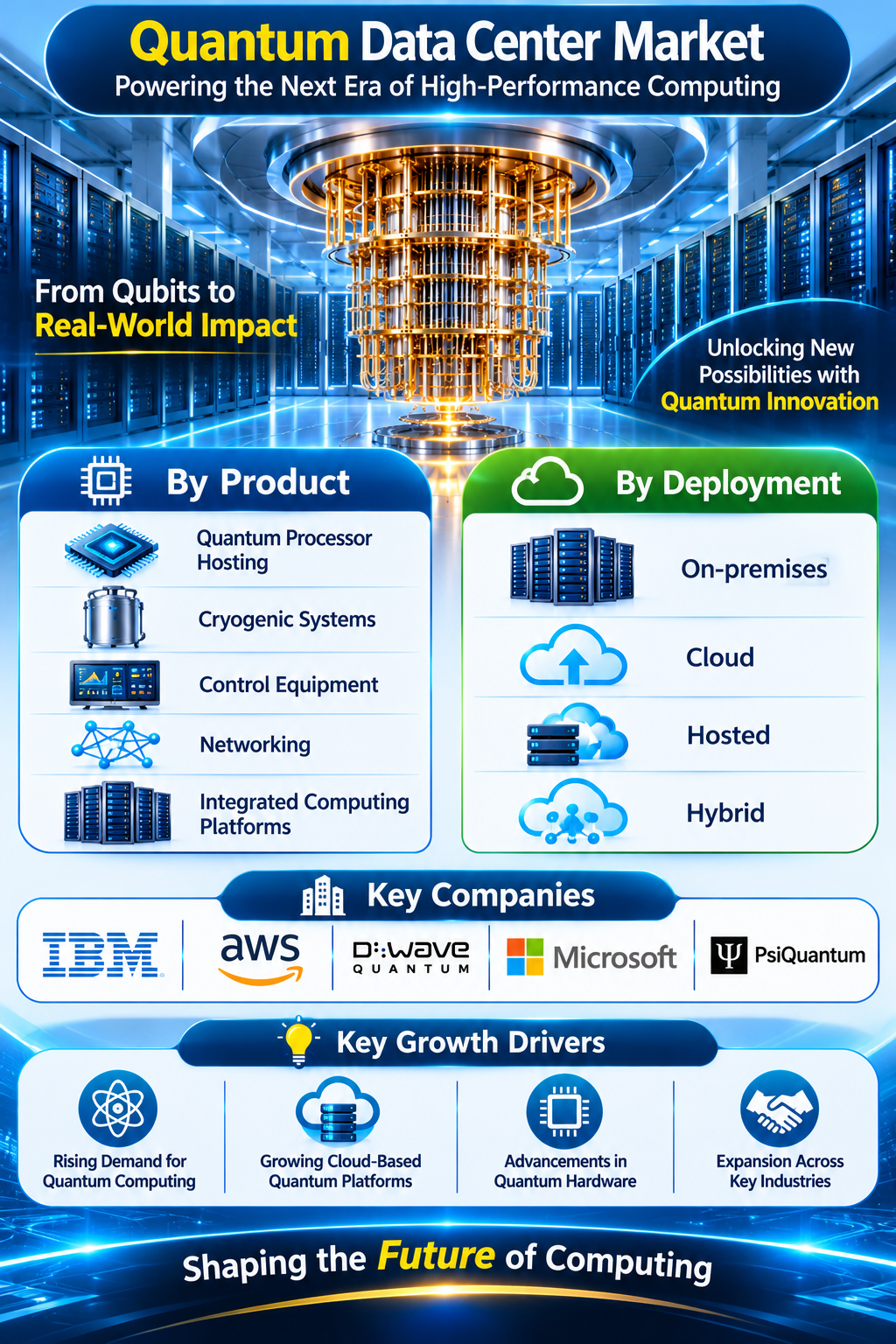
Quantum Data Center Market: Understanding the Industry Landscape
Quantum data centers are specialised computing facilities designed to accommodate quantum processors and the supporting infrastructure required to operate them. These facilities differ from traditional data centers because quantum processors operate under highly controlled environmental conditions.
For example, superconducting quantum processors require extremely low temperatures, often maintained using dilution refrigerators and specialised cryogenic systems. Other quantum technologies, including trapped-ion and photonic systems, require specialised vacuum chambers, laser equipment, optical components, and precision control mechanisms.
The integration of quantum processors with conventional CPUs, GPUs, and HPC infrastructure is another important industry development. Hybrid quantum-classical computing allows organisations to combine the processing capabilities of quantum systems with established computing resources.
Cloud computing is also expanding access to quantum infrastructure. Through Quantum Computing-as-a-Service (QCaaS), businesses, researchers, and academic institutions can access quantum processors without building and maintaining dedicated facilities.
These developments are encouraging investment across hardware manufacturing, specialised engineering, data center infrastructure, cloud platforms, and system integration.
Key Investment Trends Driving the Quantum Data Center Market
1. Increasing Investment in Quantum Computing Infrastructure
Investment in quantum computing infrastructure is increasing as technology companies and governments seek to develop advanced computing capabilities. Funding is being directed toward quantum processors, cryogenic systems, control electronics, specialised networking, and integrated computing platforms.
Technology companies are also investing in research facilities and partnerships to accelerate the development of scalable quantum systems. These investments are creating opportunities for suppliers of advanced cooling technologies, precision electronics, semiconductor components, and data center infrastructure.
The growing requirement for fault-tolerant quantum computing is expected to create additional investment opportunities in processor architecture, error correction, quantum interconnects, and supporting infrastructure.
2. Growing Demand for Cryogenic Cooling Systems
Cryogenic cooling represents one of the most important investment areas in the Quantum Data Center Market. Superconducting quantum processors require extremely low operating temperatures to maintain qubit stability and computational performance.
This creates demand for dilution refrigerators, vacuum enclosures, thermal shields, cryogenic wiring, and advanced temperature-monitoring equipment.
Equipment manufacturers are focusing on developing scalable and modular cryogenic systems that can support larger quantum processors and interconnected computing architectures. Companies with expertise in industrial cooling, precision engineering, and thermal management can benefit from this growing requirement.
3. Expansion of Cloud-Based Quantum Computing
Cloud-based quantum computing is creating new commercial opportunities by making specialised quantum hardware accessible to enterprises and research organisations.
Cloud platforms allow users to access quantum processors remotely, reducing the need for substantial upfront investment in specialised infrastructure. This approach is particularly attractive to organisations exploring quantum applications in financial modelling, pharmaceutical research, materials science, and optimisation.
Companies offering cloud-based quantum computing services can generate recurring revenue through subscriptions, processor access, technical support, and integrated development environments.
Platforms such as Amazon Braket and IBM Quantum demonstrate how cloud infrastructure can connect users with quantum computing resources
4. Integration of AI, IoT, and Automation
Artificial intelligence, Internet of Things (IoT), and automation technologies are becoming important for managing complex quantum computing facilities.
IoT sensors can continuously monitor temperature, vibration, pressure, power consumption, and equipment performance. AI-based monitoring systems can analyse operational information, identify unusual conditions, and support predictive maintenance.
Automation can also improve quantum processor calibration, workload scheduling, and infrastructure management. These capabilities are particularly important as quantum facilities become larger and more complex.
Investors can explore opportunities in intelligent facility management software, automated control systems, monitoring solutions, and predictive maintenance technologies.
5. Development of Hybrid Quantum-Classical Computing
Hybrid quantum-classical computing is gaining importance because quantum processors are generally used alongside conventional computing infrastructure rather than as complete replacements for traditional systems.
Quantum processors can address specialised computational tasks, while classical CPUs and GPUs manage data preparation, workload coordination, error correction, and post-processing.
This integration is creating demand for high-speed networking, advanced control equipment, integrated computing platforms, and specialised software.
Data center operators and technology companies investing in hybrid infrastructure can position themselves to serve enterprises seeking access to emerging quantum computing capabilities.
High-Growth Business Opportunities in the Quantum Data Center Market
The expansion of quantum computing infrastructure is creating business opportunities across multiple product categories and service models.
1. Quantum Processor Hosting Infrastructure
Quantum processor hosting is a promising business opportunity for specialised data center operators and quantum hardware companies. These facilities provide the physical environment, cooling infrastructure, control equipment, and connectivity required to operate quantum processors.
As quantum computing adoption increases, organisations may prefer hosted quantum infrastructure instead of investing in dedicated facilities. This creates opportunities for data center operators to develop specialised hosting services and establish partnerships with quantum processor manufacturers.
2. Cryogenic Equipment and Thermal Management
The growing complexity of quantum processors is creating demand for advanced cryogenic infrastructure. Manufacturers of dilution refrigerators, vacuum systems, thermal shields, and specialised cooling equipment can benefit from increasing infrastructure investments.
Companies with expertise in precision engineering and industrial cooling can explore opportunities in developing scalable cooling solutions for next-generation quantum processors.
3. Quantum Networking and Connectivity
Quantum networking is another emerging business opportunity. Connecting multiple quantum processors requires specialised communication systems, high-speed interconnects, and advanced networking technologies.
Businesses developing quantum communication equipment, optical interconnects, specialised cabling, and secure networking solutions can benefit from the expansion of interconnected quantum computing environments.
4. Integrated Quantum Computing Platforms
Integrated quantum computing platforms combine quantum processors, classical computing infrastructure, control electronics, networking, and software into unified computing environments.
These platforms can simplify infrastructure deployment and enable enterprises to access hybrid computing capabilities. Technology providers can generate business opportunities through integrated hardware solutions, platform development, system integration, and infrastructure management services.
5. Quantum Computing-as-a-Service
Quantum Computing-as-a-Service offers opportunities for cloud service providers, technology companies, and quantum hardware manufacturers.
Organisations can provide remote access to quantum processors through subscription-based models, pay-per-use services, and enterprise computing agreements.
This business model reduces infrastructure ownership requirements for customers while creating recurring revenue opportunities for service providers.
Quantum Data Center Market Segmentation: Key Investment Areas
The market offers investment opportunities across product categories and deployment models. Each segment addresses different infrastructure requirements and customer needs.
Deployment Model Opportunities
On-premises Deployment: Large enterprises, government laboratories, and research institutions may invest in dedicated quantum computing facilities to maintain greater control over hardware, security, and computational resources.
Cloud Deployment: Cloud-based quantum infrastructure enables organisations to access quantum processors remotely. This model creates opportunities for cloud providers and quantum technology companies offering subscription-based computing services.
Hosted Deployment: Hosted quantum infrastructure allows customers to use specialised quantum processors maintained by third-party providers. This approach can reduce infrastructure management requirements.
Hybrid Deployment: Hybrid environments combine on-premises computing resources with cloud-based quantum systems. This model supports flexible workload management and integration with existing enterprise infrastructure.
Regional Investment Opportunities in the Quantum Data Center Market
North America: Leading Quantum Infrastructure Development
North America represents a leading region in the Quantum Data Center Market, supported by established technology companies, research institutions, cloud service providers, and government funding. The United States has a strong quantum computing ecosystem involving IBM, Google, Microsoft, Amazon Web Services, IonQ, and Quantinuum.
Investment opportunities include quantum processor development, cryogenic infrastructure, cloud-based computing, and hybrid quantum-classical systems. Canada also offers opportunities through its quantum research ecosystem and specialised technology companies.
Europe: Government Funding and Industrial Collaboration
Europe is developing its quantum computing infrastructure through national strategies, research programmes, and public-private partnerships. Germany, the United Kingdom, France, and the Netherlands are important markets for quantum research and technology development.
Industrial engineering, advanced manufacturing, aerospace, pharmaceuticals, and financial services are potential sources of future demand. Investments in quantum networking, precision electronics, and cryogenic engineering are expected to support regional development.
Asia Pacific: Emerging High-Growth Investment Destination
Asia Pacific is expected to offer significant growth opportunities as countries increase investments in quantum research, semiconductor technologies, and advanced computing infrastructure.
China, Japan, South Korea, India, and Australia are strengthening their quantum technology capabilities through government programmes and research initiatives. India’s National Quantum Mission is supporting the development of quantum computing, communication, sensing, and related technologies.
The region offers opportunities for technology manufacturers, research organisations, infrastructure providers, and cloud computing companies.
Competitive Landscape: Key Companies Shaping the Market
The Quantum Data Center Market includes quantum hardware developers, cloud infrastructure providers, cryogenic equipment manufacturers, and specialised engineering companies.
Some important industry participants include:
- IBM: Developing quantum processors, modular quantum systems, and cloud-accessible quantum computing infrastructure.
- Amazon Web Services: Providing quantum computing access through Amazon Braket and supporting hybrid computing environments.
- Microsoft: Expanding quantum computing access through Azure Quantum and its quantum technology ecosystem.
- Google: Investing in superconducting quantum processors and quantum error-correction research.
- D-Wave Quantum: Developing quantum annealing systems and hybrid quantum computing solutions.
- PsiQuantum: Developing large-scale photonic quantum computing infrastructure.
- IonQ: Developing trapped-ion quantum computing systems.
- Quantinuum: Developing integrated quantum hardware, software, and computing platforms.
Strategic collaborations between quantum hardware developers, cloud providers, data center operators, and specialised equipment manufacturers are expected to influence competitive positioning. Companies that can deliver scalable infrastructure, reliable processor hosting, and integrated computing solutions may gain advantages as commercial demand develops
Major Challenges and Investment Considerations
Despite its growth potential, the Quantum Data Center Market faces several challenges that investors and businesses must consider.
High Infrastructure Costs: Quantum computing facilities require specialised equipment, advanced cooling technologies, and precision environmental controls. These requirements increase initial capital expenditure.
Technical Complexity: Maintaining quantum processor stability requires specialised engineering expertise and advanced operational capabilities.
Scalability Challenges: Increasing the number of qubits and connecting multiple quantum processors require improvements in cryogenic systems, control electronics, and networking infrastructure.
Limited Commercial Applications: Many quantum computing applications remain under development. Wider commercial adoption will depend on improvements in hardware performance, error correction, and practical business use cases.
Talent and Supply Chain Constraints: The industry requires professionals with expertise in quantum physics, electrical engineering, cryogenics, photonics, and advanced computing.
Businesses investing in this market should prioritise scalable technologies, strategic partnerships, infrastructure reliability, and long-term commercial opportunities.
Future Outlook of the Quantum Data Center Market
The future of the Quantum Data Center Market will be shaped by advancements in quantum processors, cryogenic technologies, quantum networking, and integrated computing infrastructure. As quantum computing progresses toward fault-tolerant systems, the demand for specialised facilities and advanced infrastructure is expected to increase.
One of the most important developments will be the transition from standalone quantum processors toward interconnected quantum computing systems. Modular infrastructure, advanced cooling technologies, and scalable control electronics will become essential for supporting larger computing architectures.
Cloud-based quantum computing is also expected to expand market accessibility. Enterprises will increasingly explore quantum computing for complex optimisation, scientific simulation, pharmaceutical research, and financial modelling.
AI and automation will further improve quantum data center operations through predictive maintenance, intelligent monitoring, and automated calibration. These technologies can help improve operational efficiency and reduce infrastructure management complexity.
According to the market outlook provided by MarketsandMarkets, the market is expected to reach approximately USD 3.5 billion by 2032. This growth creates opportunities for companies developing quantum processors, specialised infrastructure, networking solutions, and integrated computing platforms.
Frequently Asked Questions (FAQs)
1. What is the Quantum Data Center Market size?
The global Quantum Data Center Market is estimated at approximately USD 1.2 billion in 2025 and is projected to reach USD 3.5 billion by 2032, at an estimated CAGR of 16.5%.
2. What are the major factors driving the Quantum Data Center Market?
Increasing investments in quantum computing, demand for cryogenic cooling systems, government research programmes, cloud-based quantum computing, and hybrid quantum-classical infrastructure are major market growth drivers.
3. Which region is expected to offer significant growth opportunities?
North America is a leading market due to its established quantum technology ecosystem, while Asia Pacific is expected to offer significant growth opportunities through investments in quantum research and advanced computing infrastructure.
4. What are the major product segments in the Quantum Data Center Market?
The major product segments include quantum processor hosting, cryogenic systems, control equipment, networking, and integrated computing platforms.
5. Who are the key companies operating in the Quantum Data Center Market?
Major industry participants include IBM, Amazon Web Services, Microsoft, Google, D-Wave Quantum, PsiQuantum, IonQ, and Quantinuum.
Conclusion
The Quantum Data Center Market represents an emerging investment opportunity within the global computing infrastructure industry. Increasing demand for quantum processors, specialised cooling technologies, advanced networking, and hybrid computing platforms is creating new business opportunities across the technology ecosystem.
As enterprises and research institutions explore practical quantum computing applications, investments in specialised infrastructure are expected to increase. Companies focusing on cryogenic systems, quantum processor hosting, integrated computing platforms, and cloud-based quantum services will be positioned to participate in this developing market.
Although infrastructure costs, technical complexity, and scalability remain important challenges, continued technological innovation and strategic collaborations are expected to support market development. The transition toward scalable and commercially accessible quantum computing infrastructure will make quantum data centers an important part of the next generation of advanced computing.
