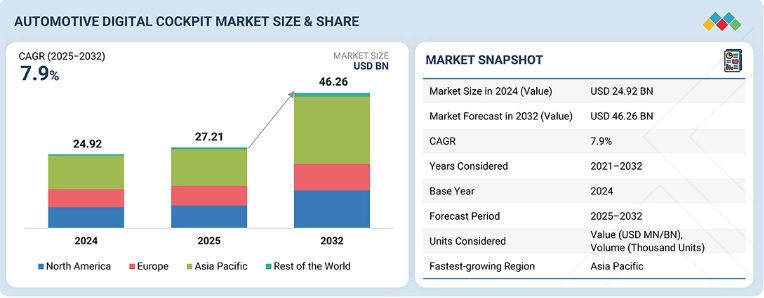
The global automotive digital cockpit market size is witnessing rapid growth due to increasing adoption of connected vehicle technologies, rising demand for enhanced in-vehicle user experiences, and growing integration of AI-powered infotainment systems across passenger vehicles worldwide. Automakers are increasingly deploying advanced digital cockpit systems to improve vehicle connectivity, driver interaction, passenger comfort, and intelligent mobility experiences.
The automotive digital cockpit market size is also expanding due to increasing implementation of software-defined vehicle architectures, cockpit domain controllers, digital instrument clusters, augmented reality head-up displays, and intelligent voice assistant technologies. As vehicles become increasingly connected, electrified, and software-centric, demand for immersive and integrated cockpit systems is expected to accelerate significantly during the forecast period.
Automotive Digital Cockpit Industry Overview
Automotive digital cockpit systems integrate digital instrument clusters, infotainment displays, head-up displays (HUDs), cockpit domain controllers, connectivity platforms, and intelligent human-machine interfaces into centralized vehicle cockpit architectures. These systems improve driver interaction, passenger engagement, navigation functionality, and overall in-vehicle digital experiences.
Modern digital cockpits increasingly support AI-powered voice assistants, connected services, smartphone integration, cloud-based applications, over-the-air software updates, and multi-display dashboard systems. Automakers are focusing on developing highly personalized and software-driven cockpit ecosystems capable of supporting future autonomous and connected mobility applications.
The growing transition toward connected and software-defined vehicles is expected to continue driving automotive digital cockpit market growth globally.
Software-Defined Vehicles Accelerating Digital Cockpit Market Growth
Software-defined vehicles (SDVs) are becoming one of the strongest growth drivers within the automotive digital cockpit market. Vehicle manufacturers increasingly adopt centralized computing architectures and software-centric vehicle platforms capable of supporting integrated cockpit systems, OTA software updates, and continuous feature enhancements.
Cockpit domain controllers consolidate multiple electronic control units into centralized high-performance computing systems that improve processing efficiency, reduce hardware complexity, and enable synchronized operation of infotainment displays, instrument clusters, and driver assistance interfaces.
The increasing shift toward software-defined mobility ecosystems and centralized vehicle computing platforms is expected to significantly strengthen demand for advanced digital cockpit technologies worldwide.
Download PDF Brochure @ https://www.marketsandmarkets.com/pdfdownloadNew.asp?id=56470878
AI-Powered Infotainment and Voice Assistants Transforming In-Vehicle Experience
Artificial intelligence is transforming automotive infotainment and in-vehicle user experiences. Modern digital cockpit systems increasingly integrate AI-powered voice assistants, predictive navigation systems, intelligent recommendation engines, and personalized content platforms to improve driver convenience and passenger engagement.
AI-enabled infotainment systems allow drivers to control navigation, climate settings, media playback, vehicle functions, and connected services through natural voice commands and intelligent conversational interfaces. Machine learning algorithms also help personalize user preferences, optimize route planning, and improve contextual interaction within the vehicle environment.
The growing demand for intelligent mobility experiences and connected vehicle ecosystems is expected to accelerate adoption of AI-powered automotive cockpit technologies globally.
Cockpit Domain Controllers Supporting Multi-Display Vehicle Architectures
Cockpit domain controllers are becoming critical components within modern digital vehicle architectures. These systems integrate processing functions for infotainment systems, instrument clusters, HUDs, rear-seat entertainment systems, and connected vehicle applications into centralized computing platforms.
Automotive manufacturers increasingly deploy multi-display cockpit architectures capable of supporting immersive digital dashboards, panoramic displays, and synchronized in-vehicle interfaces. Centralized cockpit systems also improve system scalability, software integration, and cybersecurity management while reducing overall electronic complexity.
The increasing adoption of high-performance vehicle computing platforms and connected mobility technologies is expected to significantly strengthen demand for cockpit domain controllers during the forecast period.
Electric and Premium Vehicles Increasing Demand for Smart Cockpit Technologies
Electric vehicles and premium passenger cars are significantly increasing demand for advanced digital cockpit systems. EV manufacturers increasingly focus on delivering immersive digital experiences through large infotainment displays, intelligent connectivity platforms, voice-enabled interfaces, and highly personalized cockpit environments.
Premium vehicle brands are also deploying augmented reality HUDs, curved OLED displays, gesture recognition systems, and AI-driven user interfaces to differentiate vehicle offerings and improve customer experience. Digital cockpits play an increasingly important role in enhancing brand value, passenger engagement, and software-driven mobility ecosystems.
Growing adoption of premium electric vehicles and connected mobility platforms is expected to create major growth opportunities within the automotive digital cockpit market.
Asia Pacific Leading Automotive Digital Cockpit Market Share
Asia Pacific accounts for the largest automotive digital cockpit market share due to rapid expansion of connected vehicle technologies, increasing electric vehicle production, and strong demand for premium passenger vehicles across China, Japan, South Korea, and India.
China remains a major hub for smart mobility innovation, connected car adoption, and EV manufacturing, while Japanese and South Korean automakers continue investing heavily in intelligent cockpit systems and software-defined vehicle technologies. Increasing consumer demand for advanced infotainment and connected mobility experiences is further accelerating market growth across the region.
The rapid development of smart transportation ecosystems and growing investments in connected vehicle technologies are expected to continue driving automotive digital cockpit market growth across Asia Pacific during the forecast period.
Request Free Sample Report @ https://www.marketsandmarkets.com/requestsampleNew.asp?id=56470878