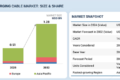
The Canada oligonucleotide synthesis market is a growing sector driven by significant government investment and a strong focus on genomic research and precision medicine. The landscape is characterized by a push toward national leadership in genetic advancements, highlighted by the federal government’s allocation of USD 400 million to support a Pan-Canadian Genomics Strategy and additional investments to help genomic companies commercialize their products. While the market for core synthesis reagents is projected to reach USD 45 million by 2033, the broader oligonucleotide synthesis market in the country is expected to hit over USD 282 million in the same period, growing at a double-digit compound annual growth rate. Key demand is fueled by the rising prevalence of genetic disorders and the increasing use of synthesized oligonucleotides in diagnostic laboratories and pharmaceutical research. Despite this momentum, the market faces challenges common to the region, including high manufacturing costs for complex sequences and a shortage of specialized personnel to manage high-throughput synthesis workflows.
Key Drivers, Restraints, Opportunities, and Challenges in the Canada Oligonucleotide Synthesis Market
The Canada oligonucleotide synthesis market is primarily driven by the increasing use of synthesized oligos in therapeutic and diagnostic applications, growing government investments in genomics, and a rising prevalence of genetic disorders and chronic diseases. Significant growth opportunities exist in the shift toward precision medicine, the expansion of RNA-based therapeutics like ASOs and siRNA, and advancements in CRISPR gene-editing technologies. However, the industry faces restraints such as high manufacturing and purification costs, complexities associated with the delivery of oligonucleotide drugs to specific targets, and stringent regulatory requirements. Challenges remain, including a shortage of skilled clinical research professionals, potential intellectual property disputes, and the technical difficulty of maintaining high purity and stability during large-scale production.
Customer Segmentation, Needs, Preferences, and Buying Behavior in the Canada Oligonucleotide Synthesis Market
The target customers for the Canada oligonucleotide synthesis market primarily include pharmaceutical and biotechnology companies, academic and research institutes, and diagnostic laboratories. These customers prioritize access to high-purity, clinical-grade, and GMP-compliant oligonucleotides to support the development of novel therapeutics for rare diseases, genetic disorders, and oncology. Their preferences are increasingly leaning toward specialized contract development and manufacturing organizations (CDMOs) that can provide integrated services, including synthesis, purification, and regulatory support. Purchasing behavior is characterized by significant investments in research and development, with a growing emphasis on custom-synthesized oligos for advanced applications like CRISPR gene editing and molecular diagnostics. Additionally, the market is influenced by government funding and academic grants, which sustain the demand for synthesis reagents and equipment used in foundational life science research across various Canadian provinces.
Regulatory, Technological, and Economic Factors Impacting the Canada Oligonucleotide Synthesis Market
The Canada oligonucleotide synthesis market is influenced by a complex interplay of regulatory, technological, and economic factors that shape its competitive landscape and growth potential. Regulatory entry is facilitated by government initiatives like the Pan-Canadian Genomics Strategy and the establishment of the pan-Canadian Genome Library, which provide significant funding and a framework for ethical genomic research, though maintaining precise control over therapeutic structures to meet rigorous quality standards remains a challenge for new entrants. Technologically, the market is being disrupted by the shift toward enzymatic DNA synthesis and high-throughput platforms that improve production efficiency by over 30%, though the transition from traditional phosphoramidite methods requires substantial technical expertise and infrastructure investment. Economically, while increasing demand from the pharmaceutical and biotechnology sectors sustains a projected CAGR of 9.4%, profitability is often constrained by high manufacturing and purification costs—which can account for up to 60% of total production expenses—and a shortage of skilled clinical research professionals, which can hinder the expansion of smaller firms in a market dominated by major global players.
Current and Emerging Trends in the Canada Oligonucleotide Synthesis Market
The Canada oligonucleotide synthesis market is undergoing a rapid evolution driven by the maturation of RNA-based therapeutic platforms, including siRNA, CRISPR-associated guide RNAs, and antisense oligonucleotides, which are fueling a domestic demand growth of 14% to 18% annually. A significant emerging trend is the shift toward large-scale, gram-level synthesis for in vivo studies and early-phase drug substance supply, a segment expanding at 20% to 25% per year and placing substantial pressure on local purification and quality assurance capacities. Additionally, the industry is transitioning toward enzymatic and high-throughput synthesis methods to improve production efficiency and sustainability, while the convergence with CRISPR-based functional genomics is creating a sustained need for high-complexity libraries. These trends are accelerating quickly as the market is projected to reach US$ 282.5 million by 2033, supported by strong macro demand signals from Canada’s biopharmaceutical research and development pipeline.
Technological Innovations and Disruption Potential in the Canada Oligonucleotide Synthesis Market
The Canada oligonucleotide synthesis market is being significantly disrupted by the transition from traditional phosphoramidite chemistry to enzymatic synthesis platforms, which enable the production of longer, higher-purity DNA and RNA strands with reduced environmental impact. Technological innovations such as high-throughput automated synthesis, micro-array based platforms, and “DNA printers” are gaining traction by dramatically increasing production efficiency and reducing turnaround times for custom sequences. Furthermore, advancements in analytical characterization—including the integration of liquid chromatography-mass spectrometry (LC-MS) and artificial intelligence for real-time process monitoring—are streamlining quality control and ensuring the sequence fidelity required for complex therapeutic applications like CRISPR guides and antisense oligonucleotides. These innovations, coupled with the development of novel delivery-focused chemistries and pH-sensitive linkers for peptide-marker conjugation, are decentralizing production and empowering Canadian biotechnology firms to accelerate the development of next-generation genomic medicines.
Short-Term vs. Long-Term Trends in the Canada Oligonucleotide Synthesis Market
In the Canada oligonucleotide synthesis market, the initial reliance on basic standard-grade desalted oligos for routine research is increasingly viewed as a maturing segment with moderate growth, whereas several other trends represent long-term structural shifts. The transition toward high-complexity and clinical-grade RNA-based therapeutic platforms, including siRNA, CRISPR-associated guide RNAs, and antisense oligonucleotides, is a permanent transformation driven by the maturation of Canada’s biopharmaceutical R&D pipeline and a 14–18% annual increase in demand. Similarly, the industry-wide move toward enzymatic synthesis and high-throughput automated platforms is a fundamental shift aimed at addressing the high manufacturing costs and scalability limitations of traditional chemical methods. Other enduring structural changes include the strategic focus on rare diseases and oncology, fueled by the Pan-Canadian Genomics Strategy and significant government investments in genomic infrastructure, ensuring that custom RNA and DNA synthesis remains a cornerstone of precision medicine through 2035.