The rapid proliferation of unmanned aerial vehicles, commonly known as drones, has brought about transformative benefits across commercial, civil, and defense sectors. From package deliveries and surveillance to mapping and rescue missions, UAVs are now deeply integrated into global operations. This surge in drone adoption has also amplified concerns over unauthorized usage, security threats, and airspace safety. As a result, the drone detection, tracking, and identification market has emerged as a critical defense and security segment. This market leverages advanced technologies such as radar, RF scanners, and optical systems to monitor, classify, and neutralize UAVs before they pose threats. Understanding the market dynamics, technology adoption, and regional developments provides insight into how the industry is evolving to meet the challenges of the drone era.
Importance of Detection, Tracking, and Identification in Modern Security
The significance of drone detection and tracking technologies lies in their ability to safeguard sensitive infrastructure, air traffic, and civilian populations from malicious UAV activities. Airports face major risks from unauthorized drones interfering with commercial flights, while governments grapple with drone intrusions over borders, prisons, and critical assets. In defense, drones equipped with surveillance equipment or weaponry represent new age asymmetric threats that conventional air defense systems struggle to address. The ability to detect, track, and identify drones in real time enables security forces to deploy countermeasures such as jamming, netting, or kinetic systems. With UAVs increasingly available at low cost, proactive monitoring has become indispensable in securing both civilian and defense airspace.
Market Overview and Growth Potential
The drone detection, tracking, and identification market is witnessing rapid expansion, fueled by rising drone activity and heightened global security concerns. Governments are investing heavily in counter drone systems to protect military bases, borders, and civilian infrastructure. Civil aviation authorities are mandating airports to deploy UAV monitoring systems to prevent disruptions and accidents. Market research indicates strong compound annual growth rates as technological innovations in radar, RF scanners, and optical sensors expand detection range and accuracy. The integration of artificial intelligence, machine learning, and data fusion into these systems further enhances their ability to distinguish between drones and other flying objects such as birds or aircraft. The commercial adoption of UAV detection for events, stadiums, and industrial facilities is also contributing to market growth, creating opportunities for system integrators and technology providers.
Radar Technology in UAV Detection
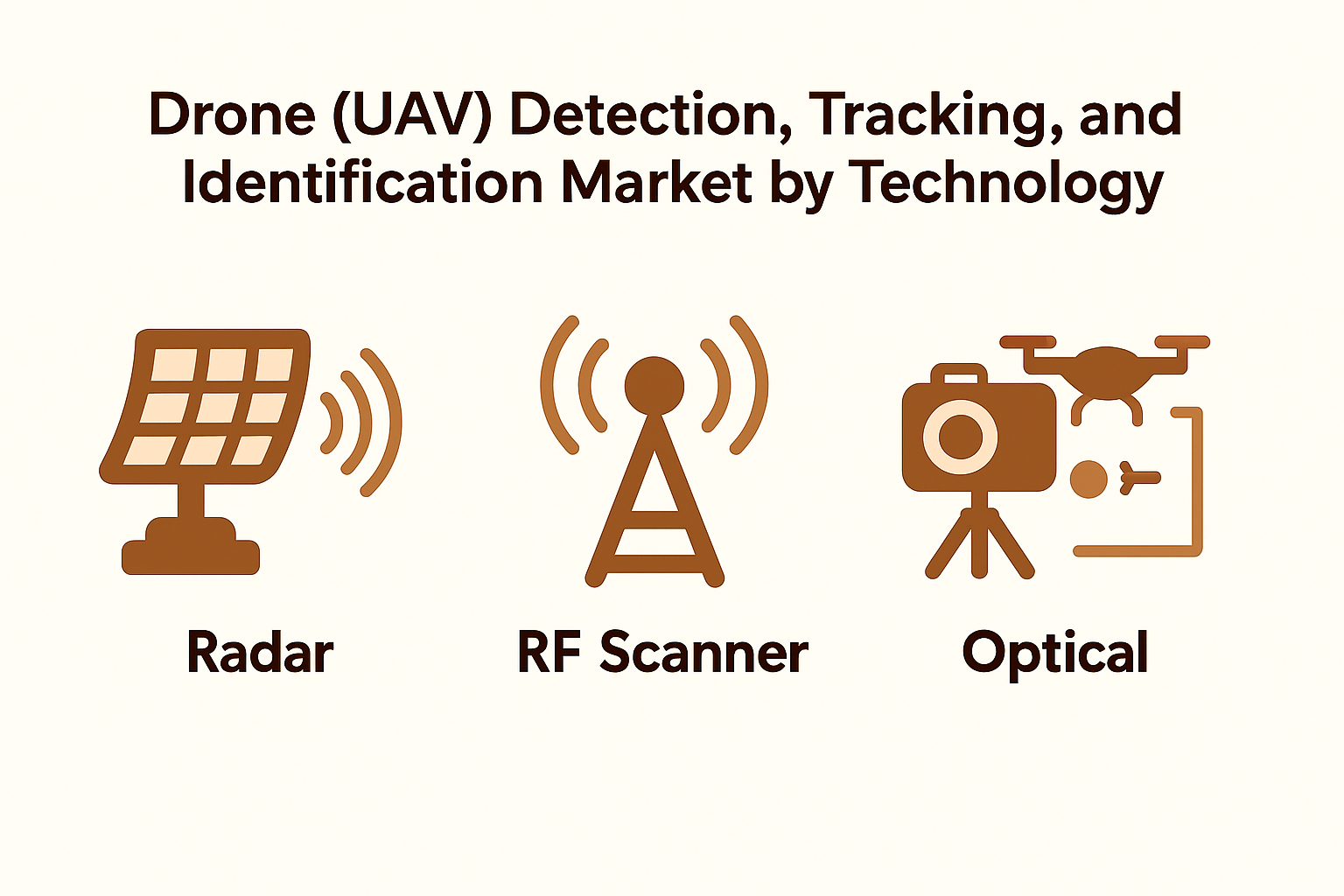
Radar remains one of the most robust and widely used technologies for detecting drones. Its strength lies in its ability to monitor wide airspaces and detect objects based on size, shape, speed, and altitude. Traditional radar systems, initially designed for aircraft, have evolved to meet the unique challenges of detecting small, low altitude drones with minimal radar cross sections. Modern counter UAV radars incorporate higher frequencies, multiple input multiple output (MIMO) technology, and advanced tracking algorithms to differentiate drones from clutter such as birds. Radar’s ability to provide long range detection and continuous tracking makes it indispensable for border protection, defense applications, and airport surveillance. Radar alone cannot always distinguish between friendly and hostile drones, making it most effective when integrated with RF and optical systems.
RF Scanner Technology in UAV Detection
RF scanners play a pivotal role in detecting and tracking drones by intercepting the radio frequency signals between a UAV and its controller. Unlike radar, which identifies drones through physical characteristics, RF scanners analyze communication links, frequencies, and transmission patterns to detect the presence of drones. This technology is particularly effective in identifying commercial drones that rely on standardized frequencies such as Wi Fi, GPS, and proprietary radio controls. RF scanners can pinpoint the location of both the drone and its operator, providing a critical advantage for law enforcement and defense agencies. Drones that operate autonomously without active communication links may evade RF detection, which is why RF systems are often paired with radar and optical technologies to form hybrid counter drone solutions.
Optical Systems for UAV Detection
Optical systems, including electro optical (EO) and infrared (IR) cameras, provide high precision visual confirmation of drone presence. These systems are invaluable in differentiating drones from false positives such as birds or debris detected by radar. Equipped with advanced zoom lenses and thermal imaging, optical systems can identify drone models, payloads, and even flight patterns in both day and night conditions. The integration of artificial intelligence enables real time image recognition, allowing systems to classify drones based on size, shape, and behavior. Optical systems are widely used in urban environments, critical facility protection, and defense bases where visual confirmation is essential for decision making. Their limitation lies in weather dependency and line of sight requirements, making them most effective when combined with radar and RF scanners in multi sensor platforms.
AI and Machine Learning Integration in Drone Detection
The fusion of AI and machine learning is transforming drone detection systems into intelligent, adaptive solutions. AI algorithms analyze large volumes of data from radar signals, RF scans, and optical images to detect drones with higher accuracy and speed. Machine learning models are trained to differentiate drones from birds, aircraft, and other aerial objects, reducing false alarms. AI driven analytics can predict flight paths, classify drone types, and even assess potential intent based on behavior. The integration of AI also allows autonomous operations, where detection systems can trigger countermeasures without human intervention, a feature critical in high security environments such as military bases or government facilities. This convergence of AI and traditional detection technologies is a key driver of innovation in the counter UAV market.
Applications Across Key Sectors
The demand for UAV detection and tracking spans multiple sectors, each with unique requirements. In defense, these systems are crucial for protecting troops, convoys, and military infrastructure from surveillance or weaponized drones. Homeland security agencies rely on UAV detection to safeguard borders, prisons, and public events from drone based threats. Civil aviation uses these technologies to protect airports and flight paths, ensuring passenger safety and preventing costly delays. Commercial and industrial operators, including energy plants, oil refineries, and stadiums, deploy UAV monitoring systems to protect assets and ensure compliance with regulations. Emergency response teams also use UAV detection to secure disaster zones, where unauthorized drones could hinder rescue efforts. This broad range of applications underlines the market’s growing importance across defense and civilian ecosystems.
Regional Market Insights
The adoption of drone detection and tracking technologies varies by region, influenced by security priorities, regulatory frameworks, and technological capabilities. North America leads the market with significant investments from the U.S. Department of Defense, homeland security agencies, and airport authorities. Europe follows closely, driven by stringent aviation safety regulations and growing concerns over drone related disruptions at major airports. The Asia Pacific region is experiencing rapid adoption, particularly in China, Japan, and India, where both defense modernization and commercial UAV usage are expanding. The Middle East is investing heavily in counter drone systems to protect critical energy infrastructure and urban hubs from drone incursions. Latin America and Africa are emerging markets, gradually adopting UAV detection technologies to address border and urban security challenges.
Future Outlook and Technological Advancements
The future of the drone detection, tracking, and identification market lies in the development of integrated, hybrid systems that combine radar, RF scanners, and optical technologies with AI powered analytics. These multi layered systems provide comprehensive coverage, adaptability, and resilience against evolving drone threats. Emerging innovations such as passive radar, advanced signal processing, and quantum detection hold promise for detecting stealthier and more autonomous UAVs. The integration of countermeasure technologies, such as jammers, lasers, and net based systems, will further strengthen security frameworks. As drones become faster, smaller, and more autonomous, detection technologies must evolve in tandem, ensuring proactive protection for defense, aviation, and civilian sectors. The market’s trajectory points toward continued growth, driven by innovation, regulation, and the unrelenting rise of drone adoption worldwide.
The Drone (UAV) Detection, Tracking, and Identification Market is at the forefront of addressing one of the most pressing challenges of the modern era: securing airspace against unauthorized drone activity. By leveraging radar, RF scanners, and optical systems, stakeholders across defense, aviation, and commercial sectors are building robust solutions to mitigate risks. With AI integration enhancing detection precision and predictive capabilities, the market is poised for significant expansion in the coming years. Regional investments, cross sector applications, and hybrid system innovations ensure that the industry will remain dynamic, resilient, and indispensable in safeguarding both civilian and defense environments.
