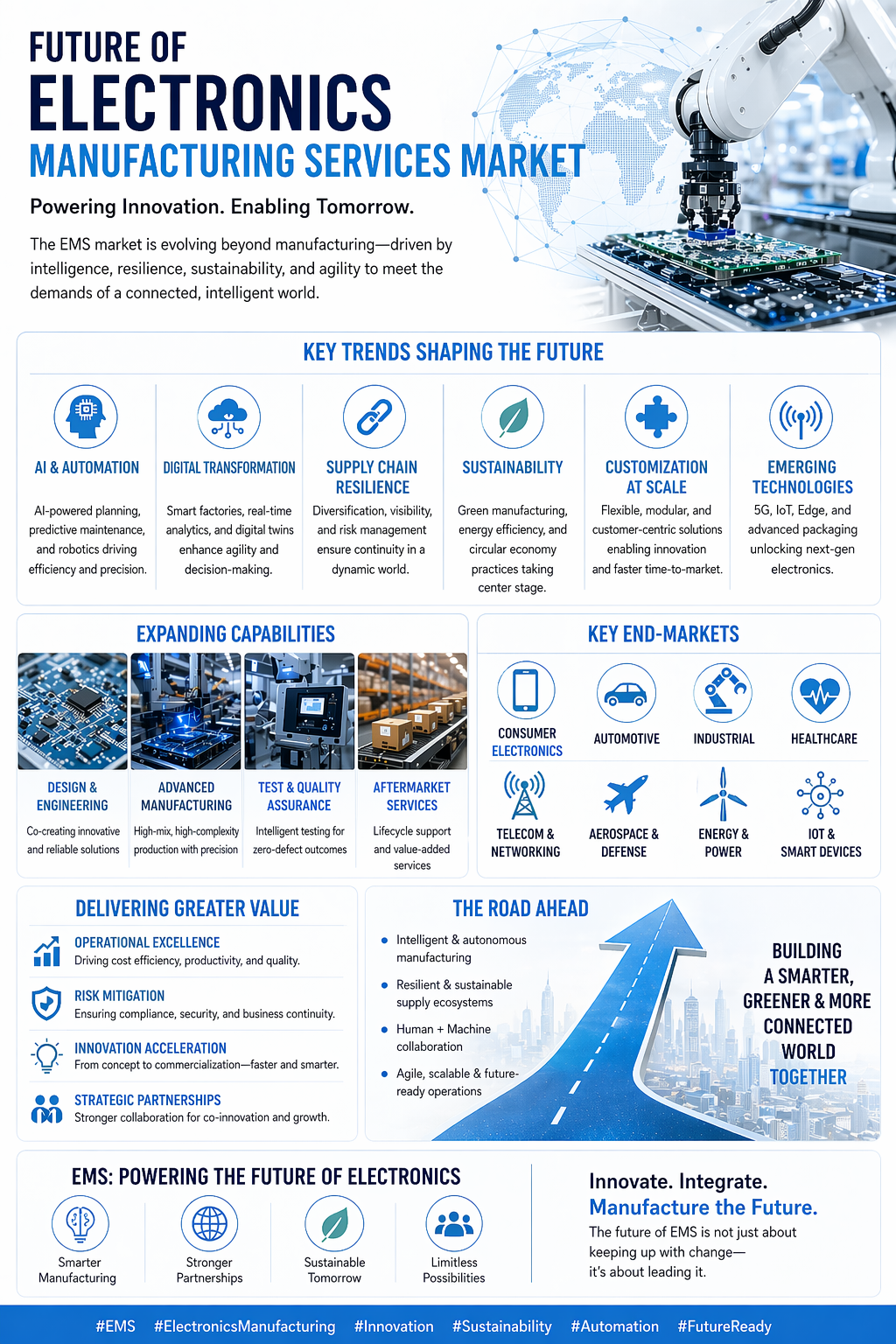
The global Electronics Manufacturing Services (EMS) market is entering a phase of accelerated growth, fueled by surging demand for consumer electronics, rapid digital transformation, and increasing reliance on outsourced manufacturing. As industries strive to remain competitive in an era defined by innovation and speed, EMS providers are emerging as critical partners in delivering scalable, cost-efficient, and technologically advanced production solutions.
From smartphones and wearables to automotive electronics and industrial automation systems, the proliferation of electronic devices is driving unprecedented demand for manufacturing services. This shift is further amplified by advancements in artificial intelligence (AI), Internet of Things (IoT), and automation technologies, which are transforming traditional manufacturing into smart, connected ecosystems.
Rising Demand Across Key End-Use Industries
One of the primary drivers of growth in the EMS market is the expanding demand for electronic products across multiple sectors. The consumer electronics industry continues to dominate, with increasing adoption of smartphones, laptops, smart home devices, and wearable technologies. As product life cycles shorten and innovation cycles accelerate, original equipment manufacturers (OEMs) are increasingly outsourcing production to EMS providers to maintain agility and reduce time-to-market.
The automotive sector is another major contributor to EMS growth, particularly with the rise of electric vehicles (EVs) and autonomous driving technologies. Modern vehicles rely heavily on electronic components such as sensors, control units, and infotainment systems, creating significant opportunities for EMS providers specializing in automotive-grade manufacturing.
In addition, industries such as healthcare, aerospace, and industrial automation are witnessing increased adoption of electronics, further driving demand for high-precision manufacturing services. Medical devices, for instance, require stringent quality standards and advanced manufacturing capabilities, areas where EMS providers excel.
Shift Toward Outsourcing and Strategic Partnerships
The growing complexity of electronic products and the need for cost optimization are encouraging OEMs to outsource manufacturing operations. EMS providers offer a range of services, including design, prototyping, assembly, testing, and supply chain management, enabling OEMs to focus on core competencies such as innovation and branding.
Strategic partnerships between OEMs and EMS companies are becoming increasingly common, with long-term collaborations aimed at improving efficiency and ensuring consistent quality. These partnerships also facilitate knowledge sharing and innovation, allowing both parties to stay ahead in a competitive market.
Furthermore, EMS providers are expanding their capabilities to include end-to-end solutions, from product design to after-sales support, creating a more integrated and value-driven service model.
Impact of AI, IoT, and Smart Manufacturing
Technological advancements are playing a pivotal role in shaping the future of the EMS market. The integration of AI and machine learning into manufacturing processes is enabling predictive maintenance, quality control, and process optimization. AI-driven analytics can identify defects in real time, reducing waste and improving production efficiency.
The adoption of IoT-enabled devices is transforming factories into smart manufacturing hubs, where machines and systems communicate seamlessly to optimize operations. Real-time data collection and analysis allow manufacturers to monitor performance, identify bottlenecks, and make informed decisions.
Automation and robotics are also revolutionizing EMS operations by increasing production speed, reducing labor costs, and enhancing precision. Advanced robotic systems can perform complex assembly tasks with high accuracy, ensuring consistent quality across large production volumes.
Additionally, the use of digital twins—virtual replicas of physical systems—is gaining traction in the EMS industry. These models enable manufacturers to simulate production processes, identify potential issues, and optimize performance before actual implementation.
Download PDF Brochure @ https://www.marketsandmarkets.com/pdfdownloadNew.asp?id=123721672
Regional Dynamics and Market Expansion
The EMS market is highly globalized, with Asia Pacific emerging as the dominant region due to its strong manufacturing base, cost advantages, and well-established supply chain networks. Countries such as China, India, Vietnam, and Malaysia are major hubs for electronics manufacturing, attracting investments from global OEMs.
North America and Europe, while smaller in terms of manufacturing volume, are focusing on high-value, specialized production and innovation. These regions are also investing in reshoring initiatives to reduce dependence on overseas manufacturing and enhance supply chain resilience.
Emerging markets in Latin America and the Middle East are gradually gaining traction, driven by increasing industrialization and government initiatives to promote local manufacturing.
Challenges and Competitive Pressures
Despite its growth potential, the EMS market faces several challenges that could impact its trajectory. Supply chain disruptions, particularly those caused by geopolitical tensions and global events, have highlighted the vulnerabilities of highly interconnected manufacturing networks.
The shortage of skilled labor is another significant challenge, as advanced manufacturing processes require specialized expertise. EMS providers are addressing this issue by investing in workforce training and adopting automation to reduce reliance on manual labor.
Additionally, intense competition among EMS providers is driving price pressures, compelling companies to differentiate themselves through innovation, quality, and service offerings. The need to comply with stringent regulatory standards, particularly in industries such as healthcare and aerospace, further adds to operational complexity.
Future Outlook: A Smart and Sustainable EMS Ecosystem
Looking ahead, the EMS market is poised for sustained growth as demand for electronic devices continues to rise across industries. The transition toward smart manufacturing, powered by AI, IoT, and automation, will play a crucial role in enhancing efficiency, reducing costs, and improving product quality.
Sustainability is also becoming a key focus area, with EMS providers adopting eco-friendly manufacturing practices, reducing waste, and optimizing energy consumption. The use of recyclable materials and energy-efficient processes is expected to gain prominence as environmental regulations become more stringent.
Moreover, the increasing adoption of 5G technology, edge computing, and advanced semiconductor solutions will further drive demand for EMS services, creating new opportunities for market expansion.
The Electronics Manufacturing Services market is set for strong growth, driven by rising electronics demand, technological advancements, and the increasing trend of outsourcing. As industries continue to embrace digital transformation, EMS providers will play a critical role in enabling innovation and delivering high-quality products at scale.
In an increasingly competitive landscape, success will depend on the ability to leverage advanced technologies, build strategic partnerships, and adapt to evolving market dynamics. With its central role in the global electronics ecosystem, the EMS market is well-positioned to remain a key driver of industrial and technological progress in the years ahead.
About MarketsandMarkets™
MarketsandMarkets™ has been recognized as one of America’s Best Management Consulting Firms by Forbes, as per their recent report.
MarketsandMarkets™ is a blue ocean alternative in growth consulting and program management, leveraging a man-machine offering to drive supernormal growth for progressive organizations in the B2B space. With the widest lens on emerging technologies, we are proficient in co-creating supernormal growth for clients across the globe.
Today, 80% of Fortune 2000 companies rely on MarketsandMarkets, and 90 of the top 100 companies in each sector trust us to accelerate their revenue growth. With a global clientele of over 13,000 organizations, we help businesses thrive in a disruptive ecosystem.
The B2B economy is witnessing the emergence of $25 trillion in new revenue streams that are replacing existing ones within this decade. We work with clients on growth programs, helping them monetize this $25 trillion opportunity through our service lines – TAM Expansion, Go-to-Market (GTM) Strategy to Execution, Market Share Gain, Account Enablement, and Thought Leadership Marketing.
Built on the ‘GIVE Growth’ principle, we collaborate with several Forbes Global 2000 B2B companies to keep them future-ready. Our insights and strategies are powered by industry experts, cutting-edge AI, and our Market Intelligence Cloud, KnowledgeStore™, which integrates research and provides ecosystem-wide visibility into revenue shifts.
To find out more, visit www.MarketsandMarkets™.com or follow us on Twitter , LinkedIn and Facebook .
Contact:
Mr. Rohan Salgarkar
MarketsandMarkets™ INC.
1615 South Congress Ave.
Suite 103, Delray Beach, FL 33445
USA: +1-888-600-6441
