The Generative AI Server Market Growth Accelerates as organizations move from experimenting with generative AI to deploying large-scale, business-critical applications. Large language models (LLMs), AI copilots, content-generation platforms, recommendation engines, automation tools, scientific research, and multimodal AI systems require powerful computing infrastructure capable of handling enormous workloads with low latency.
According to MarketsandMarkets, the global Generative AI Server Market is projected to grow from USD 103.92 billion in 2025 to USD 448.60 billion by 2030, registering a CAGR of 34.0% during 2025–2030. Rising demand for LLM training and inference, hyperscale data-center expansion, and GPU- and ASIC-accelerated computing are among the key factors supporting this rapid expansion.
Top 10 Key Takeaways
- The Generative AI Server Market is projected to reach USD 448.60 billion by 2030.
- The market is expected to grow at a 34.0% CAGR from 2025 to 2030.
- Rising LLM training and inference requirements are major growth drivers.
- GPU-based servers currently dominate the processor segment.
- Inference is expected to record the fastest growth by function.
- Liquid cooling is gaining importance as AI server power densities increase.
- Enterprise adoption represents a major emerging opportunity.
- On-premises AI infrastructure is expected to experience strong growth.
- Asia Pacific is projected to record the highest CAGR.
- AI chip innovation, advanced cooling, and energy-efficient infrastructure will be critical to future market development.
Generative AI Server Market Growth Accelerates With AI Adoption
The phrase Generative AI Server Market Growth Accelerates reflects a fundamental shift in enterprise computing. Generative AI applications require significantly more computing power than many conventional workloads. Training sophisticated models involves processing massive datasets, while deploying those models at scale requires continuous inference capabilities.
Organizations across IT and telecommunications, automotive, healthcare, finance, media and entertainment, manufacturing, and other sectors are increasingly integrating generative AI into their operations. Applications include text and image generation, video synthesis, code generation, customer-service automation, synthetic data creation, and advanced research.
As these applications become embedded in everyday workflows, investment in specialized servers is increasing.
GPUs Remain the Foundation of Generative AI Infrastructure
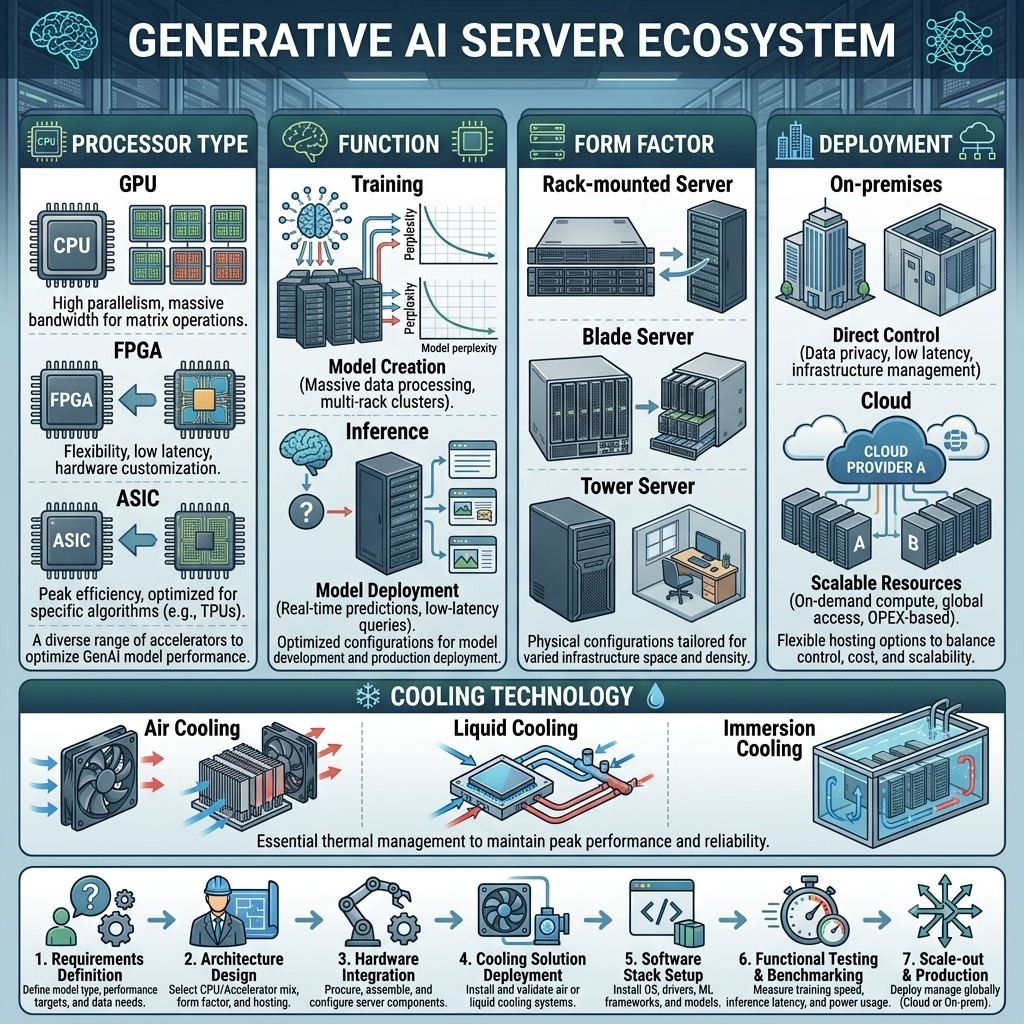
Processor technology is at the center of the Generative AI Server Market Growth Accelerates trend. GPU-based servers currently dominate because GPUs provide highly parallel processing capabilities that are well suited to AI training and inference workloads.
MarketsandMarkets reports that GPU-based servers accounted for a 70.7% share in 2024. Their widespread adoption among enterprises and hyperscale data centers, combined with mature AI software ecosystems, makes GPUs a preferred technology for high-performance generative AI infrastructure.
However, the market is not limited to GPUs. FPGA- and ASIC-based servers are also becoming important as organizations seek specialized architectures optimized for particular AI workloads. Continued innovation in accelerators is expected to broaden the infrastructure choices available to enterprises and cloud providers.
Download PDF Brochure @ https://www.marketsandmarkets.com/pdfdownloadNew.asp?id=242200223
Training and Inference Create Different Infrastructure Needs
The Generative AI Server Market Growth Accelerates across two major functions: training and inference.
Training requires substantial computational resources to develop and fine-tune AI models. Large-scale training environments typically require high-performance processors, high-bandwidth memory, fast networking, and sophisticated data-center infrastructure.
Inference, meanwhile, occurs when trained models generate responses or predictions. As organizations deploy AI copilots, chatbots, recommendation engines, and real-time content-generation applications, inference workloads are growing rapidly.
MarketsandMarkets expects inference to register the highest CAGR of 29.6% during the forecast period. Increasing demand for low-latency, high-volume inference is encouraging organizations to deploy servers optimized for efficient AI execution.
This transition from model development to widespread deployment could become one of the most important factors shaping the market through 2030.
Liquid Cooling Becomes Critical
Higher AI computing density is creating new thermal-management requirements. Generative AI servers equipped with powerful GPUs and ASICs can generate substantial amounts of heat, making conventional air cooling less effective for certain high-density deployments.
Consequently, liquid cooling is emerging as a major opportunity within the Generative AI Server Market Growth Accelerates landscape.
MarketsandMarkets expects liquid cooling to register the highest CAGR of 37.3% among cooling technologies during the forecast period. Liquid cooling can provide improved thermal management, support higher compute density, and potentially improve energy efficiency in AI-focused data centers.
The growth of AI servers is therefore creating opportunities not only for server manufacturers but also for cooling technology providers, data-center operators, power-management companies, and infrastructure integrators.
Enterprise Adoption Opens New Opportunities
One of the most significant opportunities behind Generative AI Server Market Growth Accelerates is the increasing adoption of AI by enterprises.
Businesses are moving beyond experimental projects and integrating generative AI into core processes. Potential applications include marketing content creation, software development, customer service, product design, financial analysis, healthcare research, and workflow automation.
MarketsandMarkets identifies emerging enterprise demand as a major market opportunity. The enterprises segment is expected to register the highest CAGR of 37.7% during the forecast period.
This creates a substantial opportunity for server vendors to develop infrastructure tailored to enterprise requirements, including security, scalability, data governance, and integration with existing IT environments.
On-Premises AI Infrastructure Gains Momentum
Cloud platforms have played a major role in making generative AI resources accessible. However, organizations handling sensitive data or requiring greater control over infrastructure are increasingly considering on-premises deployments.
MarketsandMarkets projects on-premises deployment to experience the highest growth rate in the market.
Organizations may choose on-premises infrastructure because of requirements related to data privacy, latency, regulatory compliance, customization, or predictable long-term workloads.
This does not necessarily mean cloud adoption will decline. Instead, hybrid infrastructure is likely to become increasingly important, allowing enterprises to combine cloud scalability with dedicated on-premises AI resources.
Rack-Mounted Servers Lead the Market
By form factor, rack-mounted servers are expected to hold the largest market share in 2030. These systems are well suited to data-center environments because they can be deployed at scale and integrated into existing infrastructure.
As AI workloads become more demanding, rack-mounted platforms can support high-density deployments involving multiple accelerators, advanced networking, high-bandwidth memory, and sophisticated cooling systems.
Blade and tower servers continue to serve specialized requirements, but rack-mounted systems are positioned to remain central to large-scale AI infrastructure.
Hyperscale Data Centers Fuel Demand
The rapid expansion of hyperscale data centers is another major factor supporting Generative AI Server Market Growth Accelerates.
Cloud service providers are investing heavily in AI infrastructure to support growing demand for generative AI services. These investments require large numbers of high-performance servers, accelerators, networking equipment, storage systems, and cooling infrastructure.
As AI models become larger and applications attract more users, infrastructure providers need to increase both computing capacity and efficiency.
This is creating opportunities throughout the AI infrastructure ecosystem, from semiconductor manufacturers and server OEMs to cooling, power, networking, storage, and software companies.
AI Infrastructure Faces High Costs
Despite rapid expansion, high infrastructure costs remain a significant restraint. Training and operating sophisticated generative AI models requires expensive processors, servers, storage, networking, power infrastructure, and cooling systems.
MarketsandMarkets identifies high infrastructure costs and power consumption and sustainability concerns among the key restraints affecting the market.
Organizations must therefore balance AI performance with total cost of ownership. Energy-efficient processors, optimized software, advanced cooling, workload scheduling, and specialized accelerators can help improve infrastructure economics.
The focus is increasingly shifting from simply maximizing computing power to achieving better performance per watt and cost per inference.
Sustainability Becomes a Strategic Priority
The environmental impact of AI infrastructure is becoming increasingly important as data-center power consumption rises.
High-density generative AI servers require substantial electricity and cooling capacity. As a result, data-center operators are exploring liquid cooling, renewable energy, energy-efficient processors, workload optimization, and other approaches to reduce environmental impact.
This creates a growing opportunity for companies developing sustainable AI infrastructure. Cooling technologies, power-management systems, efficient processors, and data-center optimization solutions will increasingly influence purchasing decisions.
AI Chip Innovation Creates New Opportunities
The Generative AI Server Market Growth Accelerates alongside continued innovation in AI processors.
GPU manufacturers remain critical to the ecosystem, but specialized ASICs and FPGAs can provide alternatives optimized for specific applications. AI chip developers are increasingly focusing on performance, memory bandwidth, energy efficiency, and cost optimization.
Open hardware initiatives and specialized accelerator architectures could also diversify the market over time. MarketsandMarkets identifies AI chip innovation and open hardware initiatives as an important opportunity.
This competition could encourage faster innovation and provide enterprises with more options when designing AI infrastructure.
Asia Pacific Offers Strong Growth Potential
Asia Pacific is expected to record the highest CAGR in the Generative AI Server Market during the forecast period. Government initiatives supporting AI infrastructure, expanding data centers, and increasing enterprise AI adoption are contributing to regional growth.
The region includes major technology and manufacturing hubs, creating opportunities for server manufacturers, cloud providers, semiconductor companies, and infrastructure suppliers.
Growing investments in AI research, digital transformation, and data-center infrastructure are expected to further strengthen demand.
Competitive Landscape
The competitive landscape includes major server and infrastructure providers such as Dell Technologies, Hewlett Packard Enterprise, Lenovo, Huawei, IBM, Supermicro, Cisco, and Fujitsu. MarketsandMarkets identifies these companies among the key players in the market.
Competition is increasingly focused on complete AI infrastructure rather than servers alone. Vendors are combining high-performance computing, accelerators, cooling, networking, software, management tools, and flexible deployment models to address enterprise and hyperscale requirements.
Key Challenges Ahead
Data privacy, sovereignty, and regulatory requirements represent important challenges as organizations deploy AI across multiple regions. Generative AI models can process sensitive corporate, customer, and personal information, increasing the need for secure infrastructure and appropriate data governance.
Another challenge is the shortage of professionals with expertise in AI infrastructure design and deployment. Building and operating high-performance AI environments requires knowledge spanning processors, networking, storage, cooling, power, software, and model optimization.
Addressing these skills gaps will be essential as organizations scale their AI infrastructure investments.
Future Outlook
The future of the Generative AI Server Market Growth Accelerates around one central trend: AI is moving from experimentation to continuous, large-scale deployment.
As enterprises increasingly integrate AI copilots, automation, content generation, scientific discovery, and intelligent decision-making into their workflows, demand for dedicated infrastructure will continue to rise.
GPU-based servers will remain foundational, while specialized accelerators could gain traction in targeted workloads. Inference is expected to become increasingly important as AI applications reach more users. Liquid cooling will gain momentum as computing densities increase, while on-premises and hybrid deployment models will help organizations balance performance, security, and control.
The market’s projected expansion from USD 103.92 billion in 2025 to USD 448.60 billion by 2030 demonstrates the scale of the infrastructure opportunity.
For technology providers, data-center operators, and enterprises, the message is clear: the next stage of the generative AI revolution will depend not only on better models, but also on the servers, processors, cooling systems, networking technologies, and infrastructure platforms capable of running those models efficiently at scale.
Key Players
Key companies operating in the generative AI server market include Dell Inc. (US), Hewlett Packard Enterprise Development LP (US), Lenovo (US), Huawei Technologies Co., Ltd (China), IBM (US), Super Micro Computer, Inc. (US), INSPUR Co., Ltd. (China), H3C Technologies Co., Ltd. (China), Cisco Systems, Inc. (US), and Fujitsu (Japan), among others.
Frequently Asked Questions (FAQs)
1. What is the Generative AI Server Market?
The Generative AI Server Market includes servers and computing infrastructure designed to support generative AI workloads, including large language model (LLM) training, inference, content generation, and other AI applications.
2. How fast is the Generative AI Server Market growing?
According to MarketsandMarkets, the market is projected to grow from USD 103.92 billion in 2025 to USD 448.60 billion by 2030, at a 34.0% CAGR.
3. What is driving Generative AI Server Market Growth Accelerates?
Key factors include increasing adoption of generative AI, growing LLM training and inference workloads, expansion of hyperscale data centers, enterprise AI deployment, and demand for GPU- and ASIC-accelerated computing infrastructure.
4. Why is liquid cooling important for generative AI servers?
Generative AI servers can generate substantial heat because of high-performance GPUs and other accelerators. Liquid cooling provides efficient thermal management and supports high-density AI computing environments while helping improve energy efficiency.
5. What are the major opportunities in the Generative AI Server Market?
Major opportunities include AI inference infrastructure, enterprise AI deployments, specialized AI chips, liquid cooling, on-premises AI systems, and hyperscale data-center expansion. These areas are expected to create significant demand as organizations scale generative AI applications.