The Generative AI Server Market Growth is accelerating as enterprises, hyperscalers, and cloud service providers invest heavily in infrastructure capable of training, fine-tuning, and running increasingly sophisticated generative AI models. Large language models (LLMs), multimodal AI, AI copilots, content generation, code generation, automation, and real-time inference are creating workloads that demand significantly higher computing performance than many traditional applications.
According to MarketsandMarkets, the Generative AI Server Market is expected to reach USD 448.60 billion by 2030 from USD 103.92 billion in 2025, registering a CAGR of 34.0% during the forecast period. The market’s rapid expansion is being driven by rising adoption of generative AI applications, demand for high-performance computing (HPC), hyperscale data-center expansion, and increasing use of GPU- and ASIC-accelerated infrastructure.
Why Generative AI Server Market Growth Is Accelerating
The primary factor behind Generative AI Server Market Growth is the increasing adoption of generative AI across industries. Organizations are deploying AI for text generation, image and video synthesis, software development, customer service, synthetic-data generation, research, and enterprise automation.
These workloads require powerful computing infrastructure capable of processing enormous datasets and complex models. Training and inference workloads increasingly depend on advanced processors, high-bandwidth memory, high-speed networking, and optimized data-center architectures.
As generative AI moves from experimentation into production, infrastructure requirements are changing. Businesses need servers capable not only of training models but also of delivering low-latency inference to large numbers of users. This shift from model development toward continuous AI deployment is becoming an important contributor to Generative AI Server Market Growth.
GPU-Based Servers Remain at the Center of AI Infrastructure
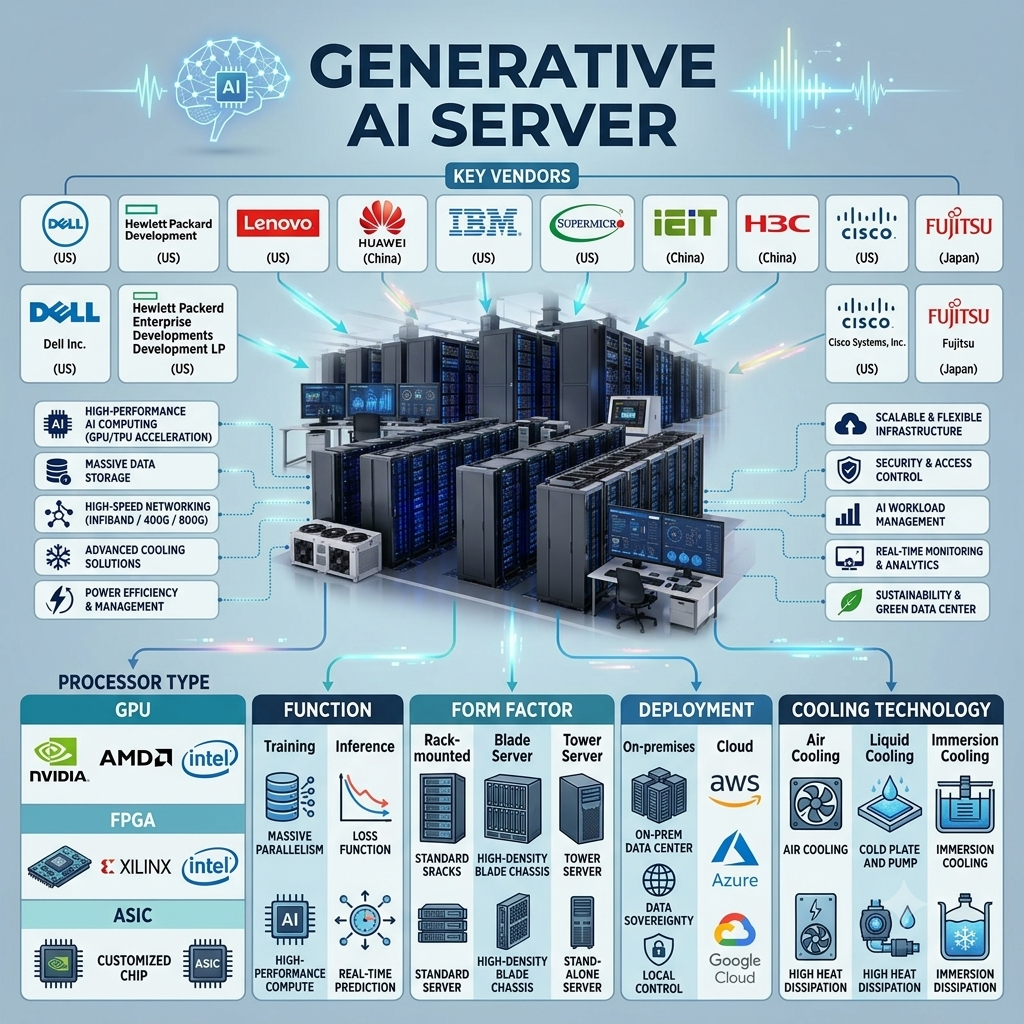
GPU-based servers are expected to remain the dominant processor architecture in the market. MarketsandMarkets indicates that GPU-based servers accounted for a 70.7% share in 2024.
GPUs are well suited to generative AI because their parallel-processing capabilities enable them to perform large numbers of mathematical operations simultaneously. This makes them particularly valuable for LLM training, model development, inference, and other compute-intensive workloads.
The established software ecosystem surrounding GPUs is another important advantage. Developers and enterprises can access mature programming frameworks, libraries, optimization tools, and AI software stacks, making GPU infrastructure easier to integrate into existing AI development environments.
However, the competitive landscape is expanding beyond GPUs. FPGA- and ASIC-based servers are increasingly being evaluated for specialized workloads where efficiency, latency, or workload-specific optimization is particularly important.
AI Accelerators Are Transforming Server Architecture
The rise of specialized AI accelerators is another important element of Generative AI Server Market Growth. AI workloads can require enormous amounts of compute while simultaneously demanding high memory bandwidth and efficient data movement.
ASICs can be designed specifically for AI workloads, potentially delivering greater efficiency for targeted applications. FPGAs can offer flexibility for certain AI processing requirements and can be adapted to specialized workloads.
This evolution is encouraging server manufacturers and data-center operators to develop architectures that combine CPUs, GPUs, AI accelerators, high-bandwidth memory, advanced networking, and sophisticated cooling systems.
Download PDF Brochure @ https://www.marketsandmarkets.com/pdfdownloadNew.asp?id=242200223
High-Performance Computing Is Becoming Essential
Generative AI servers are increasingly overlapping with the world of high-performance computing. Training large models can involve massive datasets, billions of parameters, and highly parallel computation.
HPC infrastructure provides the computing power, networking, storage, and orchestration capabilities required for these workloads. As AI models become larger and more complex, the boundaries between AI infrastructure and traditional HPC environments are becoming increasingly interconnected.
MarketsandMarkets identifies demand for high-performance computing infrastructure as one of the key drivers of the market.
High-Bandwidth Memory Supports Larger AI Workloads
Memory performance is just as important as processor performance for modern AI servers. Generative AI models require significant memory capacity and bandwidth because model parameters, datasets, and intermediate calculations need to be accessed rapidly.
High-bandwidth memory (HBM) is therefore becoming an important technology in AI infrastructure. Faster memory access can help reduce bottlenecks between processors and data, improving overall system performance.
The integration of advanced processors with HBM is helping server manufacturers build platforms optimized for increasingly demanding generative AI workloads.
Inference Is Becoming a Major Growth Engine
Training has traditionally received significant attention in discussions about AI infrastructure. However, inference is becoming increasingly important as organizations deploy AI applications at scale.
MarketsandMarkets expects the inference segment to register the highest CAGR of 29.6% during the forecast period. The growth is being driven by AI copilots, chatbots, real-time content generation, and other applications that require continuous, low-latency AI processing.
This represents a major shift in infrastructure requirements. Training environments are optimized for massive batch workloads, while inference infrastructure must often prioritize latency, availability, energy efficiency, and cost per query.
As generative AI becomes embedded in everyday enterprise applications, inference-focused server architectures are expected to become increasingly important.
Liquid Cooling Is Reshaping Data Centers
One of the most significant technological trends influencing Generative AI Server Market Growth is the move toward liquid cooling.
High-performance GPUs and AI accelerators generate substantial amounts of heat. As server power density increases, conventional air cooling can become less effective for certain high-density configurations.
MarketsandMarkets expects liquid cooling to register the highest CAGR of 37.3% during the forecast period. Liquid cooling provides more effective thermal management and can support high-density AI deployments while improving energy efficiency and operational performance.
This trend is influencing data-center design itself. Operators increasingly need to consider power delivery, cooling infrastructure, rack configuration, heat management, and facility-level efficiency when expanding AI capacity.
Rack-Mounted Servers Lead Data-Center Deployment
Rack-mounted servers are expected to hold the largest market share by 2030. Their standardized design, scalability, and efficient use of data-center space make them well suited to high-density AI infrastructure.
AI clusters can be constructed using large numbers of rack-mounted systems, allowing organizations to scale computing resources as workloads grow.
The ability to integrate high-performance GPUs, advanced networking, and liquid-cooling solutions into rack architectures is further supporting their use in hyperscale and enterprise environments.
Cloud Deployment Continues to Expand
Cloud deployment currently holds the largest market share because organizations can access AI infrastructure without making the full upfront investment required for dedicated hardware.
Cloud platforms provide access to high-performance GPUs, AI accelerators, storage, networking, and AI development tools. They also allow businesses to scale resources according to workload requirements.
This model is particularly attractive for companies experimenting with generative AI because it allows them to test models, develop applications, and scale successful workloads without building an entire AI data center.
The cloud is therefore expected to remain a major contributor to Generative AI Server Market Growth.
Enterprises Are Becoming a Major Growth Opportunity
While hyperscalers have historically represented some of the largest AI infrastructure buyers, enterprises are increasingly investing in dedicated AI infrastructure.
MarketsandMarkets expects the enterprise segment to register the highest CAGR of 37.7% during the forecast period. Organizations are adopting generative AI for automation, customer engagement, decision-making, software development, content generation, and industry-specific applications.
Some enterprises are also exploring private AI infrastructure because of data-security requirements, customized models, regulatory considerations, and the need for greater control over sensitive information.
This is creating demand for on-premises generative AI servers alongside cloud infrastructure.
Data Centers Are Being Redesigned for AI
The emergence of generative AI is changing the physical architecture of data centers. Traditional facilities were not necessarily designed for the high power densities associated with modern AI servers.
AI-ready data centers require greater power capacity, advanced cooling, high-speed networking, and optimized rack configurations.
The growing adoption of liquid-cooled systems is particularly significant because it can require changes to facility infrastructure, including cooling distribution and rack-level design.
As AI workloads continue expanding, data-center operators are increasingly treating AI infrastructure as a specialized environment rather than simply adding AI servers to conventional facilities.
Edge AI Creates New Infrastructure Opportunities
Generative AI is also moving beyond centralized cloud environments. Edge AI deployments can bring computing closer to users, devices, and operational environments.
This can be useful when organizations require lower latency, localized processing, greater data control, or reduced dependence on centralized cloud connectivity.
MarketsandMarkets highlights the growing importance of cloud-native and edge-based AI models in shaping the generative AI server ecosystem.
Future architectures could increasingly combine edge, on-premises, and cloud infrastructure, creating hybrid AI environments optimized for different workloads.
Sustainability Is Becoming a Strategic Issue
Rapid Generative AI Server Market Growth comes with an important challenge: energy consumption.
High-performance AI servers can consume significant amounts of electricity, while the cooling infrastructure required to operate them adds additional energy requirements. As AI clusters become larger, data-center operators are under increasing pressure to improve performance per watt.
Liquid cooling, workload optimization, more efficient AI accelerators, and improved data-center designs can help address these concerns.
Sustainability is therefore becoming a key consideration in AI infrastructure purchasing decisions rather than simply an environmental objective.
Key Challenges in the Generative AI Server Market
Despite strong growth prospects, the market faces several challenges.
High Infrastructure Costs
Building AI infrastructure requires substantial investment in servers, accelerators, networking, storage, power systems, and cooling. MarketsandMarkets identifies high infrastructure costs as a major restraint.
Power Consumption
The energy requirements of large AI clusters can increase operating costs and create sustainability challenges. Data centers must balance computational performance with energy efficiency.
Hardware Availability and Vendor Lock-In
The rapid increase in demand for AI accelerators can create supply constraints. Organizations may also become dependent on particular hardware and software ecosystems, creating vendor lock-in concerns.
Data Privacy and Regulation
Generative AI infrastructure must handle increasingly sensitive enterprise information. Data sovereignty, privacy requirements, and evolving AI regulations can influence where models are trained and where inference workloads are processed.
Talent Shortage
Designing and operating advanced AI infrastructure requires specialized expertise across data-center engineering, AI software, networking, storage, cooling, and accelerator technologies. MarketsandMarkets identifies talent shortages in AI infrastructure design as a significant challenge.
Asia Pacific Leads Regional Growth
Asia Pacific is expected to register the highest CAGR in the generative AI server market during the forecast period.
The region is benefiting from increasing AI infrastructure investments, national AI strategies, cloud expansion, and growing adoption of LLMs. China, Japan, South Korea, and Singapore are highlighted as important markets, while India is also experiencing increasing demand supported by government-led AI initiatives and its growing startup ecosystem. M
This regional expansion is also supported by the growth of data centers and the broader technology manufacturing ecosystem.
Competitive Landscape
The competitive environment includes server manufacturers, technology companies, AI hardware providers, and infrastructure specialists. MarketsandMarkets identifies Dell Inc., Hewlett Packard Enterprise, Lenovo, Huawei Technologies, IBM, Super Micro Computer, INSPUR, H3C Technologies, Cisco Systems, and Fujitsu among the key companies in the market.
Dell Technologies is identified as a leading player, while H3C Technologies is highlighted as an emerging leader. Companies are competing through AI-optimized servers, high-density configurations, liquid cooling, hybrid infrastructure, AI services, and workload-specific solutions.
Recent developments demonstrate how quickly the market is evolving. In 2026, Dell expanded its AI server platform with pre-integrated open models for on-premises AI workloads, while Dell and NVIDIA partnered with NxtGen AI to develop a large-scale AI factory in India using liquid-cooled systems and thousands of NVIDIA Blackwell GPUs. Lenovo has also introduced new servers aimed at enterprise AI inference.
Future Outlook
The future of Generative AI Server Market Growth will depend on how effectively infrastructure providers address the increasing computational demands of generative AI.
The next generation of AI servers is likely to emphasize several characteristics: higher accelerator density, faster memory, advanced networking, improved energy efficiency, liquid cooling, optimized inference, and flexible deployment models.
AI infrastructure will also become more workload-aware. Training, fine-tuning, and inference require different performance and efficiency characteristics, creating opportunities for specialized architectures.
At the same time, hybrid AI infrastructure combining cloud, on-premises, and edge resources could become increasingly common as enterprises balance scalability, cost, security, latency, and data sovereignty.
The Generative AI Server Market Growth story is ultimately a story about the transformation of data-center infrastructure. As generative AI becomes embedded across business processes, organizations require increasingly powerful and efficient systems to train and deploy models.
According to MarketsandMarkets, the market is expected to grow from USD 103.92 billion in 2025 to USD 448.60 billion by 2030, representing a 34.0% CAGR.
GPUs, AI accelerators, high-bandwidth memory, liquid cooling, high-speed networking, and rack-scale architectures are becoming fundamental components of AI-ready infrastructure. Meanwhile, cloud computing, enterprise AI adoption, edge deployments, and growing inference workloads are opening new opportunities.
