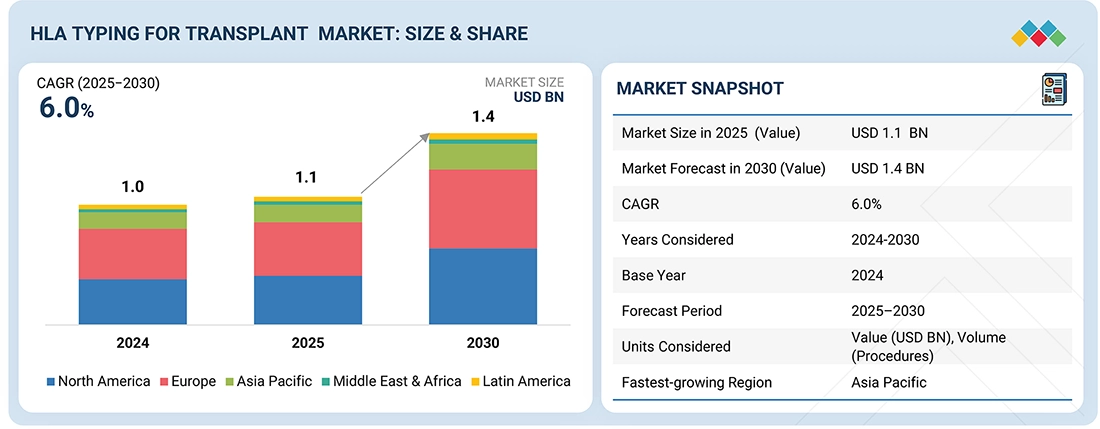
The global HLA Typing for Transplant Market is projected to grow from USD 1.1 billion in 2025 to USD 1.4 billion by 2030, at a CAGR of 6.0% during the forecast period. Market expansion is being driven by the rising volume of organ transplantation procedures, advancements in molecular diagnostic technologies, and increasing investments in transplant research and infrastructure.
Download PDF Brochure:- https://www.marketsandmarkets.com/pdfdownloadNew.asp?id=96374742
Market Dynamics: Rising Transplant Demand and Precision Diagnostics Fuel Growth
The growing global demand for organ transplants is a primary factor driving the adoption of HLA typing solutions. Accurate donor-recipient matching is critical to reducing transplant rejection rates and improving patient outcomes, making HLA typing an essential component of modern transplantation practices.
Technological advancements—particularly in next-generation sequencing (NGS) and polymerase chain reaction (PCR)—are significantly enhancing the precision and speed of HLA typing. In addition, supportive government initiatives and increased funding for genomics research are accelerating innovation and expanding access to advanced diagnostic solutions.
Industry players are also focusing on strengthening manufacturing capabilities and distribution networks, especially in emerging markets, further contributing to market growth.
Segment Insights: Reagents & Consumables Lead Market Demand
By product & service, the reagents & consumables segment accounted for the largest share of the market in 2024. This dominance is driven by the growing need for accurate and rapid identification of HLA alleles during transplantation procedures.
The increasing emphasis on minimizing transplant rejection and improving clinical outcomes has elevated the importance of high-quality reagents and consumables. Continuous advancements in molecular biology techniques are expected to further enhance the efficiency and reliability of these products, supporting sustained segment growth.
Technology Trends: Molecular Assays Dominate HLA Typing
By technology, the molecular assays segment held the largest market share in 2024. Techniques such as NGS and PCR are widely adopted due to their superior resolution and accuracy compared to traditional serological methods.
These technologies enable precise donor-recipient matching, which is critical for successful transplantation outcomes. As healthcare providers increasingly adopt advanced molecular diagnostics, this segment is expected to remain a key driver of market growth.
End-User Insights: Reference Laboratories Lead with High Throughput Expertise
By end user, independent reference laboratories accounted for the largest share of the market in 2024. Their ability to handle high sample volumes efficiently, combined with specialized expertise in complex HLA testing, positions them as key contributors to the transplantation ecosystem.
These laboratories play a crucial role in delivering accurate and timely results, supporting transplant centers and hospitals in making informed clinical decisions.
Regional Outlook: North America Leads, Asia Pacific Emerges as Growth Engine
North America dominated the HLA typing for transplant market in 2024, driven by a high volume of organ transplant procedures, strong presence of leading diagnostic companies, and robust research collaborations.
Meanwhile, the Asia Pacific region is expected to witness the fastest growth during the forecast period, supported by expanding healthcare infrastructure, increasing awareness of transplant diagnostics, and rising investments in genomic technologies.
Sepak To Analyst:- https://www.marketsandmarkets.com/speaktoanalystNew.asp?id=96374742
Competitive Landscape: Innovation and Strategic Expansion Shape Market Leadership
The HLA typing market is characterized by strong competition and continuous technological innovation. Key players include: Thermo Fisher Scientific (US), Illumina, Inc. (US), QIAGEN (Germany), CareDx, Inc. (US), F. Hoffmann-La Roche Ltd. (Switzerland), Bio-Rad Laboratories, Inc. (US), Immucor, Inc. (US), Werfen (US), TBG Biotechnology Corporation (Taiwan), Fujirebio (Japan), Omixon Inc. (US), GenDX (Netherlands), BAG Diagnostics GmbH (Germany), Creative Biolabs (US), and PacBio (US)
These companies are focusing on advanced sequencing technologies, product innovation, and strategic collaborations to strengthen their market presence and address the growing demand for precision transplant diagnostics.
Strategic Outlook: Precision Matching to Define the Future of Transplantation
As the global healthcare ecosystem increasingly prioritizes precision medicine and improved transplant outcomes, HLA typing technologies are becoming indispensable.
The continued evolution of molecular diagnostics, coupled with expanding transplant programs and growing investments in genomics, is expected to drive sustained market growth. Going forward, innovation, scalability, and accessibility will be key factors shaping the future of HLA typing for transplantation.
