In an era defined by immersive digital experiences and portable smart devices, the microdisplay industry has emerged as a critical enabler of compact, high-resolution visual technology. Microdisplays—tiny displays typically under one inch in size—are redefining how visual information is delivered in applications ranging from augmented reality (AR) and virtual reality (VR) to defense, healthcare, and industrial systems.
Understanding Microdisplay Technology
Microdisplays are miniature display panels designed to deliver exceptionally high pixel density, often exceeding thousands of pixels per inch (PPI). Unlike traditional flat-panel displays, microdisplays are optimized for near-eye viewing, making them ideal for head-mounted and projection-based systems.
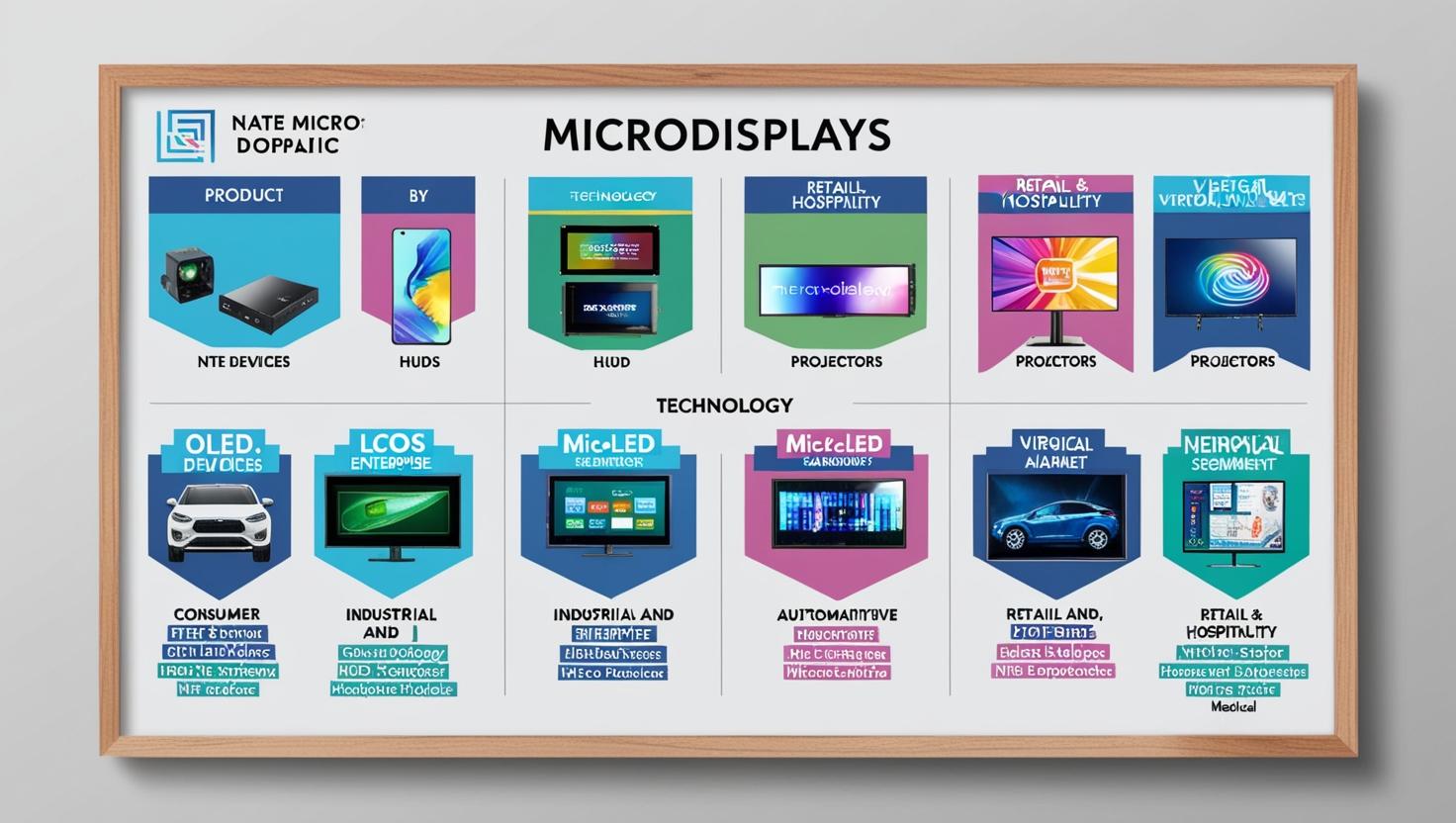
Key microdisplay technologies include:
- OLED-on-Silicon (OLEDos) – Known for high contrast, fast response times, and deep blacks
- Liquid Crystal on Silicon (LCoS) – Offers high resolution and excellent color reproduction
- MicroLED – An emerging technology delivering superior brightness, efficiency, and longevity
These technologies allow manufacturers to pack more visual detail into smaller form factors without compromising performance.
Download PDF Brochure @ https://www.marketsandmarkets.com/pdfdownloadNew.asp?id=430
Driving Demand for Compact, High-Resolution Displays
The growing adoption of AR/VR headsets, smart glasses, head-up displays (HUDs), and wearable electronics is fueling demand for microdisplays. Consumers and enterprises alike expect lightweight devices that deliver sharp images, wide color gamuts, and low power consumption—requirements that microdisplays are uniquely positioned to meet.
In addition to consumer electronics, sectors such as defense and aerospace rely on microdisplays for night vision systems, thermal imaging, and helmet-mounted displays, where clarity, reliability, and compact size are mission-critical.
Enabling Immersive and Intelligent Experiences
Microdisplays play a foundational role in creating immersive experiences. In AR and VR applications, ultra-high resolution helps reduce the “screen-door effect,” improves visual comfort, and enhances realism. Meanwhile, high brightness and fast refresh rates ensure seamless performance in dynamic environments.
In industrial and medical settings, microdisplays enable precise visualization for remote assistance, surgical imaging, training simulations, and real-time diagnostics, supporting better decision-making and operational efficiency.
Innovation in Materials and Manufacturing
Advancements in semiconductor fabrication, optical design, and materials science are accelerating innovation in the microdisplay industry. Manufacturers are focusing on:
- Higher pixel density with lower power consumption
- Improved brightness for outdoor and mixed-reality use
- Longer lifespan and thermal stability
- Scalable manufacturing for cost reduction
These improvements are making microdisplays more accessible and commercially viable across a broader range of applications.
The Road Ahead
As devices continue to shrink while performance expectations rise, the importance of microdisplays will only grow. The convergence of AI, spatial computing, and extended reality (XR) is expected to further expand the role of microdisplays in next-generation human–machine interfaces.
From redefining wearable technology to enabling advanced visualization in critical industries, the microdisplay industry is at the forefront of compact, high-resolution display innovation—shaping how we see, interact with, and experience the digital world.
The microdisplay industry is transforming display technology by delivering high performance in ultra-compact formats. As innovation accelerates and new applications emerge, microdisplays will remain a cornerstone of immersive, intelligent, and portable visual systems—bringing sharper, smarter displays to the forefront of modern technology.
Frequently Asked Questions (FAQ)
1. What is a microdisplay?
A microdisplay is a very small display panel—typically less than one inch in size—designed to deliver extremely high resolution and pixel density. It is mainly used in near-eye applications such as AR/VR headsets, smart glasses, and head-up displays.
2. How are microdisplays different from conventional displays?
Unlike conventional displays used in TVs or smartphones, microdisplays are optimized for compact size, high pixel density, and close-range viewing. They often work with optical systems to project images directly into the user’s field of view.
3. What technologies are used in microdisplays?
Common microdisplay technologies include:
- OLED-on-Silicon (OLEDos)
- Liquid Crystal on Silicon (LCoS)
MicroLED
Each technology offers unique benefits in terms of brightness, power efficiency, contrast, and lifespan.
4. What are the main applications of microdisplays?
Microdisplays are widely used in:
- Augmented and Virtual Reality (AR/VR)
- Smart glasses and wearable devices
- Head-up displays (HUDs)
- Defense and aerospace systems
- Medical imaging and surgical visualization
- Industrial training and remote assistance
About MarketsandMarkets™
MarketsandMarkets™ is a blue ocean alternative in growth consulting and program management, leveraging a man-machine offering to drive supernormal growth for progressive organizations in the B2B space. We have the widest lens on emerging technologies, making us proficient in co-creating supernormal growth for clients.
The B2B economy is witnessing the emergence of $25 trillion of new revenue streams that are substituting existing revenue streams in this decade alone. We work with clients on growth programs, helping them monetize this $25 trillion opportunity through our service lines – TAM Expansion, Go-to-Market (GTM) Strategy to Execution, Market Share Gain, Account Enablement, and Thought Leadership Marketing.
Built on the ’GIVE Growth’ principle, we work with several Forbes Global 2000 B2B companies – helping them stay relevant in a disruptive ecosystem. Our insights and strategies are molded by our industry experts, cutting-edge AI-powered Market Intelligence Cloud, and years of research. The KnowledgeStore™ (our Market Intelligence Cloud) integrates our research, facilitates an analysis of interconnections through a set of applications, helping clients look at the entire ecosystem and understand the revenue shifts happening in their industry.
To find out more, visit www.MarketsandMarkets™.com or follow us on Twitter, LinkedIn and Facebook.
Contact:
Mr. Rohan Salgarkar
MarketsandMarkets™ INC.
1615 South Congress Ave.
Suite 103
Delray Beach, FL 33445
USA : 1-888-600-6441
