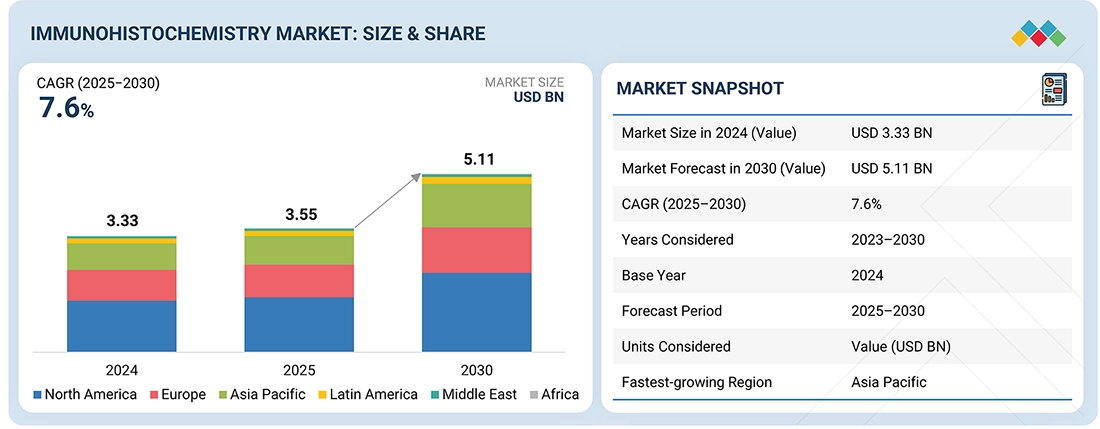
The global Immunohistochemistry (IHC) Market is projected to grow from USD 3.55 billion in 2025 to USD 5.14 billion by 2030, registering a CAGR of 7.6% during the forecast period. Growth is primarily driven by increasing cancer incidence, expanding diagnostic applications, and the rising need for accurate, biomarker-based disease identification.
Browse
- 794 Market Data Tables
- 65 Figures
- 563 Pages and in-depth TOC on “Immunohistochemistry Market – Global Forecast to 2030”.
Access key market insights and highlights from the report brochure:-https://www.marketsandmarkets.com/pdfdownloadNew.asp?id=121632939
Market Dynamics: Reimbursement Support and Diagnostic Demand Fuel Adoption
Favorable reimbursement frameworks in developed markets are significantly boosting the adoption of IHC testing by reducing patient out-of-pocket costs and increasing test volumes. This, in turn, is driving demand for IHC instruments, reagents, and consumables.
However, variability and complexity in reimbursement policies across regions remain a challenge, potentially slowing the adoption of advanced and high-cost IHC assays in certain markets.
Product Trends: Kits Segment Emerges as Fastest-Growing Category
By product and service, the kits segment is expected to register the highest growth during the forecast period. This growth reflects a clear shift toward integrated, ready-to-use solutions among hospitals, diagnostic laboratories, and research institutions.
IHC kits offer:
- Pre-validated, standardized components
- Reduced manual preparation and workflow complexity
- Improved reproducibility and diagnostic accuracy
These advantages streamline laboratory operations, increase throughput, and enhance consistency—making kits the preferred choice for high-volume diagnostic environments.
End-User Insights: Hospitals & Diagnostic Laboratories Lead Market Demand
The hospitals & diagnostic laboratories segment accounted for the largest share of the market in 2024. IHC plays a critical role in diagnosing cancers, infectious diseases, and autoimmune conditions by enabling detailed tissue-level analysis.
Its importance in identifying protein biomarkers—essential for targeted therapies—has made it a cornerstone of modern oncology diagnostics. Rising global cancer incidence and the expansion of in-house diagnostic capabilities among hospitals are further strengthening this segment’s dominance.
Regional Outlook: Asia Pacific Emerges as Leading Market
The Asia Pacific region dominated the global IHC market in 2024, driven by rapid healthcare infrastructure development, increasing disease burden, and expanding access to advanced diagnostics.
Key growth factors include:
- Government healthcare initiatives such as national health programs
- Expansion of private diagnostic laboratory networks
- Growth in medical tourism hubs across countries like Singapore and Thailand
- Rising demand from contract research organizations (CROs) supporting global clinical trials
These factors collectively position Asia Pacific as a high-growth region for IHC technologies.
Competitive Landscape: Global Leaders Focus on Innovation and Integration
The immunohistochemistry market is highly competitive, with leading players investing in advanced reagents, automation platforms, and integrated diagnostic solutions. Key companies include:
- F. Hoffmann-La Roche Ltd
- Danaher Corporation
- Agilent Technologies, Inc.
- Thermo Fisher Scientific Inc.
- Merck KGaA
These organizations are focusing on expanding product portfolios, enhancing automation, and improving assay accuracy to meet growing diagnostic demands.
Strategic Outlook: IHC as a Cornerstone of Precision Diagnostics
As healthcare systems increasingly prioritize precision medicine and biomarker-driven therapies, IHC continues to play a vital role in clinical decision-making and research.
Future market growth will be supported by:
- Increasing integration of automation and digital pathology
- Expansion of biomarker discovery programs
- Rising demand for standardized, high-throughput diagnostic solutions
Organizations that offer scalable, accurate, and workflow-efficient IHC solutions will be well-positioned to capitalize on emerging opportunities.