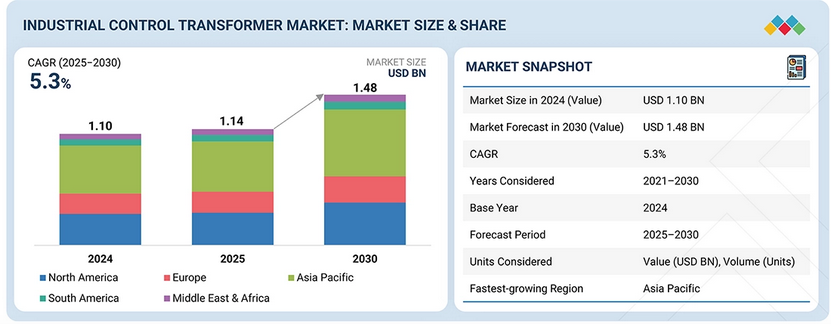
The global industrial control transformer market is estimated to grow from USD 1.14 billion in 2025 to USD 1.48 billion by 2030, at a CAGR of 5.3% during the forecast period. This growth is due to the rising demand for uninterrupted and reliable power in industries and the global shift toward automation and smart manufacturing. As industries adopt advanced control systems, robotics, and IoT-enabled machinery, the need for a stable voltage supply through control transformers becomes essential. The modernization of power generation facilities, the expansion of oil & gas exploration, and the increasing electrification of chemical and metal processing plants further fuel adoption. Additionally, government initiatives for energy efficiency, the growing integration of renewable energy into industrial operations, and the replacement of aging transformer infrastructure collectively contribute to sustained market growth through 2030.
Download PDF Brochure @ https://www.marketsandmarkets.com/pdfdownloadNew.asp?id=96246259
One of the most impactful advancements reshaping the industrial control transformer market is the integration of digital monitoring and IoT-enabled smart transformers. Traditionally, control transformers have been passive devices; however, with the advent of sensor-based technologies and real-time monitoring systems, they can now track parameters such as load, temperature, and voltage fluctuations. This digitalization enhances operational reliability and predictive maintenance and aligns with the broader Industry 4.0 trend, where interconnected devices drive efficiency and cost savings. As industries move toward data-driven operations, smart control transformers are becoming a critical enabler of resilient and energy-efficient manufacturing environments, redefining the market landscape.
In North America, the US dominates the industrial control transformer market, which can be attributed to its advanced industrial base, modernization of power infrastructure, and widespread adoption of automation technologies. Trends such as the integration of smart factories, the growing deployment of robotics in manufacturing, and the adoption of energy-efficient equipment also create strong demand for reliable control transformers. The US government’s push for grid modernization and industrial energy efficiency standards further supports market expansion. Additionally, opportunities are emerging due to the increasing renewable energy projects, including solar and wind, which require advanced transformer solutions for integration into industrial operations. The replacement of aging transformer infrastructure and the rising use of IoT-enabled monitoring systems also reshape the US market, making it a hub for technological innovation and large-scale demand in the industrial control transformer market.
Make an Inquiry @ https://www.marketsandmarkets.com/Enquiry_Before_BuyingNew.asp?id=96246259
By phase, the three-phase segment is projected to be the fastest-growing category in the industrial control transformer market during the forecast period, owing to its widespread application in large-scale industrial and commercial operations. The increasing adoption of automation in sectors such as oil & gas, power generation, and manufacturing augments the demand for three-phase transformers, which provide superior efficiency, higher load-bearing capacity, and stable performance compared with single-phase systems. Moreover, the modernization of industrial infrastructure and the integration of renewable energy sources into the grid further fuel the shift toward three-phase solutions. As industries prioritize operational reliability and energy efficiency, three-phase control transformers are emerging as the preferred choice, reinforcing their strong growth trajectory across the US and the broader North American market.
Based on power rating, the 25–500 VA segment is expected to register the highest CAGR in the industrial control transformer market in North America from 2025 to 2030, primarily due to its extensive use in small- to medium-scale industrial applications. These transformers are widely deployed in control panels, lighting systems, and automation equipment, where consistent and low-capacity voltage regulation is critical. The segmental growth is fueled by the rapid adoption of automation technologies in manufacturing and process industries, as well as the increasing demand from the commercial sector for reliable low-voltage solutions. Additionally, the trend toward compact, energy-efficient equipment in industries such as electronics, packaging, and building automation further accelerates the demand for 25–500 VA control transformers. Its cost-effectiveness and versatility across end-use industries make it a key driver of overall regional market growth.
Ask Sample Pages of the Report @ https://www.marketsandmarkets.com/requestsampleNew.asp?id=96246259
Companies operating in the industrial control transformer market increasingly leverage opportunities arising from industrial automation, digitalization, and the growing emphasis on energy efficiency. With industries across manufacturing, oil & gas, chemicals, and metals modernizing their operations, the demand for compact, efficient, and reliable transformers capable of providing stable voltage to sensitive control equipment is rising. Major companies, such as ABB (Switzerland), Siemens (Germany), Schneider Electric (France), GE Vernova (US), and Eaton (Ireland), are well-positioned to capitalize on these trends by expanding their portfolios of advanced control transformers, integrating smart monitoring features, and developing eco-efficient solutions. These players also invest in R&D to enhance transformer durability, safety, and adaptability to Industry 4.0 environments, while forming partnerships with OEMs and industrial automation providers. Furthermore, their ability to offer end-to-end services, including predictive maintenance and digital diagnostics, allows them to address tightening regulatory standards around operational efficiency and environmental compliance. By aligning with global trends, such as smart manufacturing, renewable energy integration, and industrial electrification, these companies reinforce their market leadership and shape the future growth trajectory of the industrial control transformer market.