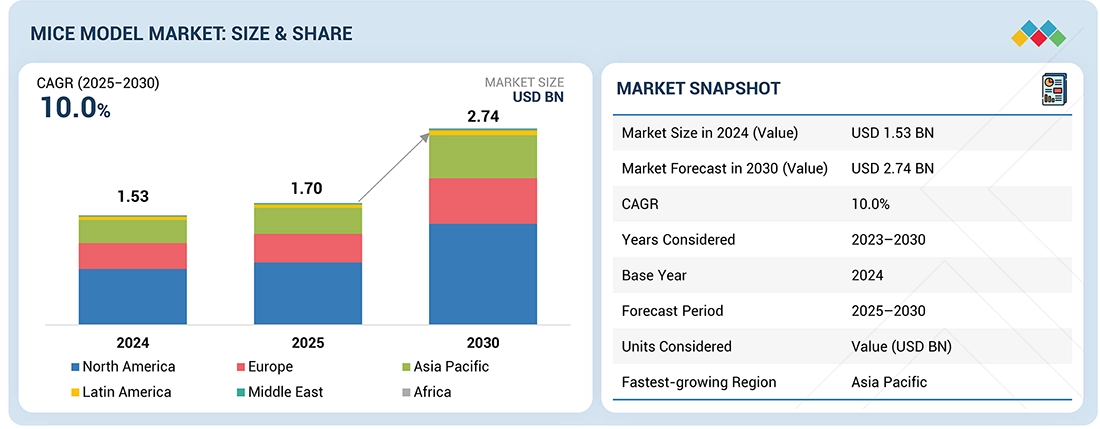
The global Mice Model Market is projected to grow from USD 1.70 billion in 2025 to USD 2.74 billion by 2030, registering a CAGR of 10.0% during the forecast period. Growth is being fueled by increasing reliance on mice models in preclinical research, rising adoption of mouse clinical trials (MCTs), and expanding applications in personalized medicine—particularly in oncology.
Download PDF Brochure:- https://www.marketsandmarkets.com/pdfdownloadNew.asp?id=1308
Market Drivers: Precision Medicine and Preclinical Innovation Take Center Stage
The growing use of mice models in biomedical research is driven by their genetic and physiological similarity to humans, making them highly effective for disease modeling and therapeutic validation. The rising emphasis on personalized medicine and targeted therapies is further accelerating demand for disease-specific and genetically engineered models.
Advancements in genetic engineering technologies, especially CRISPR-based genome editing, are significantly reducing development timelines and enabling more precise and scalable model generation—supporting faster drug discovery and translational research.
Model Type Insights: Inbred Mice Segment Leads the Market
By model type, the inbred mice segment accounted for the largest market share in 2024. These genetically identical (isogenic) models offer high reproducibility across experiments, making them essential for consistent research outcomes.
Inbred mice are widely used across pharmacology, oncology, cardiovascular studies, and behavioral research. Their ability to isolate genetic variables supports applications ranging from tumor biology and therapy response studies to vaccine and diagnostic validation.
Technology Trends: CRISPR/Cas9 Emerges as Dominant Innovation Driver
By technology, the CRISPR/Cas9 segment held the largest market share in 2024, driven by its precision, efficiency, and scalability in genome editing.
CRISPR enables targeted gene modifications at the embryonic stage, eliminating lengthy breeding cycles and significantly accelerating model development. Its ability to perform multiplex gene editing supports high-throughput in vivo screening, making it a preferred technology for research institutions and pharmaceutical companies.
Recent scientific advancements further highlight its impact, with large-scale gene knockout studies demonstrating its effectiveness in identifying novel therapeutic targets.
Regional Insights: North America Maintains Market Leadership
North America accounted for the largest share of the mice model market in 2024, supported by strong biomedical research infrastructure, regulatory frameworks, and high R&D investments.
The US leads the region, driven by a dense ecosystem of contract research organizations (CROs), academic institutions, and biotechnology firms. Major players continue to expand breeding capabilities and preclinical service offerings to meet growing demand.
Key companies operating in this space include: Charles River Laboratories (US), Inotiv (US), THE JACKSON LABORATORY (US), JSR Corporation (Japan), Biocytogen (China), Trans Genic Inc. (Japan) Harbour BioMed (China), genOway (France), GemPharmatech (China), Cyagen (US), Ozgene Pty Ltd (Australia), Taconic Biosciences, Inc. (US), TransCure bioServices (France), Vivo Bio Tech Ltd (India), ingenious targeting laboratory (US), Janvier Labs (France), Champions Oncology, Inc (US), and Vitalstar Biotechnology Co., Ltd. (China), among others.
These organizations play a critical role in advancing genetically engineered models and supporting end-to-end preclinical research services.
Speak To Analyst:- https://www.marketsandmarkets.com/speaktoanalystNew.asp?id=1308
Competitive Landscape: Expanding Capabilities Across Global Players
The market is highly competitive, with players focusing on expanding genetic engineering capabilities, improving breeding efficiency, and offering integrated preclinical solutions. Companies are also investing in CRISPR-based platforms and disease-specific model development to strengthen their market position.
Strategic Outlook: Growing Importance in Drug Discovery and Translational Research
As pharmaceutical and biotechnology companies accelerate drug development pipelines, the demand for reliable, scalable, and high-fidelity animal models will continue to rise.
The integration of advanced gene-editing technologies, increasing adoption of personalized medicine, and expansion of CRO-led research are expected to create significant growth opportunities in the global mice model market through 2030.