The Military Logistics and Defense Sustainment Market is estimated to reach approximately USD 16.8 billion in 2023 and is projected to exceed USD 23.5 billion by 2028, registering a CAGR of 7% during the forecast period. Rising geopolitical tensions, rapid military modernization programs, increasing defense budgets, and the growing complexity of joint military operations are accelerating investments in advanced logistics and sustainment systems worldwide.
Military logistics and defense sustainment have become central pillars of modern battlefield readiness as global armed forces increasingly prioritize operational agility, supply chain resilience, and technology-enabled mission support capabilities. Modern warfare is no longer defined solely by combat platforms and weapon systems; instead, the effectiveness of military operations increasingly depends on the ability to sustain forces across multi-domain environments through efficient transportation, predictive maintenance, autonomous supply networks, and real-time operational visibility.
Download Brochure Analyst-Verified Insights @ https://www.marketsandmarkets.com/pdfdownloadNew.asp?id=155479010
Artificial intelligence, IoT-enabled asset tracking, autonomous transportation platforms, digital twin technology, predictive analytics, and cloud-based logistics management are fundamentally transforming military sustainment operations. These technologies are improving operational readiness, reducing maintenance downtime, enhancing supply chain efficiency, and enabling faster deployment capabilities across land, air, naval, cyber, and space domains.
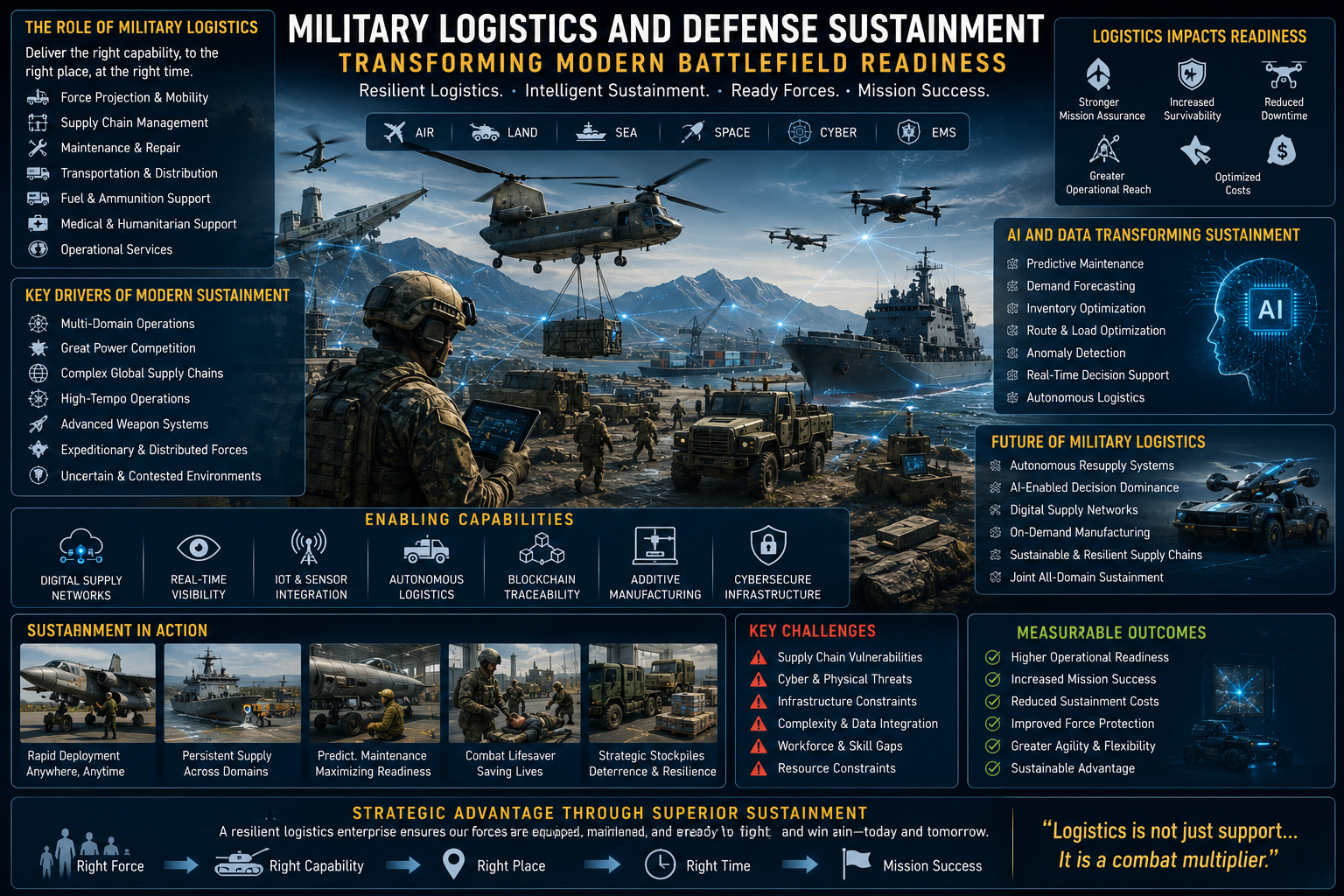
The Strategic Importance of Military Logistics
Military logistics has historically determined the outcome of conflicts by ensuring continuous availability of fuel, ammunition, spare parts, food, medical supplies, and operational equipment. In modern warfare, logistics has evolved into a highly digitized and data-driven operational ecosystem that directly influences battlefield survivability and mission effectiveness.
Contemporary defense operations require sustainment systems capable of supporting:
- Multi-domain combat operations
- Rapid global force deployment
- Autonomous battlefield systems
- Distributed military units
- Long-duration ISR missions
- Expeditionary warfare environments
Military planners increasingly recognize logistics resilience as a strategic advantage, particularly in contested operational theaters where traditional supply routes may be disrupted by cyberattacks, electronic warfare, or kinetic threats.
AI and Predictive Sustainment Revolutionizing Operations
Artificial intelligence is transforming military sustainment by enabling predictive logistics, automated inventory management, and intelligent maintenance systems. Traditional reactive maintenance models often result in equipment downtime, operational delays, and excessive sustainment costs. AI-driven predictive maintenance platforms analyze real-time equipment performance data to identify potential failures before they occur.
AI-enabled defense sustainment systems support:
- Predictive equipment diagnostics
- Automated maintenance scheduling
- Real-time supply optimization
- Intelligent fleet management
- Autonomous logistics planning
- Dynamic battlefield resupply operations
Machine learning algorithms can process vast volumes of operational data from aircraft, armored vehicles, naval vessels, and communication systems to improve asset availability and operational readiness.
Digital sustainment platforms are increasingly integrated with command-and-control systems, enabling military leaders to make faster operational decisions based on real-time logistics intelligence.
IoT-Enabled Asset Visibility Enhancing Battlefield Readiness
The Internet of Things is significantly improving military supply chain visibility through real-time asset monitoring and connected logistics networks. IoT-enabled sensors are being deployed across military vehicles, containers, warehouses, fuel systems, and supply convoys to track operational status, environmental conditions, and movement patterns.
Connected logistics infrastructures enable:
- Real-time cargo tracking
- Smart inventory management
- Fuel consumption monitoring
- Environmental condition monitoring
- Automated warehouse operations
- Enhanced battlefield visibility
IoT-based systems also improve accountability and reduce supply chain inefficiencies by providing continuous situational awareness across military logistics networks.
Advanced telemetry systems integrated into military platforms allow sustainment teams to monitor equipment performance remotely and coordinate maintenance operations more efficiently.
Autonomous Logistics Systems Expanding Operational Agility
Autonomous logistics platforms are becoming increasingly important for modern battlefield sustainment operations. Autonomous ground vehicles, drones, robotic supply systems, and unmanned cargo aircraft are reducing operational risk while improving resupply capabilities in contested environments.
Military organizations are investing heavily in:
- Autonomous resupply convoys
- Unmanned cargo drones
- Robotic warehouse systems
- AI-enabled route optimization
- Autonomous maritime logistics vessels
- Smart ammunition distribution systems
Autonomous logistics systems provide several operational advantages:
- Reduced human exposure to combat zones
- Faster resupply operations
- Improved supply chain resilience
- Lower operational costs
- Enhanced mission flexibility
Drone-based logistics systems are particularly gaining traction for delivering medical supplies, ammunition, and mission-critical equipment to remote or hostile operational areas.
Cloud Computing and Digital Logistics Transformation
Cloud computing technologies are reshaping military logistics by enabling centralized data integration, real-time collaboration, and scalable operational management. Cloud-based logistics platforms allow defense organizations to coordinate global supply chains, maintenance operations, and procurement activities more efficiently.
Modern digital logistics ecosystems support:
- Centralized operational visibility
- Multi-domain coordination
- Secure data sharing
- Real-time inventory synchronization
- Scalable sustainment planning
- Integrated predictive analytics
Cloud-enabled systems also improve interoperability between allied military forces during joint operations and multinational missions.
Cybersecurity is becoming increasingly critical as military logistics systems become more digitally connected. Defense agencies are prioritizing secure cloud infrastructures and zero-trust cybersecurity architectures to protect sustainment networks from cyber threats.
Supply Chain Resilience Becoming a National Security Priority
Recent geopolitical disruptions and global supply chain challenges have highlighted the strategic importance of resilient defense logistics networks. Military organizations worldwide are increasingly focusing on supply chain diversification, domestic manufacturing capabilities, and strategic stockpile management.
Key resilience initiatives include:
- Regionalized defense manufacturing
- Strategic material reserves
- Distributed warehousing systems
- Alternative transportation corridors
- AI-driven demand forecasting
- Supply chain risk analytics
Governments are also strengthening partnerships with defense contractors and commercial logistics providers to improve emergency response capabilities and sustainment readiness during large-scale conflicts.
Advanced Defense Manufacturing Supporting Sustainment
Advanced manufacturing technologies are improving military sustainment capabilities by enabling faster production, rapid repair, and on-demand component manufacturing. Additive manufacturing, robotics, and AI-driven production systems are increasingly being integrated into defense logistics ecosystems.
Modern sustainment manufacturing technologies include:
- 3D-printed spare parts
- Robotic maintenance systems
- Smart manufacturing facilities
- Digital twin simulation platforms
- Automated inspection systems
- AI-powered quality assurance
Forward-deployed additive manufacturing systems allow military units to produce mission-critical components directly in operational environments, reducing dependency on long supply chains.
Digital twin technology is also enabling virtual simulation of military platforms and logistics systems to optimize maintenance schedules and operational performance.
Defense Sustainment for Autonomous and Multi-Domain Warfare
The rise of autonomous systems and multi-domain warfare is significantly increasing the complexity of military sustainment operations. Modern military forces must support interconnected ecosystems that include drones, robotic combat systems, cyber infrastructures, space assets, and advanced communication networks.
Future defense sustainment systems must support:
- Autonomous combat platforms
- AI-enabled ISR systems
- Space-based defense architectures
- Hypersonic weapon systems
- Electronic warfare infrastructure
- Integrated battlefield networks
These advanced systems require highly specialized logistics support, predictive maintenance capabilities, and secure digital supply chains.
Regional Market Insights
North America currently dominates the Military Logistics and Defense Sustainment Market due to extensive defense modernization programs, advanced digital infrastructure, and substantial military expenditures. The United States leads global investments in AI-enabled sustainment systems, autonomous logistics platforms, and predictive maintenance technologies.
Europe is witnessing strong growth driven by NATO modernization initiatives, increasing defense collaboration, and rising investments in supply chain resilience and military mobility programs.
Asia Pacific is projected to experience the fastest growth through 2035 due to expanding defense budgets, regional security concerns, and large-scale military modernization efforts in China, India, Japan, and South Korea.
The Middle East is also strengthening military sustainment capabilities through investments in defense infrastructure modernization and autonomous logistics technologies.
Competitive Landscape
The Military Logistics and Defense Sustainment Market is highly competitive, with major defense contractors and technology companies focusing on AI integration, autonomous logistics systems, cloud-based sustainment platforms, and predictive maintenance technologies.
Key companies operating in the market include:
- Lockheed Martin
- Northrop Grumman
- RTX Corporation
- BAE Systems
- General Dynamics
- Boeing Defense
- L3Harris Technologies
- IBM
- SAP
- Palantir Technologies
These companies are investing heavily in digital transformation, AI-powered logistics platforms, autonomous systems integration, and advanced supply chain management technologies.
Explore In-Depth Industry Analysis: https://www.marketsandmarkets.com/Market-Reports/military-vehicle-sustainment-market-155479010.html
Future Outlook
The future of military logistics and defense sustainment will be increasingly defined by artificial intelligence, automation, predictive analytics, autonomous transportation systems, and digitally integrated supply chains. Battlefield readiness will depend not only on combat capability but also on the ability to sustain highly complex and distributed military operations in contested environments.
AI-driven logistics ecosystems, autonomous resupply systems, digital twin technologies, and resilient cloud infrastructures are expected to become foundational components of next-generation defense sustainment strategies.
As global military operations continue evolving toward multi-domain and autonomous warfare environments, advanced logistics and sustainment systems will remain critical for ensuring operational superiority, force survivability, and long-term mission success across modern battlefields.
