The global defense industry is undergoing a profound transformation, and one of the most disruptive shifts is the electrification of military vehicles. Militaries around the world have traditionally relied on fossil fuel powered vehicles, but escalating fuel costs, rising geopolitical tensions over oil supply, and the urgent need to reduce carbon emissions are pushing governments toward electrified alternatives. Military vehicle electrification encompasses combat vehicles, support vehicles, and unmanned armored platforms, each contributing to the overall modernization of defense capabilities. This shift is not just about sustainability; it is about enhancing mobility, efficiency, stealth, and adaptability in modern combat and support operations.
Electrification in the defense sector is not new, but recent advancements in battery technology, hybrid propulsion, and energy storage systems have accelerated adoption. Programs in North America, Europe, and Asia Pacific are driving the global market, with leading defense contractors collaborating with electric vehicle technology companies to build next generation platforms. The integration of electrification is positioning military forces to become less dependent on oil supply chains while gaining operational superiority.
Market Dynamics and Growth Drivers
The military vehicle electrification market is being shaped by several growth drivers. One of the most prominent is the rising cost of fossil fuels, which makes maintaining large fleets of fuel based vehicles economically challenging. At the same time, militaries are under pressure to decarbonize operations as governments introduce sustainability targets even within defense budgets. Initiatives such as the U.S. Department of Defense’s climate adaptation plan and NATO’s energy efficiency goals reflect the increasing importance of cleaner, more energy efficient military technologies.
Electrification also provides tactical advantages. Hybrid electric and fully electric vehicles reduce reliance on long fuel supply chains, which have historically been vulnerable in conflict zones. A vehicle that consumes less fuel not only lowers operational costs but also reduces exposure risks for logistics convoys. Electric drivetrains offer quieter operation and lower thermal signatures, giving soldiers an advantage in stealth missions. These benefits, combined with advances in AI integration and autonomous vehicle systems, are pushing militaries to accelerate investments in electrification.
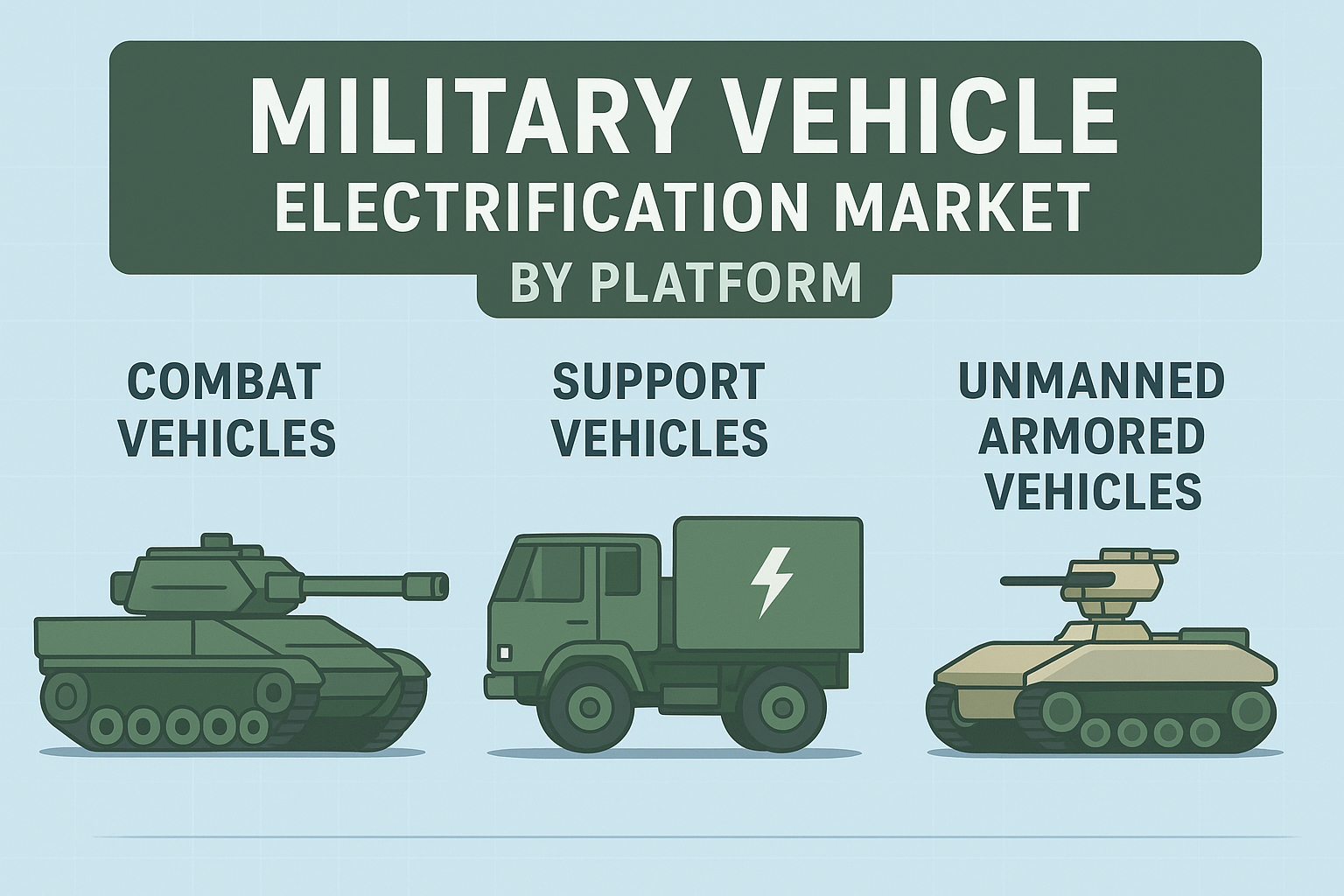
Combat Vehicles Electrification
Combat vehicles are the backbone of land forces, and their electrification is transforming how armies approach battlefield dominance. Tanks, infantry fighting vehicles, and armored personnel carriers are being retrofitted with hybrid electric propulsion systems or designed from scratch with electrification in mind. Hybrid models allow vehicles to switch between electric and fuel based modes depending on mission requirements. This dual capability ensures that combat effectiveness is not compromised while still benefiting from fuel efficiency and stealth features.
Several defense programs are already testing electric combat vehicles. The U.S. Army has been piloting hybrid electric versions of the Bradley Fighting Vehicle, while European countries like Germany and the U.K. are evaluating similar models. Combat vehicles with electric propulsion systems can achieve reduced acoustic signatures, making them harder to detect during night operations. They also enable on board systems such as directed energy weapons, advanced sensors, and communications technology to operate more efficiently, powered directly by electric energy. The electrification of combat vehicles marks a step forward in military innovation, where battlefield resilience, adaptability, and sustainability converge.
Support Vehicles Electrification
Support vehicles are the logistical backbone of any army, ensuring that troops receive supplies, medical aid, and equipment in the field. Traditionally powered by diesel engines, these fleets contribute significantly to fuel consumption and operational costs. Electrification of support vehicles, including trucks, transporters, ambulances, and engineering platforms, is now gaining momentum.
Electrified support vehicles not only reduce dependence on fossil fuels but also enable more efficient logistics management. They can be integrated into smart energy systems where renewable sources such as solar panels power field charging stations. In high risk areas, reducing the frequency of fuel convoys lowers exposure to ambushes and attacks. Electrified support vehicles also play a role in humanitarian operations, where clean and quiet vehicles are essential for disaster response missions. Countries like the U.S., France, and India are testing hybrid electric supply trucks that can carry heavy loads while maintaining long operational ranges.
By electrifying support vehicles, militaries are strengthening operational readiness while aligning with global sustainability goals. These vehicles demonstrate how electrification is not limited to combat but also extends to the essential, behind the scenes roles that sustain armed forces in the field.
Unmanned Armored Vehicles Electrification
The rise of unmanned systems is one of the most significant trends in modern warfare. Electrification is playing a pivotal role in the development of unmanned armored vehicles, which are increasingly deployed for reconnaissance, logistics, and combat missions. Electric propulsion is ideal for unmanned platforms because it allows for quieter operation, reduced heat signatures, and easier integration with autonomous systems.
Unmanned Ground Vehicles (UGVs) powered by electric batteries can be used for high risk missions, reducing the need to place soldiers in dangerous environments. These platforms are being deployed for mine clearance, perimeter surveillance, and even frontline combat roles. Countries like Russia, Israel, and the United States are investing heavily in electric powered unmanned armored platforms to strengthen their robotic warfare capabilities.
The electrification of unmanned armored vehicles also opens new possibilities in swarm tactics, where multiple unmanned units coordinate autonomously on the battlefield. With advanced AI integration and electric propulsion, militaries can achieve new levels of adaptability and lethality in both offensive and defensive operations.
Technological Innovations in Military Vehicle Electrification
Technological innovations are at the heart of this transformation. The development of high density lithium ion and solid state batteries has made it feasible for military vehicles to achieve longer operational ranges and faster charging times. Fuel cells are being tested for their ability to provide sustained power in energy intensive scenarios. Hybrid propulsion systems that combine traditional engines with electric drivetrains are bridging the gap between legacy vehicles and fully electric models.
Energy storage innovations also allow electrified vehicles to power advanced onboard systems, such as radar, sensors, and directed energy weapons. Integration with renewable energy grids in military bases further enhances operational sustainability. The application of AI and predictive analytics enables better battery management, optimizing energy consumption in real time during missions. These innovations ensure that electrification is not merely a trend but a long term shift in how militaries design, operate, and sustain their vehicles.
Operational Benefits and Challenges
The benefits of military vehicle electrification are substantial. Electrified vehicles produce less noise and heat, making them harder to detect on the battlefield. They reduce reliance on vulnerable fuel convoys, enhancing operational safety. The cost savings over time from reduced fuel consumption and lower maintenance requirements are also attractive for defense budgets.
Challenges remain. Current battery technology faces limitations in terms of durability, weight, and capacity for heavy duty combat scenarios. Charging infrastructure in combat zones is another concern, as militaries need mobile and resilient solutions to keep electrified fleets operational. Extreme weather conditions, such as deserts and arctic environments, pose additional hurdles for battery performance. Despite these challenges, continuous innovation and increasing government funding are pushing the industry toward overcoming these obstacles.
Regional Market Analysis
The adoption of military vehicle electrification varies by region. North America, led by the United States, is spearheading large scale programs to integrate electrified platforms across combat, support, and unmanned categories. Europe is equally active, with NATO member states driving collective research and development efforts. Germany, France, and the U.K. are particularly focused on hybrid combat vehicles and electrified support fleets.
Asia Pacific is emerging as a dynamic region, with China and India investing heavily in military modernization programs that include electrification. In the Middle East, electrification is gaining attention due to rising fuel costs and the need to diversify military energy sources. Each region is contributing to global market growth, creating opportunities for defense contractors and technology companies alike.
Competitive Landscape and Key Players
The competitive landscape of the military vehicle electrification market is shaped by collaborations between traditional defense contractors and new age technology firms. Companies such as BAE Systems, General Dynamics, Lockheed Martin, and Rheinmetall are leading electrification programs. Partnerships with EV battery manufacturers and energy storage innovators are accelerating the transition.
Startups and mid sized companies specializing in electric propulsion are also entering the defense supply chain. The ecosystem is becoming increasingly collaborative, as defense organizations seek to combine military expertise with commercial electric vehicle technology. This cross industry convergence is vital for developing scalable and mission ready electrified platforms.
Future Outlook of Military Vehicle Electrification
The future of military vehicle electrification is promising, with steady growth expected across combat vehicles, support vehicles, and unmanned platforms. As technology matures, more countries will adopt hybrid and fully electric solutions. By the 2030s, it is likely that electrification will be standard across new generation military fleets.
Future developments will integrate AI, autonomous systems, and advanced energy storage into electrified platforms. These capabilities will reshape the battlefield, where silent, efficient, and intelligent vehicles provide an edge in both conventional and asymmetric warfare. The combination of sustainability goals and operational superiority ensures that electrification will remain a cornerstone of defense modernization strategies for decades to come.
