Near Field Communication (NFC) technology is moving beyond its traditional role in contactless payments and becoming an increasingly important component of connected consumer electronics, smart retail, transportation, healthcare, automotive, access control, and digital authentication. Near Field Communication (NFC) Market is projected to reach USD 37.42 billion by 2032 from an estimated USD 24.42 billion in 2026, growing at a CAGR of 7.4%
NFC Adoption Accelerates Across Connected Applications
The growing demand for fast, secure, and convenient contactless interactions is a major factor supporting NFC market expansion. NFC-enabled smartphones, smartwatches, wearable devices, payment terminals, tags, and readers are increasingly being integrated into everyday consumer and commercial environments.
Contactless payments and digital wallets remain important growth engines. Consumers are increasingly using smartphones, wearables, and NFC-enabled cards for tap-to-pay transactions, while businesses are expanding contactless payment infrastructure across retail, hospitality, transportation, and other sectors. The technology’s short-range communication and authentication capabilities also make it suitable for applications where convenience and security are important.
However, the next phase of NFC growth is expected to come from applications extending well beyond payments.
Smart Retail and Product Authentication Create New Opportunities
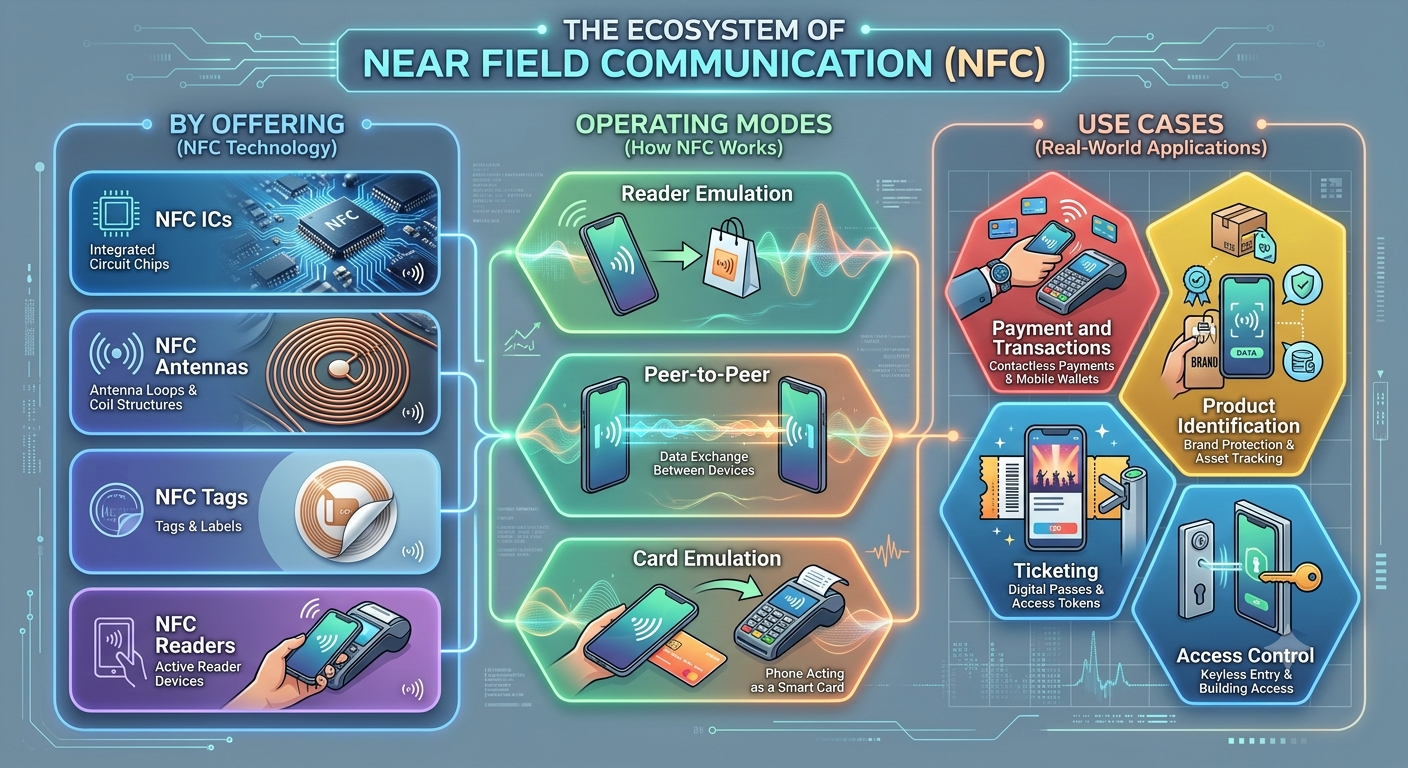
Smart retail represents one of the most promising emerging application areas for NFC technology. NFC tags embedded in products or packaging can connect physical products with digital information, allowing consumers to access product details, verify authenticity, interact with brands, and receive digital content through a simple tap.
For manufacturers and retailers, NFC can support product identification, traceability, anti-counterfeiting initiatives, and customer engagement. As brands seek greater visibility across product lifecycles and stronger relationships with consumers, connected products and smart packaging could generate additional demand for NFC tags, readers, ICs, antennas, and supporting software.
Product authentication is particularly relevant in industries where counterfeit products create financial and safety risks. NFC-based authentication can provide products with a digital identity that consumers and businesses can use to verify origin and access product information.
Consumer Electronics Expected to Lead in 2032
Consumer electronics is projected to account for the largest share of the NFC market by vertical in 2032. NFC functionality is increasingly integrated into smartphones, smartwatches, tablets, laptops, and other connected devices.
The technology supports multiple functions, including contactless payments, digital wallets, device pairing, authentication, access control, and data exchange. Rising smartphone and wearable adoption, combined with advances in miniaturized NFC components, is making NFC integration increasingly practical across a broad range of devices.
This expansion also creates opportunities for component manufacturers. MarketsandMarkets expects the NFC ICs and antennas segment to hold the largest market share in 2032, supported by integration into smartphones, wearables, payment terminals, automotive systems, and other NFC-enabled products.
Download PDF Brochure @ https://www.marketsandmarkets.com/pdfdownloadNew.asp?id=520
Card Emulation Remains a Key NFC Use Case
Among operating modes, card emulation is expected to hold the largest share in 2026. Card emulation enables NFC-enabled smartphones and smartwatches to function similarly to contactless cards, supporting payments, transit ticketing, access control, digital identification, and related applications.
Its integration into mobile devices is helping expand NFC deployment across banking and finance, transportation, retail, hospitality, and consumer electronics. As digital wallets and mobile credentials become more widespread, card emulation is likely to remain an important foundation of the NFC ecosystem.
NFC Expands Into Healthcare, Automotive, and Access Control
NFC adoption is also spreading into specialized commercial applications. In healthcare, NFC tags can support product authentication, traceability, and access to medical information. Automotive applications can use NFC for digital keys, authentication, device connectivity, and other connected-car functions.
Access control is another area in which NFC can provide a convenient alternative to traditional credentials. Smartphones and wearable devices can serve as digital credentials for buildings, workplaces, hospitality environments, and other controlled-access locations.
These applications demonstrate how NFC is evolving from a payment technology into a broader platform for secure physical-to-digital interactions.
Asia Pacific Maintains a Strong Market Position
Asia Pacific represented approximately 46% of the global NFC market in 2025, according to MarketsandMarkets. Strong adoption of contactless payments, NFC-enabled smartphones and wearables, expanding digital payment infrastructure, and the presence of major NFC technology providers in China, Japan, South Korea, and India are supporting the region’s market position.
Investments in digital wallets, smart transportation, connected consumer electronics, and contactless payment infrastructure are expected to continue supporting regional demand.
Emerging Energy-Efficient NFC Applications
NFC technology is also expanding into low-power and battery-free applications. MarketsandMarkets identifies light energy harvesting as the energy-source segment projected to register the highest CAGR during the forecast period. Advances in photovoltaic energy harvesting could support NFC-enabled sensing applications that operate with limited or no conventional battery power.
This development could be particularly significant for IoT applications, where reducing maintenance requirements and extending device lifetimes are important considerations.
Security and Interoperability Remain Critical Challenges
Despite its growth potential, the NFC market faces technical and security challenges. NFC ecosystems involve smartphones, tags, readers, payment terminals, secure elements, operating systems, and software platforms, making interoperability an important consideration.
Security is even more critical for payment, banking, access control, healthcare, and digital identity applications. Threats such as unauthorized access, data interception, relay attacks, and credential theft require continuous improvements in authentication, encryption, tokenization, secure elements, and security protocols.
NFC providers therefore face the challenge of improving security without compromising the speed and simplicity that make contactless interactions attractive to consumers.
Technology Innovation to Shape the NFC Market Through 2032
Recent product developments illustrate how NFC is moving toward new connected-device applications. MarketsandMarkets reports that in June 2026, STMicroelectronics introduced the ST25DA-C, a secure NFC device designed to support Matter 1.6 NFC commissioning for smart-home devices. In the same month, NXP introduced the EdgeLock SE051H for secure NFC commissioning of Matter-enabled devices. These developments highlight NFC’s expanding role in smart-home connectivity and secure device onboarding.
Such innovations could help NFC become an enabling technology for connected ecosystems rather than simply a method for exchanging payment credentials.
Competitive Landscape
The global NFC market includes major semiconductor, connectivity, security, and technology companies. MarketsandMarkets identifies NXP Semiconductors, Broadcom, Qualcomm Technologies, Texas Instruments, STMicroelectronics, Renesas Electronics, ams-OSRAM, Thales, Infineon Technologies, and Sony among the key market participants.
Competition is focused on NFC ICs and controllers, antennas, secure elements, tags, readers, contactless payment technologies, and solutions for digital identity, automotive, retail, healthcare, and consumer electronics.
Outlook for 2032
The NFC technology market is entering a broader phase of development in which contactless payments remain an important foundation while new applications create additional growth opportunities. Smart retail, product authentication, connected consumer electronics, digital identification, healthcare, automotive, smart homes, access control, and low-power IoT applications are expanding the potential addressable market.
With the global NFC market forecast to reach USD 37.42 billion by 2032, the industry’s growth is likely to depend not only on the number of NFC-enabled devices but also on how effectively technology providers develop secure, interoperable, energy-efficient solutions for new applications.
As NFC increasingly connects physical products, digital identities, connected devices, and consumer experiences, its role in the broader digital ecosystem is expected to become more significant through 2032.
FAQs
1. What is the projected size of the NFC market by 2032?
The global NFC market is projected to reach USD 37.42 billion by 2032, growing from an estimated USD 24.42 billion in 2026 at a 7.4% CAGR during 2026–2032.
2. What are the major factors driving NFC market growth?
Key growth drivers include the increasing adoption of contactless payments and digital wallets, NFC-enabled smartphones and wearable devices, connected consumer electronics, and growing demand for secure digital authentication and seamless connectivity.
3. Which segment is expected to dominate the NFC market in 2032?
The consumer electronics segment is expected to hold the largest market share by vertical in 2032. Increasing integration of NFC into smartphones, smartwatches, tablets, laptops, and other connected devices is supporting this growth. The NFC ICs & antennas segment is also expected to account for the largest share by hardware type in 2032.
4. What are the emerging applications creating opportunities in the NFC market?
Emerging opportunities include smart retail, product authentication, smart packaging, digital identification, access control, connected wearables, automotive applications, healthcare, and battery-free IoT sensing. NFC-enabled product authentication is particularly promising because it can help brands improve traceability, combat counterfeiting, and provide consumers with digital product information.
5. Which region is leading the global NFC market?
Asia Pacific held approximately 46% of the global NFC market in 2025 and is expected to remain a major growth region. Adoption is supported by contactless payments, NFC-enabled smartphones and wearables, expanding digital payment infrastructure, and the presence of major NFC technology providers across China, Japan, South Korea, and India.