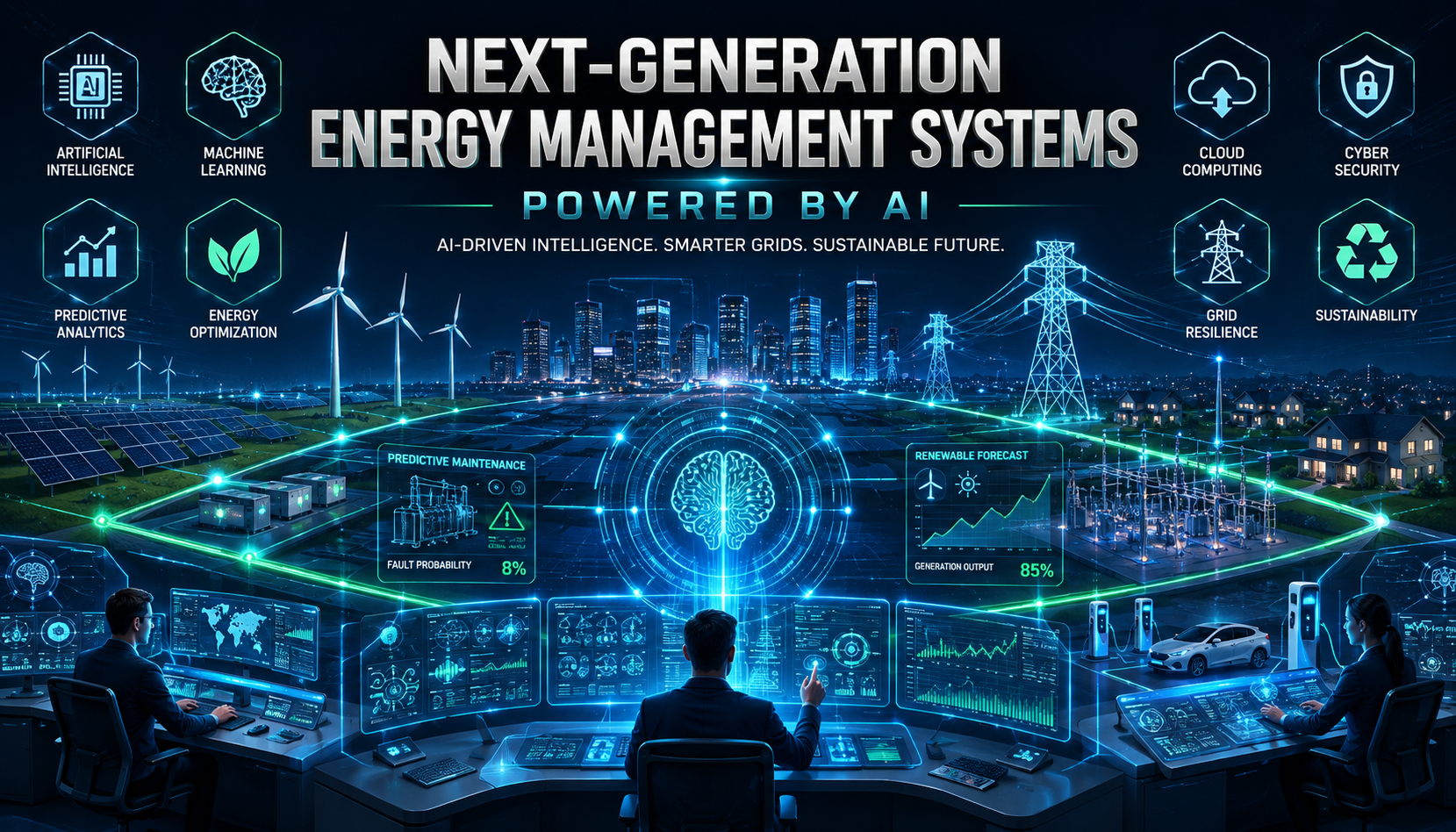
What are AI-powered next-generation energy management systems?
AI-powered next-generation energy management systems combine Artificial Intelligence, machine learning, Internet of Things (IoT), cloud computing, edge analytics, and advanced data intelligence to monitor, predict, and optimize electricity generation, transmission, distribution, and consumption in real time. These intelligent platforms improve grid reliability, lower operational costs, accelerate renewable energy integration, and enable utilities to make faster, data-driven decisions.
The global energy sector is experiencing one of the most significant digital transformations in its history. Utilities are modernizing aging power infrastructure to address rising electricity demand, strengthen grid resilience, and accommodate the rapid expansion of renewable energy resources. Conventional grid management approaches are no longer sufficient for managing increasingly decentralized and intelligent electricity networks, positioning the Smart Grid Analytics Market at the center of utility modernization.
Artificial Intelligence has evolved into the intelligence engine behind modern power systems. Rather than relying on reactive maintenance and manual supervision, utilities now deploy AI-enabled platforms capable of continuously analyzing operational data, forecasting electricity demand, predicting equipment failures, and optimizing power flows. These capabilities significantly improve operational efficiency while enhancing service reliability and customer satisfaction.
The convergence of Artificial Intelligence, cloud computing, IoT connectivity, digital twins, and edge computing continues to accelerate Smart Grid Analytics Market growth worldwide. Governments, energy providers, and private investors are increasing investments in intelligent utility infrastructure to strengthen energy security, reduce carbon emissions, and achieve long-term sustainability objectives.
Renewable energy adoption is another major factor supporting the Smart Grid Analytics Market outlook. As utilities integrate solar farms, wind energy, battery storage, and distributed energy resources into existing networks, AI-powered analytics enable real-time balancing of electricity supply and demand, ensuring stable grid performance while maximizing clean energy utilization.
This article presents a comprehensive Smart Grid Analytics Market analysis, examining how AI-powered next-generation energy management systems are reshaping utility operations, improving infrastructure intelligence, expanding investment opportunities, and supporting the transition toward resilient digital power networks.
Understanding the Smart Grid Analytics Market
Why are AI-powered energy management systems important for the Smart Grid Analytics Market?
AI-powered energy management systems play a vital role in the Smart Grid Analytics Market by enabling utilities to monitor infrastructure performance, forecast equipment failures, optimize electricity distribution, integrate renewable energy sources, and automate operational decisions. These capabilities improve efficiency, reliability, sustainability, and customer experience across modern electricity networks.
The Smart Grid Analytics Market encompasses advanced software platforms that collect and analyze data generated from smart meters, substations, transmission networks, renewable energy installations, and distributed energy resources. By converting massive volumes of operational information into actionable intelligence, utilities gain deeper visibility across their infrastructure while making faster and more informed business decisions.
Unlike conventional grid management systems that respond only after operational disruptions occur, AI-powered platforms leverage predictive analytics to anticipate equipment failures and operational risks before service quality is affected. Machine learning algorithms continuously evaluate weather conditions, asset health, electricity demand, and network congestion to optimize maintenance schedules and resource allocation proactively.
One of the defining characteristics of next-generation energy management systems is their ability to integrate multiple digital technologies into one unified operational environment. Artificial Intelligence, Geographic Information Systems (GIS), cloud computing, Advanced Metering Infrastructure (AMI), IoT sensors, and digital twin technology work together to provide utilities with a comprehensive digital representation of the entire power grid.
The widespread deployment of smart meters continues expanding the Smart Grid Analytics Market size. Millions of connected devices generate continuous streams of consumption and operational data, giving utilities unprecedented insight into customer demand, outage events, voltage quality, and transmission losses. AI-powered analytics convert this information into meaningful intelligence that supports accurate forecasting and more efficient energy distribution.
Edge computing is also strengthening the Smart Grid Analytics Market share by enabling analytics closer to substations, renewable energy facilities, and distribution assets. Processing operational data locally reduces latency and allows utilities to respond immediately to changing network conditions while improving grid resilience and supporting mission-critical operations.
According to the latest Smart Grid Analytics Market report, utilities increasingly prioritize cloud-native analytics platforms that integrate Artificial Intelligence, predictive analytics, cybersecurity, and automation. These intelligent platforms provide greater scalability, reduce operating costs, and improve infrastructure flexibility while supporting the future demands of electrification, renewable energy integration, and digital transformation.
Market research indicates strong trends Download the PDF to uncover business insights.
Why AI Is Becoming the Foundation of Smart Grid Intelligence
How is Artificial Intelligence transforming the Smart Grid Analytics Market?
Artificial Intelligence is transforming the Smart Grid Analytics Market by enabling predictive maintenance, real-time grid monitoring, demand forecasting, renewable energy optimization, automated outage management, and intelligent decision-making. AI-powered analytics improve operational efficiency, reduce energy losses, strengthen infrastructure resilience, and support sustainable electricity distribution.
Modern electricity networks generate enormous volumes of operational information every second. Traditional energy management platforms often struggle to process fragmented datasets quickly enough to support real-time decision-making. Artificial Intelligence addresses this challenge by continuously analyzing information from substations, smart meters, renewable assets, transformers, and transmission systems.
Machine learning models identify hidden operational patterns, predict electricity demand, detect abnormal equipment behavior, and recommend corrective actions before failures affect customers. These predictive capabilities reduce maintenance expenses, minimize outages, and improve infrastructure utilization while strengthening service reliability.
Cloud computing further enhances AI-powered energy management by providing scalable computing resources capable of processing massive utility datasets across geographically distributed networks. Centralized analytics environments improve collaboration, accelerate operational decisions, and simplify enterprise-wide digital transformation initiatives.
The growing adoption of AI-enabled operational intelligence continues strengthening Smart Grid Analytics Market growth, allowing utilities to transition from reactive grid management toward autonomous and predictive operations.
This Sample Report is designed to fuel your business growth—download it today.
Core Technologies Powering Modern Energy Management Systems
Machine learning has become one of the most valuable technologies driving intelligent utility operations. Unlike traditional analytical models, AI continuously learns from evolving operational conditions, improving forecasting accuracy and optimizing decision-making over time.
Utilities increasingly rely on machine learning to predict transformer failures, monitor equipment health, forecast electricity consumption, and optimize preventive maintenance programs. This predictive approach reduces unexpected service interruptions while extending the operational lifespan of critical infrastructure assets.
Demand forecasting has also become significantly more accurate through Artificial Intelligence. By analyzing historical consumption patterns, weather forecasts, industrial production, seasonal demand, and electric vehicle charging behavior, utilities optimize electricity generation while reducing unnecessary reserve capacity.
The rapid deployment of Internet of Things (IoT) devices has dramatically increased operational visibility throughout modern electricity infrastructure. Smart meters, intelligent transformers, voltage regulators, substations, renewable energy assets, and distribution equipment continuously transmit operational information to centralized analytics platforms.
AI processes these real-time data streams to detect voltage fluctuations, equipment degradation, transmission losses, and abnormal operating conditions almost instantly. Continuous monitoring enables utilities to respond proactively rather than waiting for customer complaints or equipment failures.
The growing adoption of connected infrastructure continues expanding the Smart Grid Analytics Market, enabling energy providers to improve operational efficiency, enhance customer satisfaction, and build intelligent power networks capable of supporting future energy demands.
AI Technologies Accelerating the Smart Grid Analytics Market
AI Technologies Powering Intelligent Energy Management
Artificial Intelligence has become the operational intelligence behind modern utility networks, enabling faster decisions, predictive insights, and autonomous grid management. As electricity demand becomes more dynamic, utilities require intelligent platforms capable of analyzing millions of real-time data points while optimizing power generation, transmission, and distribution. This technological evolution continues to accelerate the Smart Grid Analytics Market, allowing energy providers to improve efficiency without compromising reliability.
Unlike conventional monitoring systems that respond after operational issues arise, AI-powered analytics continuously evaluate asset performance, weather conditions, customer demand, and network behavior. Utilities can identify abnormalities before they become failures, reducing downtime and maintenance costs while improving service quality.
The integration of AI with cloud computing, IoT, edge analytics, and digital twins is strengthening the Smart Grid Analytics Market growth, enabling utilities to shift from reactive operations to predictive and increasingly autonomous energy management.
Machine Learning Enables Predictive Grid Intelligence
Machine learning is transforming how utilities manage critical infrastructure by converting operational data into actionable intelligence. Instead of relying solely on historical reports or scheduled inspections, AI models continuously learn from changing grid conditions to improve forecasting accuracy.
Utilities apply machine learning to:
- Predict transformer and substation failures before outages occur.
- Forecast electricity demand using weather, seasonal trends, and customer consumption patterns.
- Optimize maintenance schedules based on equipment health.
- Detect voltage instability and transmission losses early.
- Improve renewable energy forecasting for solar and wind assets.
This predictive approach minimizes unexpected interruptions while extending the lifespan of critical infrastructure. As more utilities embrace predictive maintenance, the Smart Grid Analytics Market analysis increasingly highlights AI as a strategic tool for reducing operational expenditure and improving asset utilization.
IoT and Smart Sensors Deliver Real-Time Grid Visibility
The rapid deployment of Internet of Things (IoT) devices has significantly expanded data visibility across electricity networks. Smart meters, intelligent transformers, substations, renewable energy installations, and transmission equipment continuously generate operational information that feeds AI-powered analytics platforms.
These connected devices enable utilities to monitor:
- Power quality
- Voltage fluctuations
- Equipment temperatures
- Energy losses
- Network congestion
- Renewable energy output
Rather than waiting for customer complaints or equipment failures, operators receive immediate alerts when abnormal conditions occur. Real-time intelligence allows utilities to respond proactively, reducing outage durations while improving operational resilience.
The expanding deployment of connected infrastructure is also increasing the Smart Grid Analytics Market size, as utilities invest in advanced sensing technologies that support intelligent decision-making across distributed energy networks.
Cloud Computing and Edge Analytics Strengthen Grid Operations
Cloud computing has become a foundational technology supporting modern utility analytics. Cloud-native platforms consolidate operational information from geographically distributed assets into centralized environments where AI algorithms process massive datasets efficiently.
Key advantages of cloud-enabled analytics include:
- Enterprise-wide operational visibility
- Faster software deployment
- Scalable computing resources
- Lower infrastructure costs
- Improved disaster recovery
- Simplified collaboration across utility operations
At the same time, edge computing complements cloud infrastructure by processing critical data closer to substations, renewable energy facilities, and distribution assets. Instead of transmitting every data point to centralized systems, edge devices analyze information locally and execute immediate operational responses.
This hybrid cloud-edge architecture improves response times for mission-critical applications such as voltage regulation, renewable energy balancing, outage detection, and fault isolation. These innovations continue strengthening the Smart Grid Analytics Market outlook, enabling utilities to operate increasingly decentralized and intelligent electricity networks.
Growth Drivers, Market Size, and Emerging Trends in the Smart Grid Analytics Market
Why the Smart Grid Analytics Market Is Expanding Rapidly
The Smart Grid Analytics Market is experiencing sustained momentum as utilities modernize aging electricity infrastructure while responding to rising energy demand, renewable integration, and electrification initiatives. Conventional grid management systems were designed for centralized power generation and limited operational visibility. Today’s energy ecosystem requires intelligent analytics capable of managing decentralized assets, distributed generation, and millions of connected devices in real time.
Governments, utility providers, and private investors are increasing investments in AI-powered grid modernization to improve energy security, reduce carbon emissions, and strengthen infrastructure resilience. These strategic initiatives continue accelerating Smart Grid Analytics Market growth, positioning advanced analytics as a core component of digital utility transformation.
Another significant growth catalyst is the rapid expansion of distributed energy resources, including solar farms, wind parks, battery storage systems, and community microgrids. AI-powered analytics help utilities balance fluctuating renewable generation with changing electricity demand while maintaining grid stability and service reliability.
Utilities are also embracing intelligent analytics to improve customer engagement, reduce operating expenses, strengthen regulatory compliance, and optimize asset performance. These measurable business outcomes continue reinforcing the long-term Smart Grid Analytics Market outlook across developed and emerging economies.
Smart Grid Analytics Market Size and Business Growth
The Smart Grid Analytics Market size continues expanding as utilities transition toward data-driven energy ecosystems supported by Artificial Intelligence, cloud computing, and advanced analytics. Growing electricity consumption, aging transmission infrastructure, and increasing renewable energy deployment are driving demand for intelligent software platforms that enable real-time operational decision-making.
A major contributor to Smart Grid Analytics Market growth is the widespread deployment of Advanced Metering Infrastructure (AMI). Millions of smart meters generate continuous streams of operational and consumption data, allowing utilities to forecast demand more accurately, detect outages faster, identify technical losses, and optimize energy distribution.
The increasing adoption of distributed energy resources further strengthens the Smart Grid Analytics Market share. Utilities require intelligent analytics capable of coordinating rooftop solar systems, utility-scale renewable projects, battery storage, electric vehicle charging infrastructure, and microgrids while maintaining power quality across increasingly decentralized networks.
Regional investments continue supporting market expansion. North America remains a leader due to significant investments in AI-enabled grid modernization and renewable energy infrastructure. Europe is advancing through ambitious decarbonization programs and digital energy initiatives, while Asia Pacific is witnessing rapid growth driven by urbanization, industrial development, smart city investments, and government-backed digital transformation strategies.
As automation and predictive intelligence become central to utility operations, the latest Smart Grid Analytics Market forecast indicates continued long-term expansion supported by digital infrastructure investment and accelerating energy transition initiatives.
Emerging Smart Grid Analytics Market Trends
The latest Smart Grid Analytics Market trends demonstrate that utilities are moving beyond traditional monitoring systems toward autonomous, AI-enabled energy management platforms capable of making intelligent operational decisions in real time.
Artificial Intelligence Becomes the Core of Grid Intelligence
Artificial Intelligence is rapidly becoming the foundation of intelligent utility operations. AI continuously analyzes operational information collected from substations, smart meters, renewable assets, transformers, and transmission networks to improve forecasting accuracy, automate operational decisions, and optimize electricity distribution.
Machine learning also enables predictive maintenance by identifying equipment deterioration before failures occur, reducing maintenance costs while improving infrastructure availability.
Cloud-Native Energy Platforms Accelerate Digital Transformation
Cloud computing has become a strategic enabler of utility modernization. Cloud-native analytics platforms consolidate operational information from geographically distributed assets into centralized environments that support enterprise-wide collaboration, scalable computing resources, and continuous software innovation.
These platforms reduce infrastructure complexity while enabling utilities to deploy new analytics capabilities more rapidly.
Digital Twins Improve Grid Planning
Digital twin technology is emerging as one of the most valuable innovations within the Smart Grid Analytics Market analysis. Utilities create virtual representations of substations, transmission networks, renewable energy assets, and distribution systems to simulate operational scenarios before implementing physical changes.
Digital twins improve infrastructure planning, asset utilization, maintenance strategies, and emergency preparedness while reducing operational risks.
Edge Computing Enables Faster Decisions
Edge computing processes operational data close to substations, renewable facilities, and distribution assets instead of relying exclusively on centralized cloud environments. This approach reduces latency while enabling immediate responses to voltage fluctuations, equipment abnormalities, renewable generation variability, and grid disturbances.
Edge-enabled intelligence significantly improves outage response, power quality management, and renewable energy integration across modern utility networks.
Distributed Energy Resource Management Expands
The increasing deployment of solar farms, wind turbines, battery storage systems, and community microgrids continues transforming electricity generation. AI-powered analytics coordinate these distributed resources by forecasting renewable production, balancing electricity demand, optimizing battery utilization, and maintaining grid stability.
These capabilities are strengthening the Smart Grid Analytics Market report, demonstrating how intelligent analytics enable utilities to maximize renewable energy adoption without compromising operational reliability.
Electric Vehicle Infrastructure Creates New Opportunities
The rapid expansion of electric vehicle adoption is creating additional demand for intelligent energy management. AI-powered analytics help utilities forecast charging demand, optimize load balancing, prevent localized network congestion, and improve electricity utilization across charging infrastructure.
As transportation electrification accelerates globally, EV integration will remain one of the strongest drivers supporting the long-term Smart Grid Analytics Market companies ecosystem and future market expansion.
Key Use Cases and Investment Opportunities in the Smart Grid Analytics Market
Key Use Cases of AI-Powered Energy Management Systems
The Smart Grid Analytics Market is transforming utility operations by enabling intelligent automation across the entire electricity value chain. AI-powered analytics convert operational data into actionable insights that improve efficiency, enhance reliability, and support faster decision-making. As utilities continue their digital transformation journey, these capabilities are becoming essential for building resilient and sustainable power networks.
Predictive Maintenance for Critical Grid Assets
Predictive maintenance is one of the most valuable applications driving the Smart Grid Analytics Market. Conventional maintenance strategies rely on scheduled inspections or reactive repairs after equipment failures occur. AI replaces these approaches with continuous monitoring that detects equipment deterioration before outages happen.
Machine learning models evaluate transformer health, substation performance, voltage fluctuations, thermal conditions, and equipment utilization to identify potential failures early. Utilities can schedule maintenance proactively, reducing downtime, extending equipment life, lowering maintenance costs, and improving overall grid reliability.
Intelligent Load Forecasting and Demand Response
Electricity demand changes continuously due to weather patterns, industrial production, population growth, and electric vehicle charging. AI-powered forecasting models analyze these variables to deliver highly accurate demand predictions.
Utilities use these forecasts to optimize electricity generation, improve energy procurement, schedule maintenance efficiently, and balance renewable energy resources. Demand response programs also encourage consumers to shift electricity consumption during peak periods, improving grid stability while reducing operational costs.
These forecasting capabilities continue strengthening the Smart Grid Analytics Market analysis, enabling utilities to make faster operational decisions while improving customer service.
Renewable Energy Integration
Renewable energy is reshaping electricity generation, but its intermittent nature introduces operational complexity. Solar farms, wind turbines, battery storage systems, and distributed generation require continuous coordination to maintain grid stability.
AI-powered analytics continuously evaluate weather forecasts, renewable generation output, battery capacity, and electricity demand to optimize power distribution in real time. Intelligent forecasting minimizes energy curtailment, maximizes renewable utilization, and supports national decarbonization initiatives.
As governments accelerate clean energy investments, renewable integration remains one of the strongest contributors to Smart Grid Analytics Market growth.
Real-Time Outage Detection and Grid Restoration
AI significantly improves outage management by enabling utilities to identify faults immediately and restore power faster.
Smart meters, IoT sensors, substations, and distribution equipment continuously transmit operational information to centralized analytics platforms. AI identifies outage locations, prioritizes restoration activities, recommends repair strategies, and optimizes field workforce deployment.
Automated outage management improves service reliability, reduces customer downtime, lowers emergency response costs, and strengthens overall operational resilience.
Smart Meter Analytics and Customer Intelligence
The widespread deployment of Advanced Metering Infrastructure (AMI) has expanded the Smart Grid Analytics Market size by providing utilities with continuous visibility into customer energy consumption.
AI-powered analytics transform smart meter data into valuable business intelligence by:
- Detecting abnormal consumption patterns
- Identifying energy theft
- Improving billing accuracy
- Supporting dynamic pricing models
- Delivering personalized energy efficiency recommendations
These insights improve customer engagement while helping utilities optimize demand-side management programs.
Distributed Energy Resource Management
Distributed Energy Resources (DERs), including rooftop solar, battery storage, microgrids, and EV charging stations, require sophisticated coordination to maintain power quality.
AI-powered energy management systems automatically optimize distributed generation, storage utilization, voltage regulation, and electricity balancing across decentralized networks. These capabilities improve operational flexibility while supporting the continued expansion of renewable energy ecosystems.
According to the latest Smart Grid Analytics Market report, intelligent DER management will remain one of the fastest-growing applications throughout the forecast period.
Investment Opportunities in the Smart Grid Analytics Market
The Smart Grid Analytics Market continues attracting significant public and private investment as governments, utilities, and technology providers accelerate digital infrastructure modernization. Organizations are prioritizing intelligent software platforms that improve operational efficiency while supporting sustainability objectives.
One of the strongest investment opportunities lies in AI-powered analytics platforms that automate predictive maintenance, outage management, energy forecasting, and asset optimization. These solutions reduce operational costs while improving network reliability and infrastructure utilization.
Cloud-native utility platforms represent another rapidly growing investment segment. Utilities are replacing legacy on-premise software with scalable cloud environments that enable centralized analytics, enterprise collaboration, continuous innovation, and lower long-term IT costs.
Edge computing infrastructure is also gaining momentum as utilities require real-time intelligence closer to substations, renewable energy assets, and distribution networks. Edge-enabled analytics improve response times, enhance resilience, and support mission-critical operations.
Digital twin technology is emerging as another strategic investment area. Virtual models of substations, transmission systems, and renewable assets allow utilities to simulate operational scenarios, evaluate infrastructure upgrades, optimize maintenance strategies, and reduce investment risks before implementing physical changes.
The rapid expansion of electric vehicle charging infrastructure is creating new opportunities across the Smart Grid Analytics Market outlook. AI-powered energy management platforms help utilities forecast charging demand, optimize load balancing, and integrate transportation electrification without overloading existing distribution networks.
Cybersecurity also remains a high-priority investment segment. As utility infrastructure becomes increasingly connected, AI-driven security analytics strengthen threat detection, protect critical assets, improve regulatory compliance, and enhance operational resilience.
The latest Smart Grid Analytics Market forecast indicates that organizations investing in Artificial Intelligence, predictive analytics, cloud computing, edge intelligence, digital twins, renewable integration, and advanced cybersecurity will strengthen their competitive position while supporting long-term digital transformation across the global energy sector.
Challenges, Competitive Landscape, Future Outlook, and Conclusion
Challenges Affecting the Smart Grid Analytics Market
Despite its strong momentum, the Smart Grid Analytics Market faces several operational, technical, and regulatory challenges. Utilities are transitioning from legacy infrastructure to intelligent, AI-powered energy management platforms while maintaining uninterrupted service. Achieving this balance requires substantial investment, workforce transformation, and advanced cybersecurity strategies.
Legacy Grid Modernization
Many utilities continue operating decades-old transmission and distribution infrastructure that was not designed for real-time analytics or autonomous decision-making.
Integrating Artificial Intelligence, cloud computing, IoT devices, and digital twins with existing SCADA systems, substations, and control centers presents significant technical complexity. Most organizations are adopting phased modernization strategies that combine legacy assets with intelligent digital platforms, allowing gradual transformation while minimizing operational risks.
Cybersecurity and Critical Infrastructure Protection
As utility networks become increasingly connected, cybersecurity has become one of the highest priorities within the Smart Grid Analytics Market.
Connected smart meters, cloud platforms, renewable energy assets, IoT devices, and remote substations expand the attack surface for ransomware, malware, insider threats, and sophisticated cyberattacks.
To strengthen resilience, utilities are investing in:
- Zero Trust security frameworks
- AI-powered threat detection
- Identity and access management
- End-to-end encryption
- Security Operations Centers (SOCs)
- Continuous security monitoring
These technologies help utilities protect critical infrastructure while maintaining regulatory compliance and customer trust.
Managing Massive Operational Data
Modern utilities generate enormous amounts of operational data every second.
Smart meters, battery storage systems, substations, weather monitoring platforms, electric vehicle charging stations, and renewable energy assets continuously produce information that must be collected, analyzed, and converted into business intelligence.
Without standardized data governance and intelligent analytics, utilities struggle to transform raw information into actionable insights. AI-powered data management platforms simplify integration, improve data quality, and enable faster operational decision-making.
Regulatory Compliance and Workforce Transformation
Electric utilities operate within highly regulated environments that require compliance with cybersecurity standards, environmental regulations, customer privacy requirements, and grid reliability guidelines.
AI-powered platforms must provide transparent decision-making, secure data handling, audit trails, and continuous compliance monitoring.
At the same time, utilities face shortages of professionals skilled in Artificial Intelligence, cloud computing, cybersecurity, IoT, data science, and digital energy systems. Organizations are addressing this challenge through workforce development, certification programs, technology partnerships, and increased automation.
Competitive Landscape and Smart Grid Analytics Market Companies
Competition within the Smart Grid Analytics Market companies ecosystem is increasingly centered on software innovation rather than traditional utility equipment. Technology providers are expanding investments in Artificial Intelligence, cloud-native platforms, predictive analytics, digital twins, and edge intelligence to help utilities modernize operations.
Leading vendors are developing integrated analytics platforms capable of connecting data from:
- Smart meters
- SCADA systems
- Renewable energy assets
- Battery storage systems
- Electric vehicle charging infrastructure
- IoT sensors
- Distribution networks
Artificial Intelligence has become a major competitive differentiator. Vendors now integrate machine learning into energy forecasting, predictive maintenance, outage management, cybersecurity, and asset optimization to improve operational efficiency and reduce infrastructure costs.
Strategic partnerships among software companies, cloud providers, renewable energy developers, telecommunications firms, and utility operators continue accelerating innovation across the digital energy ecosystem.
According to the latest Smart Grid Analytics Market report, customers increasingly evaluate technology providers based on:
- AI capabilities
- Cloud compatibility
- Cybersecurity features
- Scalability
- Interoperability
- Predictive analytics
- Digital twin integration
- Long-term platform support
Organizations delivering flexible, AI-driven, cloud-native solutions are expected to strengthen their Smart Grid Analytics Market share during the forecast period.
Future Outlook and Smart Grid Analytics Market Forecast
The long-term Smart Grid Analytics Market forecast remains highly optimistic as utilities continue investing in Artificial Intelligence, cloud computing, edge analytics, digital twins, renewable energy integration, and autonomous grid operations.
Future power networks will become increasingly intelligent, decentralized, and self-optimizing. AI will evolve beyond operational support toward fully autonomous grid management capable of predicting failures, balancing electricity demand, coordinating distributed resources, detecting cyber threats, and restoring outages with minimal human intervention.
Digital twins will play an increasingly strategic role in infrastructure planning by enabling utilities to simulate network expansion, renewable integration, disaster recovery, and capital investment decisions before implementing physical changes.
The continued growth of electric vehicles, battery energy storage, hydrogen infrastructure, community microgrids, and distributed renewable generation will further increase demand for intelligent analytics platforms.
Another defining trend will be the rise of autonomous energy ecosystems, where Artificial Intelligence continuously learns from operational data to optimize grid performance, improve asset utilization, reduce carbon emissions, and strengthen resilience.
The latest Smart Grid Analytics Market analysis indicates sustained expansion supported by government modernization initiatives, renewable energy investments, digital transformation programs, and increasing electricity demand. Organizations investing in AI-powered utility platforms today will be well positioned to improve operational efficiency and maintain long-term competitiveness.
The Smart Grid Analytics Market is redefining the future of energy management by enabling utilities to build intelligent, resilient, and highly efficient electricity networks. As renewable energy adoption, electrification, and digital transformation accelerate worldwide, advanced analytics platforms have become indispensable for maintaining grid stability and delivering reliable power.
Artificial Intelligence is transforming every stage of utility operations, from predictive maintenance and demand forecasting to renewable energy optimization, outage management, smart meter analytics, and cybersecurity. These capabilities help utilities reduce operational costs, improve infrastructure performance, enhance customer satisfaction, and achieve sustainability objectives.
As highlighted throughout this Smart Grid Analytics Market analysis, continued investment in AI, cloud-native platforms, edge computing, predictive analytics, digital twins, and intelligent automation will sustain Smart Grid Analytics Market growth over the coming decade.
The evolving Smart Grid Analytics Market size, expanding technology ecosystem, and increasing adoption of intelligent energy management solutions reinforce a highly positive Smart Grid Analytics Market outlook. Organizations that embrace AI-driven analytics today will be best positioned to deliver secure, sustainable, and future-ready power systems while strengthening their leadership in the rapidly evolving global energy industry.
