The humanoid robot industry is entering a transformative phase as advances in artificial intelligence, physical AI, robotics, sensors, actuators, and simulation technologies move humanoid robots from research and demonstrations toward real-world commercial deployment The humanoid robot market size is estimated to be USD 5.41 billion in 2026 and is projected to reach USD 50.27 billion by 2035, expanding at a CAGR of 28.1% from 2026 to 2035
One of the most significant trends shaping the market is the rapid development of physical AI and robot foundation models. Unlike conventional industrial robots designed for highly structured and repetitive tasks, humanoid robots are being developed to perceive their surroundings, understand instructions, plan movements, manipulate objects, and interact with people. Improvements in AI-based perception, motion planning, manipulation software, computer vision, and simulation-based training are helping robots become more adaptable and capable of performing complex tasks in human-centric environments.
Manufacturing is emerging as a particularly important growth opportunity. MarketsandMarkets expects the manufacturing application segment to register the highest growth rate of approximately 27–30% during the forecast period. Humanoid robots can support assembly, inspection, material handling, machine tending, and other repetitive or physically demanding activities. Their human-like form provides a potential advantage because they can be designed to operate within existing workplaces, workstations, and environments originally created for human workers.
The opportunity is also expanding into warehousing and logistics, where labor shortages, e-commerce growth, fulfillment requirements, and the need to improve operational efficiency are driving interest in robotic automation. Humanoid robots could increasingly be used for material movement, picking, sorting, and other repetitive warehouse activities. MarketsandMarkets identifies rising demand from the logistics sector as an important opportunity for the industry, particularly as companies look for flexible automation solutions that can operate alongside existing infrastructure.
Download PDF Brochure @ https://www.marketsandmarkets.com/pdfdownloadNew.asp?id=99567653
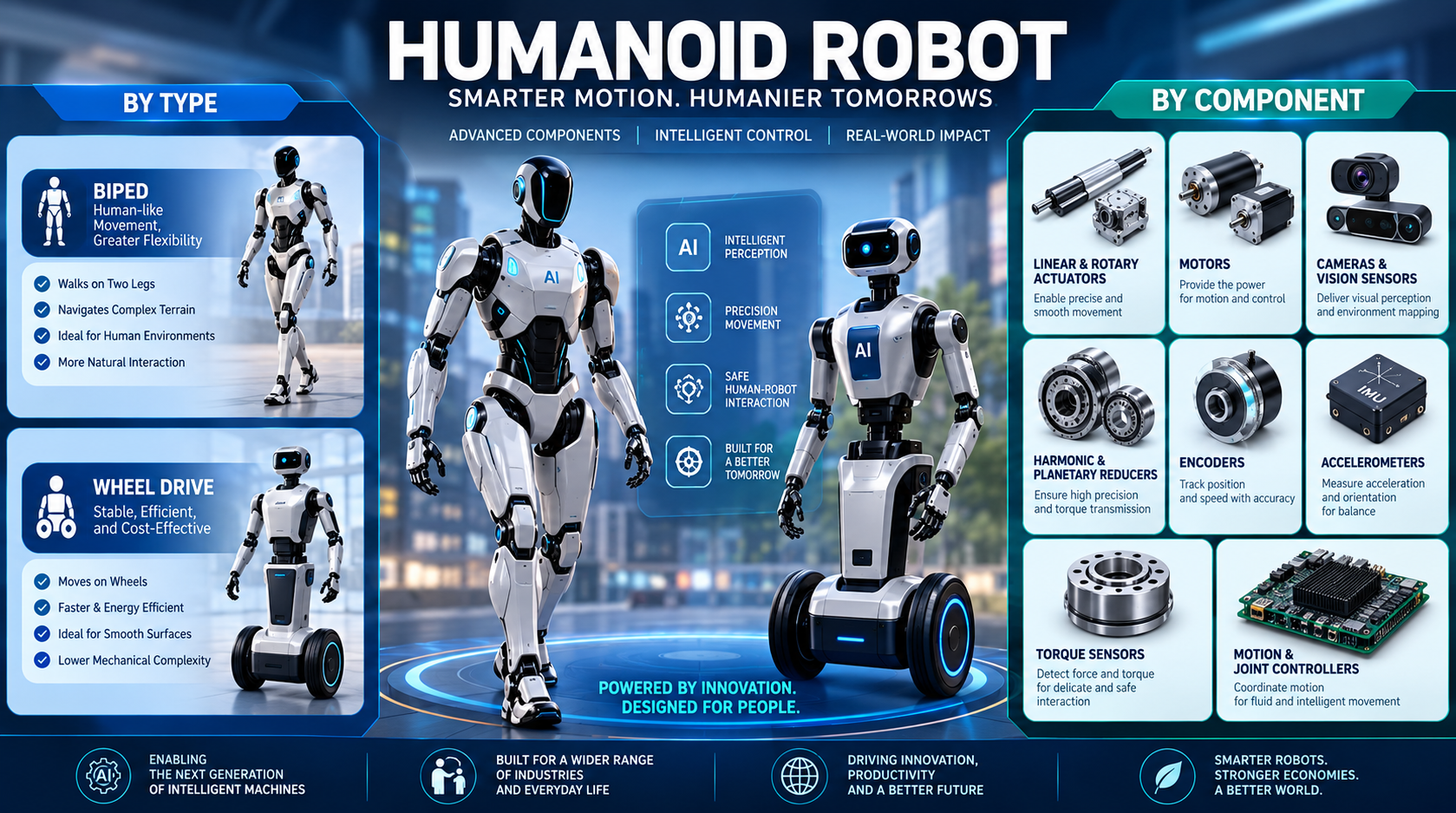
Another important development is the growing importance of the software layer. While hardware is expected to hold the largest share of the market, accounting for approximately 65–75% in 2026, software is projected to register the highest growth rate. Advances in perception, motion planning, manipulation, robot foundation models, simulation, fleet management, and robot intelligence platforms are creating new opportunities beyond traditional robot hardware. This shift could enable new business models centered around intelligent software, data, digital twins, connectivity, predictive maintenance, and AI-enabled robot services.
The adoption of Robotics-as-a-Service (RaaS) and fleet-management models could further accelerate commercialization. Instead of requiring companies to make large upfront investments in robot ownership, service-based models can provide access to robotic capabilities through recurring or usage-based models. These solutions can support remote monitoring, software updates, performance optimization, predictive maintenance, and coordination of multiple robots. As humanoid robotics matures, such models could reduce barriers to adoption and enable businesses to scale deployments more efficiently.
Asia Pacific is positioned as a major center of the humanoid robot market. MarketsandMarkets expects the region to account for more than 50% of market share throughout the forecast period, supported by established robotics manufacturing ecosystems, increasing automation investments, and rapid commercialization in countries such as China, Japan, and South Korea. China is particularly notable, with its humanoid robot market projected to grow from USD 0.40 billion in 2025 to USD 2.80 billion by 2030, representing a 47.6% CAGR. South Korea is also expected to experience strong growth, with its market projected to reach USD 583.5 million by 2030 from USD 112.6 million in 2025.
Despite the significant opportunity, the industry faces several challenges. Developing humanoid robots requires substantial capital investment and extensive R&D across hardware, AI software, sensors, actuators, batteries, control systems, testing, and safety validation. Performance limitations in unstructured and unpredictable environments remain another concern. Safety is particularly important because humanoid robots are intended to operate close to workers, customers, patients, and other people. Improving reliability, collision avoidance, emergency response, task accuracy, and compliance with safety requirements will be essential for widespread adoption.
The competitive landscape is also becoming increasingly dynamic, with established robotics companies, technology companies, startups, and emerging players developing humanoid platforms for industrial and commercial applications. Companies such as Unitree Robotics, AGIBOT, UBTECH Robotics, Leju Robotics, EngineAI, Figure AI, Agility Robotics, Tesla, and Boston Dynamics are among the key players identified by MarketsandMarkets.
The long-term opportunity extends far beyond the robot itself. Humanoid robotics is creating demand across the broader ecosystem, including AI models, semiconductors, sensors, actuators, motors, reducers, batteries, controllers, simulation platforms, connectivity solutions, fleet-management software, and robotics services. As these technologies converge, humanoid robots could become an important component of next-generation automation and Physical AI.
The humanoid robot market is therefore moving toward an important inflection point. The transition from prototypes to commercial deployment could create opportunities for robot manufacturers, component suppliers, software developers, AI companies, system integrators, investors, and end-user industries. Organizations that understand the evolving technology stack and identify practical use cases early may be better positioned to capture emerging opportunities.
The humanoid robot era is accelerating. The question is no longer whether humanoid robots will influence the future of automation—it is how quickly they will scale, where they will create the greatest value, and which companies will capture the opportunity.
Are you ready to capture the opportunity? Explore the latest market trends, technologies, applications, regional developments, and competitive insights shaping the global Humanoid Robot Market.
Frequently Asked Questions
1. What is the current size of the humanoid robot market?
According to MarketsandMarkets, the global humanoid robot market is estimated to reach USD 5.41 billion in 2026 and is projected to reach USD 50.27 billion by 2035, growing at a 28.1% CAGR during the forecast period.
2. What are the key factors driving the humanoid robot market?
The market is being driven by advances in artificial intelligence, physical AI, robotics, computer vision, sensors, actuators, simulation technologies, and robot foundation models. Growing automation requirements, labor shortages, and demand for flexible robots across industrial and commercial environments are also supporting market growth.
3. Which industries are expected to adopt humanoid robots?
Humanoid robots are gaining opportunities across manufacturing, logistics and warehousing, healthcare, education, hospitality, retail, and personal assistance. Manufacturing is expected to be one of the fastest-growing application areas as companies explore humanoid robots for assembly, material handling, inspection, and other repetitive tasks.
4. Which region is expected to lead the humanoid robot market?
Asia Pacific is expected to remain a major market for humanoid robots and is projected to account for more than 50% of the market share during the forecast period. Strong robotics ecosystems, manufacturing capabilities, automation investments, and commercialization efforts in countries such as China, Japan, and South Korea are contributing to regional growth.
About MarketsandMarkets™
MarketsandMarkets™ has been recognized as one of America’s Best Management Consulting Firms by Forbes, as per their recent report.
MarketsandMarkets™ is a blue ocean alternative in growth consulting and program management, leveraging a man-machine offering to drive supernormal growth for progressive organizations in the B2B space. With the widest lens on emerging technologies, we are proficient in co-creating supernormal growth for clients across the globe.
Today, 80% of Fortune 2000 companies rely on MarketsandMarkets, and 90 of the top 100 companies in each sector trust us to accelerate their revenue growth. With a global clientele of over 13,000 organizations, we help businesses thrive in a disruptive ecosystem.
The B2B economy is witnessing the emergence of $25 trillion in new revenue streams that are replacing existing ones within this decade. We work with clients on growth programs, helping them monetize this $25 trillion opportunity through our service lines – TAM Expansion, Go-to-Market (GTM) Strategy to Execution, Market Share Gain, Account Enablement, and Thought Leadership Marketing.
Built on the ‘GIVE Growth’ principle, we collaborate with several Forbes Global 2000 B2B companies to keep them future-ready. Our insights and strategies are powered by industry experts, cutting-edge AI, and our Market Intelligence Cloud, KnowledgeStore™, which integrates research and provides ecosystem-wide visibility into revenue shifts.
To find out more, visit www.MarketsandMarkets™.com or follow us on Twitter , LinkedIn and Facebook .
Contact:
Mr. Rohan Salgarkar
MarketsandMarkets™ INC.
1615 South Congress Ave.
Suite 103, Delray Beach, FL 33445
USA: +1-888-600-6441