The global security screening market trends is undergoing a significant transformation, driven by growing safety concerns, advancements in screening technologies, and increasing adoption across diverse sectors beyond traditional aviation security. With public safety becoming a critical priority for governments and private enterprises alike, the demand for more efficient, accurate, and non-intrusive screening systems is steadily rising.
As a result, current security screening market trends highlight a shift toward intelligent systems, integration of artificial intelligence (AI), and a growing emphasis on passenger and personnel convenience without compromising security standards.
Evolving Technologies: A Closer Look at System Types
The modern security screening ecosystem is highly diversified, incorporating a range of technologies designed to address specific threats across varying environments. Key system types include:
X-ray Body and Baggage Scanners
X-ray body scanners and baggage scanners remain essential to high-traffic environments such as airports, seaports, and public venues. These systems have advanced significantly, now offering AI-assisted image analysis, enhanced automation, and improved threat detection accuracy. The integration of machine learning algorithms allows real-time identification of prohibited items, minimizing manual interpretation and reducing false alarms.
Cabinet X-ray Systems
Primarily used for mail, parcels, and small packages, cabinet X-ray systems are witnessing growing adoption in government buildings, logistics centers, and corporate offices. These systems offer enclosed, high-resolution imaging with minimal radiation exposure, making them a safe and efficient solution for high-volume scanning.
X-ray Handheld Scanners
Handheld X-ray scanners provide portability and flexibility, particularly in military, border patrol, and emergency response operations. These compact devices are ideal for field inspections, offering instant analysis of suspicious items without requiring large-scale equipment.
Electromagnetic Metal Detection Systems
Metal detection remains a foundational technology in security screening. Modern electromagnetic metal detectors, both walk-through and handheld, offer advanced capabilities including multi-zone detection, people-counting functions, and integration with access control systems. These enhancements support higher throughput and more precise threat identification.
Biometric Systems
Biometric screening has emerged as one of the most transformative segments in the security screening market. Technologies such as facial recognition, iris scanning, and fingerprint identification are now being deployed at border checkpoints, airports, corporate campuses, and secure facilities. These systems provide seamless and contactless identity verification, enhancing both security and user experience.
Download PDF Brochure @ https://www.marketsandmarkets.com/pdfdownloadNew.asp?id=264685413
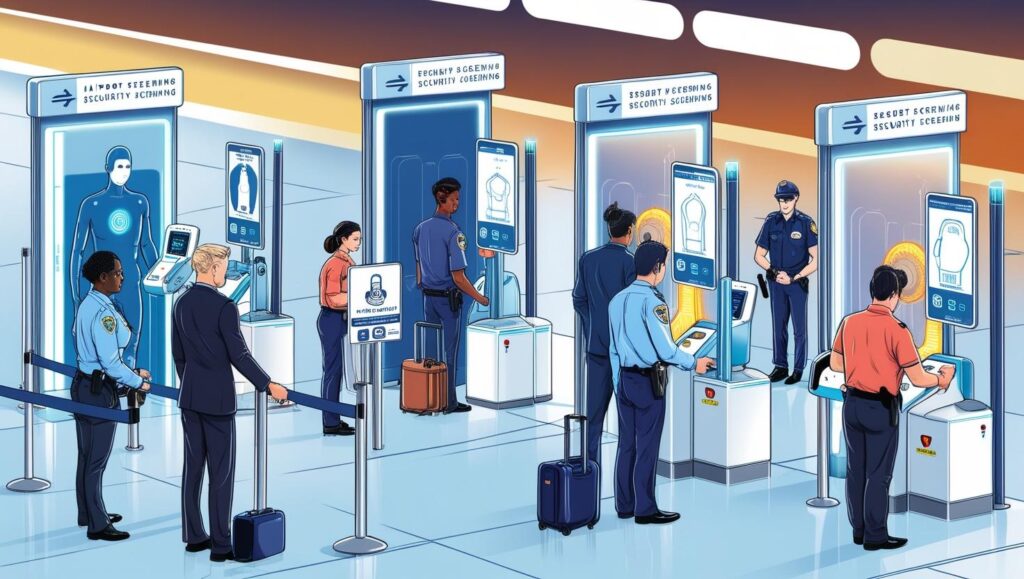
Spectrometry and Spectroscopy Systems
Spectrometry and spectroscopy-based screening systems are gaining traction for their ability to detect trace amounts of explosives, narcotics, and hazardous chemicals. These advanced systems are particularly valuable in transportation hubs, customs inspections, and high-risk public areas, where non-visible threats require sensitive and precise detection.
Key Market Trends Driving Growth
AI and Automation
One of the most significant security screening industry trends is the integration of artificial intelligence. AI-enabled systems enhance image recognition, automate threat detection, and support real-time decision-making. As labor shortages and cost pressures continue to challenge the security industry, automation plays a vital role in increasing operational efficiency and reducing reliance on human intervention.
Touchless and Non-Invasive Screening
The COVID-19 pandemic accelerated the demand for contactless solutions, which has since become a long-term trend. Technologies that enable remote and touchless screening—such as biometric systems and passive terahertz imaging—are being prioritized to ensure safety, hygiene, and public trust.
Expansion Beyond Airports
While aviation remains a key sector, the security screening market is expanding into new application areas, including government buildings, data centers, courthouses, schools, stadiums, and event venues. Increasing incidents of domestic threats and organized crime have underscored the importance of deploying advanced screening solutions across public and private infrastructure.
Compliance and Regulation
Tighter regulatory standards across regions, particularly in North America and Europe, are driving investment in compliant screening technologies. The need to meet international safety standards and certifications is compelling manufacturers to innovate and upgrade their solutions to remain competitive.
Regional Insights and Market Outlook
Asia-Pacific is anticipated to witness the fastest growth in the security screening market due to increased infrastructure development, rising defense budgets, and airport expansion projects. Countries like China, India, and Southeast Asian nations are investing heavily in smart cities and border security technologies, further boosting market potential.
Meanwhile, North America and Europe continue to dominate the security screening market in terms of technology adoption and innovation. Ongoing modernization of airports and public safety systems is expected to sustain steady demand for advanced screening solutions.
The security screening market is entering a new phase of growth, driven by innovation, global security challenges, and evolving user expectations. From AI-enhanced X-ray scanners to biometric identification and chemical detection through spectrometry, the market is increasingly defined by intelligent, scalable, and user-friendly solutions.
As governments and enterprises prioritize threat prevention and operational resilience, these security screening market trends will continue to shape the technologies and strategies deployed across the globe. Stakeholders who embrace this evolution will be well-positioned to lead in a future where security is smarter, safer, and more connected than ever before.
Major companies operating in the security screening market are Smiths Detection Group Ltd. (UK), OSI Systems, Inc. (US), Leidos (US), Thales (France), and NEC Corporation (Japan).
Frequently Asked Questions (FAQ) – Security Screening Market Trends
1. What is driving the growth of the global security screening market?
The growth is primarily driven by rising global security threats, increased government investments in public safety, the demand for touchless and automated systems post-COVID-19, and advancements in technologies such as artificial intelligence, biometrics, and spectrometry. Expanding use across sectors like transportation, government, commercial buildings, and event venues is also fueling demand.
2. Which system types are contributing most to market expansion?
Key system types include:
- X-ray body and baggage scanners for high-traffic screening environments
- Cabinet X-ray systems for parcel and mail screening
- Handheld X-ray scanners for mobile field use
- Electromagnetic metal detectors for people screening in public venues
- Biometric systems for seamless identity verification
- Spectrometry/spectroscopy systems for chemical, explosive, and narcotics detection
- Each of these systems addresses specific use cases and is evolving rapidly with AI integration and enhanced automation.
3. How are AI and automation influencing security screening market trends?
AI is revolutionizing security screening by enabling faster, more accurate threat detection with reduced reliance on manual interpretation. Automated systems enhance throughput, lower operational costs, and improve user experience through faster processing times and minimal human error.
4. Which sectors are adopting security screening technologies beyond airports?
In addition to aviation, sectors such as border control, law enforcement, corporate campuses, schools, stadiums, logistics, and data centers are adopting advanced security screening technologies. The need for comprehensive threat detection across all critical infrastructure is pushing adoption across diverse industries.
