The semiconductor industry is undergoing one of its most important architectural shifts in decades, and at the center of this transformation is the rise of chiplets. Once considered an experimental approach, chiplets are now becoming a mainstream strategy for building faster, more flexible, and cost-efficient semiconductor systems. The chiplet market is expected to grow from USD 51.94 billion in 2025 to USD 157.23 billion by 2030, at a CAGR of 24.8% during the forecast period.
As traditional Moore’s Law scaling becomes increasingly difficult and expensive, the chiplet market trends are reshaping how processors are designed, manufactured, and deployed across industries such as artificial intelligence (AI), data centers, automotive, and high-performance computing.
So, what’s next in chiplet innovation, and why is the industry paying so much attention?
Understanding the Chiplet Revolution
Chiplets are small, modular semiconductor dies that can be combined to form a complete system-on-chip (SoC). Instead of building a large monolithic chip, manufacturers now integrate multiple specialized chiplets within a single package.
This approach allows companies to:
- Mix and match different technologies
- Improve manufacturing yields
- Reduce production costs
- Scale performance more efficiently
These advantages are driving rapid evolution in chiplet market trends across the global semiconductor ecosystem.
Why Chiplets Are Becoming the Future of Semiconductor Design
The shift toward chiplets is not just a trend—it is a structural response to fundamental industry challenges.
1. Limits of Traditional Chip Scaling
For decades, semiconductor performance improvements were driven by shrinking transistor sizes. However, as nodes approach extreme nanometer levels, physical and economic limitations are slowing progress.
Chiplets offer an alternative by enabling performance scaling through architecture rather than just transistor density.
This is a major driver behind current chiplet market trends.
2. Rising Cost of Advanced Semiconductor Nodes
Manufacturing advanced chips at 3nm and below is extremely expensive and complex.
Chiplets help reduce costs by:
- Using different process nodes for different functions
- Improving yield rates by manufacturing smaller dies
- Avoiding full-chip re-spins
This cost efficiency is reshaping global chiplet market trends, especially among fabless semiconductor companies.
Download PDF Brochure @ https://www.marketsandmarkets.com/pdfdownloadNew.asp?id=131809383
3. Demand for High-Performance Computing (HPC) and AI
AI workloads require massive computing power, memory bandwidth, and energy efficiency.
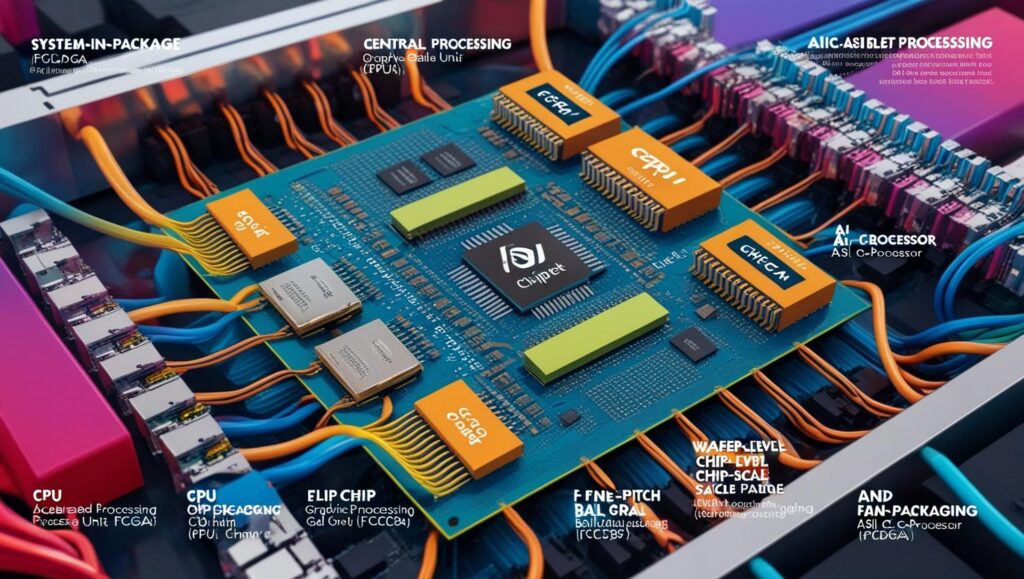
Chiplet-based architectures allow designers to combine:
- CPU chiplets
- GPU chiplets
- AI accelerators
- Memory interfaces
This modular approach is accelerating chiplet market trends in AI data centers and machine learning infrastructure.
Key Chiplet Market Trends Shaping the Industry
1. Heterogeneous Integration Is Becoming the Standard
One of the most important chiplet market trends is heterogeneous integration—combining different types of chiplets within a single package.
For example:
- Logic chiplets manufactured at advanced nodes
- Memory chiplets built on optimized cost nodes
- I/O chiplets designed for connectivity
This flexibility is redefining semiconductor design strategies.
2. Strong Growth in Data Center Applications
Data centers are the largest adopters of chiplet-based processors.
Companies are using chiplets to build:
- High-performance CPUs
- AI training accelerators
- Cloud computing processors
As cloud demand increases, data centers are driving some of the fastest chiplet market trends globally.
3. AI Is Accelerating Chiplet Adoption
Artificial intelligence is one of the biggest forces shaping semiconductor design.
Chiplets allow AI chip designers to:
- Scale compute power efficiently
- Integrate specialized AI cores
- Improve memory bandwidth
- Optimize power consumption
This makes AI one of the strongest catalysts in current chiplet market trends.
4. Packaging Technology Is Becoming Critical
Advanced packaging technologies such as:
2.5D integration
3D stacking
Interposers
Silicon bridges
are essential for chiplet integration.
Companies investing in packaging innovation are leading the evolution of chiplet market trends.
5. Open Chiplet Ecosystems Are Emerging
The semiconductor industry is gradually moving toward standardized chiplet interfaces.
Efforts like open ecosystems aim to:
Improve interoperability
Reduce vendor lock-in
Enable faster innovation
This shift toward openness is reshaping competitive dynamics in chiplet market trends.
Real-World Example: Chiplets in Modern CPUs
Leading semiconductor companies have already adopted chiplet-based architectures in modern processors.
For example, high-performance CPUs in the market today often combine:
Multiple compute chiplets
I/O dies
Cache memory modules
This design improves scalability and manufacturing efficiency while maintaining high performance.
Such real-world implementations validate the rapid evolution of chiplet market trends.
Challenges in Chiplet Adoption
Despite strong momentum, several challenges remain:
1. Complex Interconnect Design
Ensuring fast and reliable communication between chiplets is technically challenging.
2. Thermal Management Issues
Multiple chiplets in a single package generate heat density concerns.
3. Standardization Gaps
The industry is still working toward unified chiplet communication standards.
4. Packaging Costs
Advanced packaging technologies can still be expensive and complex.
However, ongoing innovation is gradually addressing these issues.
The Future of Chiplet Market Trends
The future of chiplets is expected to be defined by several key developments:
AI-Driven Semiconductor Design
AI tools will increasingly assist in optimizing chiplet layouts and system integration.
Fully Modular Computing Systems
Future processors may allow plug-and-play chiplet architectures.
Expansion Beyond Data Centers
Chiplets will move into automotive, mobile devices, edge computing, and IoT systems.
Integration with 3D Packaging
3D chip stacking will unlock even higher performance densities.
These developments will continue to accelerate chiplet market trends globally.
The semiconductor industry is entering a new era where chiplets are redefining how computing systems are built. As performance demands rise and traditional scaling slows down, chiplets offer a powerful alternative that combines flexibility, efficiency, and scalability.
From AI and data centers to future consumer electronics, chiplet-based architectures are becoming the foundation of next-generation computing.
The question is no longer whether chiplets will matter.
It is how fast chiplet market trends will reshape the entire semiconductor industry.
FAQs
1. What are chiplets in semiconductor design?
Chiplets are small modular chips that are combined to form a complete processor or system-on-chip, enabling flexible and scalable chip design.
2. Why are chiplet market trends growing so fast?
Growth is driven by rising AI demand, high-performance computing needs, cost pressure in advanced nodes, and limitations of traditional chip scaling.
3. How are chiplets used in data centers?
Data centers use chiplets to build powerful CPUs and AI accelerators that improve performance, scalability, and energy efficiency.
4. What are the biggest challenges in chiplet technology?
Challenges include interconnect complexity, thermal management, lack of standardization, and advanced packaging costs.
5. What is the future of chiplet market trends?
The future includes AI-driven design, modular computing systems, 3D integration, and broader adoption across automotive, IoT, and edge devices.
.
About MarketsandMarkets™
MarketsandMarkets™ has been recognized as one of America’s Best Management Consulting Firms by Forbes, as per their recent report.
MarketsandMarkets™ is a blue ocean alternative in growth consulting and program management, leveraging a man-machine offering to drive supernormal growth for progressive organizations in the B2B space. With the widest lens on emerging technologies, we are proficient in co-creating supernormal growth for clients across the globe.
Today, 80% of Fortune 2000 companies rely on MarketsandMarkets, and 90 of the top 100 companies in each sector trust us to accelerate their revenue growth. With a global clientele of over 13,000 organizations, we help businesses thrive in a disruptive ecosystem.
The B2B economy is witnessing the emergence of $25 trillion in new revenue streams that are replacing existing ones within this decade. We work with clients on growth programs, helping them monetize this $25 trillion opportunity through our service lines – TAM Expansion, Go-to-Market (GTM) Strategy to Execution, Market Share Gain, Account Enablement, and Thought Leadership Marketing.
Built on the ‘GIVE Growth’ principle, we collaborate with several Forbes Global 2000 B2B companies to keep them future-ready. Our insights and strategies are powered by industry experts, cutting-edge AI, and our Market Intelligence Cloud, KnowledgeStore™, which integrates research and provides ecosystem-wide visibility into revenue shifts.
To find out more, visit www.MarketsandMarkets™.com or follow us on Twitter , LinkedIn and Facebook .
Contact:
Mr. Rohan Salgarkar
MarketsandMarkets™ INC.
1615 South Congress Ave.
Suite 103, Delray Beach, FL 33445
USA: +1-888-600-6441
